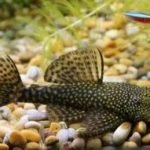
A clown pleco is a small, secretive armored catfish that spends much of its time among wood and shelters. It can suit a peaceful freshwater aquarium, but it needs deliberate feeding and maintenance. Buying one to survive on leftover food or to solve an algae problem is a poor plan.
The name usually refers to small Panaqolus sold as P. maccus or closely related forms. Confirm the seller’s identification because similar striped plecos are not necessarily the same species.
Clown pleco care at a glance
| Requirement | Practical starting point |
|---|---|
| Adult length | Usually around 3–4 inches for the small forms sold as clown plecos |
| Aquarium | Consider a 20-gallon long to 29-gallon tank for one; larger for a community or additional bottom dwellers |
| Temperature | A stable 75–79°F is a useful everyday target; confirm the needs of the actual fish |
| Water chemistry | Soft to moderately hard water; roughly pH 6.5–7.5 is a practical target |
| Water quality | 0 ppm ammonia and nitrite; control nitrate with maintenance |
| Essential furnishings | Real aquarium-safe driftwood, sheltered resting places and clear bottom space |
| Food | Suitable sinking prepared food, plant-based supplements and access to wood and its surface growth |
| Social behavior | Usually quiet with suitable companions; males may dispute territory |
Identification, size and lifespan
Clown plecos have contrasting light and dark bands, but pattern alone is not a reliable identification method. Specialist Andreas Tanke explains the longstanding naming confusion in his article on Panaqolus aff. maccus. Keep the seller’s scientific name and any L-number with your records rather than treating every “clown” label as interchangeable.
The OATA care guidance describes clown plecos as small, shy fish needing cover and wood. These are long-term pets; plan for many years of care rather than relying on a precise lifespan promise.
For comparisons with larger or more demanding catfish, see our guide to different types of plecos.
Tank size and setup
A 20-gallon long to 29-gallon aquarium is a reasonable starting range to assess for one small clown pleco. This follows the general small-pleco guidance from Aquarium Co-Op; it is not a stocking formula. Footprint, existing fish, filtration and the amount of wood all affect the space available.
Prepare the aquarium before buying the fish:
- Cycle the filter. Use our aquarium basics guide to establish a stable system before stocking.
- Add real wood. Resin ornaments that look like logs do not provide a rasping surface equivalent to driftwood. Use wood sold for aquarium use and position it securely.
- Include several refuges. Smooth caves and gaps beneath stable wood let the fish rest out of the light. Make sure it cannot become wedged.
- Leave access for cleaning. A dense pile of wood should not make it impossible to remove accumulated waste.
- Maintain circulation and oxygenation. Keep the filter working and the surface moving, with quieter shelter rather than blasting every resting place.
- Use comfortable cover. Plants and shaded areas help a timid fish settle. Direct sunlight is not a care requirement.
What should a clown pleco eat?
Provide wood continuously, but also feed the fish. A log and whatever scraps fall from other fish are not a complete feeding routine.
Aquarium Dietzenbach’s profile of the commonly traded form recommends plant-based supplemental foods alongside wood, with animal foods only occasionally. Suitable choices include sinking catfish food formulated for grazing species and small portions of zucchini. Do not make bloodworms or other rich meaty foods the staple.
Offer a modest evening portion near its usual shelter and check what remains. Adjust the amount to the individual rather than repeatedly adding food because you have not seen it eat. Remove leftovers before they break down.
Observe body condition when the fish is visible on the glass or moving between shelters. A persistently sunken abdomen, progressive weight loss or refusal of previously accepted food deserves investigation. Check food competition and water quality, then seek experienced or veterinary help if the problem continues.
Tank mates and keeping more than one
A single clown pleco is a practical choice. OATA cautions that males may fight, so do not add a second fish simply because the first one hides. More space and separate caves reduce competition but cannot guarantee compatibility.
For a community, choose peaceful fish with overlapping water requirements and room of their own. Small tetras may be candidates in a suitably sized aquarium. Territorial bottom dwellers, large predators and fish that monopolize food need particular caution.
Do not assume every cory, cichlid or livebearer is suitable because it appears on a generic compatibility list. Check the exact species’ temperature, water hardness, adult size and behavior. Have a separation plan if chasing or blocked access to shelter develops.
Maintenance and health checks
Clown plecos produce waste despite their small size. Siphon accessible deposits during regular partial water changes and clean mechanical filter media when flow declines, while protecting the established biological filtration.
Use suitable water tests, condition replacement tap water and avoid abrupt temperature or chemistry changes. The Merck Veterinary Manual emphasizes water-quality assessment when investigating fish illness. Being hardy does not mean tolerating pollution.
Daytime hiding alone is normal for a secretive fish. Hiding accompanied by poor appetite, rapid breathing, damaged skin or weight loss needs attention. Red marks do not prove a bacterial infection, and there is no sensible blanket ban on every medicine containing a particular chemical element. Identify the problem and check species-specific product directions with an aquatic veterinarian before treatment.
Can clown plecos breed in an aquarium?
Breeding is possible, but it should not be promised as automatic or effortless. These are cave spawners, with the male caring for the eggs. Aquarium Dietzenbach describes this behavior in its species profile.
Start with accurately identified mature fish, appropriate separate refuges and a plan for raising and housing young. Juveniles can be difficult to sex. Do not trap fish together or abruptly change temperature to force spawning. A breeding project needs closer observation and more preparation than simply adding a cave to a community tank.
Is a clown pleco right for your aquarium?
It is a good candidate to research if you want a small, often-hidden catfish and can provide wood, targeted meals and regular care. If you mainly want algae removed, first address lighting, feeding and maintenance; our algae-eater guide explains why adding livestock is not always the solution.