The best pond filter is the one that matches your pond volume, fish load, pump flow and maintenance routine. A small decorative pond may only need a compact prefilter, while a stocked koi pond usually needs a much larger mechanical and biological system. This guide compares five current filter styles rather than pretending one product suits every pond.
Affiliate disclosure: Aquarium Hunter may earn a commission from qualifying Amazon purchases, at no extra cost to you. We only link to an Amazon listing when we can match the exact product confidently.
Quick comparison
| System | Best suited to | Important limitation | Buying option |
|---|---|---|---|
| TetraPond Submersible Flat Box | Small ponds and pump prefiltration | Not a complete high-load biological filter | Check on Amazon |
| Aquascape UltraKlean 2000 | Compact pressurized filtration with UV | Pump is selected separately | Check on Amazon |
| OASE BioSmart 5000 | Accessible flow-through filtration | Rated capacity falls as fish load rises | Read review |
| Laguna Pressure-Flo PF1000 | Pressurized filtration and flexible return placement | Requires correct pump matching and routine cleaning | Read review |
| Aquascape Signature Series 2500 BioFalls | Waterfall-based biological filtration | Works best as part of a planned skimmer-and-waterfall system | Check on Amazon |
What a pond filter actually needs to do
A useful pond system combines several jobs. Mechanical filtration traps leaves, algae strands and suspended debris. Biological filtration gives beneficial bacteria a large oxygenated surface on which to convert toxic ammonia and nitrite into less harmful nitrate. A UV clarifier can help control free-floating green-water algae, but it does not remove settled waste or replace biological media. The pump supplies circulation; aeration may still be needed, especially in warm weather or heavily stocked ponds.
That distinction matters because a prefilter, UV unit and complete biological filter are not interchangeable. Start with the pond’s needs, then choose components that work together.
How to size a pond filter
- Calculate actual pond volume. For a rectangular pond, multiply average length by average width by average depth, then convert the result to gallons or litres. Irregular ponds require an estimate, so leave a safety margin.
- Allow for fish load. Koi and heavily stocked goldfish ponds create substantially more waste than lightly stocked wildlife ponds. Manufacturer maximums often fall when fish are present, so use the fish-load rating rather than the largest number on the box.
- Check real pump flow. A pump delivers less water after vertical lift, pipe friction and fittings are considered. Compare the filter’s recommended flow range with the pump’s flow at the system’s actual head height.
- Plan maintenance access. A technically capable filter can still be a poor choice if cleaning it is awkward. Make sure drains, backwash outlets and media are accessible.
- Think in systems. Bottom drains, skimmers, waterfalls and return jets affect what type of filter will work and where it can be installed.
TetraPond Submersible Flat Box Filter
Best for: protecting a pump and adding basic mechanical filtration in a small pond.
This low-profile box sits underwater and connects to a separate pump. Its foam pads intercept debris before it reaches the pump, and the manufacturer specifies compatibility with pumps from 200 to 2,000 GPH. That wide pump range makes it a flexible, inexpensive component for small water features and lightly stocked ponds.
Watch for: it is best understood as a pump prefilter, not a complete answer for a koi pond or a system with a high biological load. The foam must be rinsed regularly in pond water so accumulated debris does not restrict flow.
Check the exact TetraPond Flat Box listing on Amazon
Official TetraPond specifications
Aquascape UltraKlean 2000
Best for: pond owners wanting compact pressurized mechanical and biological filtration with an integrated UV clarifier.
The UltraKlean design can be positioned away from the pond and returns water under pressure, which is helpful where the outlet must feed a waterfall or stream. Its cleaning controls are more convenient than dismantling a basic submerged box. The integrated UV clarifier targets free-floating algae that cause green water.
Watch for: a UV clarifier is not a substitute for removing sludge and trapped solids. Select a compatible pump, respect the stated flow range, and maintain the filter and UV lamp according to the manual.
Check the exact Aquascape UltraKlean 2000 listing on Amazon
Official Aquascape UltraKlean information
OASE BioSmart 5000
Best for: pond owners who prefer an accessible flow-through filter with visible maintenance indicators.
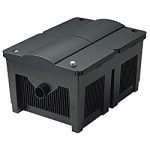
The BioSmart separates mechanical debris while providing biological media, and its above-ground layout makes routine inspection straightforward. OASE lists different capacities for ponds with no fish, ponds with fish and koi ponds. For the BioSmart 5000, the official koi/heavy-fish figure is much lower than the headline 5,000-gallon light-load rating, illustrating why stocking level must be considered.
Watch for: this is a gravity-return filter, so its outlet position and return route must be planned correctly. Do not size it using the largest nominal pond figure when fish are present.
Official OASE BioSmart 5000 specifications
Laguna Pressure-Flo PF1000
Best for: compact pressurized filtration where a flexible return location is useful.
The Pressure-Flo PF1000 combines mechanical and biological filtration with UV clarification in a sealed canister. A pressurized outlet can return water to an elevated feature, while the cleaning mechanism reduces the need to open the canister for every maintenance cycle.
Watch for: pressure filters still collect waste and need regular cleaning. Performance depends on correct pump sizing, hose diameter and head height. Follow Laguna’s stated pond and flow guidance rather than assuming the model name is a universal capacity guarantee.
Official Laguna Pressure-Flo PF1000 specifications
Aquascape Signature Series 2500 BioFalls filter
Best for: a planned ecosystem pond where the biological filter also forms the head of a waterfall.
A BioFalls unit spreads incoming water through filter media before it flows over a waterfall lip. It can be visually integrated into landscaping and pairs naturally with a pond skimmer at the opposite end, creating circulation across the pond.
Watch for: this is a system component rather than a small stand-alone canister. Installation, liner connection, pump flow and the matching skimmer all need to be planned together. Choose the BioFalls size from Aquascape’s current guidance for the intended pond and waterfall.
Check the exact Aquascape Signature Series 2500 BioFalls on Amazon
Official Aquascape BioFalls information
Which filter type should you choose?
- Submersible prefilter: simple and inexpensive for small ponds, but frequent hands-in-water cleaning may be required.
- Flow-through box: accessible media and good gravity return, provided there is space at the correct height.
- Pressurized filter: compact and flexible to position, with water able to return to a raised feature.
- Waterfall filter: combines biological media with landscape design, usually as part of a skimmer-and-waterfall layout.
- Koi-specific system: heavy fish loads often justify larger multi-stage filtration, easier waste purging and conservative sizing. See our koi pond filter comparison.
Maintenance that keeps filtration effective
Remove trapped solids before they break down, but avoid sterilising biological media. Rinse bio-media gently in dechlorinated or pond water, not untreated tap water that may damage beneficial bacteria. Check pump intakes, hoses and seals; purge settled waste; and replace a UV lamp according to the manufacturer’s schedule. Test ammonia and nitrite after starting a new system, adding fish, medicating the pond or performing major maintenance.
If green water is the main problem, read our guide to the best UV clarifiers for koi ponds. If you are planning for growing fish, our guide to how fast koi grow explains why future size matters.
Frequently asked questions
Can a pond be over-filtered?
Extra media capacity is usually helpful, but excessive flow can stress fish, bypass effective contact time or overwhelm a filter’s recommended range. Oversize biological capacity sensibly while keeping water flow within the equipment specifications.
Does a UV clarifier replace a pond filter?
No. UV can reduce free-floating algae and some suspended microorganisms, but it does not remove leaves, sludge, fish waste or dissolved ammonia. Mechanical and biological filtration remain essential in stocked ponds.
How often should a pond filter be cleaned?
There is no single schedule. Check flow and the manufacturer’s cleaning indicator, then adjust for season, feeding, fish load and falling leaves. Mechanical stages may need frequent attention during warm, heavily fed periods; biological media should be disturbed only as much as necessary.
Should the pump run all day?
For most stocked ponds, continuous circulation supports oxygenation and the beneficial bacteria living in the filter. If a filter is shut down long enough to become oxygen-depleted, stagnant water should not simply be flushed back into the pond.
How we selected these systems
We prioritised current manufacturer support, clearly described filtration roles, useful options for different pond layouts and maintainability. We did not rank products solely by a headline gallon figure, and we excluded old listings that could not be matched confidently. Amazon links above point only to exact verified product pages; manufacturer pages are provided for specifications and installation guidance.
References and further reading
- OASE BioSmart 5000
- Aquascape UltraKlean filters
- TetraPond Submersible Flat Box Filter
- Laguna Pressure-Flo PF1000
- Aquascape BioFalls filters