Denison barbs (Sahyadria denisonii), also called roseline sharks or red-line torpedo barbs, are fast, peaceful schooling fish from India’s Western Ghats. They reach about 6 inches (15 cm), need a group of at least six and require a long, mature aquarium with clean, highly oxygenated water. They are not suitable for a small community tank.
Denison barb care at a glance
| Scientific name | Sahyadria denisonii (some databases currently display Dawkinsia denisonii) |
|---|---|
| Common names | Denison barb, roseline shark, red-line torpedo barb, Miss Kerala |
| Adult length | About 6 in (15 cm) |
| Group | At least six; a larger school is preferable when space permits |
| Temperature | About 68–77°F (20–25°C) |
| pH | Approximately 6.8–7.8; prioritize stability |
| Tank | Long aquarium, roughly 75 gallons or larger for a group |
| Difficulty | Intermediate |
| Conservation | Endangered in the wild; choose verified captive-bred fish |
Appearance and correct identification
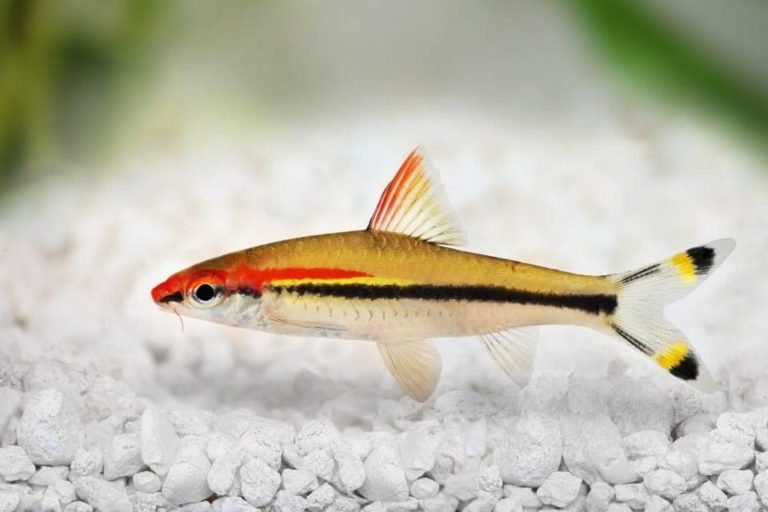
The species has a silver body, a black horizontal band and a bright red stripe extending from the snout toward the middle of the body. Black and yellow markings appear on the tail. “Roseline shark” is only a trade name; this fish is a barb in the cyprinid family, not a true shark.
Confirm the scientific name when buying. Related species and hybrids may be sold under similar common names, and taxonomy has changed over time.
Adult size, school and tank dimensions

Around 75 gallons with a four-foot or longer footprint is a practical minimum starting point for six, provided the aquarium is not crowded with other large active fish. More length and volume provide better swimming room and dilute waste. A pair or trio is not a responsible space-saving substitute for a school.
Leave a broad open lane through the middle and upper levels. Place plants, rounded rocks and securely anchored wood around the edges. Use a tight lid because startled fish can jump.
Water, flow and oxygen
Denison barbs come from flowing hill streams and rocky pools. Maintain strong gas exchange and clean water, but include calmer zones where fish can rest. A stable 68–77°F (20–25°C) suits the species better than very warm tropical conditions, which reduce dissolved oxygen and can shorten the margin for error.
Keep ammonia and nitrite at zero and manage nitrate with stocking, measured feeding and regular partial water changes. Match replacement-water temperature and chemistry, and use conditioner when the supply contains chlorine or chloramine.
Filtration and maintenance
Use mature biological filtration with substantial mechanical capacity. Direct outlets along the tank to create circulation without forcing fish to fight one concentrated jet. A separate air stone or second filter provides useful oxygen and outage redundancy.
- Rinse reusable media in removed aquarium water or conditioned water.
- Do not replace every biological surface at once.
- Vacuum accessible waste without stripping the whole aquarium sterile.
- Test more often after a filter failure, medication or major maintenance.
- Confirm every filter and air pump restarts after a power interruption.
Diet and feeding
Provide a quality omnivore staple with plant matter and appropriately sized frozen or live foods such as daphnia or brine shrimp. Feed small measured portions and distribute food across the swimming area so every member of the school eats. Remove leftovers; heavy feeding cannot substitute for an appropriate group or tank.
Tank mates
Choose peaceful, robust fish that share the cooler temperature range and can cope with an active school. Avoid slow long-finned species, tiny fish likely to be intimidated, aggressive fin-nippers and fish requiring consistently hot water. Stock the Denison group first in your capacity calculation: six 15 cm fish create a meaningful bioload.
Behavior and stress signs
A healthy group swims actively and feeds readily, with individuals able to rest without being isolated or chased continuously. Warning signs include rapid breathing, clamped fins, persistent hiding, loss of color, repeated jumping, collisions, weight loss or separation from the school.
Test ammonia, nitrite, nitrate and temperature immediately when behavior changes. Seek an aquatic veterinarian for persistent breathing problems, ulcers, swelling, loss of balance or unexplained deaths rather than adding random medications.
Quarantine and acclimation
Quarantine new fish in a fully cycled, covered aquarium with adequate oxygen. Add the whole intended group together where possible after quarantine, rather than repeatedly disrupting the school. Match temperature and acclimate according to differences in source and destination water without leaving fish in polluted transport water longer than necessary.
Breeding
Commercial and specialist breeding has been achieved, but routine community-aquarium breeding is uncommon. Do not purchase a small mixed group expecting easy spawning, and do not use repeated temperature or chemical shocks to force reproduction.
Conservation and sourcing
FishBase and IUCN sources list the Denison barb as Endangered. Wild collection, habitat loss and trade pressure have contributed to concern. Ask sellers for captive-bred stock and avoid fish with unclear origin. Never release unwanted fish or aquarium water into waterways; use a responsible retailer, aquarium group or experienced keeper for rehoming.
Frequently asked questions
Can I keep one Denison barb?
No. It is a gregarious schooling species; plan for at least six from the outset.
Are Denison barbs aggressive?
They are generally peaceful, but a cramped aquarium or inadequate group can cause stress and chasing. Their speed may also unsettle slow fish.
Can Denison barbs live with discus?
They are a poor default match. Discus are commonly kept warmer and prefer a calmer environment, while Denison barbs favor cooler, highly oxygenated moving water.
Do they need a heater?
That depends on the room. Use a controlled heater when needed to prevent the aquarium falling below the chosen stable range; do not warm the tank unnecessarily.
How long do Denison barbs live?
They can be a commitment of several years, but lifespan claims vary. Plan suitable housing for the full life of the school rather than relying on a precise promise.
References and related guidance
- FishBase: size, habitat, temperature and conservation status
- ICAR–National Bureau of Fish Genetic Resources species profile
- Compare other freshwater aquarium “sharks” by adult suitability
Final recommendation
Choose Denison barbs only when you can house at least six in a long, cool-to-moderate, highly oxygenated aquarium. Their peaceful temperament does not make them a nano fish, and captive-bred sourcing should be part of the buying decision.