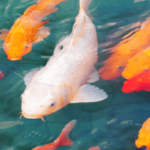
Koi grow fastest when they are young, but there is no reliable inches-per-month rule. Genetics, age, water temperature, nutrition, stocking density, water quality, health, and the length of the growing season all affect the result. A healthy juvenile may add several inches during a favorable first growing season, while an older koi may grow slowly even in an excellent pond.
The goal should not be to force rapid growth. It should be to provide enough space, clean oxygen-rich water, appropriate food, and steady seasonal care so each koi can reach its natural potential without compromising its health.

How Fast Do Koi Grow?
Koi growth is uneven rather than linear. Juveniles generally devote more energy to body growth, while growth slows as the fish matures. Warm seasons usually bring more feeding and growth; cool seasons bring reduced appetite and activity. Two koi bought at the same size can therefore end a year at very different lengths.
For planning purposes, expect a small koi to become a large, heavy-bodied pond fish. Many well-kept adult koi reach roughly 20–30 inches, although genetics and conditions produce substantial variation. Exceptional common carp records are much larger, but they are not a sensible expectation for the average ornamental koi. FishBase reports a maximum published total length of 120 cm for Cyprinus carpio, the species from which koi were developed.
| Life stage | Typical growth pattern | What matters most |
|---|---|---|
| Fry and small juveniles | Fastest relative growth, but highly variable | Frequent appropriate meals, stable water, oxygen, and protection from competition |
| Larger juveniles | Often strong seasonal growth | Pond capacity, filtration, diet, temperature, and genetics |
| Mature koi | Growth usually slows; body condition may continue changing | Long-term water quality, balanced nutrition, health, and adequate swimming room |
These stages describe a pattern, not a promise. Avoid charts that claim every koi should reach an exact length at a specific age. Breeding line, sex, early nutrition, climate, and prior care can all shift the result.
What Determines a Koi’s Growth Rate?
1. Genetics
Genetics set much of the fish’s potential adult size, body shape, and growth pattern. Good husbandry cannot turn every koi into a jumbo specimen. It can only help the fish express its inherited potential. Butterfly or longfin koi are not reliably miniature koi; their extended fins can make their overall profile look larger.
2. Age
Young koi usually grow faster than mature fish. A slowdown in an older koi can be normal. A sudden halt in a juvenile, especially with weight loss, clamped fins, isolation, sores, or abnormal breathing, deserves closer investigation.
3. Water Temperature and Season
Koi are ectothermic, so water temperature affects metabolism, appetite, digestion, and oxygen demand. Growth commonly increases during a suitable warm season and slows in cold water. Do not heat a pond merely to chase a growth target. Warmer water holds less dissolved oxygen, speeds waste production, and can magnify the consequences of overfeeding or weak filtration.
Match feeding to the actual water temperature, fish behavior, and food manufacturer’s directions. Reduce or stop feeding when the fish are not digesting normally. Avoid abrupt temperature changes.
4. Water Quality and Oxygen
Water quality is more important than any growth supplement. Test ammonia, nitrite, nitrate, pH, and alkalinity, and observe temperature and fish behavior. In an established system, ammonia and nitrite should remain at zero on a hobbyist test kit. Any detectable result requires prompt action: reduce feeding, check filtration and circulation, increase aeration when appropriate, and perform a correctly conditioned water change.
Warm weather, heavy feeding, algae die-offs, medication, crowding, and nighttime plant respiration can all reduce oxygen. Gasping at the surface, gathering near a waterfall, lethargy, or sudden loss of appetite can indicate an urgent water-quality or oxygen problem.
5. Pond Space, Stocking, and Filtration
Koi do not simply “grow to the size of the container.” Inadequate housing can suppress growth through chronic stress, competition, poor water quality, limited swimming room, and disease—not through a harmless built-in size limit.
No single gallons-per-koi rule works for every pond. Usable swimming dimensions, depth, adult fish size, total biomass, filter capacity, turnover, oxygenation, climate, maintenance, and emergency backup all matter. Plan for adult koi from the beginning, not the size displayed at the store. Ordinary home aquariums are temporary housing for juveniles, not an appropriate permanent destination for adult koi. See Can Koi Live in a Fish Tank? for a fuller explanation.
6. Nutrition
Use a reputable food formulated for koi and suitable for the current season and fish size. The diet should be nutritionally complete, fresh, stored dry, and offered in pieces the fish can swallow easily. Several controlled meals may suit growing juveniles during an appropriate warm season, but the total amount must not leave uneaten food or overwhelm filtration.
More food does not automatically mean more healthy growth. Overfeeding increases feces, dissolved waste, oxygen demand, and the risk of poor body condition. Remove uneaten food and adjust the ration when appetite changes.
7. Health, Parasites, and Competition
Disease, parasites, injury, chronic stress, and bullying can all reduce growth. Watch each fish at feeding time. A koi that repeatedly misses meals may be ill, visually impaired, intimidated, or unable to compete. Quarantine new fish before introduction and seek an aquatic veterinarian when disease is suspected rather than treating blindly.
How to Measure Koi Growth Safely
Measure progress over months, not days. Frequent netting and handling can injure fish and create unnecessary stress.
- Use photographs when possible. Photograph the koi beside a known reference in a viewing bowl designed for fish.
- Wet all equipment. A wet koi sock or soft fish-safe net helps protect the mucus coat.
- Support the fish. Never lift a large koi by the fins, mouth, or tail.
- Measure total length consistently. Use the same method from the snout to the end of the tail each time.
- Record context. Note the date, water temperature, weight if safely available, appetite, and any health issue.
If you are inexperienced with handling large koi, ask a knowledgeable koi keeper or aquatic veterinarian for help. Body condition, behavior, and health are more important than reaching a target number.

Why Is My Koi Not Growing?
A small adult may simply have modest genetic potential. However, poor growth combined with other changes can signal a problem. Review:
- ammonia, nitrite, nitrate, pH, alkalinity, temperature, and oxygen;
- filter maintenance, flow, aeration, and recent power failures;
- stocking density and whether all fish can reach food;
- food age, storage, pellet size, and total ration;
- parasites, ulcers, fin damage, abnormal feces, or weight loss;
- recent additions and whether they were quarantined;
- seasonal temperature changes and sudden weather events.
Do not use rapid chemical corrections or unverified medications to solve slow growth. Stabilize water quality first, document the symptoms, and consult an aquatic veterinarian or qualified fish-health professional when the cause is unclear.
Can You Make Koi Grow Faster?
You can remove barriers to healthy growth, but you should not force it. The most useful steps are:
- provide a spacious, mature pond designed for the adult population;
- use biological and mechanical filtration sized for the real waste load;
- maintain strong circulation and aeration, especially during warm weather;
- test water consistently and respond to trends before they become emergencies;
- feed a complete koi diet in amounts the system and fish can handle;
- avoid crowding and ensure shy fish can feed;
- quarantine new arrivals and act early when illness appears;
- allow normal seasonal slowing rather than maintaining artificial high growth year-round.
Never restrict space or food to keep koi small. If a pond cannot accommodate the adult fish, arrange responsible rehoming. Do not release koi into natural waterways; ornamental fish can spread disease, disrupt ecosystems, and may be illegal to release.
Frequently Asked Questions
How long does it take a koi to reach full size?
There is no fixed age. Growth is fastest in the early years and then gradually slows, but koi may continue changing in length and body mass for many years. Genetics, climate, diet, water quality, and housing produce wide differences.
Do butterfly koi stay smaller?
No reliable rule says butterfly koi remain small. Longfin koi can become large pond fish, and their extended fins add to their overall dimensions. Plan for an adult koi, not a compact variety.
Will a koi stay small in a small pond?
A small pond may suppress growth through stress and poor conditions, but that is not safe size control. It also increases the risk of ammonia, nitrite, oxygen, temperature, and disease problems.
How big can koi get?
Many adult ornamental koi fall in the 20–30 inch range, with substantial variation. Exceptional carp can be larger. Read Is There a Small Koi Variety? before choosing koi for a limited space.
Does frequent feeding guarantee faster growth?
No. Growth requires an appropriate total diet plus clean water, oxygen, space, health, and suitable temperature. Excess feed can damage water quality and reduce welfare.
Related Koi Guides
- Smallest Koi Fish: What Size Should You Expect?
- Can Koi Live in a Fish Tank?
- How Often Do Koi Lay Eggs?
- Koi Pond Filtration Guide
References and Further Reading
- FishBase: Cyprinus carpio species summary
- Merck Veterinary Manual: Management of Aquarium Fish
- University of Florida IFAS: Carp edema virus disease and koi health management
- UK Environment Agency: Do not release ornamental fish into the wild