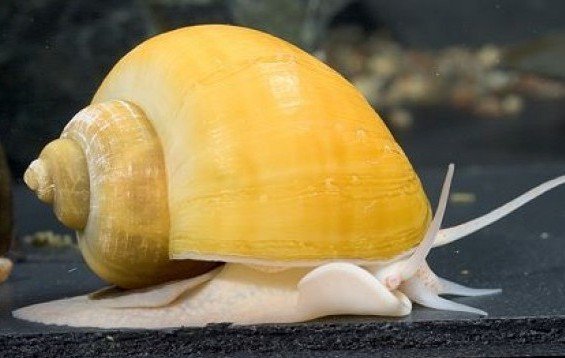
Mystery snails are peaceful freshwater snails best kept in a mature, fully cycled aquarium with clean, mineral-rich water, steady access to food, and an escape-proof lid. The aquarium species is usually the spike-topped apple snail, Pomacea diffusa (formerly sold as P. bridgesii). It is different from the large Chinese and Japanese snails also called “mystery snails.”
Mystery snail care at a glance
| Scientific name | Pomacea diffusa |
|---|---|
| Adult shell size | Usually about 1.5–2.5 inches (4–6 cm) |
| Minimum tank | 5 gallons for one; larger is easier to keep stable |
| Temperature | About 68–78°F (20–26°C) |
| Water | 0 ammonia, 0 nitrite; stable, moderately hard water is preferable |
| Diet | Algae and biofilm plus sinking foods and vegetables |
| Temperament | Peaceful; vulnerable to snail-eating tank mates |

What species is an aquarium mystery snail?
In the aquarium trade, “mystery snail” normally means Pomacea diffusa, the spike-topped apple snail. Older care sheets often use Pomacea bridgesii, but the USDA now identifies the commonly traded species as P. diffusa (formerly bridgesii).
The common name is confusing. Chinese mystery snails (Cipangopaludina chinensis) and Japanese mystery snails (C. japonica) are different animals with different biology. Sellers may also misidentify other apple snails as mystery snails. Buy from a reputable source and avoid any snail whose identity is uncertain.
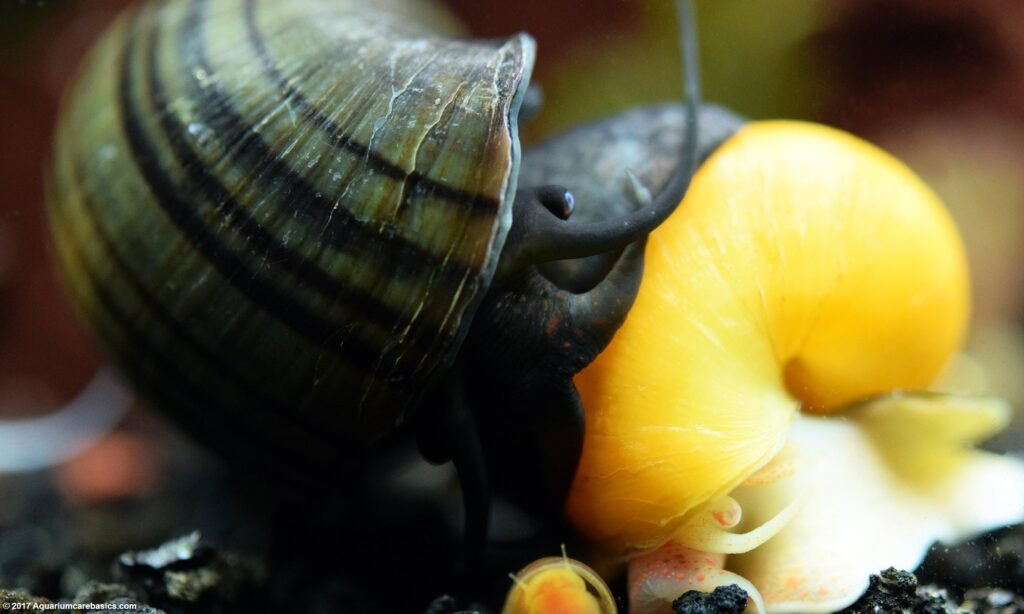
A typical P. diffusa has a rounded shell with a more pronounced spire than many other apple snails. Colors include gold, ivory, blue-gray, brown, black, and striped varieties. Color does not change the basic care requirements.
Tank setup and water quality
A five-gallon aquarium can house one adult, but a 10-gallon or larger tank is more forgiving. Snails produce more waste than their size suggests, so allow extra water volume when keeping several or adding them to a stocked community.
Use a fully cycled filter and test the water regularly. Ammonia and nitrite should remain at zero, while nitrate is controlled with partial water changes and sensible feeding. If either ammonia or nitrite appears, treat it as a water-quality problem rather than assuming the snail is ill. Our aquarium nitrogen cycle guide explains how the biofilter processes waste.
Mystery snails build their shells from minerals in their food and water. Moderately hard, alkaline water generally protects the shell better than very soft, acidic water. Stability matters more than chasing a single pH number. Test your source water before adding calcium products, because indiscriminate buffers and mineral blocks can cause sudden changes.
- Use dechlorinated freshwater.
- Keep temperature and chemistry stable during water changes.
- Cover filter intakes with a sponge if small snails could be drawn in.
- Avoid sharp decorations that could damage a falling snail’s shell.
- Never use copper medication in a tank containing snails. Copper is highly toxic to aquatic invertebrates.
Why mystery snails climb above the water
Apple snails have both a gill and a lung. They regularly travel to the surface and extend a breathing siphon, so surface visits are normal. Leave a small air space beneath a tightly fitted lid and make sure the snail can reach the surface.
The lid is essential. Mystery snails are strong climbers and females leave the water to lay eggs. Seal cable gaps without blocking ventilation. A snail repeatedly trying to leave the tank can also indicate poor water quality, unsuitable conditions, or breeding behavior, so test the water before dismissing it as curiosity.

What do mystery snails eat?
Mystery snails graze on soft algae, biofilm, and decaying organic material, but most aquariums do not grow enough natural food to sustain them. A clean-looking tank can contain a hungry snail. Offer a varied diet several times a week and adjust the amount so little remains after a few hours.
Good choices include quality sinking invertebrate pellets or wafers, softened zucchini, green beans, spinach, kale, and small portions of other aquarium-safe vegetables. Rotate foods rather than relying on one product. Remove uneaten vegetables before they foul the water.
Protein should be present in a balanced prepared food but does not need to dominate the diet. Calcium-rich foods and suitably mineralized water support shell growth. Do not assume a cuttlebone or calcium block is automatically necessary; test hardness first and avoid products that cause abrupt chemistry changes.
Will mystery snails eat live plants?
Pomacea diffusa usually prefers algae, biofilm, leftover food, and damaged or dying plant tissue. A healthy, correctly identified and adequately fed snail is less destructive than several other apple-snail species. However, a hungry snail may rasp soft leaves, and an incorrectly identified apple snail can consume healthy plants aggressively.
If plant damage starts suddenly, check the snail’s identity, feeding schedule, and water quality. Remove melting leaves so the snail is not blamed for cleaning up tissue that was already dying.
Tank mates
Mystery snails suit calm community aquariums. Small peaceful fish, shrimp, and other nonaggressive snails are often compatible when the tank has enough space and food. Watch individual behavior: even a normally peaceful fish may peck at tentacles.
Avoid pufferfish, most loaches, large or aggressive cichlids, crayfish, and other animals known to crush shells or attack snails. Bettas vary—some ignore snails, while others bite their antennae. Never force a snail to share a tank with persistent harassment.
Sex, breeding, and egg clutches
Mystery snails have separate sexes; they are not self-fertilizing hermaphrodites. A male and female are needed for mating, although a female can store sperm and may lay fertile eggs long after purchase.
The female deposits a tan-to-pink clutch above the waterline, often overnight. Do not submerge it: underwater clutches usually fail. If you intend to hatch a clutch, keep it humid but not wet and make sure you have space for many young snails and a legal, responsible plan for them.
If you do not want offspring, remove the clutch promptly and dispose of it according to local invasive-species guidance. A commonly used approach is to freeze the sealed clutch thoroughly, crush it, and place it in household trash. Never flush eggs, release snails, or dump aquarium plants or water into a drain, pond, creek, or garden waterway.
Rules vary by country and region. In the United States, USDA APHIS states that P. diffusa may move interstate without a permit, unlike most other Ampullariidae, but import requirements and state rules can still apply. Confirm current local rules before buying, selling, shipping, or rehoming any apple snail.
Shell health and common problems
Pits, cracks, and erosion
White patches, pitting, thinning, or rough new growth often point to long-term mineral deficiency, acidic water, poor nutrition, or unstable conditions. Test pH, general hardness, carbonate hardness, ammonia, nitrite, and nitrate. Correct the cause gradually. Old shell damage normally remains visible even after healthy new growth appears.
Inactivity and a closed operculum
Mystery snails rest for long periods and may close the operculum—the hard “trapdoor” at the shell opening. Test the water and observe before assuming the snail is dead. A strong foul odor is a more reliable sign of death. Remove a confirmed dead snail quickly because decomposition can cause an ammonia spike.
Floating
A snail may float after trapping air or when moving to a new location. Brief floating is not necessarily dangerous. Persistent floating combined with poor attachment, swelling, odor, or inactivity deserves closer investigation. Check water quality first and place the snail in a calm, shallow container of tank water if it cannot reach a surface safely.
Falls and handling
If a snail falls upside down, gently turn it upright, particularly on smooth substrate. Never pull a snail from glass by its shell; this can injure the mantle. Encourage it to release by patiently sliding a finger beneath the foot or moving the object it is attached to.
Acclimation and routine care
Temperature-acclimate a new snail and avoid transferring store water into the aquarium. Place it upright on the substrate and give it time to emerge. Quarantine is useful when practical, especially if the seller keeps snails with fish or plants that may carry pests or medications.
Each week, test water, remove uneaten food, inspect shell growth, and perform an appropriate partial water change. Clean the filter media in removed tank water rather than untreated tap water so the beneficial bacteria are not unnecessarily damaged.
Frequently asked questions
How long do mystery snails live?
Many aquarium mystery snails live roughly one to several years. Genetics, temperature, diet, water quality, and the snail’s age when purchased all affect lifespan. Warmer water increases metabolism and can shorten life if it is kept near the upper end continuously.
How many mystery snails can I keep?
Start conservatively—about one adult per five gallons is a practical stocking guide, not a hard rule. Filtration, other livestock, feeding, and maintenance determine the real capacity. Test nitrate and watch for leftover food rather than relying only on a formula.
Do mystery snails clean the tank?
They graze some algae and leftovers, but they also eat, excrete waste, and require dedicated feeding. They are animals to care for, not a substitute for water changes, gravel cleaning, or algae control.
Can mystery snails reproduce alone?
They need both sexes to mate, but a female may store sperm and later produce fertile clutches even when housed alone. Remove unwanted clutches responsibly.
Are mystery snails safe to release?
No. Never release aquarium snails, eggs, plants, or water into the environment. Apple snails can establish outside their native range, and similar-looking species may be regulated agricultural pests.
Sources and further reading
- U.S. Geological Survey: Pomacea diffusa species profile
- USDA APHIS: Snails and slugs movement and import guidance
- University of Florida IFAS: Applesnails of Florida
- Merck Veterinary Manual: Management of aquarium fish
Reviewed for clarity and current husbandry guidance. Local laws and product availability can change, so verify regulations in your area.