
The best water temperature for most pet guppies is 74–78°F (23–26°C). This is a practical everyday target that keeps tropical guppies active without pushing them toward either cold stress or the lower oxygen levels associated with very warm water.
Guppies can tolerate a broader range for limited periods, but “survives” is not the same as “thrives.” Stability matters as much as the exact number. Use a reliable thermometer, avoid sudden changes, and choose a heater based on the aquarium, room, and local climate rather than relying on a one-size-fits-all wattage rule.
Guppy temperature at a glance
| Water temperature | What it means | Recommended action |
|---|---|---|
| 74–78°F (23–26°C) | Good routine target for most fancy guppies | Keep stable and monitor daily |
| 70–73°F (21–23°C) | Cooler than ideal for many domestic strains | Check behavior; warm gradually if needed |
| 79–82°F (26–28°C) | Warm end of the species’ range | Increase aeration and investigate persistent heat |
| Below 68°F (20°C) | Increasing cold-stress risk | Correct the cause gradually; do not add hot water |
| Above 82°F (28°C) | Increasing heat and low-oxygen risk | Cool gradually, improve gas exchange, and test water |
FishBase lists a broad environmental range of 64–82°F (18–28°C) for Poecilia reticulata, while also describing the species as requiring fairly warm water. The narrower 74–78°F target above is easier for most aquarium keepers to manage consistently.
Do guppies need a heater?
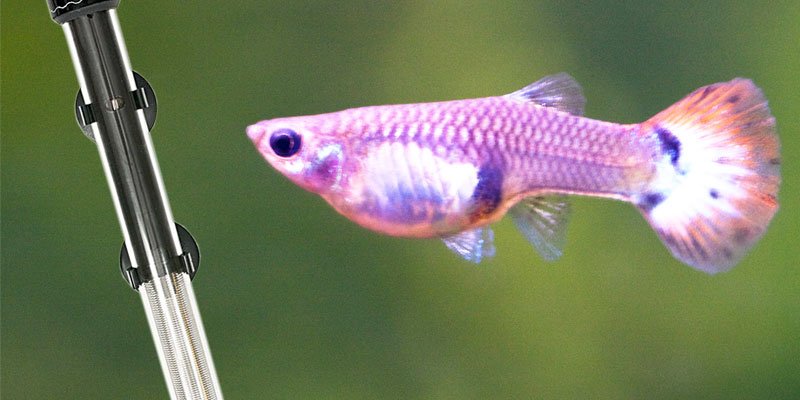
Most guppy aquariums need a thermostatically controlled heater because room temperature changes between day and night and across seasons. A heater is especially important when the room falls below 72°F, the tank is small, or air conditioning creates regular swings.
You may not need active heating if the water—not just the room—naturally remains within the target range around the clock. Even then, a heater set near the lower limit can act as insurance. Never assume a warm climate guarantees stable aquarium water.
How to choose and use a guppy heater safely
- Match it to the aquarium. Follow the manufacturer’s tank-volume and room-temperature guidance. A cold room or open-top tank loses more heat than a warm, covered aquarium.
- Use a separate thermometer. Heater dials are approximate. Place the thermometer away from the heater so it measures the wider tank, not a local warm spot.
- Maintain circulation. Position the heater where filtered water can distribute warmth through the aquarium.
- Protect the fish and equipment. Use a heater guard when appropriate, keep the unit fully submerged if required, and inspect it for cracks, condensation, or a damaged cord.
- Unplug before water changes. Follow the heater’s instructions for cooling before it is exposed to air and before restarting it.
- Plan for failure. A spare suitable heater and thermometer are more useful than guessing during an emergency. In a large tank, two smaller heaters may provide more even heat and partial backup, but both must be correctly controlled.
Do not select a heater solely from a fixed “watts per gallon” formula. Tank shape, lid, flow, room temperature, and the required temperature increase all affect performance.
Why stable temperature matters
Fish are ectotherms, so water temperature influences their metabolism, digestion, activity, oxygen demand, and immune function. Rapid fluctuation from a failed heater, large water change, sunny window, or draft can create stress even when the final number falls inside the normal range.
The Merck Veterinary Manual’s environmental hazards table associates temperature fluctuation with immune compromise and possible mortality. Check temperature whenever guppies suddenly become lethargic, clamp their fins, gasp, hide, or stop eating—but test ammonia and nitrite at the same time because water-quality problems can cause similar signs.
What happens when guppy water is too cold?
Guppies kept too cold may become sluggish, eat less, remain near the heater, clamp their fins, or become more vulnerable to disease. Prolonged exposure is more concerning than a brief, minor dip, and fancy domestic strains may be less robust than wild populations.
If the tank is cold, do not pour in hot water or turn the heater far above the target. Confirm the thermometer with a second device, check whether the heater is operating, reduce drafts, and raise the temperature gradually. A rapid correction can be as stressful as the original problem.
What happens when guppy water is too warm?
Warm water holds less dissolved oxygen while also increasing fish metabolism and oxygen demand. Guppies may breathe rapidly, gather near the filter return, or remain at the surface. The Merck Veterinary Manual explains that water temperature is a major factor controlling how much oxygen remains dissolved.
For excessive heat:
- Switch off a malfunctioning heater.
- Increase surface movement and aeration.
- Close blinds and reduce nearby heat sources.
- Float a sealed cool-water bottle if emergency cooling is needed, replacing it gradually.
- Never add loose ice or make a sudden large temperature drop.
- Test ammonia and nitrite because toxicity and oxygen demand can worsen during heat stress.
Temperature during water changes
Condition replacement water for chlorine or chloramine and match it closely to the aquarium temperature before adding it. Use a thermometer rather than your hand; human touch is poor at detecting small differences. Add water steadily so fish are not exposed to a sudden hot or cold current.
A water change should not be delayed merely because temperature matching is inconvenient. Prepare the water first, and use a safe mixing method outside the aquarium. Never run untreated tap water directly onto fish.
Acclimating new guppies
Turn off the aquarium light, compare the transport water with the tank, and follow the seller’s acclimation instructions. Floating a closed bag can equalize temperature, but it does not correct differences in pH, hardness, or salinity. When chemistry differs substantially, a gradual acclimation method may be appropriate.
Avoid adding store water to the aquarium. Transfer the fish with a net or suitable container after acclimation, and quarantine new arrivals when possible. Do not extend bag acclimation unnecessarily: once a shipping bag is opened, changing gas exchange and pH can make accumulated ammonia more hazardous.
Guppy fry and breeding temperature
Guppy fry can be kept within the same stable 74–78°F range as healthy adults. Warmer water can accelerate metabolism and growth, but it also increases appetite, waste production, maintenance demand, and oxygen needs. It should not be used as a shortcut for faster growth.
Prioritize frequent small meals, excellent water quality, appropriate stocking, and consistent warmth. Guppies reproduce readily; separate-sex housing or a realistic plan for fry is essential before breeding. A female can store sperm and produce more than one brood after mating.
Can guppies live in an outdoor pond?
Guppies can live outdoors only when the water remains safely warm and stable. Check nighttime water temperature, not just sunny daytime readings. In many climates they are seasonal pond fish and must be moved indoors before cold weather.
Use a covered or predator-aware setup, provide shade and aeration, and prevent escape during rain or flooding. Never release guppies into natural waterways. FishBase and the USGS species profile document introductions beyond the guppy’s native range, where released fish may affect local ecosystems.
Temperature is only part of guppy care
A perfect thermometer reading cannot compensate for an uncycled or overcrowded aquarium. Keep ammonia and nitrite at zero, control nitrate with stocking restraint and regular partial water changes, and maintain stable mineral content. Guppies generally do best in moderately hard, neutral-to-alkaline water rather than very soft, acidic conditions.
Provide open swimming space, plant cover, gentle-to-moderate flow, and a mature filter. Guppies are social, but a very small tank becomes unstable quickly and females can be harassed when the sex ratio and cover are poor.
Troubleshooting temperature problems
| Problem | Likely cause | First checks |
|---|---|---|
| Temperature falls every night | Undersized heater, cold room, open top | Confirm thermometer, lid, heater rating, and circulation |
| Water is warmer than the heater setting | Hot room, sun, lights, or stuck thermostat | Unplug suspect heater and verify with a second thermometer |
| Warm near heater, cool elsewhere | Poor circulation or incorrect placement | Improve flow without creating an exhausting current |
| Guppies gasp despite normal temperature | Low oxygen, ammonia, nitrite, or gill disease | Increase aeration and test water immediately |
| Temperature changes during water changes | Replacement water not matched | Measure and mix replacement water before adding it |
Frequently asked questions
Is 72°F too cold for guppies?
72°F (22°C) is at the cool end for many fancy guppies. Healthy fish may tolerate it, but a routine target around 74–78°F provides a better margin. Watch the fish, confirm the reading, and warm gradually if necessary.
Is 80°F too hot for guppies?
80°F (27°C) is within the broad species range but warmer than necessary for routine care. Ensure strong gas exchange and stable water quality. If the temperature rises above the heater setting, identify the heat source rather than accepting a continuing climb.
Can guppies survive at 60°F?
A guppy may survive brief exposure near 60°F (16°C), but this is not an appropriate target for a home aquarium. The U.S. Fish and Wildlife Service notes that the species cannot tolerate temperatures below about 59°F (15°C); that is a lower survival boundary, not a care recommendation.
How quickly should temperature be changed?
There is no single safe rate for every situation. Make ordinary adjustments slowly and avoid changes of several degrees at once. A true emergency such as severe overheating requires prompt action, but cooling should still be controlled while aeration and water quality are addressed.
Final recommendation
Set most guppy aquariums to a stable 74–78°F (23–26°C). Use a thermostatically controlled heater when the room cannot hold that range, verify it with a separate thermometer, match new water during changes, and maintain good surface movement. Stability, oxygen, and clean cycled water matter more than chasing one exact temperature.