For most aquariums, a simple siphon gravel vacuum is the safest and most useful choice. It removes debris while taking out water for a partial water change. Faucet-powered systems are more convenient for large tanks, while battery vacuums are best treated as between-water-change tools rather than replacements for water changes.
Affiliate disclosure: Aquarium Hunter may earn a commission from qualifying Amazon purchases, at no extra cost to you. We only provide an Amazon buying link when we can match the exact product confidently.
Quick comparison
| Vacuum | Best suited to | Main tradeoff | Buying option |
|---|---|---|---|
| Aqueon Siphon Vacuum | Small-to-medium tanks and bucket water changes | Choose the correct tube size for the tank | Check on Amazon |
| Python No Spill Clean and Fill | Large tanks near a compatible faucet | Long hose and faucet compatibility must be planned | Check on Amazon |
| Aqueon Aquarium Water Changer | Faucet-assisted draining and refilling | Needs a compatible faucet and careful refill procedure | Read review |
| Fluval EasyVac Medium | Controlled bucket siphoning | Still requires moving buckets | Check on Amazon |
| EHEIM Quick Vac pro | Spot-cleaning gravel between water changes | Not suitable for sand and does not remove water | Read review |
What an aquarium vacuum can—and cannot—do
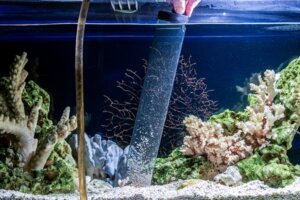
A gravel vacuum lifts fish waste, uneaten food and plant debris from the substrate. A siphon model simultaneously removes old water, which makes it useful for routine partial water changes. It does not replace the aquarium filter, and cleaning the substrate does not correct ammonia or nitrite without addressing their cause.
Battery vacuums recirculate water through a small debris screen. They are convenient for visible dirt, but dissolved waste remains in the aquarium. Regular partial water changes and water testing are still necessary.
How to choose the right vacuum
- Tank size and height: the intake must reach the substrate comfortably, and the hose must reach the bucket, drain or faucet.
- Substrate: coarse gravel can be churned inside a wide tube. Fine sand needs gentler surface hovering and more precise flow control.
- Fish and plants: use a narrow intake and lower flow around shrimp, fry, carpeting plants and delicate rooted plants.
- Water-change method: bucket siphons are simple and portable; faucet systems reduce lifting but require compatible plumbing and careful temperature control.
- Replacement parts: adapters, bulbs, hoses, clips and filter screens should be obtainable for equipment intended for long-term use.
Aqueon Siphon Vacuum Gravel Cleaner
Best for: straightforward bucket-based water changes.
Aqueon’s siphon family comes in several intake sizes. The self-priming motion starts water flow, the clear intake lets you see debris, and the included clip helps secure the hose to a bucket. The small Mini model is useful where a large tube would remove water too quickly.
Watch for: the linked Amazon product is the exact Mini 5-inch version, intended for very small aquariums. Owners of larger tanks should use Aqueon’s official size options rather than buying the Mini simply because it is listed here.
Check the exact Aqueon Mini Siphon listing on Amazon
Official Aqueon sizes and specifications
Python No Spill Clean and Fill
Best for: larger aquariums where carrying multiple buckets is impractical.
The Python system connects to a faucet and uses a long, aquarium-safe hose to drain, gravel-clean and refill. It can reduce lifting and floor spills when the aquarium is a considerable distance from a drain. Multiple hose lengths and replacement parts are available from the manufacturer.
Watch for: check the faucet thread and adapter before purchasing. Secure every connection and supervise the system continuously. During refilling, match temperature and use water conditioner correctly for the full volume of new tap water entering the aquarium.
Check the exact Python 50-foot system on Amazon
Aqueon Aquarium Water Changer
Best for: faucet-assisted water changes with a choice of hose lengths.
This system attaches to a compatible faucet, sends dirty water to the drain and can reverse flow to refill the aquarium. Its gravel-cleaning tube allows substrate cleaning during draining, and replacement flow assemblies and faucet adapters are supported by the manufacturer.
Watch for: test the adapter fit and hose connections before leaving the drain area. Never leave an aquarium refilling unattended. Condition tap water and keep replacement water close to the aquarium’s temperature.
Official Aqueon Water Changer information
Fluval EasyVac Medium Gravel Cleaner
Best for: aquarists wanting a conventional siphon with a gravel guard and easy-start valve.
The EasyVac is a bucket-draining siphon available in different tube lengths. Fluval’s design includes a gravel guard intended to reduce clogging and a tube profile that helps reach corners. Selecting the right length keeps the user’s hands out of deeper tanks and gives better control.
Watch for: the rate of water removal depends on the height difference and hose size. Pinch or lift the hose to slow flow around fine substrate and small animals. Confirm the current model and size through Fluval because an older Amazon listing previously used by this article now resolves to a different product name.
Check the exact Fluval EasyVac Medium listing on Amazon
Official Fluval EasyVac information
EHEIM Quick Vac pro
Best for: picking up visible debris from gravel between scheduled water changes.
This battery-powered unit draws debris into a removable mesh compartment and returns the water to the aquarium. It can tidy localized waste without setting up a bucket or drain hose, and EHEIM continues to document replacement components.
Watch for: EHEIM states that the Quick Vac pro is not suitable for sand. Because it returns water to the tank, it does not replace partial water changes. Clean the debris compartment after use and keep the battery housing sealed as instructed.
Official EHEIM Quick Vac pro information
How to vacuum aquarium gravel safely
- Prepare conditioned replacement water and a clean aquarium-only bucket if one is required.
- Unplug heaters and other equipment that could be exposed as the water level falls. Follow each device’s manual.
- Place the intake in the aquarium and secure the discharge hose.
- Start the siphon using the product’s priming method. Do not start it by mouth.
- Push the intake gently into gravel, allow debris to rise, then lift it before too much gravel reaches the hose.
- For sand, hover just above the surface and reduce flow. Avoid deeply disturbing the entire bed in one session.
- Watch fish, shrimp and snails continuously and stop suction if an animal approaches the intake.
- Stop at the planned water-change volume, refill with temperature-matched conditioned water, then restart equipment when safely submerged.
How much substrate should be cleaned?
There is no universal schedule. A lightly stocked planted aquarium may accumulate little accessible debris, while a heavily stocked tank with coarse gravel may need attention at every water change. Use water tests, visible waste and the aquarium’s nitrate trend to guide maintenance.
Avoid stripping the entire aquarium spotless. Rooted plants benefit from an established substrate, and beneficial organisms live on surfaces throughout the tank. Clean exposed dirty areas, work around roots, and divide neglected deep gravel into sections over several sessions.
Common mistakes
- Buying an intake so large that a small aquarium drains before cleaning is finished.
- Using full suction around shrimp, fry or fine sand.
- Leaving a faucet-connected system or refill hose unattended.
- Forgetting water conditioner or failing to match replacement-water temperature.
- Running a heater after the water falls below its safe operating level.
- Assuming a recirculating battery vacuum replaces water changes.
- Deep-cleaning all old substrate at once and releasing a large amount of trapped waste.
Frequently asked questions
Can a gravel vacuum remove beneficial bacteria?
Some bacteria live on substrate surfaces, but normal partial vacuuming does not sterilize an aquarium. Most established systems also contain large bacterial populations in the filter media and on other surfaces. Avoid aggressive whole-tank cleaning and never rinse biological filter media in untreated chlorinated tap water.
Can I vacuum sand?
Yes, with a siphon that offers controllable flow. Hover above the surface so light debris rises while the sand falls back. The EHEIM Quick Vac pro reviewed here is specifically documented as unsuitable for sand.
How often should I vacuum?
Inspect exposed substrate during each regular water change and clean where waste collects. Stocking, feeding, substrate grain, plants and flow all affect frequency. Water testing is more useful than following a rigid calendar.
Should fish remain in the tank?
Usually yes. Removing fish for routine maintenance creates unnecessary handling stress. Work slowly, keep the intake visible and use a guard or lower flow around very small animals.
How we selected these products
We compared current manufacturer support, suitability for different tank sizes and substrates, flow control, replacement parts, maintenance purpose and safety. We removed discontinued or mismatched listings and did not rank products by temporary price. The single Amazon product link is an exact match verified during this renovation; official manufacturer pages are included for specifications.
References and product information
- Aqueon Siphon Vacuum Gravel Cleaners
- Aqueon Aquarium Water Changers
- Fluval EasyVac Gravel Cleaner
- EHEIM product catalog: Quick Vac pro