

Aquascaping plants do more than make an aquarium look natural. They define the foreground, soften hardscape, create depth, shelter fish and shrimp, and use nutrients that might otherwise feed algae. The best choices are not simply the most colorful plants—they are the plants that suit your aquarium’s light, substrate, carbon dioxide (CO2) supply, and maintenance routine.
This guide compares nine reliable plants for layouts ranging from low-tech beginner tanks to carefully trimmed, CO2-injected aquascapes. Start with a simple planting plan, choose a few species that share similar needs, and give them time to establish.

Quick comparison of the best aquascaping plants
| Plant | Best position | Light | CO2 | Difficulty |
|---|---|---|---|---|
| Anubias barteri ‘Petite’ | Hardscape / foreground | Low | Not required | Easy |
| Cryptocoryne wendtii | Midground | Low–medium | Not required | Easy |
| Monte Carlo | Foreground carpet | Medium–high | Strongly recommended | Moderate |
| Java moss | Hardscape / foreground | Low–medium | Not required | Easy |
| Hydrocotyle tripartita | Foreground / midground | Medium | Helpful | Moderate |
| Java fern ‘Trident’ | Hardscape / midground | Low–medium | Not required | Easy |
| Hygrophila pinnatifida | Hardscape / midground | Medium | Helpful | Moderate |
| Staurogyne repens | Foreground / midground | Medium | Helpful | Moderate |
| Bucephalandra | Hardscape | Low–medium | Not required | Easy–moderate |
1. Anubias barteri ‘Petite’
Anubias ‘Petite’ is one of the most dependable plants for a low-tech aquascape. Its compact, dark-green leaves work well near the front of the tank, between stones, or on driftwood. It grows slowly, so it needs little trimming, but slow growth also means old leaves can collect algae when lighting is excessive.
Attach the plant to rock or wood with thread or a small amount of aquarium-safe cyanoacrylate gel. Keep its thick rhizome above the substrate; burying the rhizome can cause it to rot. The plant tolerates low light and does not require added CO2. Kew recognizes Anubias barteri as a species native to tropical western and west-central Africa.

2. Cryptocoryne wendtii
Cryptocoryne wendtii is a versatile rooted plant for the midground. Depending on the variety and growing conditions, its leaves may be green, bronze, brown, or reddish. It performs well in low-to-medium light and usually grows without injected CO2 once its roots are established.
Plant individual crowns a few inches apart in a nutrient-rich substrate or use root tabs in inert gravel or sand. Newly moved crypts sometimes shed their old leaves—a temporary response known as “crypt melt.” Leave healthy roots and crowns in place; fresh submerged leaves often follow. The species is native to Sri Lanka according to Kew’s Plants of the World Online.

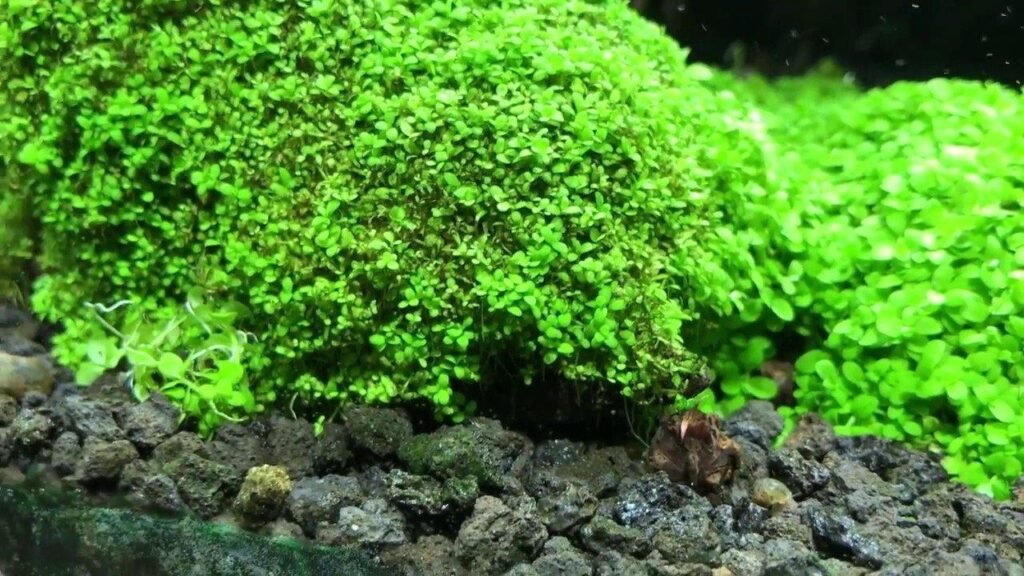
3. Monte Carlo (Micranthemum tweediei)
Monte Carlo is a small-leaved carpeting plant that can form a bright green lawn across the foreground. It is more forgiving than some demanding carpet plants, but a dense, low carpet is most reliable with medium-to-high light, stable nutrients, and injected CO2. Without CO2 it may grow more slowly and vertically instead of spreading tightly.
Divide the pot into small plugs and plant them about an inch apart with tweezers. Regular trimming encourages horizontal growth and prevents the upper layer from shading or lifting the growth underneath. A dry-start method can help the plugs root before the tank is filled, but high humidity and careful mold control are essential.
4. Java moss
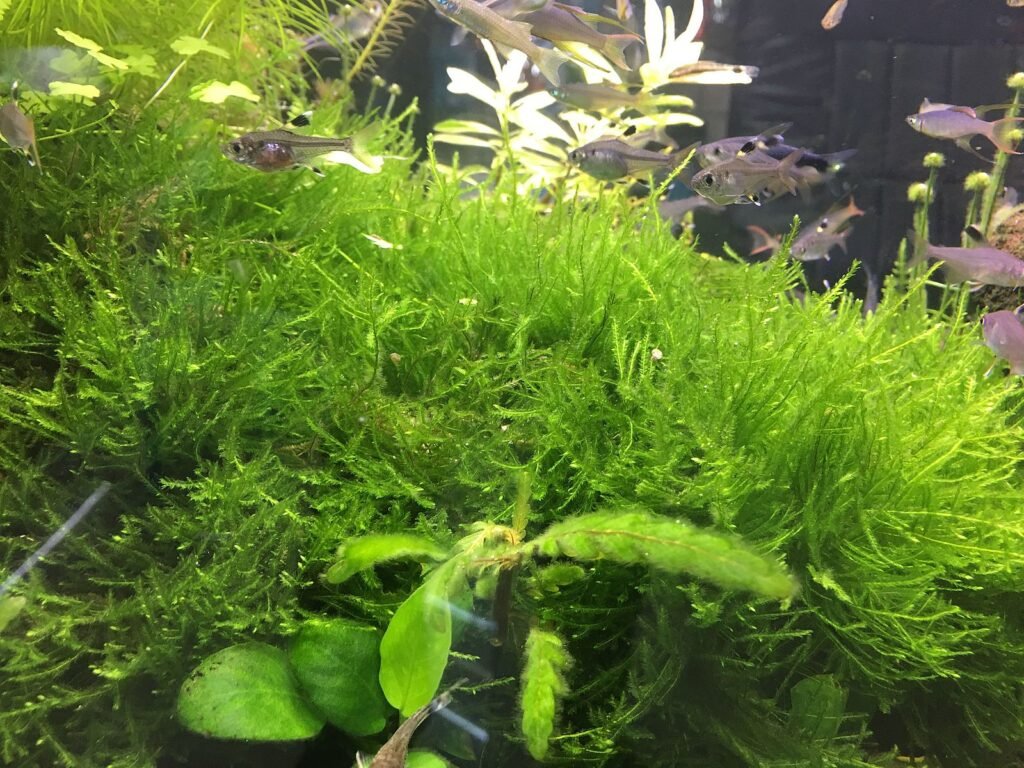
Java moss is useful wherever an aquascape needs fine texture. Tie or glue a thin layer to wood, stone, or stainless-steel mesh. It tolerates low light and does not require CO2, making it a practical choice for shrimp tanks and beginner layouts.
Avoid attaching thick clumps: the shaded interior can trap debris and deteriorate. Trim regularly and siphon loose fragments so the moss keeps a compact shape. Gentle-to-moderate flow helps prevent waste from settling in it.
5. Hydrocotyle tripartita
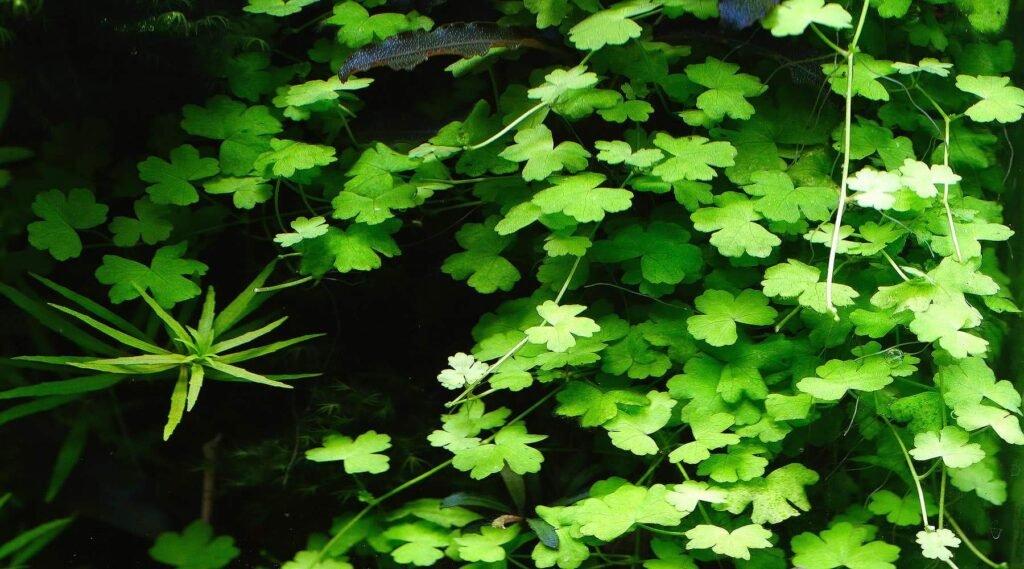
Hydrocotyle tripartita has small, clover-like leaves and a lively growth pattern. It can be allowed to creep through the foreground, cascade over rocks, or form a loose midground mound. Moderate light and consistent fertilization support compact growth; CO2 is helpful when you want a dense, controlled shape.
Pin short runners into the substrate or tuck them around hardscape, then trim and replant the healthiest tips. Without regular pruning it can climb upward and shade slower plants.
6. Java fern ‘Trident’
Java fern ‘Trident’ is a narrow, branching-leaved form of Microsorum pteropus. It adds height and movement without the visual weight of broader Java fern varieties. Like Anubias, it is an epiphyte: attach it to wood or rock and do not bury the rhizome.
Low-to-medium light is adequate, and CO2 is optional. Remove damaged older leaves at the rhizome. Small plantlets may form on mature leaves; once they develop roots, they can be detached and mounted elsewhere.

7. Hygrophila pinnatifida
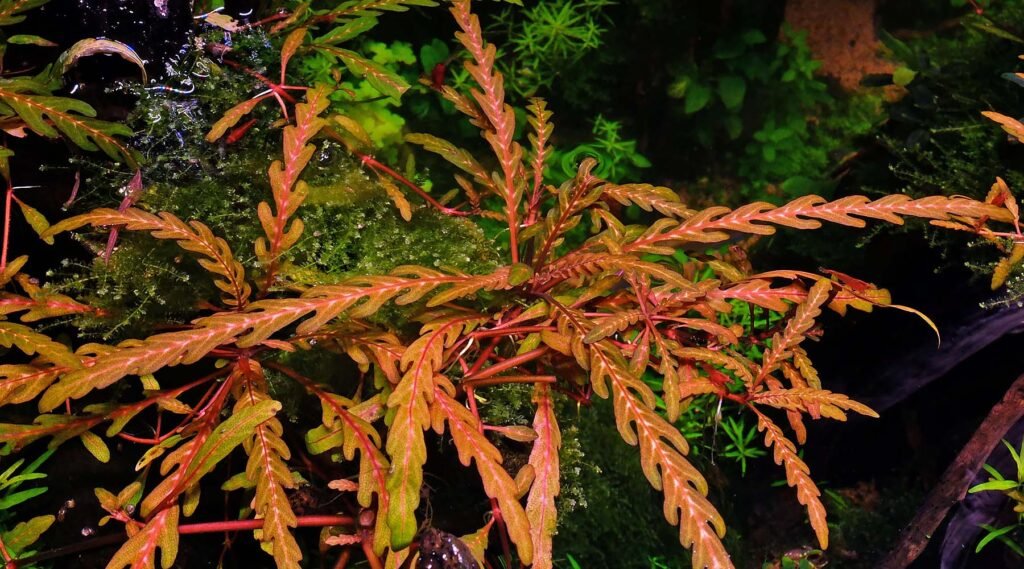
Hygrophila pinnatifida stands out for its deeply divided leaves and warm brown-to-reddish tones under stronger light. It can root in substrate or attach to porous hardscape, sending out runners and side shoots. Use it as a focal accent rather than letting it spread everywhere.
Moderate light, balanced fertilization, and good circulation are important. Added CO2 promotes compact growth and stronger coloration. Pinching the growing tips encourages branching. For a taller, easier background option from the same genus, see our guide to Hygrophila corymbosa.
8. Staurogyne repens
Staurogyne repens is a compact stem plant that bridges the foreground and midground. Its upright stems and broader green leaves contrast nicely with carpeting plants and mosses. Plant individual stems with space between them, then trim the tops to encourage low, bushy side growth.
It can survive without injected CO2, but moderate light and CO2 generally produce a fuller, more compact group. Do not allow taller plants to shade it heavily, and keep nutrients stable rather than chasing rapid growth with excessive light.
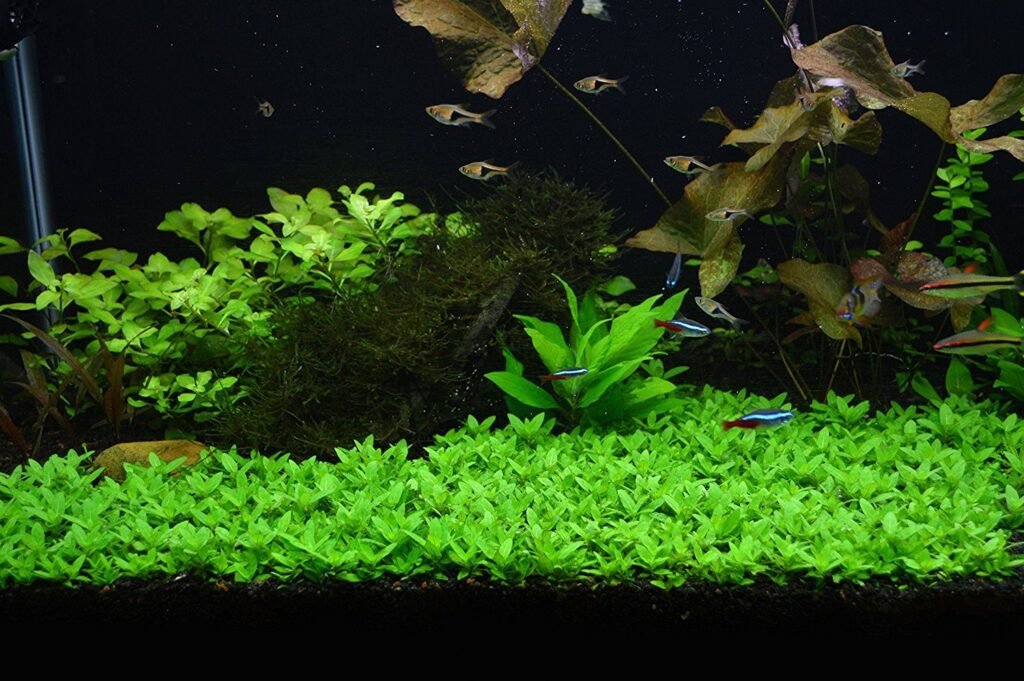
9. Bucephalandra
Bucephalandra species and cultivars are slow-growing rhizome plants prized for their varied leaf shapes, subtle colors, and iridescent surfaces. They are ideal for adding detail to shaded rock and wood. Attach the rhizome above the substrate, just as you would with Anubias or Java fern.
Low-to-medium light is usually sufficient. CO2 is not essential, although stable CO2 and nutrients can improve growth. Because Bucephalandra grows slowly, keep lighting conservative and remove algae before it becomes established on older leaves.

How to plan an aquascape that grows well
Assign each plant a role
Choose low plants for the foreground, medium plants for the visual transition, and taller stems or rosettes for the background. Epiphytes belong on rock and wood. Repeating a limited number of species usually looks calmer and more intentional than planting one of everything.
Build around a focal point
Place the main rock, wood feature, or open swimming area slightly off-center—near a rule-of-thirds line is an easy starting point. Let smaller pieces and plant groups support that focal point. Leave some open space so the layout has contrast and does not become a solid wall of foliage.
Match the substrate to the roots
Root feeders such as Cryptocoryne and Staurogyne benefit from aquasoil or periodic root tabs. Epiphytes take much of their nutrition from the water column and must keep their rhizomes exposed. Wash inert sand or gravel before use, but do not rinse active aquasoil unless its manufacturer instructs you to.
Balance light, CO2, and nutrients
More light increases plant demand for CO2 and nutrients. It also increases algae risk when the other inputs are unstable. Begin with a moderate photoperiod—often six to eight hours daily—and adjust gradually. A timer keeps it consistent. If you inject CO2, use equipment designed for aquariums and maintain a stable level during the lighting period; never sacrifice fish safety for faster plant growth.
Planting and first-month care
- Inspect and clean plants. Remove damaged leaves, rock wool, gel, and dead roots. Quarantine when practical, especially if the plants came from tanks containing fish or snails.
- Plant by growth habit. Separate rooted plants into small portions, mount rhizomes above the substrate, and attach moss in a thin layer.
- Cycle the aquarium. Plants do not eliminate the need to establish biological filtration or monitor ammonia and nitrite before adding livestock.
- Keep the first weeks stable. Perform regular partial water changes, remove melting leaves, and avoid repeatedly uprooting plants that are trying to establish.
- Trim with a plan. Cut fast plants before they shade slow ones. Replant healthy tops where needed and remove excess growth from the aquarium.
Avoid packets sold as “aquarium carpet seeds.” Many contain terrestrial or semi-aquatic plants that germinate quickly and then decay after prolonged submersion. Buy correctly identified aquatic plants from a reputable aquarium supplier instead.
Frequently asked questions
Can I create an aquascape without CO2 injection?
Yes. Anubias, Cryptocoryne, Java moss, Java fern, and many Bucephalandra varieties can make an attractive low-tech layout. Use modest lighting, choose slower-growing plants, and accept that growth will be more gradual.
How many plant species should a beginner use?
Three to five well-matched species are enough for a convincing first layout. For example, combine Monte Carlo or a low Cryptocoryne in front, Cryptocoryne wendtii in the midground, Java fern on wood, and one taller background plant. Repetition creates unity and makes maintenance easier.
Why are my new aquarium plants melting?
Some nursery-grown plants were raised above water and must replace their old leaves with submerged growth. Transport stress, unstable CO2, damaged roots, or sudden changes in water conditions can also cause leaf loss. Remove decaying material, keep conditions stable, and watch the crown or rhizome for healthy new growth.
Final recommendation
For an easy first aquascape, begin with Anubias ‘Petite,’ Cryptocoryne wendtii, Java moss, and Java fern ‘Trident.’ Add Monte Carlo, Hydrocotyle tripartita, Hygrophila pinnatifida, or Staurogyne repens when you are ready to manage stronger light, more frequent trimming, and possibly injected CO2. The best planted aquarium is not the one with the longest plant list—it is the one whose plants share compatible needs and can be maintained consistently.