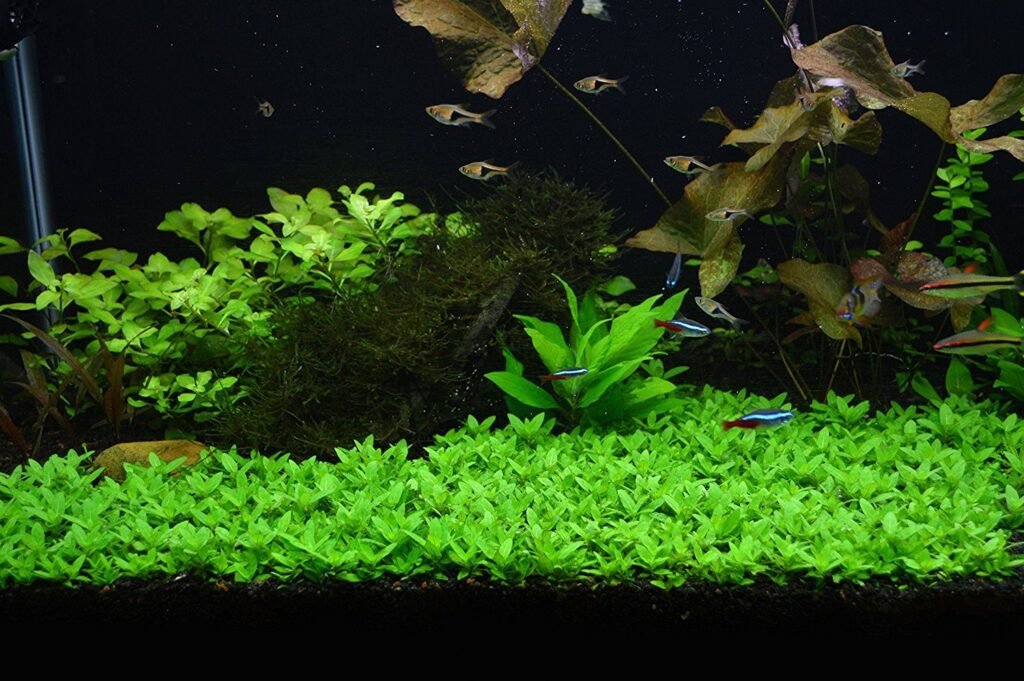
7 Brackish Aquarium Plants: What Tolerates Salt

7 Brackish Aquarium Plants: What Tolerates Salt

Brackish aquariums can support plants, but the choices shrink as salinity rises. Some genuinely salt-tolerant species are suitable for estuary-style systems, while familiar freshwater aquarium plants may survive only at the very low end of the brackish range. Success depends on measuring salinity, changing it slowly and choosing plants for the exact conditions—not merely adding “a little salt.”

Important: Specific gravity changes with temperature and is not interchangeable with parts per thousand. Use a calibrated refractometer or reliable salinity meter. Keep the plants in freshwater unless the fish genuinely require brackish water, and never add salt as a general tonic.

Seven brackish aquarium plants compared

Plant Best use Confidence in salt tolerance
Moneywort Submerged or emergent low-brackish planting High; naturally occurs in coastal and brackish habitats
Seaside brookweed Cooler, bright shallow margins High for damp coastal conditions; aquarium performance varies
Cryptocoryne ciliata Warm estuary-style margins and shallow water High relative to other Cryptocoryne
Red mangrove Open-top paludarium or very large specialist display Very high, but it is a tree rather than a normal aquarium plant
Java fern Hardscape in very low salinity Experimental; individual strains and conditions vary
Anubias barteri Emergent or attached growth at very low salinity Experimental; better treated as freshwater-first
Java moss Cover at the lowest brackish levels only Variable; monitor for browning and detachment

1. Moneywort (Bacopa monnieri)

Moneywort Bacopa monnieri growing as an aquarium stem plant

Moneywort is the strongest conventional aquarium candidate in this list. It naturally occurs across tropical and subtropical wetlands, including coastal and brackish sites. It can grow submerged, along wet margins or above the water, making it useful in tanks where the water level changes.

Give it bright light and a nutrient source at the roots or in the water column. Start in freshwater and raise salinity slowly over weeks, watching new growth rather than old leaves. Pale tips, stalled growth or repeated stem melt indicate that light, nutrients or salinity are outside the plant’s useful range.

2. Seaside brookweed (Samolus valerandi)

Seaside brookweed Samolus valerandi with green rosette leaves

Seaside brookweed is a wetland plant found in damp places, river margins and coastal environments. In an aquarium it is best treated as a cool-tolerant marginal or shallow-water plant, not a guaranteed long-term fully submerged carpet.

Use strong light, an open foreground and a nutrient-bearing substrate. Buy plants grown for aquarium use rather than collecting from the wild. If leaves become translucent or the crown rots, reduce stress and consider growing the plant with leaves above the surface.

3. Cryptocoryne ciliata

Cryptocoryne ciliata is the Cryptocoryne specifically associated with freshwater tidal zones and occasional brackish habitat. That makes it a better evidence-based choice than Cryptocoryne wendtii, which was recommended in the previous version of this guide without adequate support for brackish use.

This is a large plant for a warm, spacious setup, often performing well with leaves above the water. Give it a rich substrate and avoid abrupt changes. Cryptocoryne can shed leaves after transplanting; healthy roots and later new growth are more important than retaining every old leaf.

4. Red mangrove (Rhizophora mangle)

Red mangrove is genuinely adapted to tropical estuaries and waterlogged soils of varying salinity. It is also a tree that can grow many metres tall—not a small underwater aquarium plant. Use it only in an open-top paludarium, mangrove display or very large specialist system where the leaves remain above water.

Provide intense light, warm air, high humidity and room for roots and shoots. Salt is tolerated but not required; Kew notes that cultivated red mangroves can grow without seawater. Check collection and possession rules, and obtain legally propagated plants. Pruning does not turn a tree into a permanently maintenance-free nano-aquarium plant.

5. Java fern (Microsorum pteropus)

Java fern attached to aquarium hardscape

Java fern is a freshwater wet-tropical fern and lithophyte, not a true salt-marsh plant. Some aquarists keep it at very low salinity after gradual acclimation, but it should not be presented as broadly brackish-tolerant. Treat it as an experiment for the freshwater edge of a brackish system.

Attach the rhizome to wood or rock instead of burying it. Use moderate light and increase salinity in small measured steps. Judge success by firm new leaves; blackened, transparent or steadily shrinking foliage means the conditions are unsuitable.

6. Anubias barteri

Anubias barteri attached to aquarium wood
Compact Anubias barteri var. nana in an aquarium

Anubias is another durable freshwater-first plant sometimes used at very low brackish levels. Its thick leaves and ability to grow emersed make it a practical trial plant, especially where its leaves can remain above the saltiest water. Salt tolerance is not unlimited and may vary between plants.

Attach the rhizome to hardscape and keep it exposed. Low-to-moderate light helps control algae on the slow-growing leaves. Acclimate gradually and keep a freshwater backup plant rather than moving an entire collection into brackish water at once.

7. Java moss (Taxiphyllum barbieri)

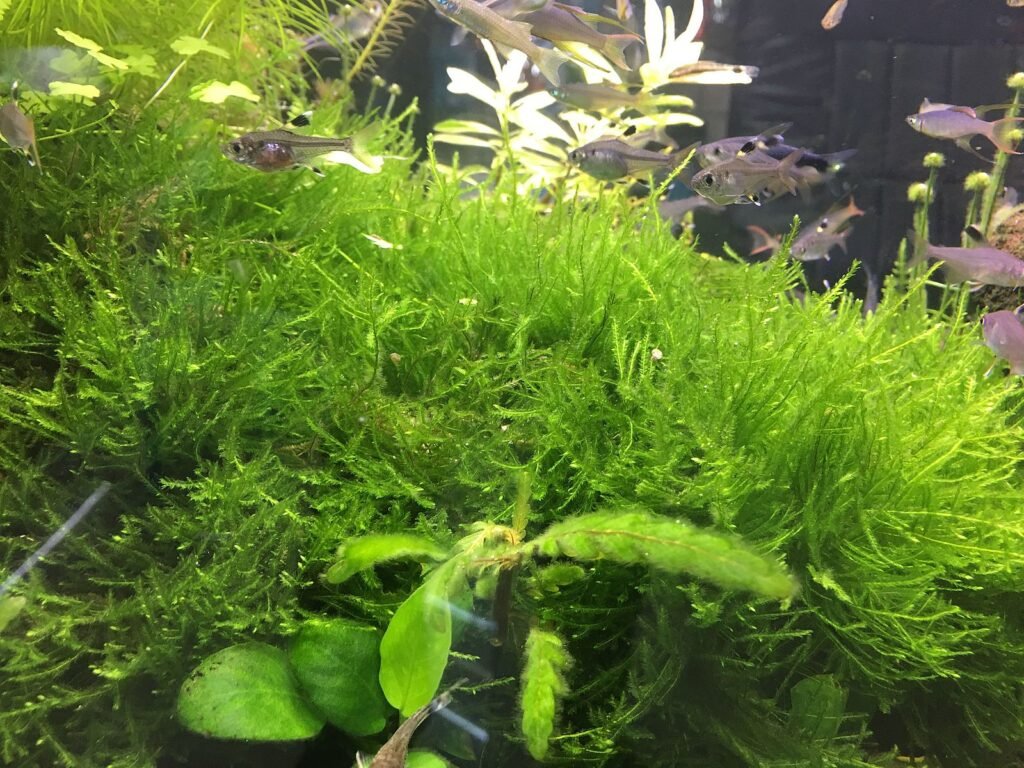
Java moss attached to aquarium hardscape

Java moss is useful for cover and grazing surfaces in freshwater, but its brackish performance is inconsistent. Try it only at the lowest salinity needed by the animals, with gradual acclimation, moderate light and good flow through the moss.

Thin dense clumps so debris does not accumulate inside them. Remove browning material promptly. If new tips stop growing after salinity rises, return the surviving portion to freshwater rather than assuming it will adapt indefinitely.

Plants removed from the old recommendations

Marimo moss balls

Marimo is a freshwater alga, not a reliable brackish plant. It was also involved in repeated invasive zebra-mussel detections in the aquarium trade, including a documented 2024 incident. Follow current local biosecurity advice before buying, moving or disposing of moss balls, and never release them or aquarium water into natural waterways.

Anacharis (Egeria densa)

Anacharis is primarily a freshwater plant, and it is invasive or regulated in some regions. It is not a responsible default recommendation for a brackish guide. Check local law before purchase and dispose of trimmings in household waste rather than drains, ponds or streams.

Cryptocoryne wendtii

Cryptocoryne wendtii is an excellent freshwater aquarium plant, but the brackish-habitat evidence within the genus points specifically to C. ciliata. The two should not be treated as interchangeable simply because they share a genus.

How to acclimate plants to brackish water

  1. Define the animals’ target salinity. Do not raise salinity beyond what the fish or invertebrates need.
  2. Measure accurately. Use a calibrated refractometer or salinity meter and record the reading and temperature.
  3. Start with healthy plants. Root and establish them in freshwater before changing conditions where possible.
  4. Increase salinity slowly. Make small changes over weeks, not a single large dose.
  5. Watch new growth. Old leaves can persist while the plant is failing; new roots and leaves are the better sign.
  6. Keep a backup. Retain a freshwater cutting or division until the trial plant shows sustained growth.

Lighting, nutrients and maintenance

Salt is only one stress. Plants also need suitable light, carbon and nutrients. Avoid changing salinity, lighting and fertiliser at the same time because you will not know which change caused a problem. Remove dead leaves before they decay, maintain circulation and continue ordinary ammonia, nitrite and nitrate testing.

Plant growth does not replace filtration or water changes. A brackish aquarium still requires a fully established nitrogen cycle, stable oxygen and species-appropriate maintenance.

Frequently asked questions

Can ordinary freshwater plants live in brackish water?

Some tolerate very low salinity for a time, but survival is not the same as healthy long-term growth. Choose naturally salt-tolerant species first and test freshwater plants cautiously.

How much salt should I add for the plants?

None unless the animals and habitat plan require brackish water. Set salinity for the verified livestock, then choose plants that tolerate that level.

Can I use table salt?

No. Use an appropriate marine salt mix when creating brackish water so the water contains the required major and minor ions. Measure salinity rather than dosing by spoonfuls.

Why are my plants melting after adding salt?

The increase may have been too fast or too high, or another factor such as temperature, light or nutrient availability may have changed. Remove decaying tissue, verify the measurement and reduce stress rather than adding more products.

Sources

Hygrophila Corymbosa Care: Temple Plant Growing Guide

Hygrophila Corymbosa

Hygrophila corymbosa is a fast-growing stem plant that can give a freshwater aquarium a full, bright-green background without demanding injected CO2. It is forgiving enough for beginners, but it still needs regular pruning, adequate nutrients, and enough room for its broad leaves.

Also called temple plant or giant hygro, this species is sold in several forms and cultivars. Their height, leaf shape, and color can differ, so confirm the plant label when buying and do not confuse it with Hygrophila polysperma, a different species that is federally regulated as a noxious weed in the United States.

Hygrophila corymbosa temple plant growing underwater in an aquarium
Hygrophila corymbosa is a broad-leaved stem plant suited to the middle or background of an aquarium.

Hygrophila corymbosa care at a glance

Common names Temple plant, giant hygro
Plant type Fast-growing stem plant
Typical aquarium height 8–12+ inches (20–30+ cm), depending on cultivar and trimming
Placement Background; compact cultivars can suit the midground
Light Low to medium; stronger light promotes denser growth
CO2 Optional, but beneficial for faster and more compact growth
Growth rate Fast
Propagation Stem cuttings and side shoots
Difficulty Easy

Tropica classifies standard H. corymbosa as an undemanding, fast-growing starter plant with low light and CO2 demands. That does not mean it thrives without nutrients or maintenance; fast growth can reveal shortages quickly.

What is Hygrophila corymbosa?

Hygrophila corymbosa is an accepted species in the Acanthaceae family. Kew’s Plants of the World Online records its native range as Indochina and the Philippines, including Cambodia, Laos, Myanmar, Thailand, and the Philippines. It grows in wet tropical habitats and can develop both submerged and emergent growth.

Submerged aquarium leaves are normally green, broad, and arranged opposite one another on an upright stem. Growth above the water can look different and may eventually produce flowers. A plant newly moved from a nursery may shed some emersed leaves while adapting to permanent submersion; healthy stems should then produce new underwater growth.

Popular forms and cultivars

The name “temple plant” is applied loosely in the aquarium trade. Common forms include broad-leaved standard plants, narrower-leaved forms often sold as “Siamensis,” and compact nursery cultivars.

Standard temple plant

The standard form becomes tall and broad. It is best used as a background plant in medium or large aquariums, where repeated groups of stems can form a dense green screen.

Hygrophila ‘Compact’

This nursery cultivar is commonly associated with H. corymbosa and has shorter spaces between the leaves with more lateral branching. Tropica notes that it stays more compact and can survive low light without injected CO2, although stronger light and CO2 promote healthier, denser growth.

Because trade names change, compare the actual plant’s leaf shape and expected height rather than assuming every pot labeled “giant hygro” will grow identically.

How to plant temple plant

  1. Remove any rock wool, foam, metal weight, or nursery anchor.
  2. Separate the bundle into individual healthy stems.
  3. Remove damaged leaves and strip leaves from the lowest 2 inches (5 cm).
  4. Insert each stem into the substrate with plant tweezers.
  5. Leave roughly 1–2 inches (2.5–5 cm) between stems so lower leaves receive light and water flow.
  6. Plant shorter stems toward the front of the group and taller stems behind them for a natural arrangement.

Do not bury intact leaves or crowd the entire bundle into one hole. Closely packed stems may shade one another, trap debris, and lose their lower leaves.

Light requirements

H. corymbosa can grow under low to moderate aquarium lighting. Under weak light it tends to stretch toward the surface, producing longer gaps between leaves and less compact growth. Moderate light usually gives a fuller shape and stronger stems.

More light also increases nutrient and carbon demand. If light intensity is raised without matching plant nutrition and maintenance, algae may increase rather than plant health. Start with a consistent 6–8 hour photoperiod and adjust gradually based on growth.

Does Hygrophila corymbosa need CO2?

No. Injected CO2 is optional for this species. It normally grows well in a stable, stocked aquarium with appropriate light and nutrients. CO2 supplementation can produce faster, denser growth, but it also increases pruning and fertilization needs.

For a beginner tank, stable conditions and balanced lighting are more valuable than adding CO2 equipment immediately.

Substrate and fertilizer

Temple plant can take up nutrients through both roots and leaves. It can grow in inert sand or gravel when the water column is fertilized appropriately, and it also benefits from a nutrient-rich planted substrate or root fertilization.

Follow a complete aquarium-plant fertilizer at the manufacturer’s measured dose and adjust using plant response, stocking, water changes, and test results. Do not add extra fertilizer merely because growth is slow; first check light, CO2 availability, temperature, plant adaptation, and whether the stems are healthy.

Temperature and water parameters

This adaptable tropical plant works across the conditions used for many community aquariums. A practical target is:

  • Temperature: approximately 72–82°F (22–28°C)
  • pH: roughly 6.0–8.0
  • Hardness: soft to moderately hard water

These are useful aquarium ranges rather than rigid boundaries. Avoid sudden changes. Matching healthy fish and maintaining stable water quality should take priority over chasing an exact pH for this forgiving plant.

How to prune Hygrophila corymbosa

Fast growth means regular trimming. When a stem approaches the surface or shades nearby plants:

  1. Cut the stem just above a healthy node at the desired height.
  2. Leave the rooted lower section in place if you want it to produce side shoots.
  3. Replant the healthy top cutting if you want a taller replacement stem.
  4. Remove weak, bare, or overcrowded old stems.

Alternating trimming heights creates a bushier group than cutting every stem into a flat line. Weekly inspection is useful in high-light or CO2-injected tanks; slower setups may need pruning much less often.

How to propagate temple plant

Propagation is straightforward. Take a healthy 4–6 inch (10–15 cm) top or side cutting, remove its lowest leaves, and plant the bare nodes in the substrate. Roots can develop from the buried nodes while the cutting resumes upward growth.

Do not release unwanted cuttings into ponds, drains, streams, wetlands, or gardens where fragments could reach natural water. Seal them in a bag for household disposal or dry them completely before composting where local rules permit.

Common problems

Lower leaves turn yellow or fall off

The lower stem may be shaded by dense growth, or the plant may lack balanced nutrients. Thin the group, check that light reaches the base, and review fertilization. Some leaf loss is also normal while emersed nursery growth converts to submerged growth.

Pinholes or damaged leaf edges

Damage may reflect nutrient imbalance, physical injury, snails feeding on already-dying tissue, or fish that nip plants. Diagnose the whole setup rather than assuming one deficiency from a single symptom.

Long gaps between leaves

Leggy growth commonly develops under weak light or heavy shading. Remove floating cover, thin neighboring stems, or moderately increase light while monitoring algae.

Stems rot after planting

Buried leaves, damaged stems, poor circulation, or a plant already deteriorating in the store can cause rot. Cut back to firm tissue and replant a healthy top section.

Growth reaches the surface too quickly

This is normal for a fast stem plant. Prune regularly, replant selected tops, or switch to a compact cultivar if the aquarium is shallow.

Fish and invertebrate compatibility

Temple plant is compatible with most peaceful community fish, shrimp, and snails. Dense stems provide cover for fry and shy animals. Goldfish, large herbivorous fish, and digging cichlids may eat, break, or uproot it.

Healthy aquarium snails usually graze biofilm and damaged material rather than destroying strong leaves. If leaves disappear, identify the actual fish or invertebrate responsible before treating the tank.

Do not confuse H. corymbosa with H. polysperma

Hygrophila polysperma—East Indian hygrophila—is a different plant. The University of Florida identifies it as a federally listed noxious weed and a prohibited aquatic plant in Florida because fragments can establish invasive populations. USDA’s weed-risk assessment for H. corymbosa treats temple plant separately and records it as introduced in Florida.

Plant laws can change and vary by state. Confirm the scientific name with the seller and check federal and state rules before purchasing or transporting any Hygrophila. Never dump aquarium plants or water containing fragments outdoors.

Frequently asked questions

Is Hygrophila corymbosa good for beginners?

Yes. It adapts to a broad range of freshwater aquariums, grows without injected CO2, and propagates easily. Its main demand is regular pruning.

Can it grow in gravel?

Yes. Anchor the stems carefully and provide balanced nutrients. A planted substrate can help, but it is not essential.

Why is my temple plant turning red or bronze?

Some cultivars develop bronze or reddish new growth under stronger light and suitable nutrition. Sudden browning, transparency, or soft tissue is more likely deterioration than healthy coloration.

Can it grow out of the aquarium?

Yes. It can grow emersed if stems reach above the surface and humidity is suitable. Trim it if the aquarium hood, lights, or desired layout cannot accommodate emergent growth.

Bottom line

Hygrophila corymbosa is an excellent background stem plant for beginners who want quick growth and a full green display. Give individual stems room, use low-to-moderate light, fertilize consistently, and prune before it shades the aquarium. Most importantly, verify the species and dispose of every cutting responsibly.

Authoritative references

Best Cold-Water Aquarium Plants: 9 Hardy Choices

Cold Water Aquarium plants

A cold-water aquarium can support healthy, attractive plants, but “cold water” needs a clear definition. In this guide, it means an unheated or lightly heated freshwater aquarium that usually stays around 60–72°F (16–22°C). That is cooler than a typical tropical tank, not icy water.

The right plant depends on the tank’s actual minimum and maximum temperatures, lighting, fish, and local plant laws. Some popular “cold-water” plants truly tolerate the low 60s, while others are better described as cool-tolerant and should remain near 68°F or warmer.

Healthy plants growing in a cool freshwater aquarium
Cold-water planted tanks work best when every species is matched to the aquarium’s measured temperature range.

Cold-water aquarium plants at a glance

Plant Best use Cool-water suitability CO2 Main caution
Java moss Hardscape, shrimp cover Excellent Not required Traps debris if overgrown
Brazilian pennywort Background or floating Fair; keep near 68°F+ Not required Can shade plants below
Duckweed Floating cover Excellent Not required Spreads extremely fast
Amazon frogbit Floating cover Good in mildly cool water Not required Dislikes wet leaf tops
Cabomba Fine-leaved background Fair; generally 68°F+ Helpful Restricted or prohibited in some places
Anacharis / Brazilian waterweed Fast background growth Excellent Not required Invasive and regulated in some regions
Canadian waterweed Submerged background Excellent Not required May be regulated outside its native range
Marimo Foreground accent Excellent Not required Buy only from a trusted legal source
Ludwigia repens Colorful background Fair; keep near 68°F+ Helpful Loses color in weak light

Important: these are practical aquarium ranges, not guarantees. Check the seller’s identification, measure your tank through the warmest and coolest parts of the year, and follow local rules before purchasing any aquatic plant.

1. Java moss

Java moss is one of the safest choices for an unheated aquarium. It tolerates cool water, low-to-moderate light, and a wide range of water hardness. Its fine branches provide shelter for shrimp, fry, and small fish.

Attach a thin layer to rock or wood with cotton thread or aquarium-safe cyanoacrylate gel. Avoid thick clumps because the shaded center can collect waste and deteriorate. Trim it regularly and gently siphon trapped debris. Added CO2 is optional.

Java moss carpeting aquarium hardscape
A thin, trimmed layer of Java moss stays cleaner than a dense, neglected clump.

2. Brazilian pennywort

Brazilian pennywort (Hydrocotyle leucocephala) has round leaves on quick-growing stems. It can be rooted in the substrate, woven through hardscape, or floated at the surface. Floating growth creates cover for timid fish and takes nutrients directly from the water column.

This is a cool-tolerant plant rather than a true cold specialist. It is a better choice when an unheated indoor aquarium remains close to 68°F (20°C) or warmer. Give it moderate light and trim it before it covers the surface. Pale new leaves may indicate insufficient nutrients, but use a complete aquarium fertilizer according to its directions rather than dosing iron alone.

Brazilian pennywort with round leaves and trailing stems
Brazilian pennywort can grow rooted or floating in a mildly cool aquarium.

3. Duckweed

Duckweed is a collective common name for tiny floating plants in the duckweed group, including Lemna species. It tolerates cool conditions, grows quickly, and uses dissolved nutrients efficiently. Fish and invertebrates often appreciate the subdued light beneath it.

Its strength is also its drawback: a few plants can become a complete surface mat. That mat can reduce light, obstruct feeding, block surface access for air-breathing fish, and get pushed into filter intakes. Keep it only if you are willing to remove excess growth every week. A floating ring can preserve an open feeding and gas-exchange area.

Duckweed forming a green layer on the water surface
Control duckweed regularly so it does not cover the entire aquarium surface.

4. Amazon frogbit

Amazon frogbit (Limnobium laevigatum) is a larger floating plant with rounded leaves and long decorative roots. It is easier to remove than duckweed and creates excellent shelter, but it still needs routine thinning.

Frogbit suits mildly cool indoor tanks more reliably than very cold ones. Keep the tops of its leaves reasonably dry; constant splashing and heavy condensation can damage them. Moderate light and gentle surface movement work well. Check local regulations because frogbit can be invasive outside its native range.

Amazon frogbit floating plant with long roots
Amazon frogbit offers floating cover but must be thinned to maintain open surface area.

5. Cabomba

Cabomba, commonly sold as Carolina fanwort (Cabomba caroliniana), has finely divided, fan-shaped leaves that add delicate texture to the background. It generally does better at the warmer edge of a cool-water setup, with good light, clean water, and steady nutrients. Added CO2 can improve compact growth.

This plant is not a universal recommendation. It is invasive and restricted or prohibited in several jurisdictions; in Australia it is a Weed of National Significance. The U.S. Geological Survey species profile also documents its invasive behavior and aquarium-trade pathway. Check current local rules before buying it, and never release aquarium plants or water outdoors.

Cabomba with finely divided fan-shaped underwater leaves
Cabomba is attractive but regulated in many places because escaped fragments can establish in waterways.

6. Anacharis or Brazilian waterweed

The name “anacharis” is often used for Brazilian waterweed, commonly called Egeria densa in the aquarium trade. It is a fast-growing submerged plant that tolerates cool water and can be planted or left floating. Its growth makes it useful for absorbing nutrients during the early life of a planted tank.

Trim long stems and replant healthy tops. Do not assume that fast growth replaces filtration, cycling, or water changes. This species is invasive and regulated in parts of the United States and elsewhere. The USGS Brazilian waterweed profile records aquarium releases, established populations, and restrictions. Buy and keep it only where legal.

Anacharis or Brazilian waterweed stems in an aquarium
Fast-growing anacharis is useful in cool tanks but can be invasive if released.

7. Canadian waterweed

Canadian waterweed (Elodea canadensis) is a genuinely cool-tolerant submerged plant. It resembles Brazilian waterweed, which is one reason common names such as elodea and anacharis create confusion. Confirm the scientific name on the plant label before purchasing.

Plant bundles loosely so light and water can reach the lower leaves, or allow a few stems to float. Moderate light is normally enough. Remove deteriorating lower growth and replant healthy tips. Even a species with “Canadian” in its common name can be nonnative or regulated where you live, so local identification and disposal rules still matter.

Canadian waterweed Elodea canadensis submerged stems
Canadian waterweed is adapted to cool water, but correct identification is important.

8. Marimo

Marimo are spherical growth forms of the filamentous alga Aegagropila linnaei, not moss. They prefer cool water, gentle light, and clean conditions. Turn them occasionally so all sides receive light and keep their rounded form. During a water change, gently rinse them in removed aquarium water and roll them back into shape.

Marimo grows very slowly and should not be treated as a substitute for ordinary aquarium maintenance. Purchase only from a reputable source and observe any current import or inspection rules; contaminated marimo shipments have previously spread invasive zebra mussels.

Green marimo balls displayed in a cool-water aquarium
Marimo is a slow-growing algae ball suited to cool, gently lit aquariums.

9. Ludwigia repens

Ludwigia repens is included for aquariums that stay at the warmer end of the cool-water range. Its leaves can develop bronze or red tones under adequate light, providing color that many hardy green plants lack.

Plant separate stems with room for light to reach the lower leaves. Trim the tops and replant them to build a bushy group. CO2 is optional but can improve growth; stable nutrition and sufficient light are more important than adding large amounts of any single fertilizer. If the aquarium routinely drops well below 68°F (20°C), choose Java moss, waterweed, or marimo instead.

Ludwigia repens stems with green and reddish leaves
Ludwigia repens adds color when a cool aquarium remains near 68°F or warmer.

How to choose plants for an unheated aquarium

Measure the real temperature range

Do not choose plants from room temperature alone. Aquarium water changes more slowly than air, and tanks near windows, exterior walls, heaters, or air conditioners can experience unexpected swings. Use a reliable thermometer and record the coolest morning and warmest afternoon temperatures for several days.

Match plants to the fish

Goldfish and some other cool-water fish may uproot, nibble, or bulldoze delicate plants. Secure moss to hardscape, protect new roots with stones, and expect floating plants to be eaten. Plant compatibility does not prove fish compatibility: every animal still needs an appropriately sized aquarium, suitable water quality, and a safe temperature range.

Start with moderate light

Cool water slows the growth of many plants. Excessively strong light can therefore favor algae before plants are established. Begin with a consistent six-to-eight-hour photoperiod and adjust gradually. Use a complete aquarium fertilizer only when plant growth and water testing indicate a need.

Maintain circulation and gas exchange

Plants release oxygen while actively photosynthesizing but consume oxygen around the clock. Keep the filter running and maintain gentle surface movement, particularly overnight and in tanks with dense floating cover. Plants do not replace biological filtration.

Planting and maintenance checklist

  • Confirm the scientific name and legal status before buying.
  • Inspect plants and remove rock wool, damaged leaves, hitchhiking snails, and visible pests.
  • Quarantine new plants when practical.
  • Plant stems separately rather than crushing them under a tight weight.
  • Keep part of the surface open when using floaters.
  • Remove melting leaves promptly and perform regular partial water changes.
  • Never dump plants, fragments, aquarium water, fish, or snails into a drain, pond, creek, or natural waterway. Seal unwanted plant material before disposal according to local guidance.

Frequently asked questions

Do cold-water aquarium plants need a heater?

Not if the aquarium naturally remains within the safe range shared by its plants and animals. A heater may still be useful as a thermostat to prevent the water falling below a chosen minimum, even when the goal is not to create a tropical tank.

Do these plants need injected CO2?

Java moss, duckweed, frogbit, waterweed, and marimo can grow without injected CO2. CO2 can improve the appearance of demanding stem plants, but stable light, nutrients, temperature, and maintenance come first.

What is the easiest combination for a beginner?

For a legal, genuinely cool setup, start with Java moss plus a correctly identified waterweed species that is permitted in your area. Add marimo from a trusted source or a manageable floating plant if local rules allow. This limited selection is easier to balance than nine competing species.

Final recommendation

Java moss is the most broadly useful cold-water aquarium plant on this list. Waterweed can provide quick background growth where it is legal, while marimo offers a slow-growing foreground accent. Brazilian pennywort, Amazon frogbit, Cabomba, and Ludwigia repens are better reserved for mildly cool tanks rather than truly cold water. Whichever plants you choose, measure the aquarium, verify the species, follow local invasive-plant laws, and never release aquarium contents outdoors.

Best Aquascaping Plants: 9 Choices for Every Skill Level

Aquascaping plants

Aquascaping plants do more than make an aquarium look natural. They define the foreground, soften hardscape, create depth, shelter fish and shrimp, and use nutrients that might otherwise feed algae. The best choices are not simply the most colorful plants—they are the plants that suit your aquarium’s light, substrate, carbon dioxide (CO2) supply, and maintenance routine.

This guide compares nine reliable plants for layouts ranging from low-tech beginner tanks to carefully trimmed, CO2-injected aquascapes. Start with a simple planting plan, choose a few species that share similar needs, and give them time to establish.

Nature-style planted aquarium with layered aquatic plants and hardscape
A successful aquascape uses plants of different heights and textures to create depth.

Quick comparison of the best aquascaping plants

Plant Best position Light CO2 Difficulty
Anubias barteri ‘Petite’ Hardscape / foreground Low Not required Easy
Cryptocoryne wendtii Midground Low–medium Not required Easy
Monte Carlo Foreground carpet Medium–high Strongly recommended Moderate
Java moss Hardscape / foreground Low–medium Not required Easy
Hydrocotyle tripartita Foreground / midground Medium Helpful Moderate
Java fern ‘Trident’ Hardscape / midground Low–medium Not required Easy
Hygrophila pinnatifida Hardscape / midground Medium Helpful Moderate
Staurogyne repens Foreground / midground Medium Helpful Moderate
Bucephalandra Hardscape Low–medium Not required Easy–moderate

1. Anubias barteri ‘Petite’

Anubias ‘Petite’ is one of the most dependable plants for a low-tech aquascape. Its compact, dark-green leaves work well near the front of the tank, between stones, or on driftwood. It grows slowly, so it needs little trimming, but slow growth also means old leaves can collect algae when lighting is excessive.

Attach the plant to rock or wood with thread or a small amount of aquarium-safe cyanoacrylate gel. Keep its thick rhizome above the substrate; burying the rhizome can cause it to rot. The plant tolerates low light and does not require added CO2. Kew recognizes Anubias barteri as a species native to tropical western and west-central Africa.

Compact Anubias Petite growing on aquarium hardscape
Anubias ‘Petite’ adds durable, slow-growing foliage to shaded hardscape.

2. Cryptocoryne wendtii

Cryptocoryne wendtii is a versatile rooted plant for the midground. Depending on the variety and growing conditions, its leaves may be green, bronze, brown, or reddish. It performs well in low-to-medium light and usually grows without injected CO2 once its roots are established.

Plant individual crowns a few inches apart in a nutrient-rich substrate or use root tabs in inert gravel or sand. Newly moved crypts sometimes shed their old leaves—a temporary response known as “crypt melt.” Leave healthy roots and crowns in place; fresh submerged leaves often follow. The species is native to Sri Lanka according to Kew’s Plants of the World Online.

Cryptocoryne wendtii planted in the aquarium midground
Cryptocoryne wendtii provides a natural transition between low foreground plants and taller stems.

3. Monte Carlo (Micranthemum tweediei)

Monte Carlo is a small-leaved carpeting plant that can form a bright green lawn across the foreground. It is more forgiving than some demanding carpet plants, but a dense, low carpet is most reliable with medium-to-high light, stable nutrients, and injected CO2. Without CO2 it may grow more slowly and vertically instead of spreading tightly.

Divide the pot into small plugs and plant them about an inch apart with tweezers. Regular trimming encourages horizontal growth and prevents the upper layer from shading or lifting the growth underneath. A dry-start method can help the plugs root before the tank is filled, but high humidity and careful mold control are essential.

Monte Carlo carpeting plant across an aquascape foreground
Monte Carlo can create a dense foreground carpet when light, nutrients, and CO2 are balanced.

4. Java moss

Java moss is useful wherever an aquascape needs fine texture. Tie or glue a thin layer to wood, stone, or stainless-steel mesh. It tolerates low light and does not require CO2, making it a practical choice for shrimp tanks and beginner layouts.

Avoid attaching thick clumps: the shaded interior can trap debris and deteriorate. Trim regularly and siphon loose fragments so the moss keeps a compact shape. Gentle-to-moderate flow helps prevent waste from settling in it.

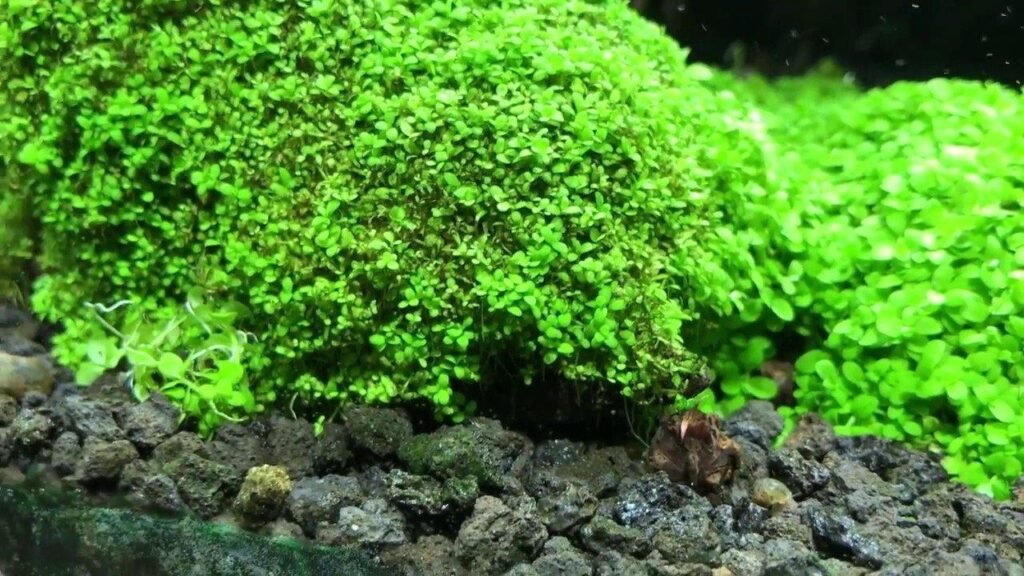
Java moss attached to aquarium hardscape
Use a thin, regularly trimmed layer of Java moss for clean texture and shelter.

5. Hydrocotyle tripartita

Hydrocotyle tripartita has small, clover-like leaves and a lively growth pattern. It can be allowed to creep through the foreground, cascade over rocks, or form a loose midground mound. Moderate light and consistent fertilization support compact growth; CO2 is helpful when you want a dense, controlled shape.

Pin short runners into the substrate or tuck them around hardscape, then trim and replant the healthiest tips. Without regular pruning it can climb upward and shade slower plants.

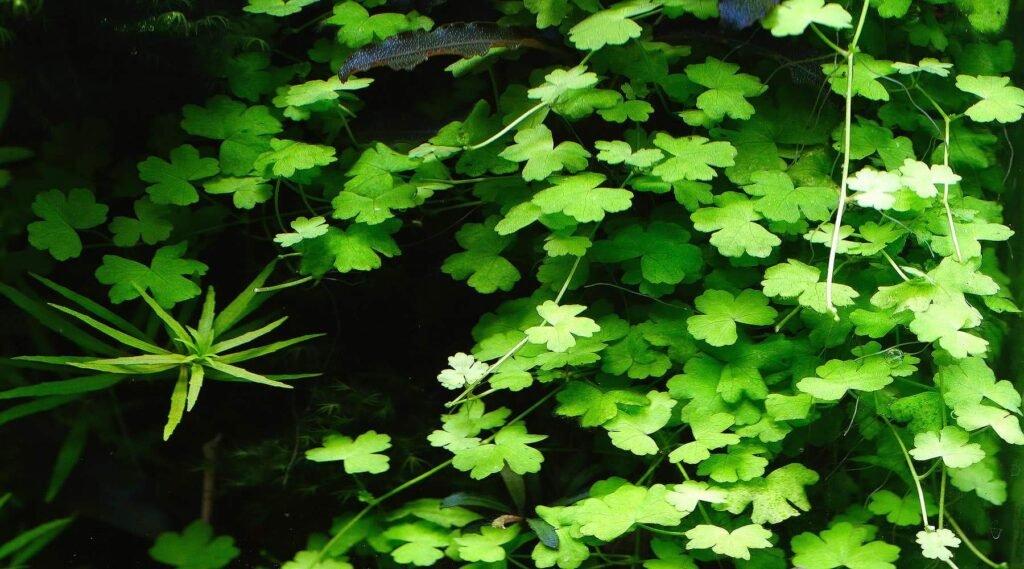
Hydrocotyle tripartita with small clover-shaped leaves
Hydrocotyle tripartita can creep, cascade, or form a bright midground mound.

6. Java fern ‘Trident’

Java fern ‘Trident’ is a narrow, branching-leaved form of Microsorum pteropus. It adds height and movement without the visual weight of broader Java fern varieties. Like Anubias, it is an epiphyte: attach it to wood or rock and do not bury the rhizome.

Low-to-medium light is adequate, and CO2 is optional. Remove damaged older leaves at the rhizome. Small plantlets may form on mature leaves; once they develop roots, they can be detached and mounted elsewhere.

Narrow branching leaves of Java fern Trident
Java fern ‘Trident’ brings fine, arching texture to wood and stone.

7. Hygrophila pinnatifida

Hygrophila pinnatifida stands out for its deeply divided leaves and warm brown-to-reddish tones under stronger light. It can root in substrate or attach to porous hardscape, sending out runners and side shoots. Use it as a focal accent rather than letting it spread everywhere.

Moderate light, balanced fertilization, and good circulation are important. Added CO2 promotes compact growth and stronger coloration. Pinching the growing tips encourages branching. For a taller, easier background option from the same genus, see our guide to Hygrophila corymbosa.

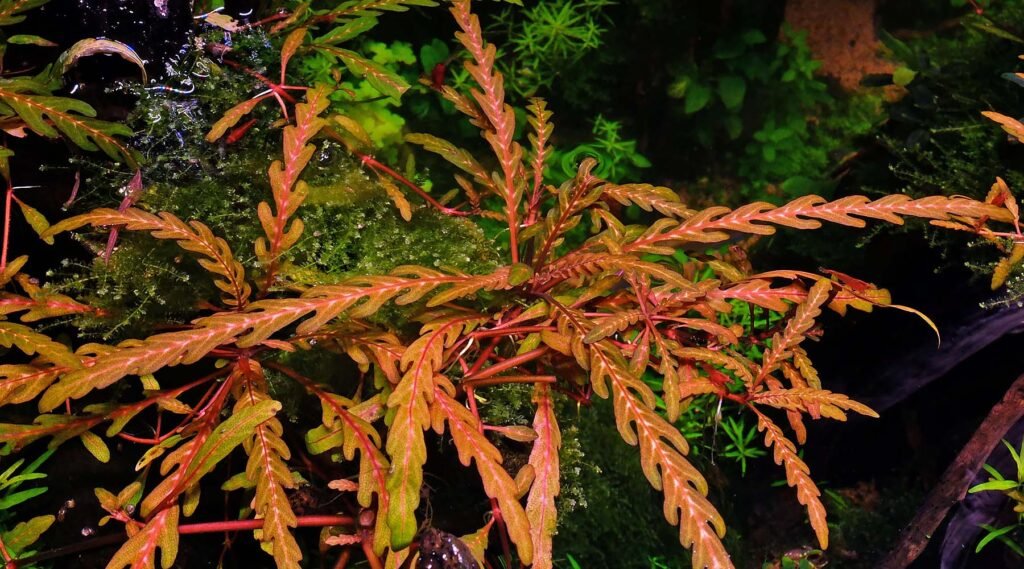
Hygrophila pinnatifida with divided brown-green leaves
Hygrophila pinnatifida makes an effective textured accent on aquarium hardscape.

8. Staurogyne repens

Staurogyne repens is a compact stem plant that bridges the foreground and midground. Its upright stems and broader green leaves contrast nicely with carpeting plants and mosses. Plant individual stems with space between them, then trim the tops to encourage low, bushy side growth.

It can survive without injected CO2, but moderate light and CO2 generally produce a fuller, more compact group. Do not allow taller plants to shade it heavily, and keep nutrients stable rather than chasing rapid growth with excessive light.

Staurogyne repens growing as a compact foreground bush
Staurogyne repens creates a strong transition between a carpet and taller midground plants.

9. Bucephalandra

Bucephalandra species and cultivars are slow-growing rhizome plants prized for their varied leaf shapes, subtle colors, and iridescent surfaces. They are ideal for adding detail to shaded rock and wood. Attach the rhizome above the substrate, just as you would with Anubias or Java fern.

Low-to-medium light is usually sufficient. CO2 is not essential, although stable CO2 and nutrients can improve growth. Because Bucephalandra grows slowly, keep lighting conservative and remove algae before it becomes established on older leaves.

Bucephalandra attached to aquarium hardscape
Slow-growing Bucephalandra adds fine detail and subtle color to hardscape.

How to plan an aquascape that grows well

Assign each plant a role

Choose low plants for the foreground, medium plants for the visual transition, and taller stems or rosettes for the background. Epiphytes belong on rock and wood. Repeating a limited number of species usually looks calmer and more intentional than planting one of everything.

Build around a focal point

Place the main rock, wood feature, or open swimming area slightly off-center—near a rule-of-thirds line is an easy starting point. Let smaller pieces and plant groups support that focal point. Leave some open space so the layout has contrast and does not become a solid wall of foliage.

Match the substrate to the roots

Root feeders such as Cryptocoryne and Staurogyne benefit from aquasoil or periodic root tabs. Epiphytes take much of their nutrition from the water column and must keep their rhizomes exposed. Wash inert sand or gravel before use, but do not rinse active aquasoil unless its manufacturer instructs you to.

Balance light, CO2, and nutrients

More light increases plant demand for CO2 and nutrients. It also increases algae risk when the other inputs are unstable. Begin with a moderate photoperiod—often six to eight hours daily—and adjust gradually. A timer keeps it consistent. If you inject CO2, use equipment designed for aquariums and maintain a stable level during the lighting period; never sacrifice fish safety for faster plant growth.

Planting and first-month care

  1. Inspect and clean plants. Remove damaged leaves, rock wool, gel, and dead roots. Quarantine when practical, especially if the plants came from tanks containing fish or snails.
  2. Plant by growth habit. Separate rooted plants into small portions, mount rhizomes above the substrate, and attach moss in a thin layer.
  3. Cycle the aquarium. Plants do not eliminate the need to establish biological filtration or monitor ammonia and nitrite before adding livestock.
  4. Keep the first weeks stable. Perform regular partial water changes, remove melting leaves, and avoid repeatedly uprooting plants that are trying to establish.
  5. Trim with a plan. Cut fast plants before they shade slow ones. Replant healthy tops where needed and remove excess growth from the aquarium.

Avoid packets sold as “aquarium carpet seeds.” Many contain terrestrial or semi-aquatic plants that germinate quickly and then decay after prolonged submersion. Buy correctly identified aquatic plants from a reputable aquarium supplier instead.

Frequently asked questions

Can I create an aquascape without CO2 injection?

Yes. Anubias, Cryptocoryne, Java moss, Java fern, and many Bucephalandra varieties can make an attractive low-tech layout. Use modest lighting, choose slower-growing plants, and accept that growth will be more gradual.

How many plant species should a beginner use?

Three to five well-matched species are enough for a convincing first layout. For example, combine Monte Carlo or a low Cryptocoryne in front, Cryptocoryne wendtii in the midground, Java fern on wood, and one taller background plant. Repetition creates unity and makes maintenance easier.

Why are my new aquarium plants melting?

Some nursery-grown plants were raised above water and must replace their old leaves with submerged growth. Transport stress, unstable CO2, damaged roots, or sudden changes in water conditions can also cause leaf loss. Remove decaying material, keep conditions stable, and watch the crown or rhizome for healthy new growth.

Final recommendation

For an easy first aquascape, begin with Anubias ‘Petite,’ Cryptocoryne wendtii, Java moss, and Java fern ‘Trident.’ Add Monte Carlo, Hydrocotyle tripartita, Hygrophila pinnatifida, or Staurogyne repens when you are ready to manage stronger light, more frequent trimming, and possibly injected CO2. The best planted aquarium is not the one with the longest plant list—it is the one whose plants share compatible needs and can be maintained consistently.

Rotala Indica Care Guide: Identification, Planting and Trimming

Rotala indica care starts with checking which plant you bought. True Rotala indica, often sold as ‘Bonsai’ or under the older trade name Ammania sp. ‘Bonsai’, has compact, upright stems and small rounded leaves. The name has also been used for Rotala rotundifolia, a different aquarium plant with different growth habits.

This guide focuses on true Rotala indica ‘Bonsai’. Confirm the supplier’s identification before applying care advice intended for another Rotala.

Rotala indica vs. Rotala rotundifolia

Dennerle’s Rotala indica profile explains the longstanding naming confusion. True indica retains closely spaced, oval to round leaves when submerged. Rotundifolia commonly develops longer, narrower underwater leaves, even though its above-water leaves can be round.

Feature Rotala indica ‘Bonsai’ Rotala rotundifolia
Underwater appearance Small rounded leaves on upright stems Usually longer, narrower leaves
Growth expectations Slow, compact growth More readily forms a bushy stem group
Typical use Trimmed foreground accent or midground group Midground or background stems

Leaf shape alone is not a guaranteed identification, especially in a newly purchased plant grown above water. Compare the grower’s label and photographs of submerged growth. Tropica’s rotundifolia profile is a useful comparison.

Care conditions for true Rotala indica

  • Temperature: Dennerle lists approximately 72–82°F.
  • Water: Dennerle lists pH 5–7 and soft to moderately hard water. Choose livestock with compatible requirements; do not abruptly alter an established aquarium to chase a number.
  • Light: Provide an unobstructed position with moderate light. Heavy shade is a poor starting point.
  • CO2: Added CO2 can support compact growth, but stable, controlled delivery matters more than maximizing the dose.
  • Placement: Leave access for trimming and space between the group and taller plants.

Tropica rates ‘Bonsai’ as a slow-growing stem plant with medium light and CO2 demand. Its listed height is roughly 2–8 inches or more, while Dennerle lists taller eventual growth. Treat height as something you manage with pruning, not a fixed limit.

How to plant it

  1. Prepare the portion. Remove the pot, packing material and any bundle weight carefully. For tissue-culture plants, follow the supplier’s directions for rinsing away the growing medium.
  2. Separate the stems. Do not bury an entire tightly packed bunch. Keep healthy leafy tops intact.
  3. Plant individually. Remove only the leaves that would sit below the substrate. Insert the lower stem gently, leaving the remaining foliage exposed.
  4. Leave growing room. Start with a small, spaced group so light can reach the lower leaves. Fill gaps later with established cuttings.

Tropica’s planting guide shows the difference between planting individual stems and other plant types. In an empty tank, shallow water makes placement easier; keep exposed plants damp while working.

Choose a substrate that holds the stems securely and plan how nutrients will be supplied. Our planted-tank substrate guide explains the options. Avoid repeatedly uprooting new stems to check for roots.

Lighting, nutrients and red tips

Lower light does not make this plant more compact: Tropica describes larger leaves and looser growth under lower light. Stronger light may bring reddish tips, but a healthy green plant is not a failure.

For a new planted setup, Tropica’s startup guide suggests six hours of light daily at first, increasing gradually toward eight hours. Use a timer and judge the response; extending the day is not a substitute for suitable light at plant level.

Use an aquarium plant fertilizer according to its label and account for the substrate and other plants. Do not add extra iron solely because leaves are pale, or deliberately starve the aquarium of nitrogen to force color. Review the whole setup before changing several inputs at once. For alternative color accents, see our red aquarium plants guide.

Trimming and propagation

Once growth is established, trim healthy tops with clean aquascaping scissors and replant suitable cuttings among the group. Keep leaves on each cutting; stripping the entire stem is unnecessary. Leave healthy rooted lower sections to produce new growth, and remove deteriorating material.

Prune to keep neighboring plants from shading the group. Because growth is slow, allow recovery between substantial trims rather than cutting to a rigid weekly schedule.

Troubleshooting before buying more equipment

  • Long gaps between leaves: check shading and light reaching the plant.
  • Loose stems: check planting depth, digging fish and the direction of filter flow.
  • Deteriorating leaves: remove decaying material and review recent changes, nutrients and growing conditions. One symptom does not identify a specific deficiency.
  • Unexpected narrow leaves and rapid growth: recheck the plant’s identity before treating it as unhealthy Bonsai.

Take a photo from the same angle each week to judge new growth. If a CO2 system is installed, prioritize animal safety and investigate any gasping promptly; our aquarium oxygenation guide covers immediate support. Never release aquarium plants or trimmings into natural waterways.

Amazon Sword Plant Care: Planting, Feeding and Pruning

Amazon Sword Plant

Amazon sword plants make impressive green focal points, but their adult size and root nutrition deserve more attention than their reputation as an easy plant. Give one enough room, keep the crown above the substrate and supply nutrients at the roots.

They can grow successfully without injected carbon dioxide (CO2). A simple planted aquarium with suitable lighting and steady maintenance is often enough; stronger lighting is not automatically better.

Amazon sword care at a glance

Care point Practical guidance
Common trade names Amazon sword; several related forms are sold under this name
Placement Background or a spacious central focal point
Adult size Often 12–20 inches tall; some forms exceed 20 inches and spread widely
Light Low to moderate aquarium lighting
Substrate Enough depth for the roots, with an appropriate nutrient source
CO2 injection Optional, not essential for a basic setup
Propagation Separate rooted plantlets produced on a stalk

Identify the plant and leave room to grow

The name Amazon sword is not a precise guarantee of size. Plants commonly labeled Echinodorus amazonicus or Echinodorus bleherae are also discussed under Echinodorus grisebachii in aquarium references. Ask the grower which form you are buying rather than relying on the small size of the plant in its pot.

Tropica’s profile of ‘Bleherae’ describes an undemanding plant that can become about 8–20 inches tall. Allow width as well as height. Our practical preference is a 20-gallon or larger aquarium for a typical full-size sword, with more space for large forms. A compact cultivar is a better choice when permanent space is limited.

Position the plant where it will not shade every smaller neighbor or block access to equipment. Compare its role with smaller species in our aquascaping plant guide.

How to plant an Amazon sword

  1. Remove the nursery basket and gently work packing material away from the roots. Rinse away loose debris and inspect for damaged tissue or unwanted hitchhikers.
  2. Choose a permanent location with space for the mature rosette. Avoid repeatedly uprooting an established plant.
  3. Make a planting hole and bury the roots. Keep the crown—the point where the leaves emerge—at or just above the substrate surface.
  4. Gently firm the surrounding substrate without burying the leaf bases.
  5. If using plain sand or gravel, add aquarium root fertilizer according to its label and keep it properly buried.

Aquarium Co-Op’s planting instructions illustrate the distinction between burying the roots and covering the crown. Sand and gravel can both work; neither supplies a complete nutrient program by itself. Our planted-tank substrate guide compares the main approaches.

Root feeding and fertilizer

A sword develops a substantial root system. Nutrient-rich planted substrate can support it, while inert or depleted substrate usually needs supplementation. Liquid fertilizer can support the wider aquarium, but do not ignore nutrition around the roots.

Follow the particular fertilizer’s dose, placement and replacement schedule. Tablet size and formulation differ, so a universal number of root tabs per month is not useful. Keep a simple record of when you fertilize and compare new leaves over time before increasing the dose.

Aquarium Co-Op’s plant-selection guide highlights the regular root-feeding needs of sword plants. Choose aquarium products appropriate for the animals you keep and use the labeled dose. Do not add iron automatically whenever a leaf changes color.

Lighting, CO2 and water conditions

Use a controllable aquarium light and start with a modest schedule, such as six to eight hours daily. Treat that as an adjustment point, not a requirement for every fixture. Increase light cautiously only when healthy growth and the rest of the setup support it.

Watts per gallon is a poor way to compare modern LED fixtures: electrical power alone does not tell you how much useful light reaches the leaves. Tank depth, shading and fixture placement also matter. Keep the light on a timer so changes are deliberate and repeatable.

No injected CO2 does not mean no carbon dioxide. Plants still use dissolved CO2 already present in the aquarium. Adding a gas system is optional and introduces another variable to manage; it is not the first response to an unhealthy leaf.

Amazon swords tolerate a range of tropical freshwater conditions. David Manthei’s species profile in Tropical Fish Hobbyist notes differences between forms, including their tolerance of harder water. Match conditions to your livestock and avoid changing pH simply to reach a supposed universal sword-plant number.

Melting, yellow leaves and holes: what to check

What you see Useful first check
Older leaves fade after planting Transition to submerged growth may be involved. Watch for new growth from a firm crown before assuming the whole plant has failed.
Continuing pale or weak new growth Review the overall nutrient supply, light and planting depth. Color alone does not identify a specific deficiency.
Holes or scraped leaf surfaces Check for physical damage and grazing, including plecos, as well as nutrient history.
Algae coating leaves Review light duration, shading and maintenance. Avoid increasing brightness as an automatic fix.
Plant repeatedly comes loose Check root anchoring and whether digging fish are disturbing it.

Remove deteriorating tissue and judge recovery by healthy new leaves. Take a weekly photo from the same angle; it makes gradual improvement easier to see than checking repeatedly through one afternoon.

Pruning and propagation

Remove damaged or oversized outer leaves near their base without cutting into the crown. Do not shear all the leaf tips to make a permanently undersized plant. Tropica’s trimming guide recommends selective removal of outer or shading leaves for Echinodorus.

A mature sword may send out a long stalk carrying daughter plants. Wait until a plantlet has its own leaves and roots, then carefully detach and plant it. A loose leaf is not a stem cutting that will reliably produce another sword.

If the parent repeatedly overwhelms the aquarium, move or rehome it and choose a smaller plant. Regular pruning can manage some shade, but it cannot change the mature growth habit you selected.

Best Aquarium Carpet Plants: 7 Choices for Your Setup

Best Aquarium Carpet Plants: 7 Choices for Your Setup

The best aquarium carpet plant is one that can spread under the light and carbon supply your tank actually provides. For a tank without injected CO₂, start by considering Marsilea hirsuta or a low mat of Java moss. For a compact, small-leaved lawn in a planted tank with stronger lighting and CO₂, Monte Carlo is a more practical starting point than demanding dwarf baby tears.

A carpet is a planting style, not a guarantee of easy care. Some plants stay short; others form a taller meadow or need frequent trimming. This guide compares seven useful choices and explains how to establish them without relying on promises of an instant, maintenance-free lawn.

Best aquarium carpet plants at a glance

Choose by growing conditions, not just the photograph on the package.
Plant Best use Main limitation
Marsilea hirsuta A lower-demand rooted carpet Leaf shape and height change after planting
Monte Carlo A compact, rounded-leaf lawn Best results need good light and added CO₂
Dwarf hairgrass ‘Mini’ A fine, grassy foreground Needs adequate light at the substrate
Dwarf sagittaria A forgiving, taller meadow Can grow much taller than its name suggests
Cryptocoryne parva A slow-growing, small-leaved foreground Slow coverage; dislikes being shaded
Java moss A mat attached to low hardscape Traps debris and needs shaping
Dwarf baby tears ‘Cuba’ A fine-textured high-tech carpet High light and CO₂ demands

1. Marsilea hirsuta: a practical low-tech starting point

Marsilea hirsuta is an aquatic fern that spreads through runners. Its relatively low light and CO₂ requirements make it a sensible choice when you want rooted foreground coverage without building a high-tech aquascape.

Do not expect every leaf to resemble a four-leaf clover. Nursery-grown plants can change considerably underwater, producing single or divided leaves. Height also varies with conditions, so leave room for a less uniform result than the very short lawn in a sales photograph.

Choose it if adaptability matters more than achieving a precise appearance quickly. Give new growth time to develop before repeatedly moving the plants.

2. Monte Carlo: a rounded-leaf carpet for a well-equipped tank

Micranthemum tweediei ‘Monte Carlo’ makes a bright green carpet with small, rounded leaves. It is generally more forgiving than dwarf baby tears, but “easier” does not mean it will form a dense lawn under any aquarium lid.

Moderate to strong light, adequate nutrients, and injected CO₂ give the most dependable compact growth. A no-CO₂ setup may support it, but coverage can be slower and less predictable. Do not buy it on the assumption that extra hours of weak light will solve that limitation.

Once established, trim before the mat becomes thick and layered. Shaded lower growth can deteriorate and allow sections to lift. Remove loose clippings instead of leaving them to collect around the filter intake.

3. Dwarf hairgrass ‘Mini’: for a fine lawn effect

Check the scientific name when shopping: “dwarf hairgrass” can refer to different plants. Tropica lists Eleocharis pusilla ‘Mini’, also encountered under older trade naming, as a short foreground option with leaves around 1–2 inches long under suitable conditions.

This is a good choice for an open grassy foreground, especially in a smaller aquascape. It still needs useful light down at substrate level; a tall tank or overhanging plants can make that difficult. Tropica rates its light and CO₂ demands as medium.

Separate the purchased clump into small plugs rather than burying one dense block. Leave exposed substrate between them so spreading growth has room to fill in.

4. Dwarf sagittaria: a meadow rather than a miniature lawn

Sagittaria subulata is a useful, comparatively undemanding runner plant. Its straplike leaves suit a natural-looking foreground in a larger aquarium.

The important caveat is size. Despite the common name, it can become several inches tall and sometimes much taller. Tropica reports growth approaching 20 inches in some conditions. It is therefore a poor choice when your design requires every leaf to remain below 2 inches.

Plant individual rosettes with their roots covered and the crown at the substrate surface. Remove unwanted daughter plants to keep a path open, or relocate taller plants toward the back.

5. Cryptocoryne parva: for patient aquarists

Cryptocoryne parva forms a small, grassy-looking foreground, but it is not a fast way to cover bare substrate. Its slow growth makes a dense initial planting useful if you want a fuller appearance sooner.

Unlike the reputation of many larger crypts, this species needs good light to develop well. Avoid placing it beneath broad leaves or a thick cover of floating plants. Keep the root zone supplied with nutrients and leave healthy plants settled while they establish.

Choose it for gradual, manageable coverage rather than a quick carpet. Remove deteriorating leaves carefully instead of uprooting the whole planting at the first sign of adjustment.

6. Java moss: a carpet alternative for hardscape

Java moss, commonly sold as Taxiphyllum barbieri, tolerates lower light and does not need a nutrient-rich substrate beneath it. Attach a thin layer to low rocks or wood for a soft green foreground.

It is not a rooted lawn. Leaving a loose ball on the bottom rarely produces a tidy carpet, and thick growth can collect food and debris. Secure it without loose loops that could catch fish, trim it into shape, and gently remove trapped waste during maintenance.

This is a useful alternative when your main aim is low greenery and shelter rather than perfectly even coverage. See our low-light aquarium plant guide for other manageable planting choices.

7. Dwarf baby tears ‘Cuba’: a demanding option

Sold as Hemianthus callitrichoides or Micranthemum callitrichoides ‘Cuba’, dwarf baby tears has exceptionally small leaves and can produce a fine-textured carpet.

It belongs in a setup that can provide strong light, added CO₂, nutrients, and circulation. It should not be presented as an easy beginner choice for every tank. If you cannot supply those conditions consistently, choose Marsilea or consider Monte Carlo with realistic expectations.

Plant small portions and maintain a thin mat through regular trimming. A lush top surface can hide declining lower growth if the carpet gets too thick.

How to plant and establish a carpet

  1. Plan the root zone. Choose substrate that holds small roots securely. Nutrient-bearing aquarium soil and inert sand or gravel are different systems; inert material may need root fertilizer as well as water-column feeding. Our planted-tank substrate guide explains the options.
  2. Prepare the plants. Rinse the growing medium from tissue-culture plants. Remove pots and packing material from potted specimens carefully, then divide the plants into manageable portions. Keep them moist while working.
  3. Plant small groups. Use tweezers to anchor roots while leaving leaves above the substrate. For many small carpeting plants, roughly 1 inch between portions is a useful starting layout, adjusted to the plant and quantity available. Attach moss to hardscape instead of burying it.
  4. Fill gently. Direct the water onto a plate or another protected surface so the flow does not wash new plugs out. In an established tank, work in sections to limit disruption.
  5. Start with a controlled light schedule. Around six hours daily is a reasonable starting point for a newly planted aquarium. Adjust gradually as growth becomes established. Duration cannot compensate for unsuitable intensity, shading, or insufficient carbon.
  6. Feed for the setup. Follow the fertilizer and substrate instructions rather than adding multiple products blindly. See our aquarium plant fertilizer guide for the difference between root and liquid feeding.

Plants do not make a new aquarium instantly ready for livestock. Complete cycling and check water quality before stocking. Choose a carpet layout that also leaves suitable feeding and resting areas for your fish.

Why a carpet fails to fill in

  • Plugs float up: check planting depth, substrate grip, and whether fish are disturbing them. Replant carefully rather than burying all the leaves.
  • Growth reaches upward: review shading and the light reaching the bottom, but also confirm the species. Dwarf sagittaria may simply be a taller plant than your design needs.
  • Old leaves deteriorate: remove decaying material and look for healthy new growth. Nursery-grown plants may change form after submersion; ongoing decline needs a review of light, nutrition, and stability.
  • Algae covers the plants: clean gently, remove waste, and review the lighting schedule and overall balance. Longer lighting is not a general cure for slow growth.
  • A mature mat lifts: thin overgrown sections and replant healthy portions. Keeping a carpet low enough for light to reach its lower growth is part of routine care.

Buying the right plant

Buy a named live plant from a seller who identifies the species and growing form. Compare portion size, condition, shipping protection, and whether the plant is tissue cultured or nursery grown. An unidentified “water shamrock” or generic carpet listing is not enough information to predict aquarium suitability.

For a first carpet, choose one species and a modest planting area. Expand once it is producing healthy new growth. A smaller successful patch is more useful than a full foreground of plants whose requirements your tank cannot meet.

Sources and further reading

Plant requirements were checked against Tropica’s cultivation profiles. Growth and final height depend on the individual aquarium.

7 Best Floating Aquarium Plants for Beginners

Floating aquarium plants can soften bright light, create cover for fish and fry, and take up dissolved nutrients—but they grow quickly and are not legal to own or transport everywhere. The best beginner choices are Amazon frogbit, red root floater, common duckweed, water spangles, dwarf water lettuce, Azolla, and hornwort used as a free-floating submerged plant.

Always confirm the scientific name and your local biosecurity rules before buying. Never release aquarium plants, fragments, or water into drains, ponds, streams, or wetlands. Compost or seal unwanted plants according to local guidance.

Quick Comparison

Plant Growth Best feature Main caution
Amazon frogbit Moderate to fast Long hanging roots Dislikes wet leaf tops and strong flow
Red root floater Moderate Red color under suitable conditions Needs stable light and nutrients
Common duckweed Very fast Tiny leaves suit small tanks Difficult to remove completely
Water spangles Fast Textured paired leaves May be regulated; verify species
Dwarf water lettuce Fast Large rosettes and roots Often unsuitable for small covered tanks
Azolla Fast Fine fern-like surface mat Some species are prohibited
Hornwort Fast Submerged cover without planting Can shed brittle leaves

Before Adding Any Floating Plant

  • Check legality: restrictions vary by country, state, and even species within a genus.
  • Quarantine: inspect for snails, eggs, algae, duckweed hitchhikers, pesticides, and decay.
  • Protect equipment: use a floating ring or corral to keep plants away from filter intakes and feeding areas.
  • Leave open surface: do not allow a solid mat to block gas exchange, feeding, or access for labyrinth fish.
  • Match light and flow: floating leaves often scorch close to strong lights and are damaged by splashing.

1. Amazon Frogbit (Limnobium laevigatum)

Amazon frogbit floating at the aquarium surface

Amazon frogbit forms round floating leaves and long branching roots that offer attractive cover. It is easier to handle than duckweed because each rosette is larger, but healthy plants can still multiply quickly.

Keep the upper leaf surfaces mostly dry, provide gentle circulation, and thin crowded plants before they overlap heavily. Long roots may need occasional trimming with clean scissors if they obstruct the tank, but never remove every root from a rosette.

2. Red Root Floater (Phyllanthus fluitans)

Red root floater leaves and roots in an aquarium

Red root floater can develop reddish leaves and roots when light, nutrition, and other conditions suit it. Color is not guaranteed, and pushing light intensity merely to force red growth can overheat or unbalance a tank.

This plant prefers calm water and consistent access to nutrients. Pale new growth may indicate a nutrient or lighting problem, but diagnose the whole aquarium before adding fertilizer. Excess fertilizer can harm livestock and encourage algae.

3. Common Duckweed (Lemna minor and Related Species)

Small duckweed fronds covering part of an aquarium surface

Duckweed is tiny, adaptable, and extremely quick to spread. It can provide shade and nutrient uptake, but it enters filter compartments, sticks to tools, and is notoriously difficult to eradicate. Choose it only if you are comfortable removing handfuls regularly.

Keep a clear feeding opening and rinse equipment over a container—not a sink. Never flush excess duckweed or discard it outdoors.

4. Water Spangles (Salvinia minima)

Water spangles Salvinia minima floating plant

Water spangles have paired, textured floating leaves and a submerged leaf that resembles roots. They make an attractive surface mat and usually tolerate a range of aquarium conditions when the surface is calm.

Correct identification is essential. The Salvinia genus includes highly invasive and regulated species, and plants can be mislabeled or mixed in trade. Do not order or transport any Salvinia until local authorities confirm it is permitted.

5. Dwarf Water Lettuce (Pistia stratiotes)

Dwarf water lettuce forms velvety rosettes with long roots. Despite the trade name, it is the same species as larger water lettuce and size depends strongly on conditions. It can outgrow small tanks and may struggle when condensation repeatedly wets the leaves under a close-fitting lid.

Pistia stratiotes is invasive or prohibited in various regions. Buy only from a legal local source, keep it fully contained, and dispose of trimmings securely.

6. Azolla or Mosquito Fern (Azolla Species)

Azolla mosquito fern forming a floating surface mat

Azolla is a tiny floating fern that can shift from green toward red or bronze in response to conditions. Its delicate branching mats provide shade but break into small pieces during maintenance and spread rapidly.

Confirm the exact species. Some Azolla species are regulated weeds, and common names are unreliable. Treat every fragment as live material when disposing of it.

7. Hornwort (Ceratophyllum demersum)

Hornwort stems growing free-floating below the water surface

Hornwort is different from the surface plants above: its stems float below the water rather than carrying leaves in air. It provides dense submerged cover without substrate and can be useful for fry or shrimp tanks.

Growth can be fast, and stressed stems may shed needle-like leaves that collect around filters and décor. Thin it from the base of the mass so the remaining stems receive light and flow. Check local rules because it can behave invasively outside its native range.

Plants Commonly Misclassified as Floaters

Java moss, water wisteria, and Cabomba can survive unattached or drift temporarily, but they are not true free-floating surface plants. Java moss normally performs better attached to wood or rock. Water wisteria and Cabomba are stem plants that usually grow more predictably when planted or deliberately anchored. Calling every unplanted stem a floating plant makes care advice confusing.

How to Quarantine New Plants

  1. Confirm the scientific name and legal status before purchase.
  2. Place new plants in a separate, fish-free container with suitable light and temperature.
  3. Inspect leaves and roots for snails, eggs, insects, algae, and damage.
  4. Remove packing material and rinse with conditioned water.
  5. Observe long enough to detect hitchhikers or pesticide damage before introducing plants to sensitive shrimp or fish.

Do not use bleach, alum, copper, or pesticides casually. Concentrations, exposure times, and plant tolerance vary, and residues can harm invertebrates. Physical inspection and quarantine are safer starting points.

Managing Surface Coverage

Aim for a patchy surface with open areas for feeding, gas exchange, and light to submerged plants. There is no universal percentage because fish behavior, lighting, filtration, and plant density differ. Thin plants when they stack, block equipment, trap excessive debris, or cause shaded plants below to decline.

Floating corrals made from airline tubing can preserve openings around the filter and feeding zone. During water changes, remove excess plants first so fragments do not enter drains.

Do Floating Plants Remove Nitrate?

Growing plants take up nitrogen and other nutrients, and removing harvested plant mass exports some of those nutrients from the aquarium. They do not replace a cycled filter, testing, appropriate stocking, or water changes. If ammonia or nitrite is detectable, address the cause immediately instead of adding plants as a cure.

Frequently Asked Questions

Why are my floating plants turning yellow?

Possible causes include inadequate or imbalanced nutrients, overly intense light, wet leaf tops, strong flow, temperature stress, or newly imported plants adjusting. Test water and change one factor at a time.

Are floating plants good for bettas?

They can provide shade and cover, but leave open access to the surface because bettas breathe atmospheric air. Avoid a dense mat and keep plants away from the filter return.

Can floating plants stop algae?

They may compete for light and nutrients, but they are not a guaranteed algae treatment. Control excess light, feeding, waste, and unstable maintenance as well.

Can I throw excess plants in the garden?

Not safely in every climate. Fragments may reach waterways through rain or drainage. Follow local invasive-species disposal guidance; sealed household waste or thoroughly dried material may be required.

Best Choice for Beginners

Amazon frogbit is a manageable first choice where it is legal and the tank has gentle flow. Red root floater suits keepers willing to provide more consistent light and nutrition. Duckweed is easy to grow but hard to remove. Whichever plant you choose, verify its identity, quarantine it, keep part of the surface open, and dispose of every trimming responsibly.

Continue with our guides to aquascaping plants, cold-water aquarium plants, and low-light aquarium plants.

Biosecurity Sources