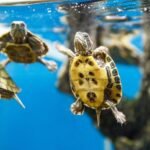
A 10-gallon tank is not a suitable long-term home for a red-eared slider or the other commonly kept aquatic turtles discussed here. A tiny hatchling fitting inside it does not make it a sound adult-housing plan. Buy for the species’ expected adult needs, including swimming space and a dry basking area.
If you already have a turtle in a ten-gallon aquarium, use this guide to plan an upgrade. Do not rely on a promise that the tank will last a year: growth, species, health and the layout determine when housing becomes inadequate.
Why ten gallons is misleading
The capacity printed on an aquarium assumes a full container. A turtle setup may hold substantially less water because it needs escape clearance and a dry area. Rocks and equipment also take up space. The useful swimming footprint matters as much as the nominal volume.
A large filter cannot create swimming room, and a small floating dock is not automatically a usable basking platform. Before buying a kit, ask whether an adult turtle could turn, swim, surface and climb out comfortably in the completed layout.
How much space should you plan for?
VCA’s aquatic turtle housing guidance, using red-eared sliders as its example, describes 10 gallons of water per inch of shell length as one planning guideline, alongside adequate swimming dimensions and a dry basking zone. This refers to water volume, not simply the aquarium’s label.
Under that guideline, a turtle with a 6-inch shell suggests roughly 60 gallons of water before allowing for the rest of the enclosure. It is a planning example, not a guarantee that every six-inch turtle belongs in the same setup. Confirm species, adult size and swimming ability with a reptile veterinarian.
MedVet’s aquatic turtle guide gives a 40–55-gallon enclosure example for a five-inch turtle. Both references illustrate why a ten-gallon starter tank should not be treated as a lasting solution.
Identify the turtle before deciding water depth
Red-eared sliders are not interchangeable with every turtle sold as a pet. Species differ in swimming ability, preferred habitat and adult size. A box turtle or tortoise needs a different housing approach altogether.
Do not automatically fill a deeper tank to the top when moving a weak, sick or unfamiliar turtle. Get species-specific guidance, provide secure access to the surface and avoid gaps where the animal could become trapped. An enclosure should prevent escape without blocking necessary ventilation.
What the replacement enclosure needs
- Usable swimming space: sufficient length, width and appropriate depth for the individual.
- A stable dry basking area: the turtle must be able to climb out and dry completely.
- Suitable heat and UVB: these serve different functions; a decorative LED does not replace either.
- Effective filtration: chosen for the actual water volume and the turtle’s waste load.
- Safe construction: a support rated for the filled enclosure, secured equipment and no swallowable gravel or unstable rock piles.
Plan the whole enclosure before buying accessories. A cheap kit is not a saving if its tank, dock and lighting all need replacing immediately.
Heating and lighting: measure, don’t guess
MedVet lists adult aquatic-turtle water temperatures of about 75–80°F and a basking area around 85–90°F in its general guide. Treat these as reference points to discuss for the species and age you keep, not universal settings for every turtle. Measure water and basking temperatures separately.
Use reptile UVB equipment with positioning and replacement intervals appropriate to the product and animal. Ordinary glass between a UVB lamp and the turtle interferes with useful exposure. Follow the lamp’s distance, fixture and screen guidance rather than assuming one bulb strength or one mounting distance fits every enclosure. Provide a normal dark period instead of decorative colored lighting all night.
If your turtle is currently in a ten-gallon tank
- Confirm its identity and shell length. Arrange a reptile veterinary visit if the species or health is uncertain.
- Assess the immediate setup. Check water quality, measured temperatures, basking access and whether the turtle can move safely.
- Arrange appropriate larger housing promptly. A purpose-built enclosure or a suitable water-safe stock tank may be an option when a glass aquarium is impractical.
- Prepare equipment before moving the turtle. Check the filter, temperature controls, dry area and escape prevention.
- Seek responsible rehoming help if necessary. Contact a reptile rescue or veterinarian rather than releasing the animal outdoors.
Temporary medical or emergency housing should follow the veterinarian’s instructions. It is not an exception that makes a ten-gallon tank a recommended purchase for permanent care.
Keep water clean without destroying the filter
Remove uneaten food and waste promptly, test the water and adjust partial water changes to the actual conditions. Prepare replacement water appropriately and avoid abrupt temperature changes. A filter reduces the maintenance burden but does not eliminate it.
Do not routinely discard all biological filter media or scrub an occupied setup with household soap. Preserve established media during normal servicing and follow equipment instructions. Disinfection after disease requires a separate plan. Our filtration explanation covers the shared principle of biological waste processing; it is not a turtle-specific stocking formula. The rock-cleaning guide explains gentle routine cleaning and why unknown materials deserve caution.
US turtle ownership and hygiene
The FDA states that turtles with shells under four inches cannot be sold as pets in the United States. A tiny animal offered for sale is not evidence that a tiny aquarium is appropriate.
Healthy-looking turtles can carry Salmonella. Wash hands after contact with the turtle, its water or equipment; keep turtle supplies out of food-preparation areas and use dedicated cleaning equipment. Follow the FDA’s advice on protecting young children and other people at greater risk.
Choose the habitat before the turtle
Budget for adult housing, ongoing electricity, filtration, UVB replacement, food and veterinary care. Ten gallons may be useful for other aquarium projects, but it should not dictate which turtle you bring home. For general water and equipment concepts, see our aquarium basics hub, alongside a species-specific reptile care plan.
This research-based guide focuses on housing decisions. It does not claim personal testing of turtle kits or replace an examination of an unwell turtle.