Disclosure: Aquarium Hunter may earn a commission from qualifying Amazon purchases made through links on this page, at no extra cost to you.
A refugium light has one main job: grow macroalgae reliably in a small, humid space. The best choice depends less on headline wattage than on the refugium footprint, mounting distance, spectrum, heat management, and how much control you want.
For most dedicated refugiums, the Kessil H160 Tuna Flora is our top premium choice because its spectrum and controls are designed for plant and algae growth. Smaller chambers can often use a compact rear-mounted light such as the Innovative Marine ChaetoMax, while budget clamp lights can suit simple setups when carefully positioned.
Quick comparison
| Refugium light | Best for | Mounting style |
|---|---|---|
| Kessil H160 Tuna Flora | Best overall / larger refugiums | Overhead; mount sold separately |
| Innovative Marine ChaetoMax | All-in-one rear chambers | External bracket or hook-and-loop mounting |
| JBJ Nano Glo | Compact refugiums | Magnetic external mounting |
| NICREW Clip-On | Budget clamp-light setups | Adjustable clamp |
| Lominie LED | Flexible positioning and dimming | Gooseneck clamp |
Best refugium light reviews
1. Kessil H160 Tuna Flora — Best overall
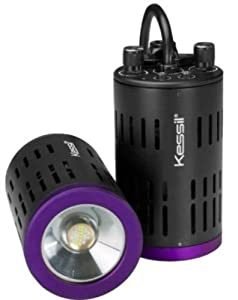
The H160 is a purpose-built horticultural fixture with four tunable spectrum positions—Blue, Grow, Bloom, and Red. Kessil states that its output spans wavelengths from 380 to 780 nm and includes UV-A and far-red chips. That makes it a strong option for aquarists who want more control than a basic white or red grow lamp provides.
Its concentrated output is most useful over a medium or larger refugium where you can adjust mounting height. Start conservatively: intense light placed too close can pale or bleach macroalgae. A suitable gooseneck or hanging mount and a timer should be included in your budget.
Pros: dedicated grow spectrum; adjustable intensity and spectrum; strong, compact output.
Cons: premium price; mounting hardware may be separate; can be excessive for a tiny chamber.
Check price on Amazon View manufacturer specifications
2. Innovative Marine ChaetoMax — Best for all-in-one rear chambers

The ChaetoMax is designed for compact refugium compartments, particularly the rear chambers found in all-in-one aquariums. Its slim shape lets the light sit outside the chamber rather than taking up valuable water volume. This design also keeps the electrical fixture out of the water.
It is a practical match for a shallow, narrow chamber holding chaetomorpha. Measure the illuminated window before buying: a small panel will not spread light evenly across a broad sump refugium.
Pros: slim profile; purpose-built for compact macroalgae chambers; simple external positioning.
Cons: limited coverage; chamber compatibility must be checked carefully.
3. JBJ Nano Glo — Best magnetic compact light
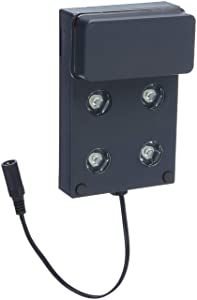
The JBJ Nano Glo is another space-saving option for a small refugium. Its magnetic mounting system allows the lamp to sit against the outside of a clear chamber wall, keeping the wet side uncluttered. The compact four-LED format is intended for a small target area rather than a full-size sump.
Confirm that the chamber wall and surrounding clearance suit the magnetic mount. Clean salt creep from the outside surface regularly because deposits can reduce usable light and trap moisture around equipment.
Pros: compact; tidy magnetic mounting; little obstruction inside the chamber.
Cons: small coverage area; less adjustable than an overhead fixture.
4. NICREW Clip-On LED — Best budget clamp option
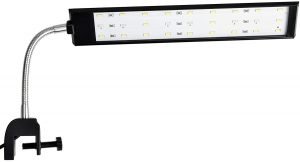
This adjustable clip-on light can be useful when a simple bracket fits the sump rim and the refugium needs modest coverage. The flexible arm makes it easier to aim the beam than a fixed rear-chamber panel.
Because this is a general aquarium light rather than the most specialized macroalgae fixture in this list, results depend heavily on distance, photoperiod, and the size of the algae bed. It is best for a modest budget setup, not as a guaranteed substitute for a high-output horticultural light.
Pros: affordable; flexible positioning; easy to remove for maintenance.
Cons: general-purpose spectrum; clamp compatibility varies; lower output than premium options.
5. Lominie LED Aquarium Light — Best for flexible positioning
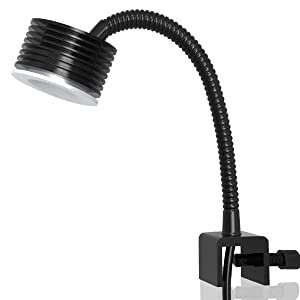
The Lominie’s gooseneck and dimming control make it easier to adjust intensity and beam position over an open refugium. This is valuable when you are acclimating a new ball of chaetomorpha or trying to avoid spilling bright light into the cabinet.
Check the exact model and spectrum on the listing before ordering, as Lominie sells several visually similar aquarium lights. Choose a plant-oriented spectrum for macroalgae rather than a coral-blue model.
Pros: adjustable arm; dimmable; compact form.
Cons: model variants can be confusing; clamp needs a secure, dry mounting point.
How to choose a refugium light
Match the light to the footprint
Measure the actual algae-growing area, not the total sump volume. A small chamber needs focused, modest output; a broad algae bed benefits from wider, more even coverage. Also check clearance for the fixture, mount, cables, and access during maintenance.
Use a plant-friendly spectrum
Macroalgae use photosynthetically active radiation, but spectrum and intensity both matter. Purpose-built refugium lights usually emphasize red and blue wavelengths. A balanced grow spectrum is generally more useful than decorative moonlight alone.
Control intensity and photoperiod
More light is not automatically better. Begin with a moderate schedule—often around 8 to 12 hours—and adjust according to growth, colour, nutrient readings, and temperature. Many reef keepers run the refugium on a reverse schedule, lighting it while the display lights are off. This can help moderate overnight pH movement, but it will not guarantee stable pH.
Remember that light is only one input
Chaetomorpha also needs suitable water movement and available nutrients. If nitrate or phosphate becomes extremely limited, adding light may not improve growth. Harvest algae regularly so the centre does not become shaded or collect detritus.
Prioritize electrical safety
Use a drip loop, keep plugs and controllers away from splash and salt creep, and connect aquarium equipment to a GFCI/RCD-protected outlet. Never submerge a fixture unless the manufacturer explicitly identifies that exact model for submerged use.
Frequently asked questions
Does a refugium need its own light?
Yes, if you expect it to grow macroalgae or plants. Light from the display tank is rarely positioned or strong enough to illuminate a separate sump chamber effectively.
Should a refugium light run 24 hours?
Continuous lighting is usually unnecessary and may stress some macroalgae. A daily dark period is a sensible starting point. Monitor the algae and the aquarium’s nutrient and pH trends, then adjust gradually.
Can a refugium replace other filtration?
No. A healthy refugium can export nutrients when algae is harvested, but it does not replace appropriate mechanical filtration, biological filtration, water changes, testing, or good feeding practices.
Final verdict
The Kessil H160 Tuna Flora is the strongest all-round choice here for aquarists who want a dedicated, controllable grow light. For a compact all-in-one aquarium, the Innovative Marine ChaetoMax is easier to fit, while the JBJ Nano Glo offers a tidy magnetic alternative. Whichever light you choose, match it to the chamber dimensions and adjust the schedule based on actual algae growth rather than leaving it at maximum power.