Best Freshwater Aquarium Fish: 8 Practical Choices

Best Freshwater Aquarium Fish: 8 Practical Choices

The best freshwater fish for an aquarium are not simply the brightest fish in a shop. A good choice must fit the tank’s footprint, temperature and water chemistry, and social species need enough companions. This guide gives eight practical starting points with published care ranges so you can build a compatible plan rather than buy fish one at a time.

Before buying: cycle the aquarium, test ammonia and nitrite, and compare the adult needs of every species. The minimums below are starting points for a correctly maintained tank, not permission to crowd several groups together.

Quick comparison

Fish Suggested minimum footprint Temperature Social need Best fit
Betta 45 × 30 cm 22–30°C Usually kept singly Planted, gentle-flow tank
Harlequin rasbora 60 × 30 cm 21–28°C 8–10 or more Peaceful tropical community
Zebra danio 90 × 30 cm 18–25°C 8–10 or more Long, active cooler aquarium
Bronze cory 80 × 30 cm 21–27°C Group Peaceful tank with fine substrate
Ember tetra 45 × 30 cm 20–28°C Group Quiet planted aquarium
Platy 60 × 30 cm 20–26°C Social livebearer Moderately hard or hard water
Guppy 45 × 30 cm 17–28°C Social livebearer Moderately hard or hard water
Kuhli loach 60 × 30 cm 21–26°C Group Soft sand, cover and subdued light

Footprints and ranges are species-specific reference values. Stocking capacity also depends on filtration, aquarium maturity, layout and the other inhabitants.

1. Betta: a single centrepiece fish

Domestic Betta splendens suit aquarists who want one conspicuous fish rather than a busy community. A planted aquarium with gentle filtration, surface cover and a secure lid suits their behaviour. Long-finned varieties should not be placed with fin-nipping tankmates, and two males must not share a tank.

The published reference footprint is 45 × 30 cm, with a broad 22–30°C temperature range. That is very different from a cup or unfiltered bowl. A heater may be necessary where room temperature is unstable. Read our betta care guidance before choosing tankmates.

2. Harlequin rasbora: a calm tropical shoal

Harlequin rasboras are peaceful mid-water fish whose copper bodies and dark wedge markings look best in a proper group. Keep at least 8–10, provide plants and shaded areas, and leave open swimming space. Their reference range is 21–28°C and pH 5.0–7.5, making captive-bred fish suitable for many established tropical community tanks.

A 60 × 30 cm footprint is the smallest published starting point. Choose similarly peaceful companions that cannot swallow them.

3. Zebra danio: active fish for a longer tank

Zebra danios are often described as easy, but their constant swimming makes tank length important. A group of at least 8–10 reduces nervousness and lets their social behaviour develop. The published footprint is 90 × 30 cm, larger than many buyers expect for a 5 cm fish.

The 18–25°C maintenance range can suit an unheated aquarium in a stable room. Avoid combining them with slow, long-finned fish simply because both species tolerate the same pH.

4. Bronze cory: a bottom forager, not a cleaner

Bronze cories are peaceful armoured catfish that forage along the bottom. They still need their own sinking food; they do not live on waste and should never be purchased as a substitute for maintenance. Keep a group over fine sand or very smooth, clean gravel and provide shaded cover.

The reference footprint is 80 × 30 cm, with a temperature range of 21–27°C. Match them with fish that will not monopolise every meal before food reaches the substrate.

5. Ember tetra: a tiny fish for a quiet planted tank

Ember tetras reach only about 2 cm standard length, but they remain social fish and need companions of their own species. Their small mouths require suitably sized food. Plants, floating cover and gentle filtration help them feel secure and display their orange colour.

The published starting footprint is 45 × 30 cm, with temperatures of 20–28°C and pH 5.0–7.0. Do not house them with fish large enough to treat them as prey.

6. Platy: a colourful choice for harder water

Platies are peaceful livebearers that suit moderately hard or hard water. They are a poor choice for a soft, acidic aquarium even though they may survive there temporarily. A planted 60 × 30 cm tank is a sensible starting point, with a published range of 20–26°C and pH 7.0–8.2.

Males can persistently court females, so mixed groups need more females than males and enough cover. Expect fry when both sexes are present; do not rely on a shop to take unwanted young.

7. Guppy: attractive, prolific and water-dependent

Guppies are adaptable feeders and widely sold, but modern ornamental strains vary in robustness. They do best in moderately hard or harder water, with a published pH range of 7.0–8.5. Avoid aggressive fin nippers and strong current, especially with large-tailed varieties.

A 45 × 30 cm footprint is a published starting point. Mixed-sex groups reproduce quickly, so plan the sex ratio and future capacity before purchase.

8. Kuhli loach: peaceful but not a beginner impulse buy

The common aquarium “kuhli” is often Pangio semicincta or a related species. These loaches need companions, soft sand for digging, abundant cover, subdued lighting and a tightly fitted lid. Protect filter intakes because slender fish can enter small openings.

The reference footprint is 60 × 30 cm and the published range is 21–26°C. Feed sinking foods after lights dim so the loaches are not expected to survive on scraps. See our detailed kuhli loach care guide.

How to choose among these fish

  1. Test the source water. Guppies and platies favour harder, alkaline conditions; ember tetras and kuhli loaches are better candidates for softer water.
  2. Measure the tank footprint. Active zebra danios need more length than their body size suggests.
  3. Choose one social plan. Budget space for the whole shoal or group before adding a centrepiece fish.
  4. Compare temperature overlap. A shared temperature does not prove that temperament, flow, substrate and water hardness are compatible.
  5. Quarantine new arrivals. Observe appetite, breathing and external signs before introducing fish to an established aquarium.

Fish omitted for good reason

Goldfish, oscars and angelfish are popular, but they are not interchangeable beginner community fish. Goldfish need substantial cool-water space and filtration. Oscars become large, powerful cichlids with heavy waste output. Angelfish are cichlids whose size and territorial behaviour require a purpose-planned aquarium. A short “best fish” list should not disguise those commitments.

Sources

5 Best Guppy Foods for Color, Growth and Healthy Fish

5 Best Guppy Foods for Color, Growth and Healthy Fish

Guppies are energetic omnivores with tiny mouths, so the best food combines animal and plant ingredients in a size they can eat easily. A complete staple should do most of the work, while a little variety can support good condition and natural colour. Food cannot compensate for poor water quality or genetics, and overfeeding is a much greater risk than offering too little.

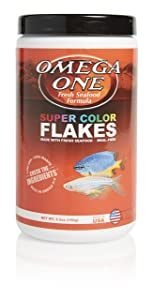
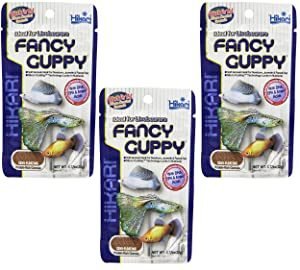
Our top pick is Hikari Fancy Guppy. Its very small, slowly sinking granules are made specifically for guppies and other livebearers. Omega One Super Color Flakes are an excellent flake alternative, while NorthFin Community is our preferred micro pellet.

Disclosure: As an Amazon Associate, Aquarium Hunter earns from qualifying purchases.

Quick comparison

Food Best for Format
Hikari Fancy Guppy Best overall Very small, slow-sinking granule
Omega One Super Color Flakes Best flakes for colour Flake
NorthFin Community 0.5 mm Best micro pellet Slow-sinking pellet
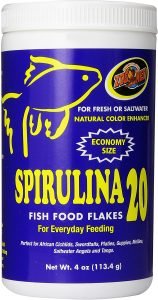
Zoo Med Spirulina 20 Best plant-rich rotation food Flake
New Life Spectrum Optimum Flakes Best for community tanks Flake

Best guppy foods reviewed

1. Hikari Fancy Guppy — Best overall

Hikari Fancy Guppy fish food

Hikari designed this food for guppies and other livebearers. The semi-floating granules absorb water and soften without quickly disintegrating, giving surface-feeding guppies time to find them. The tiny particle size also reduces the need to crush the food for adults.

The official analysis lists 50% crude protein and 8% crude fat. The formula includes colour-enhancing ingredients, seaweed as an iodine source and stabilised vitamin C. That makes it a strong everyday staple, although we still recommend occasional variety rather than relying on any single food forever.

Best for: owners who want a purpose-made guppy staple with a very small particle size.

Check price on Amazon

See manufacturer specifications

2. Omega One Super Color Flakes — Best flakes for colour

Omega One Super Color Flakes

Omega One Super Color Flakes use salmon and whole herring, with salmon skins supplying naturally occurring pigments. Flakes are convenient for guppies because they remain near the surface and can be rubbed between clean fingers for smaller fish.

The manufacturer lists 42% crude protein and 12% crude fat. This is a rich food, so use a small pinch rather than a cloud of flakes. It is a particularly good choice when you keep different sizes of guppies and want a food that is easy to crumble.

Best for: easy portioning and supporting natural colour through a quality flake diet.

Check price on Amazon

See manufacturer specifications

3. NorthFin Community Formula 0.5 mm — Best micro pellet

NorthFin Community Formula micro pellets

NorthFin Community combines krill, herring and sardine with kelp, spirulina and garlic. Its 0.5 mm version is much more suitable for adult guppies than standard-sized pellets, and the slow-sinking format lets fish feed through the upper water column.

The official analysis lists 40% crude protein and 5% crude fat. Add only a few pellets at a time: even small pellets can reach the bottom if too much is dropped in at once.

Best for: aquarists who prefer a measured micro pellet for a mixed freshwater community.

Check price on Amazon

See manufacturer specifications

4. Zoo Med Spirulina 20 Flakes — Best plant-rich rotation food

Zoo Med Spirulina 20 fish food flakes

This flake contains 20% spirulina alongside salmon meal and is labelled for daily use with freshwater and marine fish, including guppies. The plant-rich recipe makes it a useful way to add variety to an omnivorous guppy’s diet.

Its guaranteed analysis lists 45% crude protein and 4% crude fat. Crush the flakes to an appropriate size, and rotate them with a balanced guppy or community staple.

Best for: adding spirulina and variety without preparing fresh vegetables.

Check price on Amazon

See manufacturer specifications

5. New Life Spectrum Optimum Flakes — Best for community tanks

New Life Spectrum Optimum fish food flakes

New Life Spectrum Optimum Flakes are a practical general tropical food when guppies share their aquarium with other small community fish. The flakes can be crushed for tiny mouths and spread across the surface so less assertive fish get a chance to feed.

This is our broad community option rather than a guppy-specific formula. Watch how every species responds, offer only a small amount, and supplement thoughtfully if a tank mate has specialised dietary needs.

Best for: convenient feeding in a peaceful mixed tropical aquarium.

Check price on Amazon

How to choose food for guppies

Use a complete staple

Choose a food intended as a complete diet for small tropical omnivores. A sensible ingredient list includes recognisable aquatic proteins plus plant material such as spirulina or kelp. Marketing words such as “premium” matter less than an appropriate particle size, a balanced formula and food your fish actually eat.

Match the particle size

Guppies have small, upturned mouths. Fine flakes and roughly 0.5 mm granules are easier to manage than large pellets. Crush flakes or pellets when needed, especially for juveniles. If fish repeatedly spit food out, the pieces may be too large or hard.

Colour food has limits

Ingredients containing natural pigments can support normal colour, but no food can rewrite genetics. Strong colour also depends on low stress, stable water conditions and overall health. Be wary of dramatic promises or treating colour enhancement as more important than balanced nutrition.

How much and how often should guppies eat?

Feed adult guppies one or two small meals per day. Offer only what the group can finish quickly, ideally within about a minute, then remove obvious leftovers. Manufacturer directions can be broader, but the right amount depends on fish size, temperature, stocking and how much natural grazing is available.

Uneaten food breaks down and can contribute to ammonia and nitrate. If food regularly reaches the substrate, reduce the portion. Monitor body condition rather than responding to begging; healthy guppies are enthusiastic feeders even when they do not need more.

Fry need much smaller food and more frequent tiny meals because they are growing rapidly. A powdered fry food or finely crushed quality flake can work. Keep portions controlled and maintain excellent water quality, because frequent feeding also creates more waste.

Should guppies have treats?

Small amounts of frozen or cultured foods such as brine shrimp or daphnia can add enrichment and variety. Thaw frozen food in a separate container and add only a little. Avoid wild-collected live foods because they may introduce parasites or pollutants. Freeze-dried foods should be a supplement, not the whole diet.

Do not feed bread, seasoned human food or fatty mammal meat. These are not appropriate substitutes for a formulated tropical fish diet.

Storage and freshness

Buy a container your fish will finish while it is fresh. Keep the lid tightly closed and store food in a cool, dry place away from aquarium humidity and direct sun. Discard food that smells rancid, has become damp or shows mould. Using a small daily container can prevent repeatedly exposing the main supply to moisture.

Frequently asked questions

Are flakes or pellets better for guppies?

Both can work. Flakes are easy to crush and remain available at the surface; micro pellets make portions easier to measure. The best choice is a complete formula in a size your guppies swallow comfortably.

Can guppies eat betta food?

An occasional small amount is unlikely to be a problem, but betta foods are designed for more carnivorous fish. Guppies do better with a balanced omnivore staple containing both aquatic protein and plant ingredients.

Why is my guppy spitting food out?

The particle may be too large or hard, or the food may be unfamiliar. Crush it smaller and watch the fish closely. Persistent refusal to eat, especially with hiding, weight loss or abnormal swimming, can indicate stress or illness rather than a food preference.

Our verdict

Hikari Fancy Guppy is our best overall choice because its tiny, slowly sinking granules suit guppy feeding behaviour and its formula is designed for livebearers. Choose Omega One Super Color Flakes if you prefer an easily crushed flake, or NorthFin Community 0.5 mm for a measured micro pellet. Whichever food you choose, small portions, sensible variety and clean water will make the biggest difference.