Best Aquarium Media Reactors: 4 Current Options

Best Aquarium Media Reactors: 4 Current Options

A media reactor can make activated carbon, granular ferric oxide (GFO) and certain specialty media work more evenly than a passive media bag. It is not essential for every aquarium, however, and the best model depends on the media, required flow, available space and whether you need an included pump.

Aquarium media reactor used for controlled chemical filtration
A reactor should be selected and adjusted for the specific media—not simply run at maximum flow.
Quick recommendation: The Two Little Fishies PhosBan Reactor 150 is the strongest general-purpose choice because it is current, widely supported and easy to regulate. Choose the AQUATOP MR-20 when you specifically want a pump included.

Quick comparison

Reactor Best for Pump Buying option
PhosBan Reactor 150 Best all-round value Separate pump required Check on Amazon
AquaMaxx FR-SE Flexible hang-on use Separate pump required Check on Amazon
AQUATOP MR-20 Complete compact package 95 GPH pump included Check on Amazon
Innovative Marine MiniMax Pro Compatible all-in-one aquariums Integrated model-specific design View manufacturer

Listings and package contents can change. Confirm the exact model, included fittings and pump requirements before ordering.

1. Two Little Fishies PhosBan Reactor 150

Best for: a proven, adjustable reactor for GFO or carbon.

The PhosBan Reactor 150 uses bottom-to-top flow to distribute water through the media and reduce channeling. The manufacturer rates one reactor for aquariums up to 150 gallons, with a maximum of 200 grams or 385 ml of PhosBan. Those figures are limits, not universal dosing instructions: always begin with the media manufacturer’s dosage for your actual water volume.

A pump and hose are not included. Two Little Fishies recommends a pump in the 100–200 GPH range, then restricting the inlet with the supplied valve to achieve the much lower flow required by GFO. Never restrict the outlet, as that can pressurize the chamber and cause leaks.

Check the PhosBan Reactor on Amazon   Manufacturer details

2. AquaMaxx FR-SE External Media Reactor

Best for: flexible hang-on installation and higher media capacity.

The FR-SE has a 3.2-inch chamber, stands about 14.6 inches tall and holds up to one liter of media. Its bracket accommodates aquarium rims up to 3/4 inch. AquaMaxx describes it for carbon, GFO and biopellets, but these media require different quantities and flow patterns; empty and clean the reactor before changing roles.

The pump and tubing are sold separately. An adjustable pump or an inlet valve is important because suitable flow depends on the media and amount used.

Check the AquaMaxx FR-SE on Amazon   Manufacturer specifications

3. AQUATOP MR-20 Media Reactor

Best for: a compact package with its own pump and plumbing.

The MR-20 includes a 95 GPH submersible pump, intake and output tubing, a tank hook and suction cups. Its chamber is approximately 2.4 inches in diameter and 15 inches high. It can hang on the aquarium or operate in a sump, making it convenient when you do not want to source a separate feed pump.

AQUATOP rates it for tanks up to 20 gallons. Follow the chosen media’s dosage and motion requirements instead of assuming that the full pump output is suitable. Clean the pump, impeller and strainers regularly and disconnect power before servicing.

Check the AQUATOP MR-20 on Amazon   Manufacturer specifications

4. Innovative Marine MiniMax Pro

Best for: selected Innovative Marine all-in-one aquarium filter compartments.

The MiniMax Pro is designed to fit compatible rear filtration chambers, producing a clean installation without external plumbing. Compatibility is more important than the nominal aquarium size: measure the chamber and confirm the exact Desktop or Midsize version against the manufacturer’s list.

The manufacturer currently lists these reactors as out of stock, and an exact reliably available Amazon offer was not verified. For that reason, we link to the manufacturer rather than substitute a similarly named product.

Check current MiniMax availability

Do you need a media reactor?

A reactor is useful when controlled flow through a chemical medium will solve a measured problem. Carbon can remove discoloration and some dissolved organics; GFO can bind phosphate; and specialty resins have more specific uses. A reactor does not replace adequate biological filtration, protein skimming where appropriate, water changes or diagnosing the cause of poor water quality.

Do not add phosphate-removing media solely because algae is visible. Test phosphate with a suitable method, consider feeding and nutrient export, and reduce levels gradually. Rapid nutrient changes can stress corals and destabilize a mature reef.

How to choose the right reactor

Match the chamber to the media

GFO should usually move with only a gentle surface simmer; aggressive tumbling can grind it into dust. Carbon is normally held more firmly so granules do not abrade. Biopellets need stronger, continuous motion and dependable aeration and nutrient-export planning. Follow the media manufacturer’s instructions.

Check space and service access

Measure height, diameter, rim thickness, hose routes and the clearance needed to remove the lid. A reactor that technically fits but cannot be opened without dismantling the sump will be difficult to maintain.

Decide how it will be fed

A dedicated pump is simple to tune but adds heat, power use and another item to clean. Feeding from a return manifold saves a pump but must not compromise the aquarium’s main circulation. Use secure tubing and place the reactor where a minor leak cannot drain the aquarium.

Safe setup and maintenance

  1. Rinse or prepare the media exactly as its manufacturer directs.
  2. Keep the reactor upright and connect the inlet and outlet securely.
  3. Start at low flow and discharge the initial cloudy water into a bucket until it runs clear.
  4. Adjust only enough flow to achieve the correct motion for that medium.
  5. Check every connection for leaks and ensure the return cannot create a damaging back-siphon.
  6. Inspect sponges, tubing and the pump regularly. Clogged foam can change pressure and flow.
  7. Replace media according to test results and exhaustion—not an arbitrary calendar alone.

Frequently asked questions

Can carbon and GFO share one reactor?

They can sometimes be mixed when the manufacturer permits it, but they exhaust at different rates and prefer different motion. Separate reactors provide more control.

Can a reactor replace a filter?

No. It is normally an optional chemical-filtration component. The aquarium still needs appropriate biological and mechanical filtration and routine husbandry.

Should media tumble?

It depends on the medium. GFO generally needs only slight movement at the surface, carbon should not grind, and biopellets require more active circulation. Follow the instructions for the exact product.

Final verdict

The Two Little Fishies PhosBan Reactor 150 remains the best general-purpose choice for most aquarists who can supply a small pump. AquaMaxx offers more capacity and flexible mounting, while the AQUATOP MR-20 is convenient for a small system because its pump and plumbing are included. The MiniMax Pro is worth considering only when it matches the dimensions of a compatible all-in-one aquarium.

Affiliate disclosure: Aquarium Hunter may earn a commission from qualifying Amazon purchases, at no additional cost to you. We link only to products that match the model discussed.

Best Aquarium CO₂ Diffusers: 4 Current Options

Best co2 Diffuser

A good aquarium CO₂ diffuser produces fine bubbles at the pressure your system can reliably supply and places them where water flow can distribute dissolved gas through the planted tank. The best choice depends on tank size, working pressure, tubing, filtration and whether you want an in-tank diffuser or an external reactor.

Fine carbon dioxide bubbles from a diffuser in a planted aquarium
Fine bubbles and good circulation improve contact time, but safe CO₂ control matters more than bubble size alone.
Quick recommendation: The Aquario Neo CO₂ Diffuser L is the best general in-tank option here for a suitable pressurized system. The Fluval ceramic diffuser is intended as a replacement part for specific Fluval kits, while the sera active reactor is designed for much larger planted aquariums.

Quick comparison

Model Best for Important compatibility point Buying option
Aquario Neo Diffuser L General pressurized systems Confirm size and working pressure Check on Amazon
JARDLI Pollen Glass Value glass diffuser Fragile; includes bubble counter Check on Amazon
Fluval Ceramic Diffuser Replacement for Fluval 45 g/95 g kits Not a universal system Check on Amazon
sera flore Active Reactor 500 Large planted aquariums Water circuit or feed pump required Check on Amazon

Check the current listing for exact hose diameter, diffuser size and included parts. A diffuser does not include a complete regulated CO₂ system unless explicitly stated.

1. Aquario Neo CO₂ Diffuser L

Best for: a clean in-tank installation on a regulated pressurized system.

The Neo diffuser uses a replaceable-style ceramic membrane and a curved body that hangs over the aquarium rim. Its fine bubble pattern can work well when positioned below the filter outflow. The Large version should be chosen only where its physical size and gas demand suit the tank; smaller aquariums generally need a smaller diffuser.

Soak the ceramic as directed before first use and clean it when bubbles become uneven. Do not twist the body or force hardened tubing onto it.

Check the Aquario Neo L on Amazon

2. JARDLI Pollen Glass CO₂ Diffuser

Best for: a low-cost glass diffuser with a visible bubble counter.

This compact pollen-style diffuser combines a ceramic disc with a bubble-counting chamber. It offers a discreet appearance, but glass requires careful handling during installation and cleaning. Soften CO₂-resistant tubing in warm water before attaching it, and support the stem rather than pulling against the glass.

The bubble counter helps track repeatable settings but does not measure dissolved CO₂. Use plant response, livestock behavior and an appropriate indicator or measured pH change to tune the system conservatively.

Check the JARDLI diffuser on Amazon

3. Fluval Ceramic CO₂ Diffuser

Best for: replacing the diffuser on compatible Fluval pressurized kits.

Fluval identifies this as the genuine replacement diffuser for its 45 g and 95 g pressurized CO₂ kits. That makes it a sensible replacement part, not a universal recommendation for every regulator or large planted tank. Fluval notes that ceramic performance can decline with age and lists an expected service life of roughly three to six months.

If output falls, first check cylinder pressure, tubing, connections and the ceramic for fouling. Test connections for leakage using the system manufacturer’s safe procedure.

Check the Fluval diffuser on Amazon   Manufacturer compatibility

4. sera flore CO₂ Active Reactor 500

Best for: large planted aquariums where an external or in-line reactor is preferable.

The Active Reactor 500 mixes CO₂ with flowing water using internal rotors. sera recommends it for approximately 66–159 US gallons and specifies a water flow of at least 132 GPH. It can be integrated into an external-filter circuit or supplied by a suitable separate pump.

This is much more powerful than a small ceramic diffuser. The manufacturer’s instructions explicitly warn that CO₂ overdose can kill fish. Use a dependable regulator and fine needle valve, introduce gas gradually and never treat the rated bubble capacity as a target.

Check the sera Reactor 500 on Amazon   Manufacturer specifications

Diffuser versus in-line atomizer or reactor

An in-tank ceramic diffuser is inexpensive, easy to see and simple to move, but visible mist and algae on the disc require maintenance. An in-line atomizer keeps equipment out of the display but needs compatible pressurized tubing and filter hose connections. A reactor aims to dissolve most gas before water returns to the aquarium; it suits larger systems but adds plumbing complexity and can reduce flow.

How to choose

Use a regulated pressurized supply

Many fine-pore diffusers require more working pressure than fermentation-based DIY systems can provide consistently. Use CO₂-resistant tubing, a regulator intended for the cylinder, a precise needle valve, a check valve and secure connections. Never improvise pressure vessels or fittings.

Match size to the aquarium

An oversized disc can demand unnecessary gas, while a small diffuser may distribute poorly in a long tank. Tank length, plant mass and circulation are more useful than gallons alone. Position the diffuser low in the aquarium where the filter current carries bubbles across the planted area without blowing fish around.

Plan for cleaning

Biofilm and mineral deposits enlarge bubbles and reduce output. Follow the manufacturer’s cleaning method, rinse thoroughly and never combine cleaning chemicals. Replace damaged ceramic, brittle tubing or cracked glass.

Safe CO₂ setup

  1. Establish stable filtration, circulation and surface movement before adding CO₂.
  2. Install a check valve in the correct direction to protect the regulator from back-siphoning.
  3. Begin with a low gas rate before the lights turn on and increase only in small steps over several days.
  4. Observe fish and shrimp closely. Gasping, loss of balance, unusual hiding or crowding near the surface requires immediate action: stop CO₂ and increase aeration.
  5. Use a solenoid timer to stop injection when the lights are off. Plants do not need routine overnight injection.
  6. Keep sufficient surface agitation for oxygen exchange; do not seal the aquarium to retain gas.

How to monitor CO₂

Bubble count is useful only as a repeatable setting on one particular system. It cannot be compared reliably between different counters or tanks. A drop checker provides a delayed visual trend when used with the correct reference solution. A measured pH change from fully degassed water can offer better information, but only when understood and applied consistently. Livestock behavior always takes priority over a target color or number.

Frequently asked questions

Why are the bubbles suddenly larger?

The ceramic may be dry, dirty, aging or receiving insufficient pressure. Check for leaks and clean or replace the diffuser according to its instructions.

Should CO₂ run at night?

Generally no. Most planted aquariums stop injection before or when the lights go out because photosynthesis has stopped and oxygen becomes more important.

Can liquid carbon replace a diffuser?

So-called liquid carbon products do not supply controlled gaseous CO₂ in the same way and can harm sensitive plants or animals if misused. Treat them as separate products and follow their labels.

Final verdict

The Aquario Neo L is the best general in-tank choice here when its size matches the aquarium. JARDLI offers a budget glass alternative, while the Fluval unit is best reserved for the compatible Fluval kits. For large planted systems with suitable plumbing and careful control, the sera Active Reactor 500 provides far greater dissolving capacity.

Affiliate disclosure: Aquarium Hunter may earn a commission from qualifying Amazon purchases, at no additional cost to you. Recommendations are matched to the exact products discussed.

Best Goldfish Filters: 5 Current Options Compared

Best Goldfish Filters: 5 Current Options Compared

Goldfish need a filter with generous mechanical and biological capacity, reliable oxygenation and flow that does not exhaust the fish. They produce substantial solid waste, so choose by adult fish load and maintenance access—not only by the gallon number printed on the box.

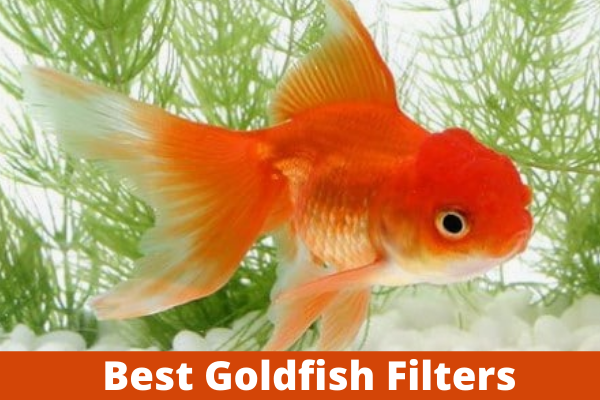
Fancy goldfish representing the need for effective aquarium filtration
Goldfish filtration must handle heavy solid waste while maintaining oxygen and comfortable swimming conditions.

Affiliate disclosure: Aquarium Hunter may earn a commission from qualifying Amazon purchases, at no extra cost to you. Buying links are included only for exact products that could be matched confidently.

Quick comparison

Filter Best suited to Main tradeoff Buying option
AquaClear 70 Reusable, customizable media Needs rear clearance and intake protection Check on Amazon
Seachem Tidal 75 Large media basket and automatic restart Strong output may need adjustment for fancy goldfish Check on Amazon
Fluval C4 Separated, serviceable filtration stages More parts to clean Check on Amazon
Tetra Whisper IQ Simple HOB filtration with flow control Cartridge dependence and modest media flexibility Check on Amazon
Hikari Bacto-Surge Large Supplemental biological filtration, quarantine and gentle flow Air pump required; limited solids removal Read review

What goldfish filtration must do

Mechanical filtration captures feces, uneaten food and suspended debris before they break down. Biological filtration provides oxygenated surfaces for bacteria that convert ammonia to nitrite and then nitrate. Surface agitation and aeration support both fish and filter bacteria.

No filter makes an aquarium maintenance-free. Water changes remove dissolved waste that media cannot, and the substrate still needs appropriate cleaning. Test ammonia, nitrite, nitrate, pH and temperature rather than judging water quality by clarity alone.

How to size a filter for goldfish

  • Plan for adult fish. Fancy and single-tail goldfish differ in swimming ability and eventual size, but both create more waste than many small tropical fish.
  • Use the rating conservatively. A filter’s maximum tank label often assumes a lighter biological load than a goldfish aquarium.
  • Prioritize media volume. Space for coarse mechanical foam and established biological media is more useful than a high flow number alone.
  • Control current. Long-bodied single tails often tolerate more movement than round-bodied fancy goldfish. Fish should be able to rest and feed without being pushed continuously.
  • Build redundancy. Two appropriately sized filters can improve circulation and preserve some biological capacity during maintenance or failure.

AquaClear 70

Best for: owners wanting a large, open media basket with reusable components.

The AquaClear 70 is intended for 40–70 gallon aquariums and separates foam, chemical media and BIOMAX. The open basket lets the owner use coarse and fine mechanical media without replacing the entire bacterial colony on a schedule. Adjustable flow helps when a fancy goldfish needs gentler current.

Watch for: protect the intake around small or weak fish and keep the aquarium water level high enough to reduce splashing. After maintenance or an outage, confirm that the filter has restarted and is moving water.

Check the exact AquaClear 70 on Amazon
Official AquaClear product information

Seachem Tidal 75

Best for: a roomy basket, surface skimming and automatic restart.

The Tidal 75 is manufactured by Sicce for Seachem and provides a broad media basket rather than a sealed disposable cartridge. Its self-priming pump, adjustable intake and maintenance indicator are convenient for a heavily maintained aquarium.

Watch for: the flow can be substantial. Observe fancy goldfish and reduce or diffuse output if they struggle to hold position. The surface skimmer does not replace substrate cleaning or regular water changes.

Check the exact Seachem Tidal 75 on Amazon
Official Seachem Tidal 75 information

Fluval C4

Best for: owners who prefer clearly separated mechanical, chemical and biological stages.

The Fluval C4 uses staged compartments that can be serviced independently. This makes it easier to rinse mechanical pads without replacing established biological media. Flow control and a visible cleaning indicator help with routine maintenance.

Watch for: the C4 has more individual parts than a simple basket filter. Clean them methodically and avoid replacing all biological media together. Confirm clearance behind the aquarium.

Check the exact Fluval C4 on Amazon
Official Fluval C4 information

Tetra Whisper IQ

Best for: a straightforward hang-on-back filter with adjustable intake flow.

The verified Amazon listing is the 130 GPH Whisper IQ model. Its simple cartridge format is accessible to newer keepers, and flow control can help in a smaller fancy-goldfish setup or quarantine aquarium.

Watch for: the specific 130 GPH model is not suitable as the sole filtration for a large or heavily stocked goldfish aquarium. Cartridge replacement can remove useful bacteria, so preserve permanent biological surfaces and monitor water quality after maintenance.

Check the exact Tetra Whisper IQ 130 GPH model on Amazon
Official Tetra Whisper IQ information

Hikari Bacto-Surge Large sponge filter

Best for: supplemental biological filtration, quarantine tanks and gentle flow.

An air-driven sponge adds biological surface area and aeration without a dangerous intake. It is useful alongside a main mechanical filter and can be kept mature for emergency or quarantine use.

Watch for: a sponge does not capture large goldfish waste as efficiently as a strong mechanical stage. It needs an air pump, airline, check valve and regular squeezing in removed aquarium water. No clearly purchasable exact Amazon offer was available during this review.

Official Hikari Bacto-Surge information

Maintenance schedule

Inspect flow and visible debris weekly. Rinse mechanical foam or pads in removed aquarium water before they clog, but do not sterilize every media stage at once. Clean the impeller and intake as directed by the manufacturer. Replace chemical media only when it is used for a defined purpose and exhausted; biological media normally remains in service unless physically deteriorated.

Use test results and nitrate trends to determine water-change frequency. Any detectable ammonia or nitrite requires prompt investigation and corrective action.

Common mistakes

  • Choosing only by the box’s maximum tank rating.
  • Replacing every cartridge and biological medium together.
  • Using very strong current that prevents fancy goldfish from resting.
  • Allowing coarse waste to accumulate because the water still looks clear.
  • Assuming a filter compensates for crowding or inadequate aquarium volume.
  • Failing to test restart after a power outage or cleaning.

Frequently asked questions

Is a canister filter better for goldfish?

A canister can provide large media volume and neat plumbing, but it is not automatically better. Hang-on-back filters are easier to inspect and clean, while canisters require disciplined servicing. Choose the system you can maintain reliably.

Can I use two filters?

Yes. Two filters can improve circulation, mechanical capacity and redundancy. Arrange the intakes and returns so debris does not collect in dead zones and the fish retain calm resting areas.

Do goldfish need an air pump?

A filter return that strongly agitates the surface may provide adequate gas exchange, but an air pump adds useful redundancy and powers a sponge filter. Warm water, heavy stocking and medication can increase aeration needs.

How often should filter media be replaced?

Replace it when it is exhausted or physically deteriorated, not simply because a calendar says so. Rinse reusable mechanical media and preserve established biological media unless there is a specific reason to change it.

How we selected these filters

We prioritized current manufacturer support, meaningful media capacity, serviceability, controllable flow and distinct uses. We removed discontinued or unavailable products, generic marketing claims, temporary prices and ten old low-resolution product thumbnails. Amazon links point to exact models; manufacturer pages are included for specifications.

Related goldfish guidance

Filtration must be planned with adult fish size and enclosure capacity. See our guidance on koi and smaller-pond alternatives and our aquarium filter overview for additional system context.

Best Aquarium Starter Kits: 4 Current Options

Best Aquarium Starter Kits: 4 Current Options

Disclosure: Aquarium Hunter may earn a commission from qualifying purchases made through links on this page, at no extra cost to you.

A good aquarium starter kit removes some of the guesswork, but the best choice still depends on the fish you plan to keep. For most beginners, a 20-gallon rectangular tank is easier to stock and keep stable than a tiny desktop aquarium. Smaller kits can work well for a single betta, shrimp or a carefully planned nano setup, but they leave less room for error.

Established freshwater aquarium showing the result a well-planned starter kit can achieve
An aquarium kit is only the starting point: appropriate stocking, cycling and regular maintenance matter just as much.

Quick comparison

Starter kit Size Best for Important limitation Buying option
Tetra Complete LED 20 20 gal Best all-round beginner choice Basic light and included equipment Check on Amazon
Fluval Spec 16 16 gal Stylish planted or small-fish setup Heater normally sold separately Check on Amazon
Aqueon Rectangle LED Kit 10 gal Compact heated freshwater setup Less forgiving than a 20-gallon tank Manufacturer details
Marineland Portrait 5 gal Single betta, shrimp or careful nano use Not a community-fish tank Check on Amazon

Our picks

1. Tetra Complete LED 20 — best overall for beginners

The Tetra Complete LED 20 is our strongest general recommendation because its rectangular 20-gallon footprint gives a new keeper more stocking flexibility and more stable water conditions than a five- or ten-gallon kit. The current kit includes a glass aquarium, LED hood, Tetra Whisper PF20 filter and a 100-watt heater.

It is a practical starting point for a modest tropical community once the tank is fully cycled and the fish have been checked for adult size, temperament and minimum group number. The supplied light is intended for general viewing; demanding live plants may need a lighting upgrade.

Check the Tetra Complete LED 20 on Amazon · Read the manufacturer specifications

2. Fluval Spec 16 — best premium compact kit

The Fluval Spec 16 combines a clean display-tank look with a concealed rear filtration compartment. Its integrated three-stage filtration and adjustable-output pump make it a polished option for small fish or a planted display, provided the stocking plan suits the tank’s footprint and flow.

A heater is not normally part of the kit, so tropical setups should budget for a correctly sized heater and a separate thermometer. The strong integrated light is useful for many common aquarium plants, but plant requirements still vary.

Check the Fluval Spec 16 on Amazon · Read the manufacturer specifications

3. Aqueon Rectangle LED Kit — best conventional 10-gallon option

Aqueon’s current rectangle LED range is a straightforward traditional setup. The 10-gallon version is listed with a glass aquarium, low-profile LED hood, QuietFlow filter, heater, thermometer, net, food, water conditioner and setup guide. That is a useful equipment bundle, although you will still need a water test kit, substrate, decorations or plants, and maintenance supplies.

Ten gallons can suit a carefully researched small-species plan, but it should not be treated as a miniature community tank. We are linking to the manufacturer because we did not find a sufficiently reliable exact Amazon listing for the current kit.

See the current Aqueon Rectangle LED kits

4. Marineland Portrait 5 — best for a carefully planned nano tank

The Marineland Portrait is attractive and compact, with hidden three-stage filtration, adjustable flow and an LED light. Its five-gallon volume makes it most appropriate for a single betta, shrimp or another deliberately researched nano setup—not a mixed community of fish.

Small tanks change quickly when food, waste or temperature fluctuates. Plan weekly maintenance, monitor water closely and make sure the filter flow suits the animal you choose. A heater may also be required for tropical livestock.

Check the Marineland Portrait 5 on Amazon · Read the manufacturer specifications

How to choose an aquarium starter kit

Choose the fish before the tank

Research the species’ adult size, social needs, swimming space, temperature range and temperament before buying a kit. A fish that is small in a shop may grow substantially, and many small fish need to live in groups. Tank length and floor area can matter as much as the advertised gallon capacity.

Bigger is often easier

More water dilutes waste and changes temperature more slowly. That does not make a larger tank maintenance-free, but a 20-gallon aquarium usually gives a beginner a wider safety margin than a tiny desktop kit. Make sure the stand is level and rated for the filled weight; water alone weighs about 8.3 lb per US gallon.

Check what the kit really includes

A kit may still need a heater, thermometer, liquid water test kit, dechlorinator, substrate, siphon, dedicated bucket, timer and decorations or plants. Confirm that the included heater suits the intended temperature and that the filter flow is appropriate for the livestock.

Do not replace all filter media at once

Beneficial bacteria live on filter media and other wet surfaces. Rinse reusable media gently in removed aquarium water when needed, and avoid replacing every piece at the same time. Disposable cartridges can be convenient, but preserving mature biological media is more important than following a rigid replacement calendar.

Before adding fish: cycle the aquarium

A newly filled tank is not biologically ready for fish. Use a fishless cycling method and a reliable test kit to establish bacteria that process toxic ammonia and nitrite. Add livestock only when the cycle is complete and tests show zero ammonia and zero nitrite, with nitrate being produced. Continue testing after fish are introduced and add animals gradually.

Use water conditioner whenever tap water containing chlorine or chloramine is added. Place electrical cords with drip loops, keep power connections away from splashes and never run a heater or filter dry.

Frequently asked questions

Is a 5-gallon aquarium good for beginners?

It can work for a single betta, shrimp or another appropriate nano plan, but it is less forgiving than a larger tank. A five-gallon aquarium is not suitable for a conventional mixed community.

Does an aquarium kit come ready for fish?

No. Even a complete kit must be assembled, dechlorinated and cycled before fish are added. You may also need equipment and supplies that are not included.

What size tank is best for a first aquarium?

For many beginners, a standard 20-gallon rectangular tank is a useful balance of stability, manageable maintenance and stocking flexibility. The right answer still depends on the species and the available space and budget.

Our verdict

The Tetra Complete LED 20 is the best general starting point in this group because its size gives a beginner more room to build a sensible freshwater community. The Fluval Spec 16 is the more refined compact choice, while the Marineland Portrait 5 should be reserved for a carefully planned nano setup.

Best CO₂ Systems for Planted Aquariums: 4 Options

Best CO₂ Systems for Planted Aquariums: 4 Options

A reliable planted-aquarium CO₂ system needs more than a diffuser. A refillable cylinder or compatible cartridge, regulator, precise needle valve, solenoid, check valve, pressure-rated tubing and suitable diffuser or reactor must work together. The best system is the one that fits the local cylinder standard and can be adjusted safely and consistently.

Healthy planted aquarium using a regulated carbon dioxide system
Stable CO₂ delivery supports plant growth, but livestock behavior and oxygenation always take priority.
Quick recommendation: The CO2Art PRO-SE is the strongest complete refillable-cylinder option here for North American CGA320 cylinders. The FZONE regulator is a more affordable exact Amazon option, while Fluval’s 95 g kit is simpler but uses small disposable cartridges.

Quick comparison

System Best for Main tradeoff Buying option
CO2Art PRO-SE Best complete refillable setup Cylinder purchased locally View manufacturer
GLA GRO / DS-Mini Premium modular regulator Choose thread standard carefully View manufacturer
FZONE Aquarium CO₂ Regulator Value refillable-cylinder option Confirm exact model and fittings Check on Amazon
Fluval 95 g Pressurized Kit Compact starter system Disposable cartridges and no automatic solenoid Check on Amazon

CO₂ cylinder connections differ by country. Never force or adapt a regulator to an incompatible cylinder thread.

1. CO2Art PRO-SE Complete System

Best for: dependable automated injection from a refillable cylinder.

The PRO-SE uses a dual-stage regulator with adjustable working pressure, integrated low-voltage solenoid, fine needle valve, bubble counter and check valve. CO2Art offers complete kits with either in-tank or inline diffusion; choose the diffuser that matches the filter and required working pressure.

The North American version uses a CGA320 connection. The cylinder is normally sourced and filled locally. Secure it upright so it cannot fall and protect the regulator from water.

Compare CO2Art complete systems

2. Green Leaf Aquariums GRO or DS-Mini

Best for: buyers prioritizing serviceable, modular equipment.

GLA’s range includes the streamlined single-stage GRO and compact dual-stage DS-Mini. A dual-stage design offers better pressure regulation as cylinder pressure changes, while the GRO is a simpler single-aquarium option. Select CGA320 for standard US cylinders or the appropriate regional connection.

Compare current GLA regulators

3. FZONE Aquarium CO₂ Regulator

Best for: a lower-cost regulator with solenoid control.

The linked FZONE model is a regulator assembly rather than a complete cylinder system. Confirm the exact thread, power supply, working-pressure range and included bubble counter before ordering because similar FZONE listings use different cylinder formats.

Leak-test every connection with an appropriate detection solution after assembly. Never submerge a regulator or solenoid and never use oil or grease on high-pressure oxygen or gas fittings.

Check the FZONE regulator on Amazon

4. Fluval 95 g Pressurized CO₂ Kit

Best for: a compact, self-contained introduction to pressurized CO₂.

Fluval rates the 95 g kit for aquariums up to 50 US gallons and includes a disposable cartridge, regulator valve, ceramic diffuser, check valve, bubble counter, bracket and hose. The small cartridge is convenient but costs more per unit of gas and requires more frequent replacement than a refillable cylinder.

The cartridge is not refillable and must not be punctured, heated or incinerated. This kit does not provide the same timer-controlled solenoid convenience as the refillable systems above.

Check the Fluval 95 g kit on Amazon   Manufacturer specifications

Components a complete system needs

  • Cylinder: refillable or manufacturer-approved disposable, secured upright.
  • Regulator: reduces cylinder pressure to a stable usable output.
  • Needle valve: makes fine flow adjustment possible.
  • Solenoid: allows a timer to stop gas when the lights are off.
  • Check valve: prevents aquarium water from back-siphoning toward the regulator.
  • CO₂-resistant tubing: ordinary airline can leak gas.
  • Diffuser or reactor: dissolves and distributes gas at the required working pressure.

Safe setup

  1. Secure the cylinder upright in a ventilated area away from heat and children.
  2. Confirm the regulator thread and washer match the cylinder; never use improvised adapters.
  3. Install the check valve in the correct direction and keep electrical parts dry.
  4. Open the cylinder and adjust working pressure according to the regulator and diffuser manuals.
  5. Leak-test all high- and low-pressure joints before normal operation.
  6. Start with a low injection rate one to two hours before the lights and increase only in small steps over several days.
  7. Use the solenoid to stop injection before darkness and maintain sufficient surface movement for oxygen exchange.

Monitoring CO₂

Bubble count is only a repeatable setting for one system; it is not a concentration measurement. A drop checker with the correct reference solution provides a delayed visual trend. Comparing aquarium pH with fully degassed water can add information when performed consistently. Fish or shrimp gasping, losing balance, hiding unusually or crowding the surface is an emergency: stop CO₂ and increase aeration immediately.

DIY yeast and citric-acid systems

Fermentation systems can work in small planted tanks but produce changing pressure and are harder to shut off safely. Chemical DIY generators are pressure vessels and should never be assembled from unapproved containers or fittings. For a valuable aquarium, a purpose-built regulated system is the more predictable choice.

Frequently asked questions

Does every planted tank need CO₂?

No. Many low-light plants grow well without injection. CO₂ becomes more useful as light intensity and plant demand rise, but nutrients and maintenance must remain balanced.

Should CO₂ run overnight?

Generally no. Photosynthesis stops in darkness while livestock still needs oxygen. Timer-controlled shutoff is safer and reduces wasted gas.

What is end-of-tank dump?

It describes an unwanted change in output as cylinder pressure falls. Good regulation helps, but livestock observation, conservative adjustment and timely cylinder replacement remain important.

Final verdict

CO2Art PRO-SE is the strongest complete refillable system here, while GLA offers excellent modular regulator choices. FZONE is the value option when the exact thread and accessories are verified. Fluval’s 95 g kit is convenient for a smaller setup but its disposable cartridges and manual control make it less economical long term.

Affiliate disclosure: Aquarium Hunter may earn a commission from qualifying Amazon purchases, at no additional cost to you. We link only to products that match the systems discussed.

Best Aquarium Magnet Cleaners: 4 Current Options

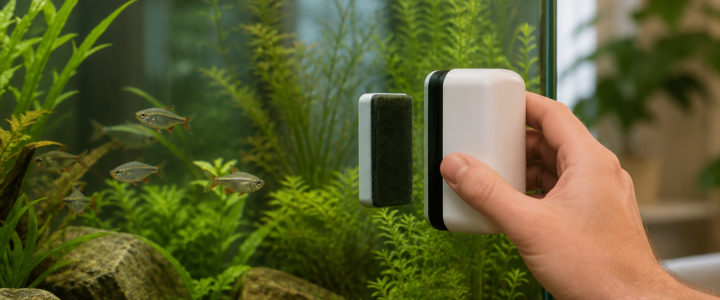
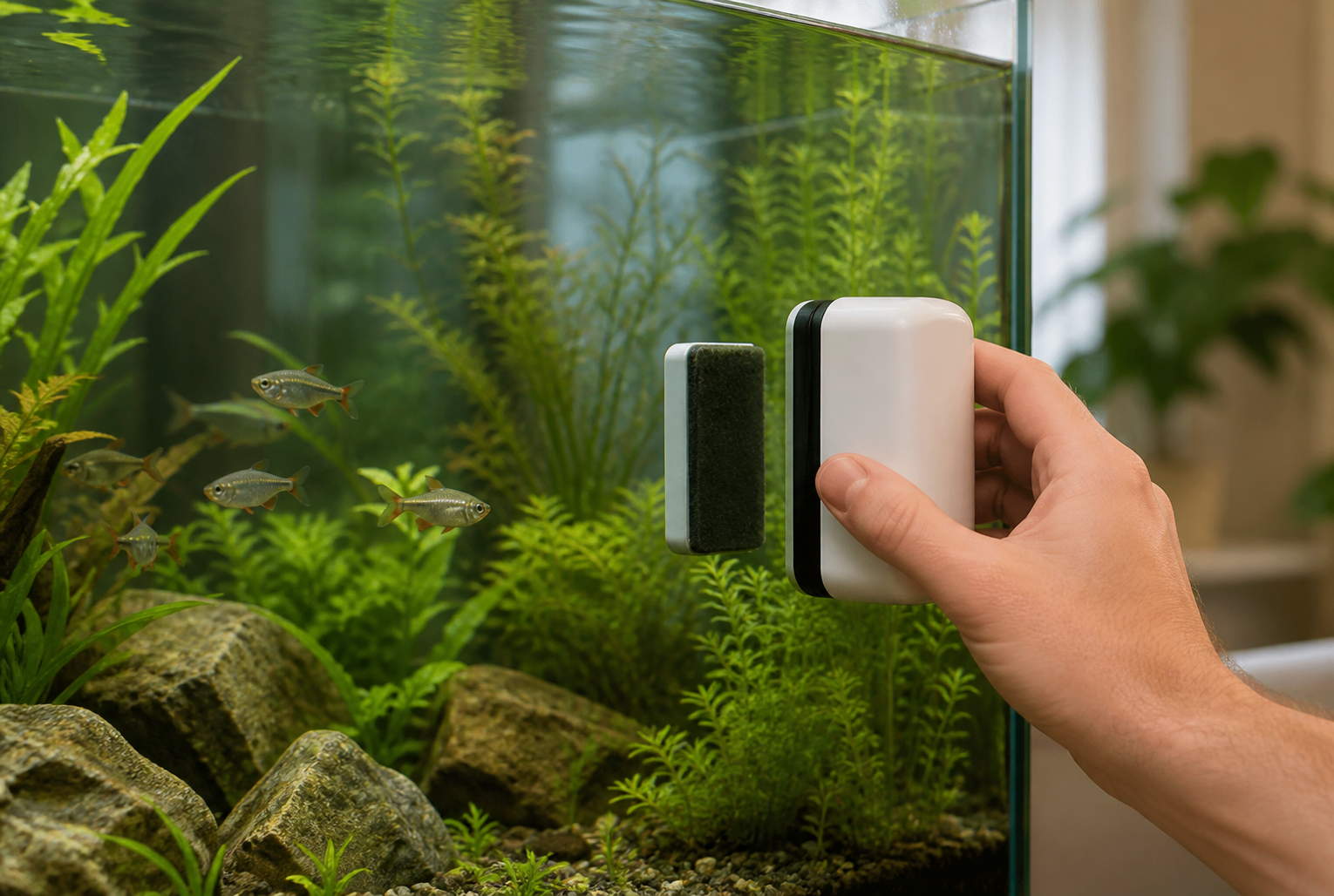
Using a floating magnetic algae cleaner on a planted aquarium

Disclosure: Aquarium Hunter may earn a commission from qualifying purchases made through links on this page, at no extra cost to you.

A magnetic aquarium cleaner lets you wipe algae from the inside of the viewing panel without putting your hand in the water. The best model is the one rated for your tank’s actual panel thickness and material. A cleaner that is too weak disconnects constantly; one that is unnecessarily strong can be awkward to move and easier to mishandle.

Using a floating magnetic algae cleaner on the front glass of a planted aquarium
Keep the wet-side pad away from sand and grit: one trapped grain can scratch an aquarium panel.

Quick comparison

Magnetic cleaner Rated panel Best for Buying option
FLIPPER Float Standard Glass or acrylic up to 1/2 in (12 mm) Best versatile scrubber and scraper Check on Amazon
Mag-Float Medium Glass Glass up to 3/8 in Best simple floating cleaner Check on Amazon
Tunze Care Magnet Long Glass 10–15 mm Best for thicker glass and sand clearance Check on Amazon
hygger Magnetic Cleaner, Medium Confirm current size chart Budget cleaner with scraper Check on Amazon

Before buying: measure the panel at an exposed edge and check the exact manufacturer range. Tank capacity is only a rough guide; two aquariums of similar volume can use different glass or acrylic thicknesses.

Best aquarium magnet cleaners

1. FLIPPER Float Standard — best overall

The FLIPPER Float Standard combines a scrubber with interchangeable scraper blades and changes sides when the handle is rotated. The manufacturer rates it for glass and acrylic panels up to 1/2 inch (12 mm). It includes a stainless-steel blade for glass and a plastic blade for acrylic, so it is the most versatile option in this group.

The wet half floats toward the surface if it disconnects, which can make retrieval easier. The blade side is useful for stubborn spot algae, but a metal blade must never be used on acrylic and should be kept clear of silicone seams.

Check the FLIPPER Float Standard on Amazon · See the manufacturer specifications

2. Mag-Float Medium Glass — best simple floating cleaner

The Mag-Float Medium Glass is a straightforward pad-style cleaner for glass aquariums. Mag-Float lists it for tanks up to 125 gallons or glass up to 3/8 inch thick, but panel thickness is the more dependable selection criterion. The inner half floats if separated.

This version is intended for glass. Mag-Float also makes material- and size-specific variants, so do not assume one Medium model is interchangeable with another. A scraper is not included with this standard version.

Check the Mag-Float Medium Glass on Amazon · See the Mag-Float size guide

3. Tunze Care Magnet Long — best for thicker glass

The Tunze Care Magnet Long uses narrow plastic blades rather than a broad pad resting directly against the pane. Tunze says the inner magnet sits more than 3 mm away from the glass, reducing the likelihood that sand becomes trapped. The Long model is rated for 10–15 mm glass and includes a stainless-steel blade plus spare plastic blades.

This is a strong choice for an appropriately thick glass aquarium, especially where substrate near the viewing panel is a concern. Match the exact Care Magnet version to the glass thickness; the Nano, Long, Strong and Strong+ are not interchangeable sizes.

Check the Tunze Care Magnet Long on Amazon · See Tunze specifications

4. hygger Magnetic Cleaner, Medium — budget option

The medium hygger cleaner combines a floating inner half, cleaning pad and scraper at a lower price than the premium alternatives. It can be a practical choice for routine film algae on a compatible glass tank.

Confirm the current listing’s thickness guidance before ordering, because this cleaner is sold in several sizes and marketplace titles can change. Inspect the pad and scraper before every use and stop if the halves drag harshly or disconnect repeatedly.

Check the hygger Medium Magnetic Cleaner on Amazon

How to choose safely

Match the aquarium material

Glass is harder to scratch than acrylic, but neither is scratch-proof. Only use a metal blade when the manufacturer explicitly approves it for glass. Acrylic needs an acrylic-safe plastic blade or pad, and even those can scratch if grit is trapped underneath.

Use panel thickness, not only gallons

Magnetic strength must reach through the aquarium panel. Measure the glass or acrylic at a visible edge, then choose a model whose stated range includes that measurement. Bow-front and curved panels can reduce contact area, so check the cleaner manufacturer’s guidance for curved tanks.

Decide whether you need a scraper

A soft cleaning pad handles routine film algae. A blade can make hard green spot algae or coralline algae easier to remove, but it increases the need for careful material selection and seam clearance. Never force a blade across damaged glass or acrylic.

Consider retrieval

A floating wet side is convenient if the halves separate. A sinking model is not automatically inferior, but retrieval can be awkward in a deep or heavily decorated tank. Floating does not make a cleaner safe to leave in place indefinitely.

How to use a magnetic cleaner without scratching the tank

  1. Inspect both halves and remove every grain of sand, shell fragment or hard deposit.
  2. Place the wet half against the inside pane and bring the dry half toward it gradually to avoid a hard snap.
  3. Move slowly in overlapping passes. Stop if you feel grinding, unusual resistance or repeated disconnection.
  4. Stay above the substrate line. Clean the final lower strip separately with an appropriate handheld tool.
  5. Keep scraper blades away from silicone seams and decorative film.
  6. Separate the halves after use, rinse them, dry the outer felt and store them with a spacer between the magnets.

Common mistakes

  • Dragging through sand: trapped quartz or gravel can leave a permanent scratch.
  • Using the wrong blade: stainless steel is not acrylic-safe.
  • Buying by tank volume alone: the actual panel thickness determines magnetic performance.
  • Leaving the cleaner attached: debris can collect under it, and the dry-side surface can mark the outside pane.
  • Snapping strong magnets together: this can pinch fingers or damage the cleaner.

Magnet precautions

Powerful magnets can pinch fingers and may affect magnet-sensitive medical devices, electronics, magnetic cards and storage media. Keep the separated halves and packaged cleaner away from children and follow the manufacturer’s safety instructions. People with implanted medical devices should follow their device manufacturer’s advice about safe distances from magnets.

Frequently asked questions

Can magnetic cleaners scratch aquarium glass?

Yes. Glass cleaners most often scratch when sand or another hard particle is trapped between the wet side and the pane. Inspection and careful technique are essential.

Can I use a glass cleaner on acrylic?

Only when the exact cleaner and its installed pad or blade are explicitly rated for acrylic. Never use a metal scraper blade on acrylic.

Will a magnetic cleaner remove every type of algae?

No. Routine film algae is usually easy, while hard spot algae or coralline algae may need a suitable scraper. Algae growing on silicone seams, textured backgrounds or decorations needs a different cleaning method.

Our verdict

The FLIPPER Float Standard is the most versatile option because it combines scrubbing, material-specific blades and floating retrieval. The Mag-Float Medium Glass is a simpler choice for compatible glass aquariums, while the Tunze Care Magnet Long stands out for thicker glass and its deliberate clearance from substrate.

Best Aquarium Power Filters: 5 Current HOB Filters Compared

Best Aquarium Power Filters: 5 Current HOB Filters Compared

Disclosure: Aquarium Hunter may earn a commission from qualifying purchases made through links on this page, at no additional cost to you. Recommendations are based on filtration design, maintainability, current manufacturer documentation, and suitability—not commission size.

The best aquarium power filter is one that fits the tank, supports a stable biological filter, offers enough mechanical media for the fish’s waste load, and remains easy enough to maintain consistently. For most freshwater community aquariums, a hang-on-back (HOB) power filter is a practical balance of performance, access, and price.

After removing discontinued, mismatched, and poorly supported choices from the old list, these five current filters remain worth comparing. Our most flexible recommendation is the Fluval AquaClear/AC platform; the Fluval C4 is the stronger choice for clearly separated filtration stages, while the Aqueon QuietFlow is convenient when automatic restart is a priority.

Best aquarium power filters: quick comparison

Filter Best for Media style Flow control Main tradeoff
Fluval AquaClear 110 Large aquariums and reusable media Open media basket Yes Large unit; must be primed after service
Fluval C4 Organized multi-stage filtration Separate mechanical, chemical, and biological stages Yes More parts to clean
Aqueon QuietFlow 75 LED PRO Easy restart and cartridge convenience Cartridge plus biological grid Model-dependent More reliance on proprietary consumables
Tetra Whisper 60 Basic filtration for a larger community tank Cartridge-based Limited Less media customization
Marina Slim S15 Small tanks with limited rear clearance Compact cartridge system Yes Lower media capacity

Manufacturer tank ratings are starting points, not stocking guarantees. Choose from the exact model’s specifications and increase filtration capacity for messy fish, heavy stocking, or unusual tank dimensions. Never use a stronger current that prevents fish from resting or swimming normally.

1. Fluval AquaClear 110: best for flexible reusable media

The AquaClear 110 is the established large-tank version of Fluval’s HOB platform. Its open basket holds foam, activated carbon, and BIOMAX separately, allowing each stage to be accessed without discarding everything at once. That is an important advantage: biological media can remain established while mechanical foam is rinsed.

Fluval rates the AquaClear 110 for 60–110 US gallons and provides adjustable flow. The official AquaClear line includes smaller models, so select the version matched to your aquarium rather than buying the 110 for every setup. The waterfall return improves surface movement, but the water level must be kept high to reduce splashing and noise.

Best features

  • Large, accessible media basket.
  • Reusable foam and separate biological media.
  • Adjustable output for different fish and feeding conditions.
  • Replacement parts and media remain documented by the manufacturer.

Limitations

  • The 110 requires substantial clearance behind the aquarium.
  • Like many conventional HOB filters, it may need to be refilled and primed after cleaning or a power interruption.
  • Its intake requires a sponge prefilter for shrimp, fry, or long-finned fish.
Fluval AquaClear 110 hang-on-back aquarium power filter
The AquaClear 110 uses a large basket with independently serviceable filter media.

Check AquaClear 110 on Amazon

2. Fluval C4: best organized multi-stage filter

The Fluval C4 separates filtration into two mechanical stages, one chemical stage, and two biological stages. Fluval rates it for aquariums up to 70 US gallons, with a stated 120-volt circulation rate of 264 US gallons per hour. A cleaning indicator helps identify a clogged mechanical pad, although it does not replace routine visual checks.

The C4 is a good match for keepers who want each filtration role clearly defined. Its wet/dry biological area receives oxygen-rich water, and the adjustable output can extend media contact time. The tradeoff is complexity: more trays, pads, screens, and channels require careful cleaning than a simple open basket.

Best features

  • Clearly separated mechanical and biological stages.
  • Adjustable flow and documented model specifications.
  • Mechanical pad slides out for rinsing.
  • Good choice when you prefer organized media rather than a single cartridge.

Limitations

  • Higher maintenance complexity than simpler HOB filters.
  • Replacement pads and parts must match the C-Series model.
  • Maximum rim thickness should be checked before purchase; Fluval lists 1 1/8 inches for the C4.
Fluval C4 multi-stage aquarium power filter
The Fluval C4 separates mechanical, chemical, and biological filtration into accessible stages.

Check Fluval C4 on Amazon

3. Aqueon QuietFlow 75 LED PRO: best for automatic restart

The Aqueon QuietFlow 75 LED PRO uses an internal pump that is designed to self-prime and restart automatically after power returns. That convenience is useful for an aquarium that may experience short outages, although every filter should still be checked after power restoration.

Aqueon describes five filtration stages, including floss, activated carbon, a biological holder and grid, and space for a specialty pad. The LED indicator responds to restricted water flow through the cartridge; it is a maintenance reminder, not a water-quality monitor.

Best features

  • Self-priming internal pump.
  • Simple cartridge removal and broad model range.
  • Permanent biological surfaces are separate from the disposable floss cartridge.
  • Current manufacturer documentation and replacement media.

Limitations

  • Ongoing cartridge cost.
  • Replacing all media together can remove useful bacteria; keep the permanent biological grid wet and do not replace it routinely.
  • The LED does not measure ammonia, nitrite, nitrate, or filter maturity.
Aqueon QuietFlow 75 LED PRO aquarium power filter
Aqueon’s QuietFlow LED PRO emphasizes automatic restart and cartridge-based maintenance.

Check Aqueon QuietFlow 75 LED PRO on Amazon

4. Tetra Whisper Power Filter 60: best straightforward large-tank option

The Tetra Whisper 60 is a basic three-stage HOB filter marketed for aquariums up to 60 US gallons. Its simple cartridge system is approachable for a new keeper, and the model remains available through major retailers.

This filter works best for someone who values straightforward replacement media over customization. The downside is reduced flexibility and the temptation to replace a complete cartridge on a calendar. When the cartridge contains an established bacterial population, rinse reusable portions gently in removed aquarium water and avoid changing every biological surface at once.

Best features

  • Simple installation and familiar replacement cartridges.
  • Twin-sided design on the 60-gallon model distributes intake and return flow.
  • Widely available consumables.

Limitations

  • Less media flexibility than AquaClear or Fluval C-Series baskets.
  • Cartridge costs accumulate.
  • Model rating may be optimistic for heavily stocked or high-waste aquariums.
Tetra Whisper 60 hang-on-back aquarium power filter
The Tetra Whisper 60 is a straightforward cartridge-based filter for larger community aquariums.

Check Tetra Whisper 60 on Amazon

5. Marina Slim S15: best for a compact aquarium

The Marina Slim S15 has a narrow body and adjustable flow, making it useful when rear clearance is limited or a gentler current is needed. Its compact size is also its main constraint: media volume is modest, so it suits an appropriately stocked small aquarium rather than a messy or crowded tank.

Confirm the exact S15 model, voltage, aquarium rating, and included cartridges on the retailer page before buying. Product variants and regional electrical specifications can differ.

Best features

  • Slim profile.
  • Adjustable flow.
  • Easy access for routine cleaning.

Limitations

  • Small media capacity.
  • Cartridge-dependent design.
  • Not appropriate as the only filter for large, messy fish.
Marina Slim S15 compact aquarium power filter
The Marina Slim S15 trades media volume for a compact profile and adjustable flow.

Amazon listing currently unavailable; review retained for readers comparing an existing or locally available unit.

How we selected these filters

We prioritized models that remain available, have current manufacturer or retailer documentation, and represent meaningfully different use cases. We compared:

  • Mechanical and biological media capacity.
  • Ability to service one stage without discarding the entire bacterial colony.
  • Flow adjustment and suitability for delicate livestock.
  • Restart behavior after cleaning or power loss.
  • Availability of compatible media, parts, and instructions.
  • Clear limitations, including clearance, noise, cartridge cost, and maintenance complexity.

We removed the old Marineland Emperor and Penguin listings because their linked versions were not reliably available, the Penn-Plax entry lacked enough verified detail to outrank the current choices, and the Aqueon internal filter did not belong in a HOB comparison. The Green Killing Machine was also removed because a UV sterilizer is a specialized water-clarifying device, not a general substitute for a properly sized mechanical and biological filter.

How to size a power filter

Do not choose by tank gallons alone. Consider adult fish size, stocking, feeding, plant debris, substrate, and how often you can service the filter. A lightly stocked planted aquarium and a goldfish aquarium of the same volume have very different waste loads.

Manufacturer “up to” ratings are useful for comparing models within a product line, but they assume conditions that may not match your tank. When uncertain, choose more media capacity and distribute the flow safely. Two filters can provide redundancy and better circulation in a long aquarium, but both still require maintenance.

Check physical fit

Measure the aquarium rim, distance to the wall, hood openings, and the vertical distance from the intake to the substrate. Keep the water level high enough for the return and follow the manufacturer’s leveling instructions.

Protect small animals

Add a sponge prefilter over the intake for shrimp, fry, snails, and delicate fins. Rinse it regularly because a clogged sponge reduces flow.

Understanding filter media

Mechanical filtration

Foam, floss, and pads trap uneaten food, waste, and plant fragments. Rinse reusable mechanical media in removed aquarium water before it becomes severely clogged. Replacing dirty mechanical media is not a substitute for removing waste from the substrate.

Biological filtration

Porous foam, ceramic media, and permanent grids support nitrifying bacteria that process ammonia and nitrite. Keep biological media wet in dechlorinated aquarium water during service. Never replace all mature media at once unless contamination makes it unavoidable.

Chemical filtration

Activated carbon can remove some dissolved organic compounds, odors, discoloration, and medications, but it is not required continuously in every aquarium. It becomes exhausted and must be replaced when used for a specific purpose. Chemical media cannot compensate for an uncycled tank or overdue water changes.

Power filter maintenance

  1. Unplug the filter and heater before lowering the aquarium water level.
  2. Remove and rinse mechanical media in discarded tank water.
  3. Swish biological media gently only when debris is restricting flow.
  4. Clean the intake, impeller well, and return channel according to the manual.
  5. Reassemble, refill the HOB chamber if required, and restore power.
  6. Confirm normal flow and restart before leaving the aquarium.
  7. Test ammonia and nitrite after major maintenance or any loss of filter bacteria.

Clean according to flow and waste accumulation rather than an inflexible calendar. Never wash mature biological media under chlorinated tap water, and never allow it to dry during maintenance.

Frequently asked questions

Is a HOB filter enough for an aquarium?

Yes, for many appropriately stocked freshwater aquariums. It must provide adequate media capacity, circulation, and oxygen exchange. Large fish, marine systems, very long tanks, or specialized aquascapes may benefit from canister filters, sumps, sponge filters, or multiple units.

Does a higher flow rate mean better filtration?

No. Flow must carry waste to the media and distribute oxygen, but water moving too quickly can bypass fine debris or exhaust fish. Media volume, contact, maintenance, and tank circulation matter alongside gallons per hour.

Should I replace a filter cartridge every month?

Replace disposable media when it is damaged or cannot be cleaned enough to restore flow—not merely because a date has passed. Preserve established biological media whenever possible. If a cartridge combines carbon and floss, consider whether the design offers a separate permanent biological surface.

What happens during a power outage?

Keep media wet and restore oxygenation as soon as possible. After power returns, confirm that the filter has restarted; conventional HOB units may need manual priming. For a long outage, discard foul stagnant water from the filter chamber, restart with conditioned water, and monitor ammonia and nitrite.

Final recommendation

Choose the Fluval AquaClear/AC platform when reusable media flexibility and easy access are your priorities. Choose the Fluval C4 for organized multi-stage filtration, or the Aqueon QuietFlow 75 LED PRO for convenient automatic restart. The Tetra Whisper 60 and Marina Slim S15 are simpler choices for their respective tank sizes, but their cartridge systems offer less customization.

Whichever filter you buy, correct sizing, mature biological media, routine cleaning, and water testing matter more than the brand name.

Top 25 Best Aquarium Decorations

Top 25 Best Aquarium Decorations

Best Aquarium Decorations: It’s hard to define what the best aquarium decorations are, with so many to choose from, including rocks, caves, driftwood, coral, and more.

Regardless of the type of decoration you are looking for, it is important to choose a high quality product.

Comparison Table

CustomSiteStripe ImageTitleReviewBuy
Top Performance DRIFTWOOD By DRIFTWOOD4.5/5.0Check Price
cheapestPENN-PLAX NICKELODEON SPONGEBOB AQUARIUM ORNAMENT By PENN4.5/5.0Check Price

Make sure your water chemistry is not affected so your fish can enjoy it as much as you do.

If you are looking for good options, we have found some of the best decorations and have divided them into different categories so you can find exactly what you are looking for.

If you, as an in-house designer, don’t go out and play, choosing your tank decor can be a frustrating process.

That is why I created this guide to make it easier for you.

In this article you will learn:

Seven simple things to consider before choosing your decorations.
We will talk about 10 types of decorations that you can use as inspiration.
At the end I will present some of my favorite ideas for decorating aquariums.

Regardless of which form of the best aquarium decor you are looking for, it is more important to carefully select the highest quality products that are safe for your aquarium residents. In other words, only consider aquarium decorations that are specifically designed for this purpose.

Actually, it might be difficult to determine which decorations are suitable for aquariums as many of them are available in the market and generally consist of corals, caves, rocks, floating woods and the like. That’s why you may end up buying a worthwhile investment if you choose a credible brand.

Whatever you choose, always make sure the decor doesn’t negatively affect the chemistry of the tank water, so that your pet fish enjoys a safe, clean and natural haven. In short, go for those made just to hold and beautify aquariums.

The good news for you today is that the following aquarium decorating reviews and some buying guides covered in this article can provide you with informative information so you get exactly what you fish for.


Top 25 Best Aquarium Decorations – Aquarium & Tank Decor


1. Aquarium Ohko Dragon Stone Rock Mixed Sizes

The dragonstone gets its name because it resembles dragon scales. It has an interesting green-brown color and a layered appearance with lots of cracks and crevices.

This is a great decoration because it is light, durable and stackable without affecting the chemistry of the water.

They come in different sizes and shapes and each pack is different. Since it is 100% natural stone, there may be differences in color and size.

Check Price On Amazon

2. Driftwood

Natural drift wood is a popular addition to many aquariums and can help create a natural and simple feel. It is also a great hiding place for shy fish.

Driftwood can be bought in many stores and is generally very safe. However, you can fish floating wood from rivers and streams and add it to your tank without spending money.

You should be careful and make sure to quarantine wood from wild sources. If you don’t, you risk adding harmful microbes and parasites, which could seriously make your fish sick.

Check Price On Amazon

3. Penn-Plax Nickelodeon SpongeBob Aquarium Ornament

Are you looking for unique aquarium decorations that don’t have a big hole in your pocket? Then you are absolutely right with us. Try this cool decoration and give your pet fish a great place to hide and enjoy life in the tank.

This ornament is harmless for marine and freshwater applications. It is built on a solid base, so it will not tend to float when immersed in water. Its size is good enough to fit almost any home aquarium right away. This does not require a lot of maintenance since you only need to clean it thoroughly and wash it with warm water.

What makes it a smart choice is that it specifically serves as an ideal accent for any aquarium, regardless of size. Please note that the use of chemical based detergents is not recommended when cleaning to avoid damaging the fish.

However, some disadvantages of decorating this aquarium are the slightly faded color. The edges of these jewels must be sanded thoroughly to avoid damaging your pet fish.

Check Price On Amazon

4. Marina Naturals Rock Outcrop

This large and beautiful piece simulates a natural environment for your fish. It is made of a safe, non-toxic material that does not change the chemistry of the water, looks like a natural rock, and is suitable for any aquarium environment.

At 20cm in size, this piece works well as a standalone decoration, but it can also be useful for adding texture and interest when combined with other plants and decorations.

Check Price On Amazon

5. Aquarium Stones And Rocks

There are many attractive stones, pebbles, and stones on the market that serve as a great addition to many aquariums. They are also ideal for natural themed tanks that comfort fish by mimicking their natural habitat.

You can also add wild stones to your aquarium. However, before doing this, it is important that you cook the stones for an hour before adding them to avoid the introduction of harmful substances / organisms.

Also note that some stones, such as spike rocks, are sharp and can harm your fish and should be avoided.

Attractive rock options include glass rocks, ice rocks, river rocks, zebra stones, and rainbow rocks.

Check Price On Amazon

6. Penn Plax Squidward Easter Island Home Aquarium Ornament

Large aquarium decorations are definitely a must-have if you have a large tank in which your most valuable fish swim, play, and move. It’s nice to know that the decor on this fish tank is a decent size where your fish can comfortably move around and enjoy their new incubator.

This is fairly easy to set up and will not shake when positioned correctly. It is a point of attraction that all children will love. In fact, this may be one of the best gifts you can give a child interested in keeping fish or aquariums.

Interestingly, its price is quite cheap considering its fresh and distinctive appeal. This is a great center when you have a Betta fish.

Be that as it may, the safety of this decoration is somewhat questionable since the paint seems to be toxic and peel off easily, which can be dangerous for fish. The eye holes and inner edges of these jewels must be properly polished to avoid injury to fish or entrapment.

Check Price On Amazon

Aquarium Decorations Castle

7. uxcell Aquarium Resin Turtle Ramp Rock Basking Stone Decor

This giant stone is not only the perfect match for a turtle shell, but can also be used for aquarium design.

It comes with suction cups so you can place it anywhere on the tank and rest assured it stays in place. Because this stone looks so realistic, you may be surprised at how light it really is.

Check Price On Amazon

8. Caves

Caves can give your aquarium an interesting and natural look and give fish an ornament under which they can swim and interact.

In keeping prey, many hobbyists recommend adding items under which these fish can hide for safety reasons: caves serve as an attractive hiding place for such species.

While natural stones in the wild can be used as caves, you should cook these stones for at least an hour before adding them to your aquarium to kill harmful microbes and parasites.

PVC pipes can also be used. Make sure all plastics are quarantined before adding them to your tank to ensure they are safe and that there are no chemicals leaking.

Check Price On Amazon

9. Marina Décor

This is a little expensive aquarium decoration, but it looks elegant and real. It appears to be more ideal for turtle and reptile setups where it would not be completely submerged in water.

Aquarium holders should lightly sand this decor, especially around the edges to avoid damaging the fish. It can serve as the center of the aquarium and your pet fish would love to play and swim through this cool decor. This could be best seen under a bright LED lighting system.

This decoration can immediately sink and anchor at the bottom of the tank and may bubble a little for a while. However, it appears impeccably organic when immersed in water. This is useful for larger tanks as it can be a fascinating piece and a lovely addition to the aquarium.

Two minor issues that you should watch more carefully when you decide to buy this tank decoration are the strange smell once you have unwrapped it and put it in the tank. This jewelry also seems to be more prone to fungal problems.

Check Price On Amazon

10. Penn Plax Castle Aquarium Decoration Hand Painted

If you want to add something to your aquarium that really creates an underwater kingdom for your fish, take a look at this hand painted castle.

The great gray castle sits on a rocky hill above a flowing waterfall and offers its fish plenty of hiding places.

This castle has a conical roof, arches, and stone accents that make it look surprisingly realistic. It is a large decoration that measures more than 20 cm in height.

Check Price On Amazon

11. Ships

Sunken ships can be purchased from most commercial retailers. If you want to create a natural, sea-like theme, sunken ships are a safe and fish-friendly option that complements most tank structures well.

The boats also offer excellent hiding places for fish, so types of prey can be hidden for safety and comfort.

Check Price On Amazon

12. Penn-Plax Wizard’s Castle Aquarium Decoration

Have you stopped looking for realistic aquarium decorations? Well, there is no reason for you to frown when you look at the exciting design and features of these aquarium jewelry. It is large enough and can add a standout attraction to the aquarium.

As you can see, you can see that this decoration could promote visual interest for you and your pet fish. This could add a very exquisite piece of jewelry that you, your fish, and your guests would like to look at. If you want your fish to stay active and happy, this castle can help them combat boredom as they might have a place to play, move and swim.

In fact, you need to pay attention to the sharp edges found in the openings of this decoration and which need to be gently sanded, and there is a tendency for algae to accumulate in the upper tower of the castle. Therefore, a thorough and regular cleaning is essential.

Check Price On Amazon

13. Sunyiny Aquarium Decorations Ornament

Here’s another great lock that’s perfect for any tank with a capacity of 5 gallons or more.

This double-sided design can be stored anywhere in your tank and is made of high-quality resin that can be used in salt or fresh water without worrying about color fading.

There are many places where your fish can hide and holes for you to swim. The weighted base keeps it upright where you put it.

Check Price On Amazon

14. Ruins

The ancient ruins are a great addition to the Atlantis / Mermaid motif tanks and serve as perfect places where fish of prey can hide.

When adding ruins of any kind, make sure they are specially built or otherwise quarantined or safely decontaminated before use.

Check Price On Amazon

15. NICREW Aquarium Volcano Ornament Kit

You might be wondering where to buy extra large aquarium decorations and whether they are the ideal option worth buying. This volcanic tank decoration is big enough, but it doesn’t make the aquarium look overloaded.

As soon as you have purchased the kit, it already consists of the airline hose, bubble maker with built-in LED light, power supply and decoration. This consists of harmless resin, which is not a danger to the inhabitants of your aquarium and the environment. It is undemanding to install and works fairly reliably to enhance the artistic appeal of the tank.

It is important to know the negative points associated with the decoration of this tank. These consist of its unreliable durability, as it can be easily damaged and the volcano works. You have to buy an air pump separately.

Check Price On Amazon

16. SLOCME Aquarium Ornaments Resin Castle Decorations

The SLOCME resin lock is made of an environmentally friendly and non-toxic material that does not change the chemistry of the water in your aquarium. It is double-sided, so it can be placed anywhere on your tank in any direction.

You’ll love looking at the little bricks and stairs and the detailed green, and your fish will adore every hiding place and corner you can swim through. This is the perfect size for a 10 gallon tank.

Check Price On Amazon

17. Statues

The human and animal statues look great in aquariums with a marine theme and serve as attractive decorative options that give a standard moor aquarium a creative and unique feel.

The statues can be purchased from many aquatic retailers. When buying larger figures make sure your tank doesn’t get too full and follow the design and style guidelines above.

Check Price On Amazon

18. Miracliy Aquarium Decorations Castle

Sometimes it can take a long time to decide which freshwater or saltwater aquarium decor to choose, keeping in mind that there are countless options in both local and online stores. If you want to narrow down your options, you can find out what this tank decoration has to offer.

Once you have installed this decoration on your tank, your pet fish would open beautifully through the openings. It is designed for dynamic colors and the acrylic lock is made of robust acrylic material. The painting and details of this piece are out of this world. It could certainly make the aquarium look like a great sight that you would love.

Two major flaws that need to be thoroughly checked if you want to get this tank decoration are larger than expected and appear to be crooked as there is a small stain on the bottom of one edge of the decoration that was not completely solid. Before buying, be sure to check the dimensions of your tank.

Check Price On Amazon

Aquarium Decorations Driftwood

19. GEOsystem Fluval Mopani Driftwood

Wood is one of the most natural decorations you can add to your aquarium, and this Mopani floating wood is an amazing choice.

The curves, knots and holes in this wood are fun and give your tank an interesting sculptural element.

This is a natural Mopani root that has been sandblasted to prevent water contamination. It can be used alone or as an anchor for live plants.

Check Price On Amazon

20. Bubble Makers

Bubble boxes, underwater rivers, and air stones not only look attractive, but are often an essential addition to densely populated aquariums.

If you keep one or more highly active fish in a single tank, it is important that they have an adequate supply of oxygen.

Busy fish need more than slower species. Therefore, it is important that you keep oxygen levels high by adding decorations that produce air.

When installing bubble makers in your aquarium, make sure they are not too strong for your fish. If the water flow is too high, the fish will have a hard time swimming and despair, which often leads to disease.

A high flow of water can be compensated by adding dense objects such as floating wood.

Check Price On Amazon

Aquarium Decorations Plants

21. CNZ Fish Tank Decoration Ornament Artificial Plastic Plant Green

The best aquarium decorations are those that look natural, even though they are artificial. Like this ornament, it looks like a real aquatic plant that you can’t even say is made of plastic. It is exciting to buy something good for a very reasonable price.

You will find that the decoration of this tank is a practical element, since it makes the aquarium look more alive and does not endanger the health of your fish. This does a great job when it comes to breaking lines of sight in a larger aquarium. Surprisingly, it would be confusing to determine if it is real due to its natural look and style or not.

The only things that give this tank decor some negative comments are its pale stem, which doesn’t mix well with the rest of the decor, and some leaves warp.

Check Price On Amazon

22. Yizhi Miaow Aquarium Decorations Tree Log/Driftwood

If you prefer to avoid natural wood because you fear it will color the water, this resin float is an excellent alternative.

It has realistic looking artificial plants along the top and some fun nooks for your fish to explore.

The safe and non-toxic resin is ecological and does not change the chemistry of the water. It’s great in an aquarium, but it would also be a great addition to a reptile tank.

Check Price On Amazon

23. Nature’s Ocean Coral Base Rocks for Aquarium

While it is obviously true that these cool aquarium decorations are overpriced, there is no denying that they offer absolute value for money. You could help make the tank look like a natural, oceanic environment that your pet fish will thank you for.

In addition to aquariums, these products are great for many different purposes as they can also be used to grow live corals, develop live stones, and the perfect choice for growing corals. They are also of the highest quality in terms of habitat and have no negative effect on your tank cycle. Note that they must be soaked in deep water to effectively prevent leaks.

These coral beds need to be rinsed desperately as they are laden with sand and dust that must be removed completely to avoid problems once added to the reefs. And it’s expensive, which could surely hurt your budget. These are some of the minor problems that should be considered before making a final purchase decision.

Check Price On Amazon

24. Bonsai Driftwood Aquarium Tree

This floating bonsai wood tree is made from natural wood that has been transformed into a beautiful work of art. This wood is safe for fish and shrimp and nice when mixed with stones, moss, and air plants.

Since this wood contains natural tannic acid, it conditions the water and can lower the pH of your tank.

For best results, the wood should be boiled for 20 minutes to sterilize it before adding it to the tank.

Check Price On Amazon

Aquarium Decorations Caves

Aquarium Decorations Wood


25. Hygger Betta Log Resin Hollow Tree Trunk Ornament

Whether decorating saltwater or freshwater aquariums, this tank decor is a good option so you don’t waste your hard-earned money. This is one of the best picks for small and medium aquariums that need adorable decorations to entertain various species of fish that live in them.

If you look at this log, you will find that there are holes big enough for your pet fish to pass through. You’ll love the view when your water lover explores and enjoys the new cave. When you add this to your tank, you will be amazed at the transformation of the aquarium.

Two factors to consider are the various rough spots on the inside and outside of the tree trunk. The inner part of the tree trunk has very sharp edges and bumps that must be sanded to smooth them out.

Check Price On Amazon

How to choose decorations for an aquarium?

The good news is that there is no right or wrong way to decorate an aquarium. As long as you use high-quality materials that won’t change the water or harm your fish, anything is possible.

When choosing decorations, you must first decide how the overall image should look, and this can actually be very difficult because there are so many options.

Here are some things to think about when deciding which direction to go.

Natural vs Not Natural

The first thing to decide is whether you want a purely natural theme or something fantastic and fun.

What do you like more, driftwood and rocks or magnificent castles and plants that glow in the dark?

Of course, there are no strict rules for decorating aquariums, so you can mix everything if you want. However, choosing whether to stick with a natural underwater scene or create something completely different is a good place to start.

Color scheme

There are two ways of thinking about color.

First, ask yourself if you want to follow a color scheme. Do you prefer a natural interior with lots of browns and greens? Or would you also like to add some bright colors?

Then ask yourself what kind of fish you will keep in the aquarium. If you have a lot of bright and colorful fish, the best way to highlight them is to use a white substrate with natural green plants. If your fish are lighter in color, a dark substrate and dark decorations can really help them stand out.

plants

Live plants in your aquarium have many advantages, but artificial plants are much easier. There is no maintenance at all and some of them look so realistic that you can’t tell the difference.

If you choose live plants, there are many great natural decorations that can help them take root and establish themselves effectively. Adding driftwood can really help.

Design or how to make it look good

You can honestly set up your tank the way you want, but there are some design rules that need to be followed to get a more natural look.

First, choose a primary focus. It is a good idea to choose something with some holes or corners and angles to give the fish a place to hide and play.

Next, consider the height of your decorations. So think about it. Different types of fish prefer different parts of the tank. They have the best swimmers, the bottom residents and those who hang out somewhere in between.

Aquarium owners often spend a lot of time placing plants, stones, wood, or castles at the bottom of the tank, but don’t think much about height.

You must decorate the three areas where the fish like to walk. This may mean that some tall plants reach the top of the tank or a large piece of floating wood that covers the tank from the bottom up. Just be sure to add some height.

Another thing to consider is how many decorations to include. You don’t want to go overboard because your fish still need room to swim. However, the tank should not look too tight.

A good rule of thumb is to fill about 50% of the tank with decoration to ensure there is still ample room for fish to swim. Spread things out in even groups so there is a place for fish who like open spaces and areas where shy fish can hide when they need it.


conclusion

When it comes to decorating your aquarium, there are no right or wrong answers. As long as you use quality products that do not adversely affect water, you can choose any decoration.

In a way, make the decision to do what you want more difficult. Take a look at the decorations we recommend and make suggestions on how to choose the one that’s right for you. Both you and your fish are the way to a happy and beautiful aquarium.

Best Aquarium Test Kits: 5 Current Options

Best Aquarium Test Kits: 5 Current Options

The best aquarium test kit is the one that measures the parameters relevant to your livestock, source water and current problem—and that you can use consistently. A freshwater cycling kit needs ammonia, nitrite, nitrate and pH, while a reef aquarium also requires salinity and often alkalinity, calcium, magnesium and phosphate testing.

Aquarium water being tested with liquid reagents and color charts
Use clean glassware, follow timing exactly and record results so trends are easier to recognize.
Quick recommendation: The API Freshwater Master Test Kit is the most practical starting point for freshwater aquariums because it covers the nitrogen-cycle essentials. Reef keepers should combine suitable marine tests rather than assume one box measures everything.

Quick comparison

Kit Best use Main limitation Buying option
API Freshwater Master Freshwater cycling and routine checks No GH or KH Check on Amazon
API Reef Master Basic reef chemistry Not a complete cycling kit Check on Amazon
API GH & KH Hardness and buffering Separate from nitrogen tests Check on Amazon
Tetra EasyStrips Fast screening and travel Less resolution than titration tests Check on Amazon
sera Aqua-Test Box Broad freshwater testing Larger and more complex Check on Amazon

Kit contents and regional versions change. Confirm the current box lists every test you need.

1. API Freshwater Master Test Kit

Best for: cycling and maintaining a freshwater aquarium.

This liquid kit covers ammonia, nitrite, nitrate and pH ranges. Those are the core measurements for establishing the nitrogen cycle and investigating an unexpected loss of appetite, rapid breathing or cloudy water. It does not measure GH or KH, so soft-water, shrimp, livebearer and pH-stability questions may require the separate hardness kit.

Shake and time reagents exactly as instructed—especially the nitrate test—and compare colors under neutral white light.

Check API Freshwater Master on Amazon

2. API Reef Master Test Kit

Best for: an entry-level group of common reef measurements.

The Reef Master kit is intended for calcium, carbonate hardness, phosphate and nitrate. It does not replace ammonia and nitrite testing during cycling, and it does not measure salinity or magnesium. Reef aquarists should build a testing plan around the animals kept and the dosing system rather than around one manufacturer’s box.

Check API Reef Master on Amazon

3. API GH & KH Test Kit

Best for: freshwater hardness, buffering and remineralization work.

GH estimates dissolved calcium and magnesium hardness, while KH measures carbonate buffering capacity. They answer different questions and should not be used interchangeably. Drop-count titration is easy to read when performed with the correct sample volume and a clean vial.

Check API GH & KH on Amazon

4. Tetra EasyStrips

Best for: quick screening between more precise tests.

Multi-test strips are fast and useful for spotting a change, but storage humidity, dip time, reading time and subjective color matching affect results. Keep the cap closed, never touch reagent pads and confirm an unexpected or action-triggering result with a suitable liquid test.

Check whether the exact strip includes ammonia; many multi-parameter strips do not.

Check Tetra EasyStrips on Amazon

5. sera Aqua-Test Box

Best for: aquarists wanting a broader organized freshwater set.

The Aqua-Test Box groups multiple liquid tests in a carrying case. Regional versions can differ, including whether chlorine is included, so compare the exact content list with your planned aquarium. A broad kit is useful only when its reagents remain in date and the user understands which results require action.

Check the sera Aqua-Test Box on Amazon

Which parameters should you test?

  • New or troubled aquarium: ammonia, nitrite, nitrate, pH and temperature.
  • Freshwater species selection: GH and KH in addition to the basics.
  • Planted tank: nutrients such as nitrate and, where dosing requires it, phosphate; CO₂ users also need a safe monitoring method.
  • Marine aquarium: salinity plus nitrogen-cycle tests.
  • Reef aquarium: alkalinity, calcium, magnesium, nitrate and phosphate according to coral load and dosing.

How to get reliable results

  1. Check the expiry date and store reagents within the specified temperature range.
  2. Rinse vials with sample water and use the exact fill line.
  3. Hold reagent bottles as instructed and count complete drops.
  4. Shake, wait and read at the precise times in the manual.
  5. Use daylight or neutral white light against the recommended background.
  6. Record the result, time, temperature, maintenance and dosing changes.
  7. Repeat surprising results and use a second method before making a large correction.

Testing frequency

During a fishless cycle, test often enough to follow ammonia and nitrite processing. In an established aquarium, frequency depends on stocking, stability and the parameter: temperature may be checked continuously, while stable GH might need testing only after source-water changes. Reef alkalinity often deserves frequent testing when consumption or dosing is changing.

Do not chase every number

Test results guide decisions; they are not targets to change impulsively. Rapidly altering pH, hardness, salinity or alkalinity can be more harmful than a stable value slightly outside a generic chart. Investigate the source, confirm the result and correct conditions gradually unless toxic ammonia or nitrite demands immediate protective action.

Frequently asked questions

Are test strips accurate?

They are useful for screening when fresh and used correctly, but usually offer less resolution than a good liquid titration or calibrated instrument. Confirm consequential results.

Why do two kits disagree?

Different resolution, units, reagent age, timing, sample volume and color interpretation can all contribute. Run controls, repeat carefully and consult each method’s stated range.

Can a pet store test replace a home kit?

No. A store test is a useful second opinion, but emergencies and cycling decisions require immediate access. Ask for actual numbers rather than “fine.”

Final verdict

The API Freshwater Master kit is the best starting point for most freshwater owners. Add GH and KH when hardness matters. Tetra strips are convenient screening tools, the sera box provides broader coverage, and the API Reef Master is a useful reef supplement rather than a complete marine testing solution.

Affiliate disclosure: Aquarium Hunter may earn a commission from qualifying Amazon purchases, at no additional cost to you. Recommendations are matched to the exact kits discussed.

Best Aquarium Filter Media: 6 Current Options

Best Aquarium Filter Media: 6 Current Options

Disclosure: Aquarium Hunter may earn a commission from qualifying purchases made through links on this page, at no extra cost to you.

There is no single “best” aquarium filter medium because mechanical, biological and chemical media do different jobs. A dependable filter normally uses coarse mechanical media first, durable biological media that is preserved over time, and optional chemical or polishing media only when there is a clear reason to use it.

Filtered freshwater aquarium with clear water and a small fish
Clear water is only one goal of filtration; an established biological filter is essential for processing toxic ammonia and nitrite.

Quick comparison by purpose

Filter medium Type Best use Buying option
Aquatic Experts FilterFirst Floss Fine mechanical Polishing suspended debris Check on Amazon
Fluval Pre-Filter Media Coarse mechanical Protecting later media from debris Check on Amazon
Fluval BIOMAX Biological General biofilter use Check on Amazon
EHEIM SUBSTRATpro Biological Canister baskets and reusable bio media Check on Amazon
Marineland Black Diamond Carbon Chemical Odor, color and medication removal Check on Amazon
Seachem Purigen Organic adsorbent Water polishing and dissolved organic waste Check on Amazon

Recommended aquarium filter media

1. Aquatic Experts FilterFirst Floss — fine mechanical polishing

Filter floss traps small suspended particles that pass through coarser foam or prefilter media. The roll format can be cut to fit many sumps, canisters and media baskets. It is most useful as the final mechanical stage when you want clearer-looking water.

Fine floss clogs quickly if it receives raw debris, so place coarse mechanical media before it and replace or rinse it when flow starts to fall. Do not use a densely packed pad that causes a filter to bypass or starves a pump.

Check FilterFirst aquarium floss on Amazon

2. Fluval Pre-Filter Media — reusable coarse mechanical stage

Fluval’s ceramic prefilter rings are designed to catch larger solid waste before it reaches finer and biological media. They can be useful in canister filters with baskets large enough for loose media and are reusable after rinsing.

They are not a substitute for biological media simply because bacteria will eventually grow on every wet surface. Their main role is to keep later stages from loading with debris too quickly.

Check Fluval Pre-Filter Media on Amazon

3. Fluval BIOMAX — versatile biological media

BIOMAX ceramic rings provide a durable surface for nitrifying microorganisms. The loose 500-gram format fits many canister baskets, sumps and media bags, while Fluval also sells shaped inserts for particular filters.

Biological media works only after the aquarium is cycled. Preserve it during maintenance: swish a portion gently in removed aquarium water when flow is restricted, and never replace or aggressively clean all mature media at once.

Check Fluval BIOMAX on Amazon · See Fluval media formats

4. EHEIM SUBSTRATpro — premium reusable biological media

SUBSTRATpro consists of sintered, pearl-shaped media intended for dense bacterial colonization and efficient use of a filter basket. EHEIM lists it for freshwater and marine aquariums and says it can be carefully rinsed and reused.

It is a good fit when you want long-lived loose biological media rather than disposable cartridges. More surface area does not compensate for insufficient oxygen, poor flow or an aquarium that has not completed the nitrogen cycle.

Check EHEIM SUBSTRATpro on Amazon · See EHEIM specifications

5. Marineland Black Diamond Carbon — activated carbon option

Activated carbon adsorbs many dissolved organic compounds that cause odor or discoloration. It is also commonly used after a medication course when the medication instructions call for removal. Carbon is optional in many normally maintained aquariums and does not replace biological filtration or water changes.

Rinse carbon as directed to remove dust, place it where water must pass through it, and replace it after it is exhausted. Remove it before dosing medication if the medication instructions say carbon will adsorb the treatment.

Check Marineland Black Diamond Carbon on Amazon

6. Seachem Purigen — specialized organic adsorbent

Purigen is a fine synthetic resin that removes dissolved and suspended organic waste before it breaks down further. It can polish freshwater or marine aquarium water and darkens as it becomes exhausted. The small beads need a fine-mesh bag or a compatible pre-bagged format.

Regeneration involves strong oxidizing chemicals and must follow Seachem’s current directions exactly. Never improvise with scented, colored, splashless or differently concentrated products, and do not return regenerated resin to an aquarium if any chlorine remains or there is any doubt about the process. Replacing exhausted media is the safer choice for anyone uncomfortable with regeneration.

Check Seachem Purigen on Amazon · Read Seachem’s current directions and warnings

What the three filtration types do

Mechanical filtration

Foam, floss and other screens physically trap solid waste. Coarse media should normally receive water first, followed by progressively finer material. Mechanical media improves clarity and prevents biological media from clogging, but trapped waste remains in the system until it is removed during maintenance.

Biological filtration

Biological media provides wet, oxygenated surfaces for microorganisms involved in the nitrogen cycle. In an established aquarium, these communities convert toxic ammonia to nitrite and then nitrate. They do not make stocking limits or water changes irrelevant, and they take time to establish.

Chemical and adsorptive filtration

Activated carbon, specialty resins and phosphate-removal media target particular dissolved compounds. They should be used for a defined purpose and replaced or regenerated according to the exact product instructions. Chemical media does not “cycle” a tank and should not be used to conceal an unresolved water-quality problem.

How to arrange media

Follow the filter manufacturer’s flow path and instructions. A common sequence is:

  1. Coarse mechanical media to intercept leaves, uneaten food and large waste.
  2. Finer mechanical media for smaller suspended particles.
  3. Biological media in steady oxygen-rich flow after most solids have been removed.
  4. Optional chemical or polishing media positioned where water cannot bypass it.

Some filters reverse the direction or use dedicated compartments, so confirm the actual water path instead of relying on basket position alone.

Maintenance without crashing the biofilter

  • Service mechanical media before it becomes so clogged that flow drops sharply.
  • Rinse reusable foam and biological media gently in water removed from the aquarium.
  • Do not clean every biological stage or replace all cartridges on the same day.
  • Replace disposable floss when it no longer rinses clean or begins to break down.
  • Keep biological media wet and oxygenated during filter maintenance.
  • Test ammonia and nitrite after a major filter change, power interruption or medication event.

Freshwater, planted and reef considerations

Freshwater community tanks usually need dependable mechanical and biological filtration; carbon or resin is optional. Planted tanks may accumulate less nitrate, but plants do not remove the need for an established biofilter and maintenance. Reef aquariums often combine mechanical media with live rock, a protein skimmer and targeted chemical media. Any phosphate or organic-removal product should be introduced conservatively and monitored rather than used blindly.

What about zeolite and ammonia-removing media?

Zeolite can bind ammonium under suitable freshwater conditions, but its capacity is finite and its performance depends on water chemistry. It can be useful for a specific short-term purpose, yet it should not replace fishless cycling or a mature biofilter. Products designed for freshwater may not work as intended in saltwater; always check the label.

Frequently asked questions

How often should filter media be replaced?

There is no universal schedule. Replace disposable fine media when clogged or deteriorated, and chemical media according to its capacity and instructions. Durable biological media can remain in service for years when it is intact and carefully maintained.

Can I use generic foam instead of cartridges?

Often yes, if the foam is aquarium-safe, fits without bypassing, and does not obstruct flow. Keep mature media in the filter while new biological surfaces become colonized.

Does activated carbon remove ammonia?

Ordinary activated carbon is not a dependable primary ammonia-control medium. A cycled biological filter, appropriate stocking, feeding control and water changes are the foundations of ammonia management.

Should I replace brown biological media?

Discoloration alone is not a reason to replace it. Gently remove excess sludge if flow is restricted, but preserve the established microbial community unless the media is physically breaking down or contaminated.

Our verdict

Build the filter around reusable coarse mechanical media plus a stable biological medium such as Fluval BIOMAX or EHEIM SUBSTRATpro. Add fine floss when polishing is useful, and use carbon or Purigen only for a clear purpose. Preserving mature biological media is more important than continually replacing it with new products.