Best Fish for a 20-Gallon Tank: 3 Practical Stocking Plans

Best Fish for a 20-Gallon Tank: 3 Practical Stocking Plans

Ember tetras, pygmy corydoras, honey gouramis, and male guppies are useful starting points for a 20-gallon freshwater aquarium. They are alternatives to choose between, not a shopping list to combine. Match adult size, social needs, water chemistry, and temperament before deciding how many fish to buy.

Below are three modest stocking plans. Choose one, establish the aquarium first, and leave room to respond if a fish is bullied or the tank needs more maintenance than expected.

20-gallon long vs. 20-gallon high

Both hold a nominal 20 US gallons, but their swimming space differs. Aqueon’s standard 20 long measures 30¼ × 12½ × 12¾ inches; its 20 high measures 24¼ × 12½ × 16¾ inches (length × width × height). Other models vary; check the actual footprint. These measurements come from Aqueon’s aquarium dimensions chart (PDF).

For the small community fish discussed here, the long version provides a longer swimming route and more floor area. A taller tank does not compensate for insufficient swimming length, and substrate and decorations reduce the water volume in either shape.

Three separate stocking plans

Plan Fish Conditions and layout
Small centerpiece community 1 honey gourami + 10 ember tetras About 76–78°F; planted cover, gentle flow, and open swimming space. Soft to moderately hard water suited to both species.
Small schooling community 10 ember tetras + 8 pygmy corydoras About 75–77°F; preferably a 20 long, with smooth substrate, plants, and accessible feeding areas.
Hard-water livebearer tank 6 male guppies About 76–78°F; suitably hard, alkaline water, planted sight breaks, and monitoring for chasing.

These are suggested starting designs, not universal maximum capacities or guaranteed compatible groups. They assume an established filter, appropriate food, and regular maintenance. Do not merge the plans or automatically add another bottom-dwelling group. Check the conditions in which your supplier keeps the fish and confirm that your tap water suits the chosen species.

Why these fish work

Ember tetras: one coordinated group

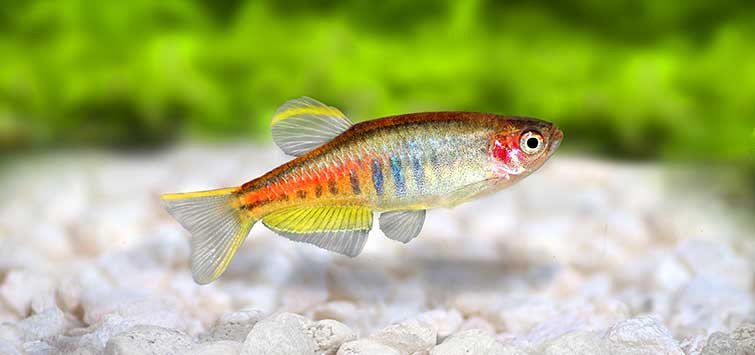
These small orange fish reach about 0.8 inch and suit peaceful planted aquariums. Keep a group rather than scattering two or three individuals among several tetra species. Ten gives you a useful shoal while leaving space for one compatible addition in the plans above. Choose food small enough for their mouths. Aquarium Co-Op’s ember tetra guide describes their social needs and preference for gentle filtration.

Honey gourami: a modest centerpiece

Confirm the scientific name, Trichogaster chuna. A honey gourami is not a dwarf gourami or the larger thick-lipped gourami sometimes sold under similar color names. One avoids the extra complications of keeping a breeding pair in a small community. Provide cover without blocking surface access, and watch feeding to make sure the fish is not intimidated. See the honey gourami care guide for identification and behavior.

Pygmy corydoras: social fish, not cleaners

Pygmy corydoras stay around an inch long and should live with their own kind. They also swim above the bottom, so do not assume they occupy otherwise unused space. Offer suitable small sinking foods directly; leftovers are not a complete feeding plan. A group of eight is a practical choice here, with quiet tankmates and places to rest. Aquarium Co-Op’s pygmy cory guide covers their group size and feeding needs.

Male guppies: a different water-chemistry option

Guppies are a better starting choice when your water is naturally hard and alkaline. An all-male group avoids deliberately adding breeding females, although males can still chase one another. Ask the seller to confirm their sex and have a separation plan for persistent bullying. Do not continually add fish to distract an aggressor. Read the guppy care guide and our guppy temperature guide before setting up.

How many fish can a 20-gallon tank hold?

There is no dependable single number. The inch-per-gallon rule overlooks body mass, activity, territorial behavior, social grouping, and adult growth. Twenty tiny fish and twenty stocky fish place very different demands on the same aquarium.

Use a complete stocking plan, not spare gallons, to decide what belongs. More filtration can help process waste but cannot create territory or swimming space. Stable test results also do not prove that a crowded or incompatible group has enough room.

Choices that need a different plan

  • Bettas: a 20-gallon aquarium can provide good space for one, but compatibility varies by individual. Do not add one to the gourami plan or assume it will tolerate small fish and shrimp.
  • Mollies and swordtails: do not substitute them for guppies without checking the exact variety, adult size, activity, and breeding needs. Larger varieties need more room; see our molly guide.
  • Goldfish and common plecos: leave these out of the small tropical communities above. Buying a juvenile does not solve its eventual housing requirements.
  • Unspecified “cichlids” or “barbs”: those labels cover very different fish. Identify the species before making any compatibility decision.

Prepare the aquarium before buying fish

Cycle the filter using a fishless method with a controlled ammonia source and testing. Simply running an empty tank for a few weeks does not demonstrate that it can process fish waste. Confirm completion of the chosen cycling method, including ammonia and nitrite returning to zero, before stocking. The RSPCA aquarium environment guide explains why this matters.

Use a suitable heater, thermometer, filter, and secure lid. Add fish in planned stages while preserving each species’ social group, and test after additions. Keep an established alternative available if fish must be separated; an uncycled bowl is not a useful backup.

Keep the plan manageable

Feed measured portions and check that every species eats. Inspect the equipment and fish daily. Use water tests and the tank’s condition to guide regular partial water changes; condition replacement tap water and avoid abrupt temperature changes. Fish, snails, and shrimp do not replace this work.

Give the aquarium a consistent day/night schedule rather than leaving the light on continuously. Adjust lighting to the plants and algae response. If maintenance becomes difficult, address feeding, filtration, and stocking before buying a supposed cleanup fish.

Start with one of the three plans, learn how that group behaves, and allow the aquarium to settle. An attractive 20-gallon tank does not need a specimen of every fish on the store’s small-fish shelf.

Best Aquarium Starter Kits: 4 Current Options

Best Aquarium Starter Kits: 4 Current Options

Disclosure: Aquarium Hunter may earn a commission from qualifying purchases made through links on this page, at no extra cost to you.

A good aquarium starter kit removes some of the guesswork, but the best choice still depends on the fish you plan to keep. For most beginners, a 20-gallon rectangular tank is easier to stock and keep stable than a tiny desktop aquarium. Smaller kits can work well for a single betta, shrimp or a carefully planned nano setup, but they leave less room for error.

Established freshwater aquarium showing the result a well-planned starter kit can achieve
An aquarium kit is only the starting point: appropriate stocking, cycling and regular maintenance matter just as much.

Quick comparison

Starter kit Size Best for Important limitation Buying option
Tetra Complete LED 20 20 gal Best all-round beginner choice Basic light and included equipment Check on Amazon
Fluval Spec 16 16 gal Stylish planted or small-fish setup Heater normally sold separately Check on Amazon
Aqueon Rectangle LED Kit 10 gal Compact heated freshwater setup Less forgiving than a 20-gallon tank Manufacturer details
Marineland Portrait 5 gal Single betta, shrimp or careful nano use Not a community-fish tank Check on Amazon

Our picks

1. Tetra Complete LED 20 — best overall for beginners

The Tetra Complete LED 20 is our strongest general recommendation because its rectangular 20-gallon footprint gives a new keeper more stocking flexibility and more stable water conditions than a five- or ten-gallon kit. The current kit includes a glass aquarium, LED hood, Tetra Whisper PF20 filter and a 100-watt heater.

It is a practical starting point for a modest tropical community once the tank is fully cycled and the fish have been checked for adult size, temperament and minimum group number. The supplied light is intended for general viewing; demanding live plants may need a lighting upgrade.

Check the Tetra Complete LED 20 on Amazon · Read the manufacturer specifications

2. Fluval Spec 16 — best premium compact kit

The Fluval Spec 16 combines a clean display-tank look with a concealed rear filtration compartment. Its integrated three-stage filtration and adjustable-output pump make it a polished option for small fish or a planted display, provided the stocking plan suits the tank’s footprint and flow.

A heater is not normally part of the kit, so tropical setups should budget for a correctly sized heater and a separate thermometer. The strong integrated light is useful for many common aquarium plants, but plant requirements still vary.

Check the Fluval Spec 16 on Amazon · Read the manufacturer specifications

3. Aqueon Rectangle LED Kit — best conventional 10-gallon option

Aqueon’s current rectangle LED range is a straightforward traditional setup. The 10-gallon version is listed with a glass aquarium, low-profile LED hood, QuietFlow filter, heater, thermometer, net, food, water conditioner and setup guide. That is a useful equipment bundle, although you will still need a water test kit, substrate, decorations or plants, and maintenance supplies.

Ten gallons can suit a carefully researched small-species plan, but it should not be treated as a miniature community tank. We are linking to the manufacturer because we did not find a sufficiently reliable exact Amazon listing for the current kit.

See the current Aqueon Rectangle LED kits

4. Marineland Portrait 5 — best for a carefully planned nano tank

The Marineland Portrait is attractive and compact, with hidden three-stage filtration, adjustable flow and an LED light. Its five-gallon volume makes it most appropriate for a single betta, shrimp or another deliberately researched nano setup—not a mixed community of fish.

Small tanks change quickly when food, waste or temperature fluctuates. Plan weekly maintenance, monitor water closely and make sure the filter flow suits the animal you choose. A heater may also be required for tropical livestock.

Check the Marineland Portrait 5 on Amazon · Read the manufacturer specifications

How to choose an aquarium starter kit

Choose the fish before the tank

Research the species’ adult size, social needs, swimming space, temperature range and temperament before buying a kit. A fish that is small in a shop may grow substantially, and many small fish need to live in groups. Tank length and floor area can matter as much as the advertised gallon capacity.

Bigger is often easier

More water dilutes waste and changes temperature more slowly. That does not make a larger tank maintenance-free, but a 20-gallon aquarium usually gives a beginner a wider safety margin than a tiny desktop kit. Make sure the stand is level and rated for the filled weight; water alone weighs about 8.3 lb per US gallon.

Check what the kit really includes

A kit may still need a heater, thermometer, liquid water test kit, dechlorinator, substrate, siphon, dedicated bucket, timer and decorations or plants. Confirm that the included heater suits the intended temperature and that the filter flow is appropriate for the livestock.

Do not replace all filter media at once

Beneficial bacteria live on filter media and other wet surfaces. Rinse reusable media gently in removed aquarium water when needed, and avoid replacing every piece at the same time. Disposable cartridges can be convenient, but preserving mature biological media is more important than following a rigid replacement calendar.

Before adding fish: cycle the aquarium

A newly filled tank is not biologically ready for fish. Use a fishless cycling method and a reliable test kit to establish bacteria that process toxic ammonia and nitrite. Add livestock only when the cycle is complete and tests show zero ammonia and zero nitrite, with nitrate being produced. Continue testing after fish are introduced and add animals gradually.

Use water conditioner whenever tap water containing chlorine or chloramine is added. Place electrical cords with drip loops, keep power connections away from splashes and never run a heater or filter dry.

Frequently asked questions

Is a 5-gallon aquarium good for beginners?

It can work for a single betta, shrimp or another appropriate nano plan, but it is less forgiving than a larger tank. A five-gallon aquarium is not suitable for a conventional mixed community.

Does an aquarium kit come ready for fish?

No. Even a complete kit must be assembled, dechlorinated and cycled before fish are added. You may also need equipment and supplies that are not included.

What size tank is best for a first aquarium?

For many beginners, a standard 20-gallon rectangular tank is a useful balance of stability, manageable maintenance and stocking flexibility. The right answer still depends on the species and the available space and budget.

Our verdict

The Tetra Complete LED 20 is the best general starting point in this group because its size gives a beginner more room to build a sensible freshwater community. The Fluval Spec 16 is the more refined compact choice, while the Marineland Portrait 5 should be reserved for a carefully planned nano setup.