Disclosure: Aquarium Hunter may earn a commission from qualifying purchases made through links on this page, at no additional cost to you. Recommendations are based on filtration design, maintainability, current manufacturer documentation, and suitability—not commission size.
The best aquarium power filter is one that fits the tank, supports a stable biological filter, offers enough mechanical media for the fish’s waste load, and remains easy enough to maintain consistently. For most freshwater community aquariums, a hang-on-back (HOB) power filter is a practical balance of performance, access, and price.
After removing discontinued, mismatched, and poorly supported choices from the old list, these five current filters remain worth comparing. Our most flexible recommendation is the Fluval AquaClear/AC platform; the Fluval C4 is the stronger choice for clearly separated filtration stages, while the Aqueon QuietFlow is convenient when automatic restart is a priority.
Best aquarium power filters: quick comparison
| Filter | Best for | Media style | Flow control | Main tradeoff |
|---|---|---|---|---|
| Fluval AquaClear 110 | Large aquariums and reusable media | Open media basket | Yes | Large unit; must be primed after service |
| Fluval C4 | Organized multi-stage filtration | Separate mechanical, chemical, and biological stages | Yes | More parts to clean |
| Aqueon QuietFlow 75 LED PRO | Easy restart and cartridge convenience | Cartridge plus biological grid | Model-dependent | More reliance on proprietary consumables |
| Tetra Whisper 60 | Basic filtration for a larger community tank | Cartridge-based | Limited | Less media customization |
| Marina Slim S15 | Small tanks with limited rear clearance | Compact cartridge system | Yes | Lower media capacity |
Manufacturer tank ratings are starting points, not stocking guarantees. Choose from the exact model’s specifications and increase filtration capacity for messy fish, heavy stocking, or unusual tank dimensions. Never use a stronger current that prevents fish from resting or swimming normally.
1. Fluval AquaClear 110: best for flexible reusable media
The AquaClear 110 is the established large-tank version of Fluval’s HOB platform. Its open basket holds foam, activated carbon, and BIOMAX separately, allowing each stage to be accessed without discarding everything at once. That is an important advantage: biological media can remain established while mechanical foam is rinsed.
Fluval rates the AquaClear 110 for 60–110 US gallons and provides adjustable flow. The official AquaClear line includes smaller models, so select the version matched to your aquarium rather than buying the 110 for every setup. The waterfall return improves surface movement, but the water level must be kept high to reduce splashing and noise.
Best features
- Large, accessible media basket.
- Reusable foam and separate biological media.
- Adjustable output for different fish and feeding conditions.
- Replacement parts and media remain documented by the manufacturer.
Limitations
- The 110 requires substantial clearance behind the aquarium.
- Like many conventional HOB filters, it may need to be refilled and primed after cleaning or a power interruption.
- Its intake requires a sponge prefilter for shrimp, fry, or long-finned fish.
2. Fluval C4: best organized multi-stage filter
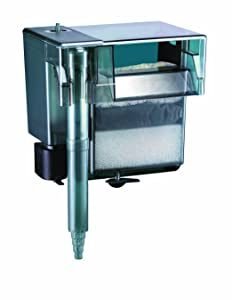
The Fluval C4 separates filtration into two mechanical stages, one chemical stage, and two biological stages. Fluval rates it for aquariums up to 70 US gallons, with a stated 120-volt circulation rate of 264 US gallons per hour. A cleaning indicator helps identify a clogged mechanical pad, although it does not replace routine visual checks.
The C4 is a good match for keepers who want each filtration role clearly defined. Its wet/dry biological area receives oxygen-rich water, and the adjustable output can extend media contact time. The tradeoff is complexity: more trays, pads, screens, and channels require careful cleaning than a simple open basket.
Best features
- Clearly separated mechanical and biological stages.
- Adjustable flow and documented model specifications.
- Mechanical pad slides out for rinsing.
- Good choice when you prefer organized media rather than a single cartridge.
Limitations
- Higher maintenance complexity than simpler HOB filters.
- Replacement pads and parts must match the C-Series model.
- Maximum rim thickness should be checked before purchase; Fluval lists 1 1/8 inches for the C4.

3. Aqueon QuietFlow 75 LED PRO: best for automatic restart
The Aqueon QuietFlow 75 LED PRO uses an internal pump that is designed to self-prime and restart automatically after power returns. That convenience is useful for an aquarium that may experience short outages, although every filter should still be checked after power restoration.
Aqueon describes five filtration stages, including floss, activated carbon, a biological holder and grid, and space for a specialty pad. The LED indicator responds to restricted water flow through the cartridge; it is a maintenance reminder, not a water-quality monitor.
Best features
- Self-priming internal pump.
- Simple cartridge removal and broad model range.
- Permanent biological surfaces are separate from the disposable floss cartridge.
- Current manufacturer documentation and replacement media.
Limitations
- Ongoing cartridge cost.
- Replacing all media together can remove useful bacteria; keep the permanent biological grid wet and do not replace it routinely.
- The LED does not measure ammonia, nitrite, nitrate, or filter maturity.

Check Aqueon QuietFlow 75 LED PRO on Amazon
4. Tetra Whisper Power Filter 60: best straightforward large-tank option
The Tetra Whisper 60 is a basic three-stage HOB filter marketed for aquariums up to 60 US gallons. Its simple cartridge system is approachable for a new keeper, and the model remains available through major retailers.
This filter works best for someone who values straightforward replacement media over customization. The downside is reduced flexibility and the temptation to replace a complete cartridge on a calendar. When the cartridge contains an established bacterial population, rinse reusable portions gently in removed aquarium water and avoid changing every biological surface at once.
Best features
- Simple installation and familiar replacement cartridges.
- Twin-sided design on the 60-gallon model distributes intake and return flow.
- Widely available consumables.
Limitations
- Less media flexibility than AquaClear or Fluval C-Series baskets.
- Cartridge costs accumulate.
- Model rating may be optimistic for heavily stocked or high-waste aquariums.

Check Tetra Whisper 60 on Amazon
5. Marina Slim S15: best for a compact aquarium
The Marina Slim S15 has a narrow body and adjustable flow, making it useful when rear clearance is limited or a gentler current is needed. Its compact size is also its main constraint: media volume is modest, so it suits an appropriately stocked small aquarium rather than a messy or crowded tank.
Confirm the exact S15 model, voltage, aquarium rating, and included cartridges on the retailer page before buying. Product variants and regional electrical specifications can differ.
Best features
- Slim profile.
- Adjustable flow.
- Easy access for routine cleaning.
Limitations
- Small media capacity.
- Cartridge-dependent design.
- Not appropriate as the only filter for large, messy fish.
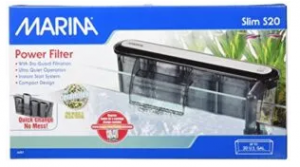
Amazon listing currently unavailable; review retained for readers comparing an existing or locally available unit.
How we selected these filters
We prioritized models that remain available, have current manufacturer or retailer documentation, and represent meaningfully different use cases. We compared:
- Mechanical and biological media capacity.
- Ability to service one stage without discarding the entire bacterial colony.
- Flow adjustment and suitability for delicate livestock.
- Restart behavior after cleaning or power loss.
- Availability of compatible media, parts, and instructions.
- Clear limitations, including clearance, noise, cartridge cost, and maintenance complexity.
We removed the old Marineland Emperor and Penguin listings because their linked versions were not reliably available, the Penn-Plax entry lacked enough verified detail to outrank the current choices, and the Aqueon internal filter did not belong in a HOB comparison. The Green Killing Machine was also removed because a UV sterilizer is a specialized water-clarifying device, not a general substitute for a properly sized mechanical and biological filter.
How to size a power filter
Do not choose by tank gallons alone. Consider adult fish size, stocking, feeding, plant debris, substrate, and how often you can service the filter. A lightly stocked planted aquarium and a goldfish aquarium of the same volume have very different waste loads.
Manufacturer “up to” ratings are useful for comparing models within a product line, but they assume conditions that may not match your tank. When uncertain, choose more media capacity and distribute the flow safely. Two filters can provide redundancy and better circulation in a long aquarium, but both still require maintenance.
Check physical fit
Measure the aquarium rim, distance to the wall, hood openings, and the vertical distance from the intake to the substrate. Keep the water level high enough for the return and follow the manufacturer’s leveling instructions.
Protect small animals
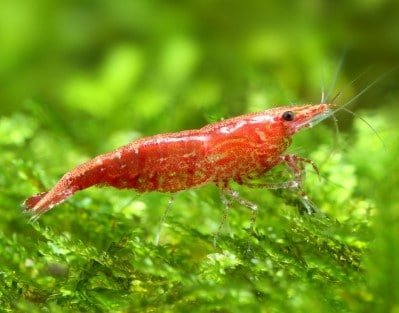
Add a sponge prefilter over the intake for shrimp, fry, snails, and delicate fins. Rinse it regularly because a clogged sponge reduces flow.
Understanding filter media
Mechanical filtration
Foam, floss, and pads trap uneaten food, waste, and plant fragments. Rinse reusable mechanical media in removed aquarium water before it becomes severely clogged. Replacing dirty mechanical media is not a substitute for removing waste from the substrate.
Biological filtration
Porous foam, ceramic media, and permanent grids support nitrifying bacteria that process ammonia and nitrite. Keep biological media wet in dechlorinated aquarium water during service. Never replace all mature media at once unless contamination makes it unavoidable.
Chemical filtration
Activated carbon can remove some dissolved organic compounds, odors, discoloration, and medications, but it is not required continuously in every aquarium. It becomes exhausted and must be replaced when used for a specific purpose. Chemical media cannot compensate for an uncycled tank or overdue water changes.
Power filter maintenance
- Unplug the filter and heater before lowering the aquarium water level.
- Remove and rinse mechanical media in discarded tank water.
- Swish biological media gently only when debris is restricting flow.
- Clean the intake, impeller well, and return channel according to the manual.
- Reassemble, refill the HOB chamber if required, and restore power.
- Confirm normal flow and restart before leaving the aquarium.
- Test ammonia and nitrite after major maintenance or any loss of filter bacteria.
Clean according to flow and waste accumulation rather than an inflexible calendar. Never wash mature biological media under chlorinated tap water, and never allow it to dry during maintenance.
Frequently asked questions
Is a HOB filter enough for an aquarium?
Yes, for many appropriately stocked freshwater aquariums. It must provide adequate media capacity, circulation, and oxygen exchange. Large fish, marine systems, very long tanks, or specialized aquascapes may benefit from canister filters, sumps, sponge filters, or multiple units.
Does a higher flow rate mean better filtration?
No. Flow must carry waste to the media and distribute oxygen, but water moving too quickly can bypass fine debris or exhaust fish. Media volume, contact, maintenance, and tank circulation matter alongside gallons per hour.
Should I replace a filter cartridge every month?
Replace disposable media when it is damaged or cannot be cleaned enough to restore flow—not merely because a date has passed. Preserve established biological media whenever possible. If a cartridge combines carbon and floss, consider whether the design offers a separate permanent biological surface.
What happens during a power outage?
Keep media wet and restore oxygenation as soon as possible. After power returns, confirm that the filter has restarted; conventional HOB units may need manual priming. For a long outage, discard foul stagnant water from the filter chamber, restart with conditioned water, and monitor ammonia and nitrite.
Final recommendation
Choose the Fluval AquaClear/AC platform when reusable media flexibility and easy access are your priorities. Choose the Fluval C4 for organized multi-stage filtration, or the Aqueon QuietFlow 75 LED PRO for convenient automatic restart. The Tetra Whisper 60 and Marina Slim S15 are simpler choices for their respective tank sizes, but their cartridge systems offer less customization.
Whichever filter you buy, correct sizing, mature biological media, routine cleaning, and water testing matter more than the brand name.