

Disclosure: Aquarium Hunter may earn a commission from qualifying purchases made through links on this page, at no extra cost to you.
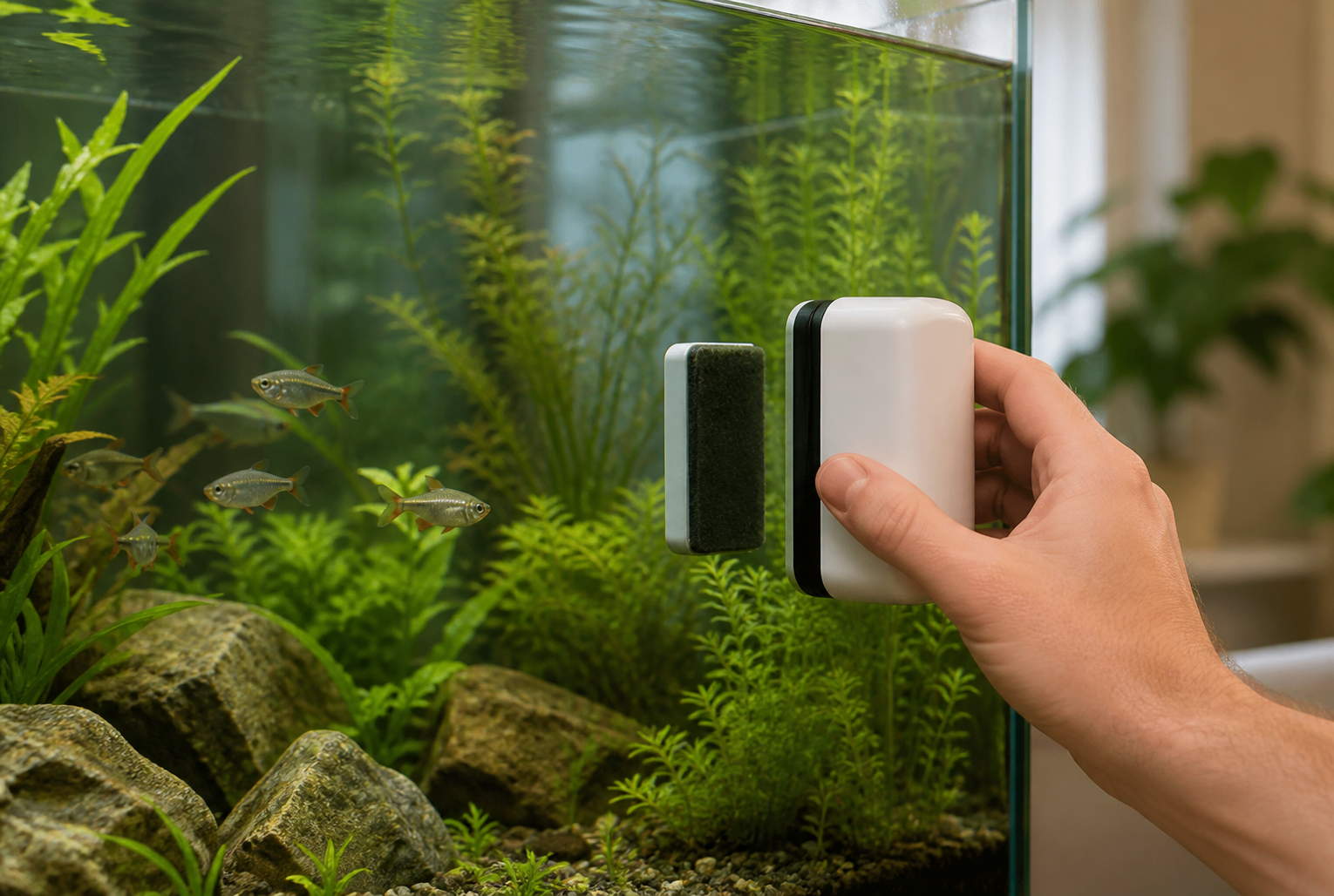
A magnetic aquarium cleaner lets you wipe algae from the inside of the viewing panel without putting your hand in the water. The best model is the one rated for your tank’s actual panel thickness and material. A cleaner that is too weak disconnects constantly; one that is unnecessarily strong can be awkward to move and easier to mishandle.
Quick comparison
| Magnetic cleaner | Rated panel | Best for | Buying option |
|---|---|---|---|
| FLIPPER Float Standard | Glass or acrylic up to 1/2 in (12 mm) | Best versatile scrubber and scraper | Check on Amazon |
| Mag-Float Medium Glass | Glass up to 3/8 in | Best simple floating cleaner | Check on Amazon |
| Tunze Care Magnet Long | Glass 10–15 mm | Best for thicker glass and sand clearance | Check on Amazon |
| hygger Magnetic Cleaner, Medium | Confirm current size chart | Budget cleaner with scraper | Check on Amazon |
Before buying: measure the panel at an exposed edge and check the exact manufacturer range. Tank capacity is only a rough guide; two aquariums of similar volume can use different glass or acrylic thicknesses.
Best aquarium magnet cleaners
1. FLIPPER Float Standard — best overall
The FLIPPER Float Standard combines a scrubber with interchangeable scraper blades and changes sides when the handle is rotated. The manufacturer rates it for glass and acrylic panels up to 1/2 inch (12 mm). It includes a stainless-steel blade for glass and a plastic blade for acrylic, so it is the most versatile option in this group.
The wet half floats toward the surface if it disconnects, which can make retrieval easier. The blade side is useful for stubborn spot algae, but a metal blade must never be used on acrylic and should be kept clear of silicone seams.
Check the FLIPPER Float Standard on Amazon · See the manufacturer specifications
2. Mag-Float Medium Glass — best simple floating cleaner
The Mag-Float Medium Glass is a straightforward pad-style cleaner for glass aquariums. Mag-Float lists it for tanks up to 125 gallons or glass up to 3/8 inch thick, but panel thickness is the more dependable selection criterion. The inner half floats if separated.
This version is intended for glass. Mag-Float also makes material- and size-specific variants, so do not assume one Medium model is interchangeable with another. A scraper is not included with this standard version.
Check the Mag-Float Medium Glass on Amazon · See the Mag-Float size guide
3. Tunze Care Magnet Long — best for thicker glass
The Tunze Care Magnet Long uses narrow plastic blades rather than a broad pad resting directly against the pane. Tunze says the inner magnet sits more than 3 mm away from the glass, reducing the likelihood that sand becomes trapped. The Long model is rated for 10–15 mm glass and includes a stainless-steel blade plus spare plastic blades.
This is a strong choice for an appropriately thick glass aquarium, especially where substrate near the viewing panel is a concern. Match the exact Care Magnet version to the glass thickness; the Nano, Long, Strong and Strong+ are not interchangeable sizes.
Check the Tunze Care Magnet Long on Amazon · See Tunze specifications
4. hygger Magnetic Cleaner, Medium — budget option
The medium hygger cleaner combines a floating inner half, cleaning pad and scraper at a lower price than the premium alternatives. It can be a practical choice for routine film algae on a compatible glass tank.
Confirm the current listing’s thickness guidance before ordering, because this cleaner is sold in several sizes and marketplace titles can change. Inspect the pad and scraper before every use and stop if the halves drag harshly or disconnect repeatedly.
Check the hygger Medium Magnetic Cleaner on Amazon
How to choose safely
Match the aquarium material
Glass is harder to scratch than acrylic, but neither is scratch-proof. Only use a metal blade when the manufacturer explicitly approves it for glass. Acrylic needs an acrylic-safe plastic blade or pad, and even those can scratch if grit is trapped underneath.
Use panel thickness, not only gallons
Magnetic strength must reach through the aquarium panel. Measure the glass or acrylic at a visible edge, then choose a model whose stated range includes that measurement. Bow-front and curved panels can reduce contact area, so check the cleaner manufacturer’s guidance for curved tanks.
Decide whether you need a scraper
A soft cleaning pad handles routine film algae. A blade can make hard green spot algae or coralline algae easier to remove, but it increases the need for careful material selection and seam clearance. Never force a blade across damaged glass or acrylic.
Consider retrieval
A floating wet side is convenient if the halves separate. A sinking model is not automatically inferior, but retrieval can be awkward in a deep or heavily decorated tank. Floating does not make a cleaner safe to leave in place indefinitely.
How to use a magnetic cleaner without scratching the tank
- Inspect both halves and remove every grain of sand, shell fragment or hard deposit.
- Place the wet half against the inside pane and bring the dry half toward it gradually to avoid a hard snap.
- Move slowly in overlapping passes. Stop if you feel grinding, unusual resistance or repeated disconnection.
- Stay above the substrate line. Clean the final lower strip separately with an appropriate handheld tool.
- Keep scraper blades away from silicone seams and decorative film.
- Separate the halves after use, rinse them, dry the outer felt and store them with a spacer between the magnets.
Common mistakes
- Dragging through sand: trapped quartz or gravel can leave a permanent scratch.
- Using the wrong blade: stainless steel is not acrylic-safe.
- Buying by tank volume alone: the actual panel thickness determines magnetic performance.
- Leaving the cleaner attached: debris can collect under it, and the dry-side surface can mark the outside pane.
- Snapping strong magnets together: this can pinch fingers or damage the cleaner.
Magnet precautions
Powerful magnets can pinch fingers and may affect magnet-sensitive medical devices, electronics, magnetic cards and storage media. Keep the separated halves and packaged cleaner away from children and follow the manufacturer’s safety instructions. People with implanted medical devices should follow their device manufacturer’s advice about safe distances from magnets.
Frequently asked questions
Can magnetic cleaners scratch aquarium glass?
Yes. Glass cleaners most often scratch when sand or another hard particle is trapped between the wet side and the pane. Inspection and careful technique are essential.
Can I use a glass cleaner on acrylic?
Only when the exact cleaner and its installed pad or blade are explicitly rated for acrylic. Never use a metal scraper blade on acrylic.
Will a magnetic cleaner remove every type of algae?
No. Routine film algae is usually easy, while hard spot algae or coralline algae may need a suitable scraper. Algae growing on silicone seams, textured backgrounds or decorations needs a different cleaning method.
Our verdict
The FLIPPER Float Standard is the most versatile option because it combines scrubbing, material-specific blades and floating retrieval. The Mag-Float Medium Glass is a simpler choice for compatible glass aquariums, while the Tunze Care Magnet Long stands out for thicker glass and its deliberate clearance from substrate.