

Brackish aquariums can support plants, but the choices shrink as salinity rises. Some genuinely salt-tolerant species are suitable for estuary-style systems, while familiar freshwater aquarium plants may survive only at the very low end of the brackish range. Success depends on measuring salinity, changing it slowly and choosing plants for the exact conditions—not merely adding “a little salt.”
Seven brackish aquarium plants compared
| Plant | Best use | Confidence in salt tolerance |
|---|---|---|
| Moneywort | Submerged or emergent low-brackish planting | High; naturally occurs in coastal and brackish habitats |
| Seaside brookweed | Cooler, bright shallow margins | High for damp coastal conditions; aquarium performance varies |
| Cryptocoryne ciliata | Warm estuary-style margins and shallow water | High relative to other Cryptocoryne |
| Red mangrove | Open-top paludarium or very large specialist display | Very high, but it is a tree rather than a normal aquarium plant |
| Java fern | Hardscape in very low salinity | Experimental; individual strains and conditions vary |
| Anubias barteri | Emergent or attached growth at very low salinity | Experimental; better treated as freshwater-first |
| Java moss | Cover at the lowest brackish levels only | Variable; monitor for browning and detachment |
1. Moneywort (Bacopa monnieri)

Moneywort is the strongest conventional aquarium candidate in this list. It naturally occurs across tropical and subtropical wetlands, including coastal and brackish sites. It can grow submerged, along wet margins or above the water, making it useful in tanks where the water level changes.
Give it bright light and a nutrient source at the roots or in the water column. Start in freshwater and raise salinity slowly over weeks, watching new growth rather than old leaves. Pale tips, stalled growth or repeated stem melt indicate that light, nutrients or salinity are outside the plant’s useful range.
2. Seaside brookweed (Samolus valerandi)
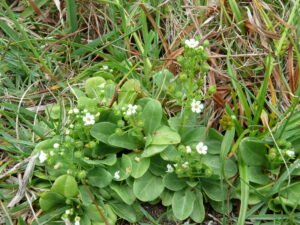
Seaside brookweed is a wetland plant found in damp places, river margins and coastal environments. In an aquarium it is best treated as a cool-tolerant marginal or shallow-water plant, not a guaranteed long-term fully submerged carpet.
Use strong light, an open foreground and a nutrient-bearing substrate. Buy plants grown for aquarium use rather than collecting from the wild. If leaves become translucent or the crown rots, reduce stress and consider growing the plant with leaves above the surface.
3. Cryptocoryne ciliata
Cryptocoryne ciliata is the Cryptocoryne specifically associated with freshwater tidal zones and occasional brackish habitat. That makes it a better evidence-based choice than Cryptocoryne wendtii, which was recommended in the previous version of this guide without adequate support for brackish use.
This is a large plant for a warm, spacious setup, often performing well with leaves above the water. Give it a rich substrate and avoid abrupt changes. Cryptocoryne can shed leaves after transplanting; healthy roots and later new growth are more important than retaining every old leaf.
4. Red mangrove (Rhizophora mangle)
Red mangrove is genuinely adapted to tropical estuaries and waterlogged soils of varying salinity. It is also a tree that can grow many metres tall—not a small underwater aquarium plant. Use it only in an open-top paludarium, mangrove display or very large specialist system where the leaves remain above water.
Provide intense light, warm air, high humidity and room for roots and shoots. Salt is tolerated but not required; Kew notes that cultivated red mangroves can grow without seawater. Check collection and possession rules, and obtain legally propagated plants. Pruning does not turn a tree into a permanently maintenance-free nano-aquarium plant.
5. Java fern (Microsorum pteropus)
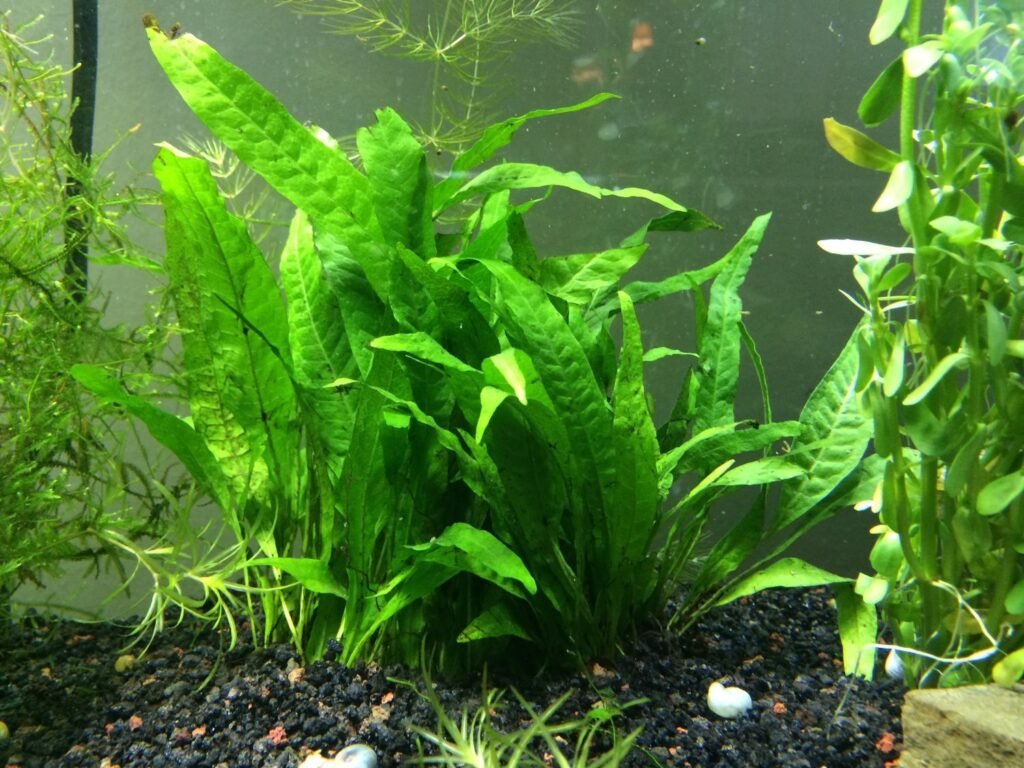
Java fern is a freshwater wet-tropical fern and lithophyte, not a true salt-marsh plant. Some aquarists keep it at very low salinity after gradual acclimation, but it should not be presented as broadly brackish-tolerant. Treat it as an experiment for the freshwater edge of a brackish system.
Attach the rhizome to wood or rock instead of burying it. Use moderate light and increase salinity in small measured steps. Judge success by firm new leaves; blackened, transparent or steadily shrinking foliage means the conditions are unsuitable.
6. Anubias barteri


Anubias is another durable freshwater-first plant sometimes used at very low brackish levels. Its thick leaves and ability to grow emersed make it a practical trial plant, especially where its leaves can remain above the saltiest water. Salt tolerance is not unlimited and may vary between plants.
Attach the rhizome to hardscape and keep it exposed. Low-to-moderate light helps control algae on the slow-growing leaves. Acclimate gradually and keep a freshwater backup plant rather than moving an entire collection into brackish water at once.
7. Java moss (Taxiphyllum barbieri)

Java moss is useful for cover and grazing surfaces in freshwater, but its brackish performance is inconsistent. Try it only at the lowest salinity needed by the animals, with gradual acclimation, moderate light and good flow through the moss.
Thin dense clumps so debris does not accumulate inside them. Remove browning material promptly. If new tips stop growing after salinity rises, return the surviving portion to freshwater rather than assuming it will adapt indefinitely.
Plants removed from the old recommendations
Marimo moss balls
Marimo is a freshwater alga, not a reliable brackish plant. It was also involved in repeated invasive zebra-mussel detections in the aquarium trade, including a documented 2024 incident. Follow current local biosecurity advice before buying, moving or disposing of moss balls, and never release them or aquarium water into natural waterways.
Anacharis (Egeria densa)
Anacharis is primarily a freshwater plant, and it is invasive or regulated in some regions. It is not a responsible default recommendation for a brackish guide. Check local law before purchase and dispose of trimmings in household waste rather than drains, ponds or streams.
Cryptocoryne wendtii
Cryptocoryne wendtii is an excellent freshwater aquarium plant, but the brackish-habitat evidence within the genus points specifically to C. ciliata. The two should not be treated as interchangeable simply because they share a genus.
How to acclimate plants to brackish water
- Define the animals’ target salinity. Do not raise salinity beyond what the fish or invertebrates need.
- Measure accurately. Use a calibrated refractometer or salinity meter and record the reading and temperature.
- Start with healthy plants. Root and establish them in freshwater before changing conditions where possible.
- Increase salinity slowly. Make small changes over weeks, not a single large dose.
- Watch new growth. Old leaves can persist while the plant is failing; new roots and leaves are the better sign.
- Keep a backup. Retain a freshwater cutting or division until the trial plant shows sustained growth.
Lighting, nutrients and maintenance
Salt is only one stress. Plants also need suitable light, carbon and nutrients. Avoid changing salinity, lighting and fertiliser at the same time because you will not know which change caused a problem. Remove dead leaves before they decay, maintain circulation and continue ordinary ammonia, nitrite and nitrate testing.
Plant growth does not replace filtration or water changes. A brackish aquarium still requires a fully established nitrogen cycle, stable oxygen and species-appropriate maintenance.
Frequently asked questions
Can ordinary freshwater plants live in brackish water?
Some tolerate very low salinity for a time, but survival is not the same as healthy long-term growth. Choose naturally salt-tolerant species first and test freshwater plants cautiously.
How much salt should I add for the plants?
None unless the animals and habitat plan require brackish water. Set salinity for the verified livestock, then choose plants that tolerate that level.
Can I use table salt?
No. Use an appropriate marine salt mix when creating brackish water so the water contains the required major and minor ions. Measure salinity rather than dosing by spoonfuls.
Why are my plants melting after adding salt?
The increase may have been too fast or too high, or another factor such as temperature, light or nutrient availability may have changed. Remove decaying tissue, verify the measurement and reduce stress rather than adding more products.
Sources
- Kew Plants of the World Online — accepted names, distributions and habitats for the plant species discussed
- Kew: Cryptocoryne habitat and the brackish-water distinction for C. ciliata
- Kew: Red mangrove ecology and cultivation
- USGS: Invasive zebra mussels found in aquarium moss balls
- USGS NAS reference: 2024 zebra mussel detection on aquarium Marimo