
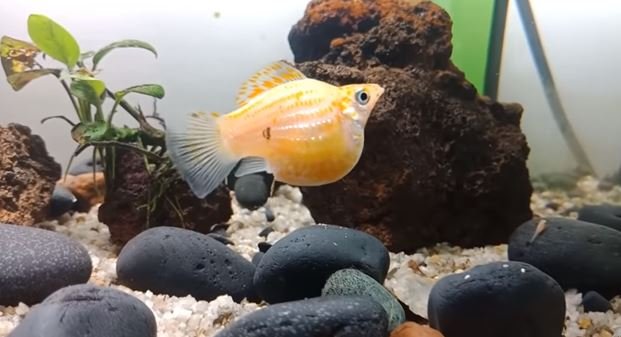
A gradually enlarging belly in a mature female that has been with a male is a useful clue that a molly is pregnant. A dark patch near the rear of the abdomen may also be visible. No single outward sign confirms pregnancy or tells you the exact day she will give birth. Check the fish’s sex, recent history, body shape, and overall health together.
Check that your molly is female
Look at the anal fin underneath the fish, behind the belly. An adult female normally has a fan-shaped anal fin; a mature male has a narrow, rod-shaped reproductive fin called a gonopodium. Color and size alone are less dependable ways to tell them apart. Aqueon’s livebearer guide explains this difference and how these fish give birth to swimming young rather than laying eggs.
A female bought recently may already have mated at the store or breeder. Mollies can store sperm, so the absence of a male in your aquarium does not rule out a later pregnancy. This is documented for sailfin mollies in the University of Florida’s research review of the species (PDF, pages 3–4).
Pregnancy clues—and their limits
| What you notice | How to interpret it |
|---|---|
| Belly grows gradually over several weeks | Supports pregnancy in an otherwise healthy female with a mating history; swelling has other possible causes. |
| Darker area toward the rear of the belly | A gravid spot can be visible on lighter fish. Pigmentation can hide it on black mollies. |
| Belly looks more squared near the rear | May occur late in pregnancy, but is not a reliable countdown to delivery. |
| Hiding, reduced appetite, or unusual stillness | Check water quality and health. These behaviors are not proof of labor. |
Compare photographs taken from the same angle several days apart without catching or handling the fish. Balloon mollies already have a rounded body shape, making a belly-only judgment especially unreliable. Never squeeze the abdomen to check for babies.
How long are mollies pregnant?
Expect several weeks, not a precise deadline. Published estimates vary with the molly species and conditions: the Florida review reports about three to four weeks for sailfin mollies, while Aquarium Co-Op’s aquarium molly guide gives a broader 30–60-day breeding timeframe. A purchase date is not a known fertilization date.
Do not raise the temperature or make abrupt water changes to try to trigger birth. Maintain the fish’s normal, stable conditions. A female becoming distressed needs a health and water-quality check, not a revised due date.
When a swollen belly needs attention
Raised scales, sores, rapid breathing, loss of balance, or persistent refusal to eat should not be dismissed as pregnancy. Test ammonia and nitrite, check the temperature and filter, and observe whether other fish are affected. Seek an aquatic veterinarian’s advice for swelling accompanied by illness or worsening symptoms. Do not start medication solely because a fish looks round.
For a fish resting abnormally or struggling to swim, our bottom-resting fish troubleshooting guide helps organize the initial checks.
Should you separate a pregnant molly?
Choose your fry-raising plan before delivery. In a planted community aquarium, dense cover offers newborns hiding places, but adults—including their mother—may eat them. This approach does not guarantee that every baby survives.
If you want to raise more fry, prepare a separate, fully cycled nursery with gentle filtration and water conditions matching the main tank. A bare container of aquarium water is not a cycled nursery. Protect filter intakes so small fish cannot be drawn in.
Avoid repeatedly chasing a heavily pregnant fish or keeping her confined in a tiny breeding trap for days while guessing her due date. If you cannot provide suitable separate housing, improve cover in the existing aquarium and plan proper grow-out space rather than improvising an unfiltered bowl.
What to do when the babies arrive
Molly fry can take suitably fine food from birth. Offer small portions of finely crushed appropriate fish food or fry food; newly hatched brine shrimp are another option. Feed little and often, remove leftovers, and monitor water quality closely. Extra feeding can quickly overwhelm a small nursery.
In a separate breeding tank, remove the mother once delivery is finished and she can be moved without unnecessary disturbance. Use the fry’s actual size and the mouths of potential tankmates to judge when they can safely join a larger aquarium—not a fixed four- or eight-week rule. See our molly fry care guide for the next stage.
Plan for more than one brood
Decide where growing juveniles will live before trying to save a whole brood. Do not release unwanted aquarium fish outdoors. Arrange suitable homes and discuss sex separation with an experienced fishkeeper; females with a previous mating history may still produce young afterward.
For long-term housing and water requirements, continue with our molly fish care guide.