
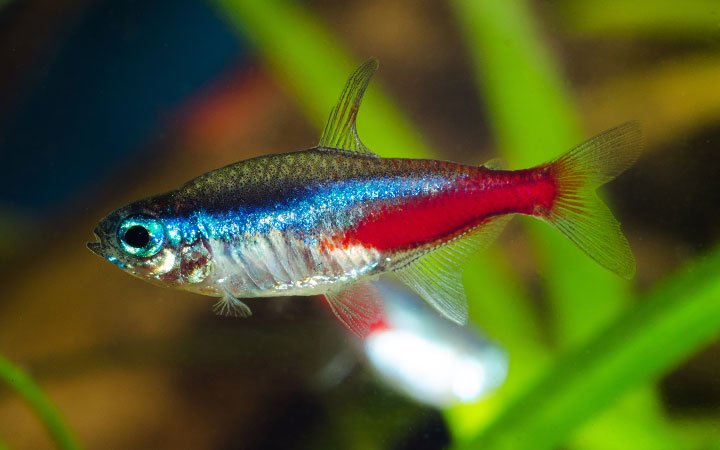
Neon tetras do not become pregnant with live babies: females develop eggs. Neon tetras (Paracheirodon innesi) lay eggs that are fertilized outside the body. However, a rounded belly alone cannot tell you whether a fish has eggs, has recently eaten, or is unwell.
Start with the fish’s behavior and your water tests. A comfortable, active female with a gently rounded abdomen needs a different response from a fish that is rapidly swelling, breathing hard, or struggling to swim.
Can neon tetras get pregnant?
Neons are egg scatterers. During spawning, a female releases eggs and a male releases sperm. There is no livebearer-style pregnancy or predictable “due date.” The more accurate term for a female carrying developed eggs is gravid.
The University of Florida’s guide to ornamental fish reproduction describes tetras as generally scattering eggs and sperm over underwater structures, without parental care. Adults may eat the eggs, so successful spawning in a community tank does not necessarily produce surviving fry.
Eggs, a full stomach, or illness?
Compare the fish with its usual appearance, ideally before feeding and from both the side and above. Adult females are often fuller-bodied than males, but body shape and the curve of the blue stripe are clues, not reliable pregnancy tests.
| What you notice | What it may mean | Best next step |
|---|---|---|
| Gradual, fairly even fullness; normal appetite and swimming | Normal female body shape or developing eggs | Observe without repeatedly catching or isolating the fish. |
| Belly looks fuller immediately after a meal | Recent feeding may explain the change | Review portion size and compare again before the next feeding. |
| Increasing or uneven swelling; appetite loss or unusual hiding | A health problem needs consideration | Test water and seek advice from a veterinarian who treats fish if it persists or worsens. |
| Raised scales, severe swelling, gasping, or loss of balance | Urgent warning signs | Address water quality promptly and contact a fish veterinarian. |
Fluid buildup can produce a swollen abdomen and raised, pinecone-like scales. As the Merck Veterinary Manual explains, fish diseases can have overlapping signs. “Dropsy” describes a condition rather than identifying its cause. A photograph or swollen belly does not justify choosing an antibiotic, salt treatment, or parasite medication.
What to do when a neon tetra looks swollen
- Check the whole aquarium. Are other fish breathing quickly, hiding, or refusing food? A shared change makes environmental trouble especially important to investigate.
- Test the water. Check ammonia, nitrite, nitrate, pH, and temperature. Ammonia and nitrite should be undetectable in an established aquarium. Our aquarium test kit guide explains which measurements different kits cover.
- Correct problems gently. Use conditioned, temperature-matched replacement water for an appropriate partial water change, and check that filtration and surface movement are working. Do not abruptly change pH or hardness to encourage spawning.
- Keep a short record. Note appetite, breathing, swimming, test results, and whether swelling changes. Clear photos taken under similar lighting help show progression.
- Escalate when needed. Rapid deterioration, raised scales, or difficulty swimming deserves prompt veterinary advice. See our guide to a fish swimming sideways for environmental checks while arranging help.
If the female otherwise behaves normally, keep ordinary maintenance and modest, balanced meals consistent. She does not need a cramped breeding box simply because she looks round. Never squeeze her abdomen to “release” eggs.
If you want to breed neon tetras
Breeding is a separate project, not a treatment for swelling. Prepare space for growing fry and an appropriate first-food culture before attempting it. A spare tank is only useful when its water quality and filtration are ready for fish.
A practical beginner preparation is a covered 10-gallon breeding aquarium with a mature, gently running sponge filter and fine-leaved plants or a spawning mop. This is a planning suggestion, not a claim that every successful breeder uses that size. Keep the community tank’s normal care routine intact.
Neon breeding commonly uses very soft, acidic water and subdued light. In his firsthand breeding account, John Robertson describes success around 75–78°F and emphasizes light-sensitive eggs and fry. Those observations are not a reason to suddenly acidify an established tank. Acclimate fish carefully; very low buffering makes pH harder to manage. Our RO and tap-water mixing guide explains why both hardness and buffering need attention.
Remove adults after spawning if you intend to protect eggs. Avoid bright inspection lights. Newly hatched larvae initially use their yolk reserves; once free-swimming, they need food small enough to swallow, such as suitable infusoria or cultured Paramecium, before progressing to larger foods. Tiny, measured feedings and careful waste removal matter more than adding large quantities of food.
Common questions
How long is a neon tetra pregnant?
It is not pregnant in the livebearer sense. A rounded female does not have a dependable countdown to spawning. Do not wait for a supposed due date if swelling is worsening or the fish is unwell.
Does chasing mean spawning is about to happen?
Not necessarily. Chasing alone cannot confirm fertilization or even that you have correctly identified a male and female. Watch for persistent harassment and give fish cover rather than assuming all chasing is courtship.
Can a female lay eggs without a male?
A female can release unfertilized eggs, but those eggs will not develop into fry. Finding eggs does not prove that fertilization occurred.
Why are there no babies in my community tank?
Eggs may be unfertilized, eaten, or lost before you notice them. Fry also need suitable food and protection from filter intakes and tank mates. A full-bellied female by itself is not evidence that any eggs were laid.