Aquarium rock should be chosen for both appearance and water chemistry. Some stone is largely inert, while limestone, coral rock and many pieces sold as Seiryu can raise hardness and alkalinity. The safest choice also needs stable placement, smooth enough surfaces for the livestock and enough open space for maintenance and swimming.

Quick comparison
| Rock | Best use | Chemistry | Buying option |
|---|---|---|---|
| Ohko Dragon Stone | Planted aquascapes | Usually selected as a low-impact stone; test each batch | Check on Amazon |
| Black Lava Rock | Lightweight planted layouts | Typically low impact; verify coating and source | Check on Amazon |
| Black Mountain Seiryu | Hard-water aquascapes | May raise KH, GH and pH | Check on Amazon |
| CaribSea South Seas Base Rock | Marine and reef foundations | Aragonitic; suited to marine chemistry | Check on Amazon |
| Marina Naturals Rock Outcrop | Lightweight artificial décor | Designed as aquarium ornament | Check on Amazon |
Natural-rock lots vary in shape, weight and mineral content. The photographs may not show the exact pieces supplied.
1. Ohko Dragon Stone
Best for: detailed planted-tank layouts.
Dragon stone has an eroded, layered texture that creates scale and planting pockets. Its cavities commonly arrive packed with clay, so soak the pieces and flush every hole repeatedly before they enter the aquarium. Do not boil rocks: trapped moisture or air can make some stone fracture dangerously.
It is often chosen for soft-water aquascapes because it generally has less buffering effect than limestone, but natural material is variable. Test representative pieces and monitor KH, GH and pH after setup.
2. Black Lava Rock
Best for: building height without the weight of dense stone.
Porous lava rock can form useful planting ledges and hidden support structures. Its rough surface provides area for biofilm but can abrade long-finned fish, soft-bellied species or animals that wedge into gaps. Inspect every piece and position sharp faces away from swimming routes.
Buy rock sold for aquarium use. Landscaping lava rock may carry dust, oils, fertilizers or unknown treatments.
Check Black Lava Rock on Amazon
3. Black Mountain Seiryu Stone
Best for: dramatic freshwater layouts where increasing hardness is acceptable.
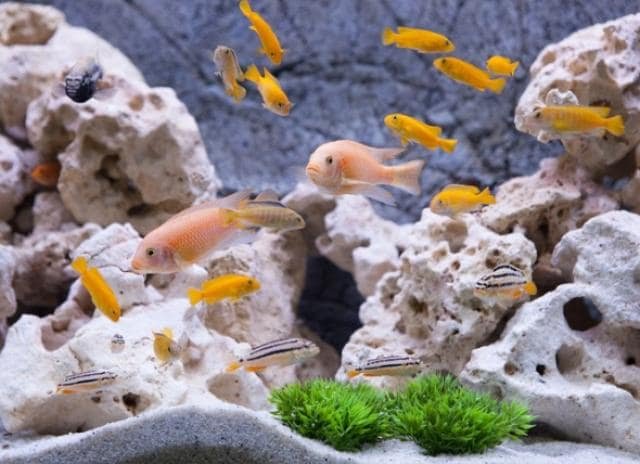
Seiryu-style stone has strong gray-blue ridges and pale veins, but carbonate minerals can raise KH, GH and pH. That can be helpful in some hard-water or African cichlid displays, yet counterproductive in a soft-water aquascape with shrimp or fish selected for low mineral content.
Acid fizz tests can indicate carbonate, but they do not quantify the change in an aquarium. A better practical check is to soak a representative piece in known water and compare KH, GH and pH over several days.
4. CaribSea South Seas Base Rock
Best for: constructing a dry foundation in marine and reef aquariums.
South Seas is an aragonitic base rock intended for saltwater use. It provides porous-looking structure without introducing hitchhikers associated with wet live rock. It is not the right choice for a soft, acidic freshwater aquarium because carbonate material can affect hardness and alkalinity.
Rinse loose dust and cure or condition the rock according to the current instructions and reef setup plan. Dry base rock does not instantly provide a mature biological filter; the aquarium still needs a controlled cycle.
Check CaribSea Base Rock on Amazon
5. Marina Naturals Rock Outcrop
Best for: a lightweight, predictable ornament.
This molded outcrop provides a rock-like shape without the variable mineral content and weight of natural stone. Artificial décor is useful in small tanks or where a heavy hardscape is impractical, but inspect openings and seams for trapped fish, rough edges or deterioration before use.
Check the Marina Outcrop on Amazon
How to tell whether a rock is aquarium safe
- Know the source: avoid stone exposed to pesticides, road runoff, mine waste, metal residues or salt spray.
- Inspect the structure: reject crumbly, oily, metallic-smelling or freshly painted material.
- Consider chemistry: carbonate-rich rock can be safe but unsuitable for the target water parameters.
- Test over time: soak a cleaned sample in known water and compare pH, KH and GH with a control container.
- Clean safely: scrub with water and a dedicated brush. Do not use household soap, and never boil unknown rock.
Building stable rockwork
Place major structural rocks on the tank base or on a purpose-designed protective support before adding deep substrate, so digging fish cannot undermine them. Keep point loads and hard edges away from bare glass. Lock pieces together mechanically with stable contact points; aquarium-safe epoxy or cyanoacrylate can reinforce a structure but should not be expected to rescue an unstable stack.
Leave clearance around the glass for cleaning and create openings large enough that fish cannot become trapped. Consider the final adult size of every animal, not its size on purchase.
Freshwater versus marine rock
Freshwater aquascapes often use dragon stone, inert river stone, lava rock or deliberately buffering limestone. Marine systems use aragonitic base rock or purpose-made reef structures that support marine chemistry. “Live rock” refers to biologically colonized marine rock and requires separate handling, curing and pest management; it should never be treated as ordinary freshwater décor.
Frequently asked questions
Can I collect rocks outdoors?
Only when collection is legal and the geological and contamination risks are understood. Purpose-sold aquarium rock is safer when the source is uncertain.
Does vinegar prove a rock is safe?
No. Visible fizz may reveal carbonate, but no reaction does not rule out metals, contamination or slow chemical effects.
How much rock should an aquarium have?
There is no correct pounds-per-gallon rule. Use enough to achieve habitat and visual goals while preserving swimming space, water flow, maintenance access and safe floor loading.
Final verdict
Dragon stone is the strongest general choice for planted freshwater aquascapes, while lava rock is useful for lightweight structure. Use Seiryu only when its possible buffering effect suits the livestock. CaribSea South Seas is the appropriate marine foundation in this group, and the Marina outcrop offers predictable artificial décor where natural stone is undesirable.
Affiliate disclosure: Aquarium Hunter may earn a commission from qualifying Amazon purchases, at no additional cost to you. Recommendations are matched to the exact products discussed.