
The best aquarium heater is one that matches your tank, holds a stable species-appropriate temperature, and has clear safety controls. Our top all-round choice is the Fluval E Series for its digital display, dual sensors, protective guard, and multiple wattages. The Aqueon Pro is a strong shatter-resistant alternative, while EHEIM, Hygger, and Orlushy suit different budgets and tank layouts.
Disclosure: Aquarium Hunter may earn a commission from qualifying Amazon purchases, at no extra cost to you. Product availability and prices can change.
Quick Comparison
| Heater | Best for | Key consideration | Buy |
|---|---|---|---|
| Fluval E Series | Best overall | Display and protective guard; check length | Check on Amazon |
| Aqueon Pro Adjustable | Shatter resistance | Thermoplastic body; no numeric display | Check on Amazon |
| EHEIM Jäger/Thermocontrol | Wide wattage choice | Long glass body; measure first | Check on Amazon |
| Hygger Titanium | External controller | Separate probe and controller add parts | Check on Amazon |
| Orlushy Submersible | Budget adjustable option | Verify the exact wattage and dimensions | Check on Amazon |
Important: tank-volume ratings are starting points, not guarantees. Room temperature, tank shape, lid, flow, target temperature, and local voltage all affect heater performance. Confirm the manufacturer’s current chart for the exact model.
How We Compared Aquarium Heaters
We reviewed current manufacturer specifications and instructions, then compared temperature control, protective construction, wattage range, physical size, visibility, installation requirements, and independent temperature monitoring. We did not assign invented star scores or rank products by temporary prices.
- Temperature control: adjustable settings are useful when species needs differ.
- Safety: guards, shatter-resistant housings, overheat protection, and clear instructions matter.
- Fit: a heater must remain at the required immersion depth with safe clearance.
- Circulation: water must move around the unit so heat is distributed evenly.
- Monitoring: every setup needs a separate reliable thermometer.
1. Fluval E Series — Best Overall

Fluval’s current E Series combines an integrated temperature display, dual digital sensors, a protective casing, and fully submersible construction. The manufacturer lists E100, E200, and E300 models for aquariums up to 30, 65, and 100 US gallons respectively, subject to operating conditions.
The color-changing display makes an abnormal temperature easier to notice, and adjustment is in 1°F increments. The main drawback is physical length: the E100 is about 11.75 inches high, while the larger models are about 14 inches. Measure the intended mounting area before buying.
Best for: keepers who value an easy-to-read display and protective guard. Not ideal for: very shallow tanks or layouts without enough vertical space.
Check the Fluval E Series on Amazon | Official specifications
2. Aqueon Pro Adjustable — Best Shatter-Resistant Body

The Aqueon Pro uses a durable thermoplastic housing instead of an exposed glass tube. Its official range is adjustable from 68 to 88°F, with an electronic thermostat, active-heating LED, overheat shutoff, and horizontal or vertical installation.
Its simple design is useful where a numeric screen is unnecessary, but the LED shows heating status rather than the measured water temperature. Use a separate thermometer on the opposite side of the tank and compare it with the set point.
Best for: a guarded, shatter-resistant adjustable heater. Watch for: model-specific wattage and tank recommendations.
Check the Aqueon Pro on Amazon | Official specifications
3. EHEIM Jäger / Thermocontrol — Best Wattage Range

EHEIM offers its adjustable heater family in many wattages, making it easier to select a model for an unusual tank volume. Current Thermocontrol documentation describes fully submersible construction, dry-run protection, fresh- and saltwater use, and adjustable control across a broad tropical range.
These heaters can be long, especially at higher wattages. Check both the exact product generation and the dimensions: the Amazon listing linked here may use the Jäger name, while EHEIM’s current regional range uses Thermocontrol branding.
Best for: buyers who need a precise wattage choice. Watch for: glass construction, length, and regional model naming.
Check EHEIM aquarium heaters on Amazon | Official specifications
4. Hygger Titanium — Best External Controller Option
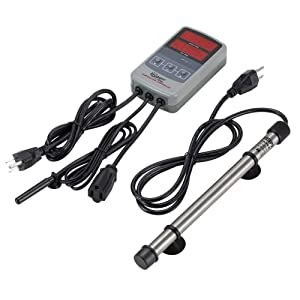
This style separates the titanium heating element, temperature probe, and external controller. That keeps adjustment outside the aquarium and avoids a glass heater tube. It can suit freshwater or marine systems when the exact model is rated for the intended use.
The tradeoff is more installation complexity. Place the probe where it reads circulating tank water—not touching the heating element—and secure every component. Confirm the current manual because Hygger sells several visually similar versions.
Best for: keepers who prefer an external display and titanium element. Watch for: probe placement and exact model differences.
Check the Hygger titanium heater on Amazon
5. Orlushy Submersible — Budget Adjustable Pick

Orlushy’s adjustable submersible range is a lower-cost conventional option with several wattages. The familiar dial design is easy to understand, but an inexpensive heater still needs careful selection, stable mounting, good circulation, and an independent thermometer.
Do not rely on a marketplace title alone for capacity. Confirm the wattage, physical size, voltage, current instructions, and whether the exact listing includes a separate thermometer.
Best for: a straightforward adjustable heater on a tighter budget. Watch for: listing variations and glass-body protection.
Check the Orlushy heater on Amazon
How to Choose the Right Wattage
A common starting estimate is around 3–5 watts per US gallon, but it is not a universal rule. A covered aquarium in a warm room may need less; a large temperature difference, open top, cold draft, or unusual shape may need more. Use the manufacturer’s chart for the exact model and the difference between room and target water temperature.
For a large or valuable system, two smaller heaters can provide more even coverage and some redundancy. Each must still be controlled correctly; redundancy does not eliminate overheating risk. A separate temperature controller can add protection, especially where a failure would endanger livestock.
Installation and Electrical Safety
- Read the exact manual before installation.
- Position the heater near steady filter flow without letting décor touch it.
- Respect minimum water-line and orientation instructions.
- Let a newly placed heater acclimate before plugging it in.
- Create a drip loop below the outlet and use a protected, correctly installed power supply.
- Unplug the heater before water changes and wait as instructed before removing it.
- Inspect the cord, casing, suction cups, and glass regularly. Replace damaged equipment.
Never handle energized aquarium equipment with wet hands. An aquarium heater is not a set-and-forget device: check temperature daily and whenever the weather, room heating, tank lid, or circulation changes.
Frequently Asked Questions
Do all aquariums need a heater?
No. The decision depends on the species’ verified temperature range and the room’s stability. Tropical fish often need heating; some temperate species do not. Never choose temperature by the tank’s label alone.
Should the heater be next to the filter?
Usually, placing it near consistent flow helps distribute heat. Follow the manual and confirm the opposite end of the aquarium reaches a similar temperature.
Can a heater burn fish?
Contact injuries are possible, especially with large, slow-moving, burrowing, or resting animals. A guarded heater and correct placement reduce risk. Follow species-specific advice.
How often should I replace a heater?
There is no universal calendar. Replace it immediately if it is damaged, erratic, leaking, corroded, or unable to hold temperature. Keep a tested spare available.
Verdict
The Fluval E Series is our best overall choice for visible monitoring and a protective guard. Choose the Aqueon Pro for a shatter-resistant housing, EHEIM for broad wattage selection, Hygger Titanium for an external controller, or Orlushy for a basic adjustable option. Whichever you select, verify the exact model, use an independent thermometer, and prioritize stable temperature over maximum heating speed.
Continue with our guides to betta tank setup, aquarium thermometers, and cycling a fish tank.