

Disclosure: Aquarium Hunter may earn a commission from qualifying Amazon purchases made through links on this page, at no extra cost to you.
The Hygger Small Aquarium Betta Heater is our best betta tank heater for most small aquariums because the current line offers appropriately sized wattages, adjustable control, a digital display and automatic protection features. For a conventional glass heater from a long-established aquarium brand, the Fluval M50 is a strong alternative. Always choose wattage for the tank volume, room temperature and heater maker’s chart—not the fish name on the package.
Bettas are tropical fish. Most should be kept at a stable 78–80°F (25.5–26.5°C), unless an aquatic veterinarian recommends otherwise. A heater should maintain that range without hot spots or rapid swings, and a separate aquarium thermometer should verify the actual water temperature.
Best Betta Tank Heaters: Quick Comparison
| Heater | Best for | Control | Amazon |
|---|---|---|---|
| Hygger Small Betta Heater | Best overall | Digital adjustable | Check on Amazon |
| Fluval T50 Electronic Heater | Premium small-tank option | Electronic adjustable | Check on Amazon |
| Fluval M50 | Best conventional glass heater | Adjustable dial | Check on Amazon |
| Eheim Thermocontrol e50 | Calibration and established design | Adjustable and recalibratable | Check on Amazon |
| Aqueon Submersible 50W | Simple adjustable option | Adjustable dial | Check on Amazon |
Important: Amazon may display several wattages on one listing. Confirm the selected wattage, dimensions, voltage and seller before ordering.
Our Betta Heater Picks
1. Hygger Small Aquarium Betta Heater — Best Overall
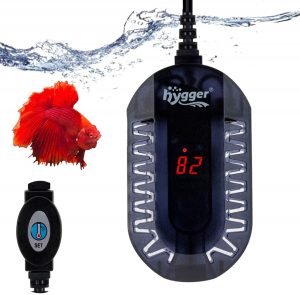
Hygger’s current small-heater line is available in multiple wattages and combines an external digital display with adjustable temperature control. This makes it easier to see the setting than on a tiny submerged dial. The listing also describes over-temperature and out-of-water protection, useful safeguards for small aquariums where the water level can change quickly.
Choose the wattage from the manufacturer’s current chart. A 10-watt model may be inadequate in a cold room, while 100 watts can be excessive for a small betta tank. The digital reading is convenient, but it does not replace a separate thermometer placed away from the heater.
Pros: several small-tank wattages; visible digital control; compact; automatic protection features.
Cons: model and controls vary by wattage; electronic display adds equipment and cable; independent verification is still necessary.
Check the Hygger Small Betta Heater on Amazon
2. Fluval T50 Electronic Heater — Best Premium Option
The Fluval T50 is a fully electronic heater marketed for freshwater aquariums up to 15 gallons. Its 50-watt output is a practical range for many 5- to 10-gallon betta tanks, provided the room-to-water temperature difference fits Fluval’s guidance. Electronic control and a protective exterior make it attractive where a bare glass tube is undesirable.
This is the most expensive option in the shortlist, and the “up to” tank rating is not a guarantee in a very cold room. Measure the aquarium’s true water volume and ambient temperature before choosing it.
Pros: electronic control; protective format; appropriate output for many standard betta tanks; established aquarium brand.
Cons: premium price; one wattage cannot suit every room and tank; freshwater-only listing should be followed.
Check the Fluval T50 on Amazon
3. Fluval M50 — Best Conventional Glass Heater

The M50 is a straightforward 50-watt adjustable submersible heater for freshwater or saltwater aquariums. Its slim glass body is easy to position near gentle filter flow, which helps distribute warmed water. It suits aquarists who prefer a familiar dial-controlled design without a separate electronic controller.
Glass heaters must be handled carefully. Inspect the tube before use, mount it where décor cannot strike it and never expose hot glass to air or cold replacement water. Read the current manual for orientation and minimum-water-line requirements.
Pros: adjustable; slim; widely established model; 50 watts suits many standard small aquariums.
Cons: glass body; dial is less convenient than an external display; requires careful handling during maintenance.
Check the Fluval M50 on Amazon
4. Eheim Thermocontrol e50 — Best for Calibration

The Eheim Thermocontrol e50 uses the brand’s long-running adjustable glass-heater format and allows the control to be recalibrated if the setting and an accurate thermometer consistently disagree. This can be useful for a stable permanent setup.
Eheim heaters are relatively long. Check the product dimensions against the usable height or width of the tank before buying. The heater must be installed in an orientation allowed by its instructions and kept submerged to the marked level.
Pros: adjustable; recalibratable; established design; clear operating indicator.
Cons: long glass body; may be awkward in compact tanks; usually costs more than basic dial heaters.
Check the Eheim Thermocontrol e50 on Amazon
5. Aqueon Submersible 50W — Simple Adjustable Choice

Aqueon’s current 50-watt submersible listing is a simple adjustable option for aquariums within its specified range. It is a better fit for a typical heated betta aquarium than the tiny, nonadjustable bowl heaters that appeared in the old version of this review.
The listing may show a generous maximum tank size, but heater capacity depends strongly on room temperature. Select conservatively for the temperature rise required and verify performance over a full day before adding a fish.
Pros: adjustable; familiar submersible design; practical wattage for many small tanks.
Cons: dial must be checked against a thermometer; glass requires care; advertised maximum volume may not apply in a cold room.
Check the Aqueon 50W Heater on Amazon
How to Choose the Right Betta Heater
Tank volume and room temperature
Start with the manufacturer’s wattage chart, then account for the difference between the coolest room temperature and the desired water temperature. A five-gallon tank in a 75°F room needs less heating than the same tank beside a winter window. Use actual filled volume after substrate and décor displacement.
Adjustable versus preset
An adjustable heater gives more control when room temperature changes, a fish needs veterinary treatment or a preset unit runs warm or cool in a particular tank. Preset heaters can be simple, but their fixed nominal setting and small wattage do not guarantee a safe temperature. For most permanent betta aquariums, adjustable control is preferable.
Independent thermometer
Every heated tank needs a separate thermometer. Place it away from the heater and check it daily at first. After installation, allow the system to stabilize in a fishless tank for at least 24 hours while monitoring the highest and lowest readings.
Heater guards and placement
Position the heater where filter circulation distributes warmth, without pinning it against substrate, décor or the tank wall contrary to its instructions. A protective guard can reduce direct contact, especially around long-finned fish, but must not trap debris or block circulation.
Safe Installation and Maintenance
- Inspect the heater, plug and cord. Do not use damaged equipment.
- Mount it exactly as the current manual permits and respect its minimum water line.
- Create a drip loop and use a GFCI-protected outlet where available.
- Let a glass heater acclimate in the water for the maker’s stated period before switching it on.
- Verify the temperature with a separate thermometer before adding the betta.
- Unplug the heater before water changes. Allow it to cool before exposing it to air, and let it re-acclimate after refilling.
- Replace any heater with cracks, condensation inside a sealed tube, erratic cycling or a damaged cable.
Never operate an aquarium heater in a container below its stated minimum water level. Do not repair or splice a heater cord. If a tank is overheating, unplug the heater safely, increase surface agitation, cool the room gradually and avoid sudden temperature shocks.
Frequently Asked Questions
Does a betta need a heater?
Usually, yes. Unless the room keeps the water consistently within the betta’s appropriate tropical range day and night, a thermostatically controlled heater is needed.
What temperature is best for a betta?
A stable 78–80°F (25.5–26.5°C) is a practical range for most healthy domestic bettas. Stability and accurate measurement matter more than chasing one exact number.
Is a 50-watt heater too strong for a five-gallon tank?
Not automatically. Many thermostatic 50-watt heaters are designed for small tanks, but the maker’s chart, room temperature and product dimensions must all fit. An oversized or malfunctioning heater can overheat water quickly, so independent monitoring is essential.
Can I put the heater beside the filter?
Often yes. Gentle flow near the heater can distribute warmth, provided the position and orientation comply with the heater instructions and fish cannot become trapped.
Verdict
The Hygger Small Aquarium Betta Heater offers the most convenient mix of appropriate wattage choices, adjustment, visible temperature information and protection features. The Fluval M50 is our preferred conventional glass alternative, while the Fluval T50 offers a more protected electronic design. Whichever heater you choose, size it for the actual aquarium and room, test it before adding the fish, and keep a separate thermometer in the tank.