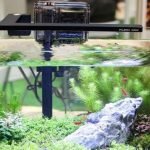
A media reactor can make activated carbon, granular ferric oxide (GFO) and certain specialty media work more evenly than a passive media bag. It is not essential for every aquarium, however, and the best model depends on the media, required flow, available space and whether you need an included pump.

Quick comparison
| Reactor | Best for | Pump | Buying option |
|---|---|---|---|
| PhosBan Reactor 150 | Best all-round value | Separate pump required | Check on Amazon |
| AquaMaxx FR-SE | Flexible hang-on use | Separate pump required | Check on Amazon |
| AQUATOP MR-20 | Complete compact package | 95 GPH pump included | Check on Amazon |
| Innovative Marine MiniMax Pro | Compatible all-in-one aquariums | Integrated model-specific design | View manufacturer |
Listings and package contents can change. Confirm the exact model, included fittings and pump requirements before ordering.
1. Two Little Fishies PhosBan Reactor 150
Best for: a proven, adjustable reactor for GFO or carbon.
The PhosBan Reactor 150 uses bottom-to-top flow to distribute water through the media and reduce channeling. The manufacturer rates one reactor for aquariums up to 150 gallons, with a maximum of 200 grams or 385 ml of PhosBan. Those figures are limits, not universal dosing instructions: always begin with the media manufacturer’s dosage for your actual water volume.
A pump and hose are not included. Two Little Fishies recommends a pump in the 100–200 GPH range, then restricting the inlet with the supplied valve to achieve the much lower flow required by GFO. Never restrict the outlet, as that can pressurize the chamber and cause leaks.
Check the PhosBan Reactor on Amazon Manufacturer details
2. AquaMaxx FR-SE External Media Reactor
Best for: flexible hang-on installation and higher media capacity.
The FR-SE has a 3.2-inch chamber, stands about 14.6 inches tall and holds up to one liter of media. Its bracket accommodates aquarium rims up to 3/4 inch. AquaMaxx describes it for carbon, GFO and biopellets, but these media require different quantities and flow patterns; empty and clean the reactor before changing roles.
The pump and tubing are sold separately. An adjustable pump or an inlet valve is important because suitable flow depends on the media and amount used.
Check the AquaMaxx FR-SE on Amazon Manufacturer specifications
3. AQUATOP MR-20 Media Reactor
Best for: a compact package with its own pump and plumbing.
The MR-20 includes a 95 GPH submersible pump, intake and output tubing, a tank hook and suction cups. Its chamber is approximately 2.4 inches in diameter and 15 inches high. It can hang on the aquarium or operate in a sump, making it convenient when you do not want to source a separate feed pump.
AQUATOP rates it for tanks up to 20 gallons. Follow the chosen media’s dosage and motion requirements instead of assuming that the full pump output is suitable. Clean the pump, impeller and strainers regularly and disconnect power before servicing.
Check the AQUATOP MR-20 on Amazon Manufacturer specifications
4. Innovative Marine MiniMax Pro
Best for: selected Innovative Marine all-in-one aquarium filter compartments.
The MiniMax Pro is designed to fit compatible rear filtration chambers, producing a clean installation without external plumbing. Compatibility is more important than the nominal aquarium size: measure the chamber and confirm the exact Desktop or Midsize version against the manufacturer’s list.
The manufacturer currently lists these reactors as out of stock, and an exact reliably available Amazon offer was not verified. For that reason, we link to the manufacturer rather than substitute a similarly named product.
Check current MiniMax availability
Do you need a media reactor?
A reactor is useful when controlled flow through a chemical medium will solve a measured problem. Carbon can remove discoloration and some dissolved organics; GFO can bind phosphate; and specialty resins have more specific uses. A reactor does not replace adequate biological filtration, protein skimming where appropriate, water changes or diagnosing the cause of poor water quality.
Do not add phosphate-removing media solely because algae is visible. Test phosphate with a suitable method, consider feeding and nutrient export, and reduce levels gradually. Rapid nutrient changes can stress corals and destabilize a mature reef.
How to choose the right reactor
Match the chamber to the media
GFO should usually move with only a gentle surface simmer; aggressive tumbling can grind it into dust. Carbon is normally held more firmly so granules do not abrade. Biopellets need stronger, continuous motion and dependable aeration and nutrient-export planning. Follow the media manufacturer’s instructions.
Check space and service access
Measure height, diameter, rim thickness, hose routes and the clearance needed to remove the lid. A reactor that technically fits but cannot be opened without dismantling the sump will be difficult to maintain.
Decide how it will be fed
A dedicated pump is simple to tune but adds heat, power use and another item to clean. Feeding from a return manifold saves a pump but must not compromise the aquarium’s main circulation. Use secure tubing and place the reactor where a minor leak cannot drain the aquarium.
Safe setup and maintenance
- Rinse or prepare the media exactly as its manufacturer directs.
- Keep the reactor upright and connect the inlet and outlet securely.
- Start at low flow and discharge the initial cloudy water into a bucket until it runs clear.
- Adjust only enough flow to achieve the correct motion for that medium.
- Check every connection for leaks and ensure the return cannot create a damaging back-siphon.
- Inspect sponges, tubing and the pump regularly. Clogged foam can change pressure and flow.
- Replace media according to test results and exhaustion—not an arbitrary calendar alone.
Frequently asked questions
Can carbon and GFO share one reactor?
They can sometimes be mixed when the manufacturer permits it, but they exhaust at different rates and prefer different motion. Separate reactors provide more control.
Can a reactor replace a filter?
No. It is normally an optional chemical-filtration component. The aquarium still needs appropriate biological and mechanical filtration and routine husbandry.
Should media tumble?
It depends on the medium. GFO generally needs only slight movement at the surface, carbon should not grind, and biopellets require more active circulation. Follow the instructions for the exact product.
Final verdict
The Two Little Fishies PhosBan Reactor 150 remains the best general-purpose choice for most aquarists who can supply a small pump. AquaMaxx offers more capacity and flexible mounting, while the AQUATOP MR-20 is convenient for a small system because its pump and plumbing are included. The MiniMax Pro is worth considering only when it matches the dimensions of a compatible all-in-one aquarium.
Affiliate disclosure: Aquarium Hunter may earn a commission from qualifying Amazon purchases, at no additional cost to you. We link only to products that match the model discussed.