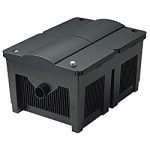
A UV clarifier can be useful when a koi pond repeatedly turns green, but it is not a complete pond filter and it is not a cure for sick fish. The right unit exposes free-floating organisms to ultraviolet-C light at a controlled flow rate. The affected algae can then clump together and be removed by mechanical filtration.
This guide compares four current pond-specific UV families supported by manufacturer documentation. The aim is to help you match the unit to pond volume, fish load, flow, plumbing, and the job you expect it to perform. We do not use invented star ratings or temporary retailer prices.
Affiliate disclosure: Aquarium Hunter may earn a commission if you buy through a marked Amazon link, at no additional cost to you. Manufacturer links remain available for specification checking. Models and electrical standards vary by region.

Quick Comparison: Current Pond UV Options
| Product family | Best fit | Strength | Watch for | Buying option |
|---|---|---|---|---|
| OASE Vitronic | Small-to-medium ponds and matched OASE filter systems | Simple pre-clarifier with inspection window and service access | Choose the regional wattage and verified system pairing | Check Amazon Vitronic 18 affiliate link |
| OASE Bitron C / Bitron Eco | Larger ponds and high-capacity OASE systems | Higher-output family with integration options | More expensive and must be matched to compatible plumbing and flow | Read review No verified exact Amazon match |
| Aqua Ultraviolet Classic / Twist | Standalone pond systems needing several wattage and plumbing choices | Detailed freshwater sizing charts distinguish clarification and sterilization flow | The intended treatment level depends on real flow, not wattage alone | Check Amazon 57-watt affiliate link |
| TetraPond GreenFree | Straightforward green-water control in smaller and medium garden ponds | Pond-specific range with replaceable lamps | External installation only; use the current model chart and manual | Check Amazon GreenFree 18-watt affiliate link |
UV Clarifier vs. UV Sterilizer
The hardware may look similar, but the labels describe different treatment goals. A clarifier is typically selected to control free-floating algae and improve water clarity. A sterilizer requires a higher effective UV dose to reduce a broader range of waterborne organisms passing through the chamber.
Effective dose depends on more than lamp wattage. It is influenced by:
- water flow through the chamber;
- lamp output and age;
- distance from the lamp;
- chamber and quartz-sleeve cleanliness;
- water clarity and UV transmission;
- the target organism and required exposure.
A unit can be sold with separate maximum flows for clarification and sterilization. Aqua Ultraviolet’s freshwater charts, for example, publish different flow and pond-volume guidance for the two goals. Use the figure that matches your intended result.
What UV Can and Cannot Do
UV Can Help With
- free-floating algae that make the water look green;
- some waterborne organisms that pass through the chamber at an adequate dose;
- improving clarity when paired with effective mechanical filtration;
- reducing recurring algae pressure in a correctly sized and maintained system.
UV Cannot
- remove feces, leaves, sludge, or uneaten food;
- convert ammonia or nitrite;
- oxygenate the pond;
- remove string algae attached to rocks and liner;
- correct excessive nutrients, overfeeding, crowding, or poor circulation;
- treat parasites or infections already living on or inside a fish;
- replace quarantine, diagnosis, or veterinary care.
Most beneficial nitrifying bacteria live on filter media, liner, and other surfaces rather than freely suspended in the water. A UV unit therefore does not normally “kill all beneficial bacteria.” It treats only what passes close enough to the operating lamp.
How to Size a Pond UV Unit
1. Measure Pond Volume
For a rectangular pond, average length × average width × average depth × 7.48 estimates US gallons. Use a water meter during filling when possible. Irregular shapes, shelves, streams, and connected chambers make rough measurements less accurate.
2. Define the Goal
If the objective is green-water clarification, use the manufacturer’s clarifier rating. If broader waterborne-organism reduction is required as part of a professionally designed system, use the sterilization chart and seek appropriate fish-health advice. Do not assume a clarifier rating provides a sterilizing dose.
3. Account for Fish Load and Sun
Koi ponds typically have more nutrients and suspended material than lightly stocked water gardens. Full sun, heavy feeding, warm water, and dense stocking can increase algae pressure. Manufacturer pond-volume ratings may need to be reduced for these conditions.
4. Verify Actual Flow
Pump labels show flow before real plumbing resistance. Pipe diameter, length, bends, elevation, valves, filters, and the UV chamber reduce output. Calculate operating head and compare the pump curve with the UV unit’s permitted flow range.
5. Match the Plumbing
Check inlet and outlet diameter, pressure rating, unions, bypass requirements, vertical or horizontal orientation, and access for removing the lamp and quartz sleeve. Undersized hose can waste pump performance.
6. Confirm Electrical Compatibility
Buy a model designed for your country. Voltage, frequency, plug, certification, and weather protection vary. Outdoor pond equipment should use a ground-fault protected supply installed to local electrical code.
Current Pond UV Shortlist
OASE Vitronic: Simple Pre-Clarifier
The Vitronic family is designed to sit before a pond filter. OASE lists 18- and 36-watt units in matched US BioSmart systems and publishes compatible pumps, filters, and fish-load ratings. The Vitronic includes a function window and quick-release access for quartz cleaning and lamp replacement.
Choose it when: you are assembling or already use a compatible OASE flow-through system and want a straightforward green-water clarifier.
Watch for: current availability and ratings differ by region. Use the exact country page and system chart rather than importing a model with incompatible electrical specifications.
Check OASE Vitronic 18 on Amazon (affiliate link)
Official OASE Vitronic specifications
OASE Bitron C or Bitron Eco: Larger Matched Systems
OASE pairs Bitron models with larger BioTec ScreenMatic² and ProfiClear systems. The Bitron Eco family uses automatic output regulation on selected models, while Bitron C is offered in multiple higher-output sizes.
Choose it when: the pond is large, the filter is already part of an OASE system, or the required wattage exceeds entry-level units.
Watch for: confirm compatibility, bypass configuration, minimum and maximum flow, and the specific filter-system combination. A high-output lamp is not useful if plumbing sends water too quickly or the sleeve becomes fouled.
Official OASE Bitron Eco specifications
Aqua Ultraviolet Classic or Twist: Detailed Dose-Based Sizing
Aqua Ultraviolet offers multiple freshwater UV sizes and publishes separate clarification and sterilization values. Its current documentation includes a 57-watt Twist option and larger configurations for higher flows.
Choose it when: you want a standalone inline unit with a detailed sizing table and several plumbing choices.
Watch for: do not copy a pond-volume number without also checking the matching flow and treatment column. Installation orientation, pressure, unions, bypasses, and lamp access must follow the manual.
Check Aqua UV 57-Watt on Amazon (affiliate link)
Official Aqua Ultraviolet specifications
TetraPond GreenFree: Basic Garden-Pond Clarification
GreenFree is a pond-specific clarifier family intended to control green water. Tetra publishes model-specific instructions and identifies it as an external unit rather than a submersible light.
Choose it when: the goal is straightforward algae clarification in a smaller or medium garden pond and the selected model matches the real volume and flow.
Watch for: install it outside the pond as directed, protect it from unsafe flooding, and leave enough space for lamp and sleeve service.
Check TetraPond GreenFree 18-Watt on Amazon (affiliate link)
Official TetraPond GreenFree specifications
Where Should a UV Clarifier Be Installed?
Follow the specific manual. Many pond clarifiers are installed after the pump and before a mechanical/biological filter so treated algae can be captured. Other complete systems specify a different position. The unit may require a bypass to keep flow within limits and allow service without shutting down the entire pond.
- Never operate an exposed UV-C lamp or look directly at it.
- Disconnect power before opening the housing.
- Do not run the lamp without water flow unless the manufacturer explicitly permits it.
- Protect electrical connections from rain, splash, and flooding.
- Use unions and isolation valves for safe removal.
- Do not place an external-only unit underwater.
Maintenance Schedule
Inspect Flow Regularly
A falling flow rate can indicate a blocked prefilter, dirty pump intake, kinked hose, or accumulating debris. Reduced flow changes UV exposure and overall circulation.
Clean the Quartz Sleeve
Mineral deposits and biofilm block UV transmission even when the lamp still glows. Clean the sleeve at the interval in the manual and more often in hard water. Handle quartz carefully and replace damaged seals.
Replace the Lamp by Output Life
A lamp can illuminate after useful UV-C output has declined. Follow the manufacturer’s replacement-hour or seasonal schedule instead of waiting for the lamp to go dark. Record the installation date.
Check Seals and Leaks
Inspect O-rings, unions, housing, and cable condition during service. Lubricate seals only with a manufacturer-approved product and never force a brittle quartz sleeve.
Maintain the Rest of the Pond
Keep mechanical and biological filtration working, test ammonia and nitrite, remove accumulated solids, avoid overfeeding, and maintain aeration. Clear water is not proof of safe water.
Troubleshooting Green Water
The Lamp Appears On but the Pond Is Still Green
- Confirm the unit has been running long enough for the system to capture treated algae.
- Check actual flow against the clarification range.
- Clean the quartz sleeve.
- Review lamp age and correct replacement model.
- Confirm pond volume and fish-load assumptions.
- Inspect mechanical filtration and clean it as directed.
- Reduce excess feeding and remove decaying organic matter.
- Check whether water is bypassing the UV chamber.
Water Is Clear but Fish Are Unwell
Test ammonia, nitrite, nitrate, pH, alkalinity, temperature, and oxygen immediately. Observe breathing, appetite, swimming, skin, and gills. UV clarity can hide serious water-quality or disease problems. Consult an aquatic veterinarian or qualified fish-health professional when symptoms persist.
Frequently Asked Questions
Should a koi pond UV run continuously?
Many units are designed for continuous seasonal operation, but follow the manual and local climate guidance. Turn the unit off before service and never operate it without the specified water conditions.
How long before green water clears?
It varies with pond volume, algae density, lamp condition, flow, sunlight, nutrients, and filter capture. Avoid universal “clear in five days” promises. Investigate sizing or maintenance if there is no improvement after the manufacturer’s expected period.
Will UV remove string algae?
No. String algae is attached to surfaces and normally does not pass through the chamber. Control requires nutrient management, physical removal, appropriate shade or planting, and overall pond maintenance.
Can UV replace a koi pond filter?
No. Review our koi pond filter guide for mechanical and biological filtration options.
Does a bigger UV unit always work better?
No. Oversizing can waste energy and complicate plumbing, while excessive flow can still produce inadequate exposure. Use a documented unit and flow combination.
Our Selection Method
We retained only pond-specific product families with a current manufacturer page or manual. We compared stated use, treatment goal, wattage range, flow guidance, plumbing, serviceability, replacement parts, electrical safety information, and system compatibility. We removed aquarium-only devices, unverifiable brands, temporary prices, retailer star ratings, and mismatched product links.
References and Manufacturer Documentation
- OASE: matched filter, pump, UV, and fish-load guidance
- OASE Vitronic product documentation
- OASE Bitron Eco product family
- Aqua Ultraviolet freshwater sizing and installation manual
- TetraPond GreenFree instructions