Peacock Gudgeon Care: Tank Setup, Feeding and Breeding

Peacock Gudgeon

Peacock gudgeons (Tateurndina ocellicauda) are colorful freshwater fish from Papua New Guinea. A planted aquarium with gentle flow, several shelters and dependable small meaty foods suits them better than a busy tank where they must compete at every meal.

They can be rewarding for an attentive beginner with a cycled aquarium, but they are not maintenance-free. Plan the layout and feeding routine before buying them, especially if you want a pair or group.

Peacock gudgeon care at a glance

Requirement Practical guidance
Adult size Approximately 2–3 inches; females usually smaller
Aquarium A 20-gallon long is a practical starting point for a pair; use more space for groups or communities
Temperature A stable 75–79°F is a useful everyday target
pH and hardness About pH 6.5–7.5; soft to moderately hard water
Water quality 0 ppm ammonia and nitrite; keep nitrate low through maintenance
Diet Varied small live or thawed frozen foods, plus suitable prepared foods they accept
Habitat Plants, multiple caves, gentle filtration and a secure lid

The tank size is a planning recommendation, not a gallons-per-fish formula. Surface area, cover, sex ratio and the other inhabitants affect what works. Confirm the seller’s water conditions and avoid abrupt changes.

Identification and natural background

These fish have blue-toned bodies with red or orange markings and a conspicuous dark spot at the base of the tail. Despite the alternative name “peacock goby,” they belong to the sleeper group, Eleotridae. They are freshwater fish; routine salt or a brackish setup is unnecessary.

Aquarium Industries’ species sheet describes their origin in eastern Papua New Guinea, adult size and preference for vegetated, slow-flowing habitat. Do not confuse their availability in overseas aquarium shops with their natural geographic range.

Set up a planted aquarium with separate retreats

Cycle the filter before adding fish. Use a heater and separate thermometer where needed, and choose filtration that maintains clean water without a powerful jet through the resting areas. A secure cover should close gaps around equipment.

Arrange plants and wood to break up long sightlines, while leaving open feeding areas. Java fern and Anubias can provide cover without needing deep planting. Provide several smooth caves or aquarium-safe tubes so a fish can retreat without being cornered by another.

Sand or smooth fine gravel can work. Avoid sharp edges, unstable rock piles and holes that might trap a fish. Use a consistent lighting schedule with shaded areas rather than trying to illuminate a fixed percentage of the tank.

Aquarium Dietzenbach’s care profile supports gentle flow, dense cover and several caves. Our aquarium basics guide explains cycling and routine equipment setup.

Pairs, groups and tank mates

A compatible pair is a manageable starting point. A larger planted aquarium can accommodate a small group, but males may defend caves, particularly during spawning. Add enough separate retreats and observe the fish rather than assuming that a fixed group size guarantees peace.

Brief displays differ from persistent chasing that prevents a fish from eating or resting. Have suitable separate accommodation available if one individual is repeatedly excluded. Do not solve a territorial problem by adding more fish to an already crowded tank.

Choose peaceful companions with overlapping water requirements and modest feeding speed. Small, calm schooling fish may work in a sufficiently large community. Avoid large predators, fin nippers and species that monopolize food or caves.

Small shrimp and fry may be eaten. A gudgeon’s peaceful reputation does not make it safe for a shrimp-breeding aquarium. Stock for the welfare of every animal rather than treating the gudgeon as decoration.

Feeding: check what each fish actually eats

Offer varied, appropriately sized meaty foods such as thawed frozen brine shrimp, daphnia and insect larvae. Suitable fine pellets or other prepared foods can add variety if accepted. Do not assume every newly purchased gudgeon will immediately thrive on flakes alone.

Feed small portions once or twice daily and watch each fish take food. Deliver some near a shy individual’s shelter if faster companions intercept everything. Remove leftovers and adjust quantities to body condition and waste.

Ask the retailer what the fish has been eating and, where possible, watch it feed before purchase. A varied diet is more useful than relying entirely on one treat food. Avoid introducing live foods from uncertain sources into the aquarium.

Maintenance and health

Check temperature and behavior daily. Test water regularly and after changes to stocking or equipment. Begin with weekly partial water changes, adjusting their size to test results and waste levels rather than waiting a month regardless of conditions.

Condition replacement tap water for chlorine and chloramine and match temperature. Siphon loose waste without uprooting the whole layout, and preserve established biological filter media. Use our water test kit guide to choose the right tests.

Reduced appetite, rapid breathing, persistent hiding, wounds or spots warrant attention. Check environmental conditions first, then seek a fish veterinarian’s advice if signs persist or are severe. Do not assume that raising temperature cures every white-spot problem, or attempt to pull an unidentified parasite from a fish yourself.

The Merck Veterinary Manual’s fish disease overview explains why husbandry and diagnosis matter. Quarantine new arrivals appropriately and avoid sharing wet equipment between quarantine and established tanks.

Sexing and breeding

Mature males typically develop a larger, more rounded head. Females are generally smaller and may show a yellow abdomen when ready to spawn. Juveniles are harder to sex; do not rely on color alone.

Peacock gudgeons lay adhesive eggs inside sheltered sites, and the male tends the clutch. Spawning may occur in a community aquarium, but raising young requires a plan for protection, very small foods and stable water.

Walter Hilgner’s breeding report at Aquarium Dietzenbach documents tube spawning and the use of tiny starter foods before larger foods were introduced. Exact hatch times vary with conditions, so observe development rather than applying a rigid timetable.

Have a suitable rearing setup and food supply ready before attempting to raise a batch. For everyday keeping, focus first on fish that eat reliably, maintain good condition and can use their shelters without constant harassment.

Black Ghost Knifefish Care: Size, Tank Setup and Feeding

Black Ghost Knifefish

The black ghost knifefish (Apteronotus albifrons) is a South American freshwater fish with a ribbonlike swimming motion and a weak electrical sense. A small juvenile can be tempting, but this is a long-term commitment to a large aquarium—not a fish to buy first and find space for later.

This guide focuses on planning for an adult, making sure a shy fish actually eats, and choosing companions that will remain suitable as it grows.

Black ghost knifefish care at a glance

Requirement Practical guidance
Scientific name Apteronotus albifrons; family Apteronotidae
Adult size Plan for a fish around 18–20 inches, with individual variation
Adult aquarium Plan in the 120–180-gallon range or larger; prioritize length, width and usable swimming space
Temperature 75–82°F, kept stable
Water Roughly pH 6.5–7.5 and soft to moderately hard water; avoid sudden changes
Diet Varied meaty foods and suitable complete pellets that the fish accepts
Social setup Usually one knifefish; companions must be too large to swallow and not bully it
Experience Best for an aquarist already comfortable managing a large, established tank

Size, lifespan and choosing the aquarium

A juvenile’s current length is a poor guide to its lifetime housing. Adults commonly become much larger than typical community fish, and care sources report different maximum sizes. Prepare for a large adult and a commitment that may exceed a decade.

Aquarium Co-Op recommends 120 or 180 gallons for an adult. Treat that as a planning range rather than a guarantee that every aquarium with that volume is suitable. A tall, narrow tank sacrifices turning room; bulky decorations can also remove much of the usable footprint.

Before buying, sketch the adult aquarium with its shelter in place. Can the fish turn without folding around ornaments? Can you reach the filter and remove waste? Can the floor, stand and maintenance routine support the installation? If the adult setup is not realistic, choose a smaller species from our fish care guides.

How to set up the tank

  • Cycle it first. Establish biological filtration before adding the fish. Review our aquarium basics guide if you are starting a new system.
  • Provide a full-length refuge. Use a smooth cave or aquarium-safe tube that comfortably accommodates the fish. Replace an outgrown shelter rather than waiting for it to become a tight fit.
  • Keep an open route through the tank. Secure rocks and wood, avoid sharp edges, and leave room to maneuver around the hide.
  • Offer shaded areas. Plants and subdued lighting help provide daytime cover. Do not repeatedly dismantle the shelter to make the fish visible.
  • Maintain filtration and oxygenation. Keep water circulating without directing the entire outlet into the resting cave. Fit a secure lid and protect equipment openings.

The Aquarium Industries species sheet supports warm, stable water, cover and careful handling of medication in this scaleless fish. A filter or UV unit does not guarantee freedom from disease.

Feeding: check the fish, not just the food

Offer a varied carnivorous diet: appropriately sized thawed frozen invertebrates, suitable worms from a reliable supplier, and complete sinking pellets if accepted. Bloodworms can be one component rather than the entire menu. Routine feeder fish are unnecessary.

Start with a small evening meal near the shelter. A feeding tube can help deliver food without reaching into the cave. Watch from a distance until you confirm swallowing; food disappearing elsewhere in the aquarium does not prove the knifefish ate it.

Adjust portions to appetite and body condition, remove leftovers, and keep a brief feeding record for a new arrival. If the fish repeatedly refuses food or loses weight, check water quality and competition promptly instead of simply adding more food.

Tank mates and territorial behavior

Peaceful behavior does not make small fish safe. Shrimp and fish that fit into the mouth can become prey, even if they initially coexisted with a juvenile. Avoid selecting companions on the assumption that the knifefish will stay small.

Choose similarly sized, nonaggressive companions with compatible water needs. Evaluate each species’ adult size, feeding speed and use of shelters; a generic label such as “catfish” or “cichlid” is not a compatibility guarantee. Watch for a fish monopolizing food or blocking the cave entrance.

Keeping one black ghost knifefish is the more practical choice for most home aquariums. Conspecifics and other electric fish can create territorial problems. Extra gallons alone do not ensure a peaceful group.

Maintenance and warning signs

Test water routinely with suitable aquarium test kits. Ammonia and nitrite should be 0 ppm. The Merck Veterinary Manual explains why water-quality checks are essential when fish show signs of illness. Schedule regular partial water changes, then adjust frequency and volume to test results, feeding and stocking. Condition replacement water and match its temperature closely.

Check the fish’s appetite, breathing, skin and tail during normal observations. Persistent refusal to eat, sores, white spots or rapid breathing warrant prompt investigation and advice from an aquatic veterinarian. Do not guess a treatment from one symptom, mix medications, or automatically halve a dose. Check the exact product’s suitability for this species.

Electricity and breeding: common questions

Can a black ghost knifefish shock you?

It produces a weak electric field used for sensing and communication, not the powerful defensive discharge of an electric eel. Its unusual navigation is a reason to observe it carefully, not to handle it unnecessarily.

Can it be bred at home?

Breeding has been documented, and commercial production exists. Aquarium Industries reports spawning its own large specimens. That does not make pairing adults in a home display a reliable breeding method. Space, territorial behavior and rearing requirements make this a specialist project.

What should I check before buying?

Ask the seller to demonstrate feeding, explain the fish’s source and describe its current water conditions. Look for an intact tail and good body condition. Arrange a suitable quarantine setup and have the adult housing plan ready before bringing it home.

Types of Plecos: 8 Choices, Adult Sizes and Care Needs

Types Of Plecos

Different types of plecos have very different adult sizes, diets and water requirements. A small bristlenose can be a sensible choice for a suitable community aquarium; a juvenile common or sailfin pleco may become a fish you cannot comfortably house.

Choose the species before choosing the fish. None is a substitute for cleaning the tank, and a sucker-shaped mouth does not mean an animal can live on algae alone.

Compare eight types of plecos

Sizes below are approximate planning guides, not promises about an individual fish. Trade names can cover several species. Confirm the scientific name or L-number and research that exact fish before deciding on its permanent aquarium.

Type Size and main planning issue
Bristlenose (Ancistrus spp.) Common domestic forms roughly 4–6 inches; a practical smaller option
Clown (Panaqolus spp., often sold as P. maccus) Small, but confirm identity; provide wood and a suitable diet
Rubber lip (Chaetostoma spp.) Often sold among the smaller plecos; species and water requirements need checking
Zebra (Hypancistrus zebra, L046) About 3–4 inches; warm, oxygen-rich specialist setup
Colombian zebra (Hypancistrus debilittera, L129) About 4 inches; not the same fish as L046
Common pleco (various Hypostomus and Pterygoplichthys) Some approach 2 feet; large adult housing is essential
Sailfin (Pterygoplichthys gibbiceps) Can readily exceed 12 inches; not a small-tank cleaner
Royal (Panaque spp.) Large-bodied fish; exact species determines adult size and space

Smaller plecos to research first

1. Bristlenose pleco

Common captive-bred Ancistrus are often the most practical starting point. Albino, brown and longfin forms are not automatically different species. The Aquarium Industries bristlenose sheet describes fish reaching around 6 inches, a vegetable-rich diet, shelter and possible aggression between mature males.

Provide a balanced sinking food appropriate for herbivorous or omnivorous catfish, with suitable vegetables such as zucchini as a supplement. Remove uneaten pieces before they foul the water. Do not assume visible algae supplies a complete ration.

For one common domestic bristlenose, a 20-gallon long to 29-gallon aquarium is a useful starting range to assess—not an allowance to add several to an already full tank. More bottom space is helpful in a community.

2. Clown pleco

These small striped wood-rasping catfish are often labeled Panaqolus maccus, but names in this group are confused. Specialist Andreas Tanke documents that problem in his account of fish sold as Panaqolus aff. maccus.

Ask the seller for the best available identification rather than identifying a fish from stripes alone. Include aquarium-safe driftwood and shelter, but do not treat wood as a complete prepared feeding plan. Use our clown pleco guide as a starting point alongside species-specific advice.

3. Rubber lip pleco

The name usually refers to Chaetostoma, rather than one universally interchangeable species. A label saying “rubber lip” is not enough to set temperature or adult tank size confidently.

Our rubber lip pleco care guide explains the identification issue and the importance of oxygenation, flow and feeding. Check those needs against the existing inhabitants before adding one to a warm, slow-moving community aquarium.

Small size does not always mean easy care

4. Zebra pleco: L046

Hypancistrus zebra is a striking black-and-white cave dweller from the Rio Xingu. Its manageable length does not make it an algae-control purchase. It needs a carefully maintained aquarium, plentiful refuges and dependable access to food.

The German pet-trade association ZZF’s species account emphasizes current, oxygenation, shaded rocky shelters and a diet with a substantial animal-food component. Plan its setup separately from the cooler-water needs of some other plecos. Seek documented captive-bred stock from a reputable seller.

5. Colombian zebra pleco: L129

Hypancistrus debilittera is another small patterned pleco, reaching about 4 inches according to Aquarium Co-Op’s pleco guide. It is not an inexpensive version of L046 with identical requirements.

Confirm the identity on the invoice, obtain the supplier’s feeding and water information, and check it against a species reference. Avoid buying either “zebra” fish on a generic algae-eater label.

Large plecos that need a permanent space plan

6. Common pleco

“Common pleco” is a trade label that can include different large species. A cheap juvenile can become an expensive housing commitment. Some reach close to 2 feet, making ordinary small and medium community aquariums unsuitable for adulthood.

Do not buy one on the assumption that a store will take it back. Confirm the species and adult enclosure first. If a fish has already outgrown its home, arrange a suitable rehome through a responsible keeper, store or aquarium organization. Never release it outdoors.

7. Sailfin pleco

Pterygoplichthys gibbiceps is also listed under the older name Glyptoperichthys gibbiceps. Aquarium Glaser reports that it readily reaches roughly 12–16 inches; that is not a guaranteed maximum.

A handsome juvenile with a tall dorsal fin can make its future scale difficult to visualize. Sketch the aquarium with an adult fish, a full-size shelter and open bottom space. Allow for substantial waste and easy access for maintenance.

8. Royal pleco

Royal plecos belong to Panaque, with several similar-looking fish sold under related names. They are not simply oversized clown plecos. FishBase records Panaque nigrolineatus at about 17 inches standard length, which excludes the tail fin.

Wood, appropriate food, strong filtration and space for a bulky adult all matter. The old claim that a royal pleco weighs 22 kilograms was incorrect. Obtain an exact identification before budgeting for the aquarium.

What about snowball, peppermint and other trade names?

Snowball, peppermint, butterfly, vampire and orange-spot labels are not reliable care instructions. Similar patterns can occur in unrelated fish with different adult sizes or diets. Ask for the scientific name, L-number where applicable, and source information. L-numbers are identification aids, not tank-size ratings.

Otocinclus are related armored catfish, but they should be researched separately rather than treated as miniature substitutes for every pleco. Likewise, a fish sold as a “pitbull” or “gold spot dwarf” needs identification before you decide how many to keep.

Choose the tank around the fish

  1. Confirm adult size. Distinguish standard length from total length and leave room for uncertainty.
  2. Check the footprint. A tall tank and a long tank of equal volume do not offer the same bottom territory.
  3. Match water requirements. Compare temperature, hardness and flow for every intended inhabitant.
  4. Plan separate refuges. Multiple plecos may compete for caves. Extra hides do not guarantee compatibility.
  5. Budget for maintenance. An additional fish adds feeding and waste, even when it grazes on algae.

Have the biological filter established before stocking. Keep ammonia and nitrite at 0 ppm, monitor nitrate, and maintain suitable oxygenation. The Merck Veterinary Manual’s water-quality guidance explains why these checks matter. Use appropriate test kits and regular partial water changes; armored skin does not protect a fish from poor water.

Do plecos keep a tank clean?

Some graze useful amounts of algae, while others need more animal-based food or spend much of their time rasping wood. None removes the need for substrate cleaning, water changes or controlling excess nutrients and light. See our algae-eater comparison before adding livestock for an algae problem.

The best choice is a fish whose identity, adult space and daily care you can confidently provide. If the shop cannot identify it, waiting is better than discovering its requirements after purchase.

Clown Pleco Care: Tank Size, Wood, Feeding and Tank Mates

Clown Pleco Care: Tank Size, Wood, Feeding and Tank Mates

A clown pleco is a small, secretive armored catfish that spends much of its time among wood and shelters. It can suit a peaceful freshwater aquarium, but it needs deliberate feeding and maintenance. Buying one to survive on leftover food or to solve an algae problem is a poor plan.

The name usually refers to small Panaqolus sold as P. maccus or closely related forms. Confirm the seller’s identification because similar striped plecos are not necessarily the same species.

Clown pleco care at a glance

Requirement Practical starting point
Adult length Usually around 3–4 inches for the small forms sold as clown plecos
Aquarium Consider a 20-gallon long to 29-gallon tank for one; larger for a community or additional bottom dwellers
Temperature A stable 75–79°F is a useful everyday target; confirm the needs of the actual fish
Water chemistry Soft to moderately hard water; roughly pH 6.5–7.5 is a practical target
Water quality 0 ppm ammonia and nitrite; control nitrate with maintenance
Essential furnishings Real aquarium-safe driftwood, sheltered resting places and clear bottom space
Food Suitable sinking prepared food, plant-based supplements and access to wood and its surface growth
Social behavior Usually quiet with suitable companions; males may dispute territory

Identification, size and lifespan

Clown plecos have contrasting light and dark bands, but pattern alone is not a reliable identification method. Specialist Andreas Tanke explains the longstanding naming confusion in his article on Panaqolus aff. maccus. Keep the seller’s scientific name and any L-number with your records rather than treating every “clown” label as interchangeable.

The OATA care guidance describes clown plecos as small, shy fish needing cover and wood. These are long-term pets; plan for many years of care rather than relying on a precise lifespan promise.

For comparisons with larger or more demanding catfish, see our guide to different types of plecos.

Tank size and setup

A 20-gallon long to 29-gallon aquarium is a reasonable starting range to assess for one small clown pleco. This follows the general small-pleco guidance from Aquarium Co-Op; it is not a stocking formula. Footprint, existing fish, filtration and the amount of wood all affect the space available.

Prepare the aquarium before buying the fish:

  • Cycle the filter. Use our aquarium basics guide to establish a stable system before stocking.
  • Add real wood. Resin ornaments that look like logs do not provide a rasping surface equivalent to driftwood. Use wood sold for aquarium use and position it securely.
  • Include several refuges. Smooth caves and gaps beneath stable wood let the fish rest out of the light. Make sure it cannot become wedged.
  • Leave access for cleaning. A dense pile of wood should not make it impossible to remove accumulated waste.
  • Maintain circulation and oxygenation. Keep the filter working and the surface moving, with quieter shelter rather than blasting every resting place.
  • Use comfortable cover. Plants and shaded areas help a timid fish settle. Direct sunlight is not a care requirement.

What should a clown pleco eat?

Provide wood continuously, but also feed the fish. A log and whatever scraps fall from other fish are not a complete feeding routine.

Aquarium Dietzenbach’s profile of the commonly traded form recommends plant-based supplemental foods alongside wood, with animal foods only occasionally. Suitable choices include sinking catfish food formulated for grazing species and small portions of zucchini. Do not make bloodworms or other rich meaty foods the staple.

Offer a modest evening portion near its usual shelter and check what remains. Adjust the amount to the individual rather than repeatedly adding food because you have not seen it eat. Remove leftovers before they break down.

Observe body condition when the fish is visible on the glass or moving between shelters. A persistently sunken abdomen, progressive weight loss or refusal of previously accepted food deserves investigation. Check food competition and water quality, then seek experienced or veterinary help if the problem continues.

Tank mates and keeping more than one

A single clown pleco is a practical choice. OATA cautions that males may fight, so do not add a second fish simply because the first one hides. More space and separate caves reduce competition but cannot guarantee compatibility.

For a community, choose peaceful fish with overlapping water requirements and room of their own. Small tetras may be candidates in a suitably sized aquarium. Territorial bottom dwellers, large predators and fish that monopolize food need particular caution.

Do not assume every cory, cichlid or livebearer is suitable because it appears on a generic compatibility list. Check the exact species’ temperature, water hardness, adult size and behavior. Have a separation plan if chasing or blocked access to shelter develops.

Maintenance and health checks

Clown plecos produce waste despite their small size. Siphon accessible deposits during regular partial water changes and clean mechanical filter media when flow declines, while protecting the established biological filtration.

Use suitable water tests, condition replacement tap water and avoid abrupt temperature or chemistry changes. The Merck Veterinary Manual emphasizes water-quality assessment when investigating fish illness. Being hardy does not mean tolerating pollution.

Daytime hiding alone is normal for a secretive fish. Hiding accompanied by poor appetite, rapid breathing, damaged skin or weight loss needs attention. Red marks do not prove a bacterial infection, and there is no sensible blanket ban on every medicine containing a particular chemical element. Identify the problem and check species-specific product directions with an aquatic veterinarian before treatment.

Can clown plecos breed in an aquarium?

Breeding is possible, but it should not be promised as automatic or effortless. These are cave spawners, with the male caring for the eggs. Aquarium Dietzenbach describes this behavior in its species profile.

Start with accurately identified mature fish, appropriate separate refuges and a plan for raising and housing young. Juveniles can be difficult to sex. Do not trap fish together or abruptly change temperature to force spawning. A breeding project needs closer observation and more preparation than simply adding a cave to a community tank.

Is a clown pleco right for your aquarium?

It is a good candidate to research if you want a small, often-hidden catfish and can provide wood, targeted meals and regular care. If you mainly want algae removed, first address lighting, feeding and maintenance; our algae-eater guide explains why adding livestock is not always the solution.

Best Aquarium Vacuum Cleaners: 5 Current Options

Best Aquarium Vacuum Cleaners: 5 Current Options

For most aquariums, a simple siphon gravel vacuum is the safest and most useful choice. It removes debris while taking out water for a partial water change. Faucet-powered systems are more convenient for large tanks, while battery vacuums are best treated as between-water-change tools rather than replacements for water changes.

Affiliate disclosure: Aquarium Hunter may earn a commission from qualifying Amazon purchases, at no extra cost to you. We only provide an Amazon buying link when we can match the exact product confidently.

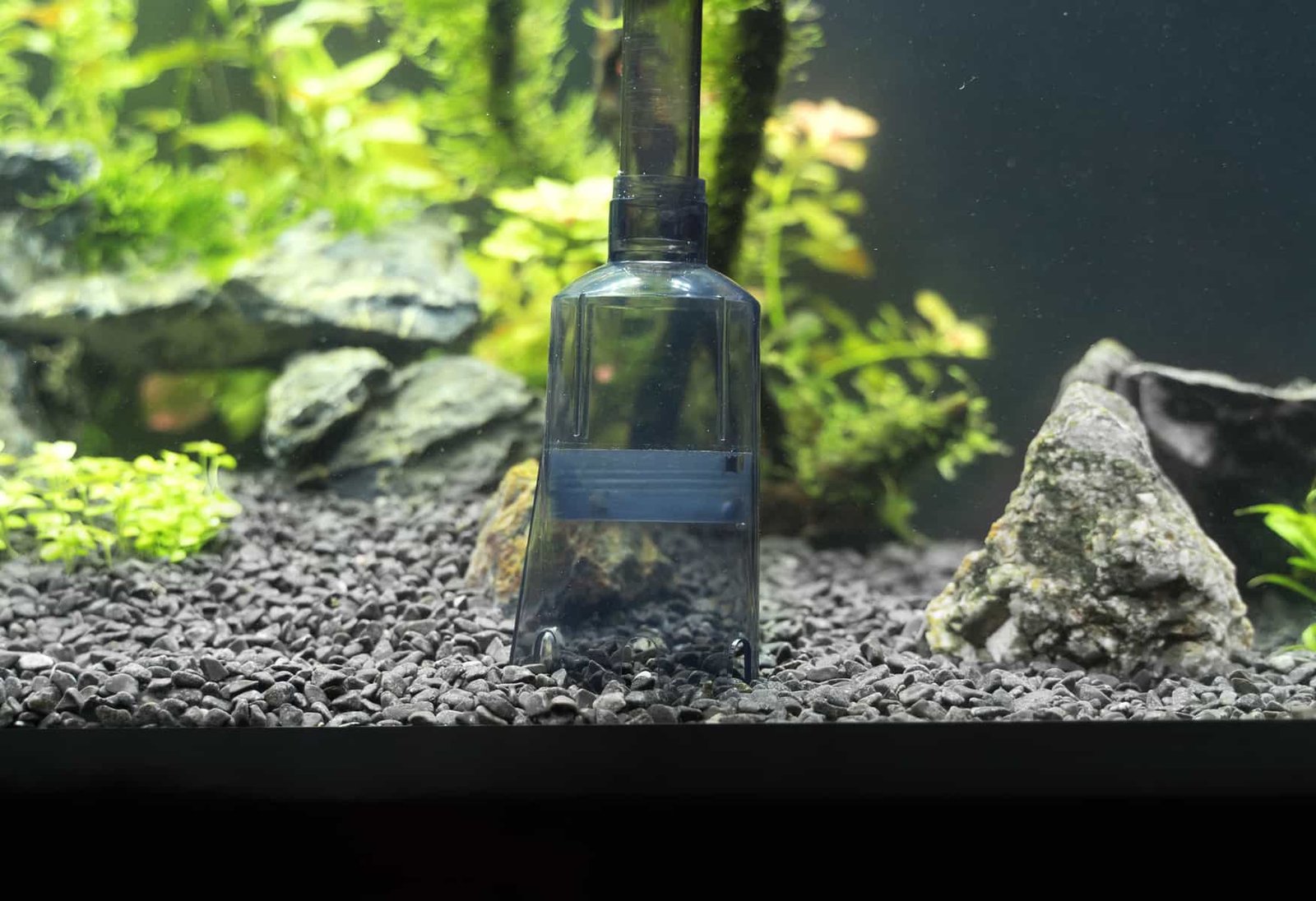
Gravel vacuum being used during aquarium maintenance
Choose a vacuum whose flow and intake size suit the aquarium and substrate.

Quick comparison

Vacuum Best suited to Main tradeoff Buying option
Aqueon Siphon Vacuum Small-to-medium tanks and bucket water changes Choose the correct tube size for the tank Check on Amazon
Python No Spill Clean and Fill Large tanks near a compatible faucet Long hose and faucet compatibility must be planned Check on Amazon
Aqueon Aquarium Water Changer Faucet-assisted draining and refilling Needs a compatible faucet and careful refill procedure Read review
Fluval EasyVac Medium Controlled bucket siphoning Still requires moving buckets Check on Amazon
EHEIM Quick Vac pro Spot-cleaning gravel between water changes Not suitable for sand and does not remove water Read review

What an aquarium vacuum can—and cannot—do

A gravel vacuum lifts fish waste, uneaten food and plant debris from the substrate. A siphon model simultaneously removes old water, which makes it useful for routine partial water changes. It does not replace the aquarium filter, and cleaning the substrate does not correct ammonia or nitrite without addressing their cause.

Battery vacuums recirculate water through a small debris screen. They are convenient for visible dirt, but dissolved waste remains in the aquarium. Regular partial water changes and water testing are still necessary.

How to choose the right vacuum

  • Tank size and height: the intake must reach the substrate comfortably, and the hose must reach the bucket, drain or faucet.
  • Substrate: coarse gravel can be churned inside a wide tube. Fine sand needs gentler surface hovering and more precise flow control.
  • Fish and plants: use a narrow intake and lower flow around shrimp, fry, carpeting plants and delicate rooted plants.
  • Water-change method: bucket siphons are simple and portable; faucet systems reduce lifting but require compatible plumbing and careful temperature control.
  • Replacement parts: adapters, bulbs, hoses, clips and filter screens should be obtainable for equipment intended for long-term use.

Aqueon Siphon Vacuum Gravel Cleaner

Best for: straightforward bucket-based water changes.

Aqueon’s siphon family comes in several intake sizes. The self-priming motion starts water flow, the clear intake lets you see debris, and the included clip helps secure the hose to a bucket. The small Mini model is useful where a large tube would remove water too quickly.

Watch for: the linked Amazon product is the exact Mini 5-inch version, intended for very small aquariums. Owners of larger tanks should use Aqueon’s official size options rather than buying the Mini simply because it is listed here.

Check the exact Aqueon Mini Siphon listing on Amazon
Official Aqueon sizes and specifications

Python No Spill Clean and Fill

Best for: larger aquariums where carrying multiple buckets is impractical.

The Python system connects to a faucet and uses a long, aquarium-safe hose to drain, gravel-clean and refill. It can reduce lifting and floor spills when the aquarium is a considerable distance from a drain. Multiple hose lengths and replacement parts are available from the manufacturer.

Watch for: check the faucet thread and adapter before purchasing. Secure every connection and supervise the system continuously. During refilling, match temperature and use water conditioner correctly for the full volume of new tap water entering the aquarium.

Check the exact Python 50-foot system on Amazon

Aqueon Aquarium Water Changer

Best for: faucet-assisted water changes with a choice of hose lengths.

This system attaches to a compatible faucet, sends dirty water to the drain and can reverse flow to refill the aquarium. Its gravel-cleaning tube allows substrate cleaning during draining, and replacement flow assemblies and faucet adapters are supported by the manufacturer.

Watch for: test the adapter fit and hose connections before leaving the drain area. Never leave an aquarium refilling unattended. Condition tap water and keep replacement water close to the aquarium’s temperature.

Official Aqueon Water Changer information

Fluval EasyVac Medium Gravel Cleaner

Best for: aquarists wanting a conventional siphon with a gravel guard and easy-start valve.

The EasyVac is a bucket-draining siphon available in different tube lengths. Fluval’s design includes a gravel guard intended to reduce clogging and a tube profile that helps reach corners. Selecting the right length keeps the user’s hands out of deeper tanks and gives better control.

Watch for: the rate of water removal depends on the height difference and hose size. Pinch or lift the hose to slow flow around fine substrate and small animals. Confirm the current model and size through Fluval because an older Amazon listing previously used by this article now resolves to a different product name.

Check the exact Fluval EasyVac Medium listing on Amazon
Official Fluval EasyVac information

EHEIM Quick Vac pro

Best for: picking up visible debris from gravel between scheduled water changes.

This battery-powered unit draws debris into a removable mesh compartment and returns the water to the aquarium. It can tidy localized waste without setting up a bucket or drain hose, and EHEIM continues to document replacement components.

Watch for: EHEIM states that the Quick Vac pro is not suitable for sand. Because it returns water to the tank, it does not replace partial water changes. Clean the debris compartment after use and keep the battery housing sealed as instructed.

Official EHEIM Quick Vac pro information

How to vacuum aquarium gravel safely

  1. Prepare conditioned replacement water and a clean aquarium-only bucket if one is required.
  2. Unplug heaters and other equipment that could be exposed as the water level falls. Follow each device’s manual.
  3. Place the intake in the aquarium and secure the discharge hose.
  4. Start the siphon using the product’s priming method. Do not start it by mouth.
  5. Push the intake gently into gravel, allow debris to rise, then lift it before too much gravel reaches the hose.
  6. For sand, hover just above the surface and reduce flow. Avoid deeply disturbing the entire bed in one session.
  7. Watch fish, shrimp and snails continuously and stop suction if an animal approaches the intake.
  8. Stop at the planned water-change volume, refill with temperature-matched conditioned water, then restart equipment when safely submerged.

How much substrate should be cleaned?

There is no universal schedule. A lightly stocked planted aquarium may accumulate little accessible debris, while a heavily stocked tank with coarse gravel may need attention at every water change. Use water tests, visible waste and the aquarium’s nitrate trend to guide maintenance.

Avoid stripping the entire aquarium spotless. Rooted plants benefit from an established substrate, and beneficial organisms live on surfaces throughout the tank. Clean exposed dirty areas, work around roots, and divide neglected deep gravel into sections over several sessions.

Common mistakes

  • Buying an intake so large that a small aquarium drains before cleaning is finished.
  • Using full suction around shrimp, fry or fine sand.
  • Leaving a faucet-connected system or refill hose unattended.
  • Forgetting water conditioner or failing to match replacement-water temperature.
  • Running a heater after the water falls below its safe operating level.
  • Assuming a recirculating battery vacuum replaces water changes.
  • Deep-cleaning all old substrate at once and releasing a large amount of trapped waste.

Frequently asked questions

Can a gravel vacuum remove beneficial bacteria?

Some bacteria live on substrate surfaces, but normal partial vacuuming does not sterilize an aquarium. Most established systems also contain large bacterial populations in the filter media and on other surfaces. Avoid aggressive whole-tank cleaning and never rinse biological filter media in untreated chlorinated tap water.

Can I vacuum sand?

Yes, with a siphon that offers controllable flow. Hover above the surface so light debris rises while the sand falls back. The EHEIM Quick Vac pro reviewed here is specifically documented as unsuitable for sand.

How often should I vacuum?

Inspect exposed substrate during each regular water change and clean where waste collects. Stocking, feeding, substrate grain, plants and flow all affect frequency. Water testing is more useful than following a rigid calendar.

Should fish remain in the tank?

Usually yes. Removing fish for routine maintenance creates unnecessary handling stress. Work slowly, keep the intake visible and use a guard or lower flow around very small animals.

How we selected these products

We compared current manufacturer support, suitability for different tank sizes and substrates, flow control, replacement parts, maintenance purpose and safety. We removed discontinued or mismatched listings and did not rank products by temporary price. The single Amazon product link is an exact match verified during this renovation; official manufacturer pages are included for specifications.

References and product information

Best Reef Sumps: 5 Current Systems and a DIY Option

Best Reef Sumps

The best reef sump is the one that fits your cabinet, holds every planned component and has enough empty capacity for drain-down when the return pump stops. Brand and display-tank ratings matter less than measured dimensions, operating water depth, plumbing layout and maintenance access.

This guide compares five current complete sumps and a DIY baffle-kit route. We did not add Amazon buying buttons because the exact current models could not be matched to trustworthy purchasable Amazon listings during our review. Manufacturer links are provided for current dimensions and configuration details.

Reef aquarium sump with filtration equipment beneath a display tank
A sump must fit the cabinet, equipment and water that drains from the display when the return pump stops.

Quick comparison

Sump Best suited to Main consideration Current information
Eshopps RS-100 5th Gen Compact, conventional reef layout Confirm current-generation dimensions and chamber fit Manufacturer range
Trigger Systems Ruby30E Flexible premium acrylic sump Measure skimmer footprint and cabinet access Manufacturer page
Fiji Cube Fiji-15 Advanced 2nd Gen Compact system needing adjustable water depth Select from the exact current size, not an old listing Manufacturer range
IceCap 36 Reef Sump V2 Larger equipment and an integrated refugium layout Verify cabinet door opening and service clearance Manufacturer page
Bashsea SS-30 Heavy-duty build and adjustable chamber depth Two-section layout may not suit every refugium plan Manufacturer page
Fiji Cube DIY baffle kit Customizing a compatible standard aquarium Assembly quality and drain-down testing are the owner’s responsibility Manufacturer range

What a reef sump does

A sump is a separate water vessel, normally below the display aquarium, connected by an overflow and return pump. It increases total water volume, hides equipment, collects surface water for mechanical filtration and creates working space for a skimmer, heaters, probes, media, reactors or a refugium.

A sump is not automatically safer or cleaner than a well-designed sumpless aquarium. Incorrect plumbing, inadequate empty volume, blocked drains or an unprotected return outlet can cause flooding. The complete system must be tested with the return pump running and switched off.

Measure before choosing a sump

  1. Measure the cabinet interior. Record width, depth and height, then measure the actual door opening. A sump that fits inside the stand on paper may not pass through its doors or frame.
  2. Map the plumbing. Confirm the number and diameter of drain lines, bulkheads, emergency drain, return hose and unions. Never force incompatible pipe into a supplied fitting.
  3. Measure every component. Record the skimmer footprint at its widest point, recommended operating depth, return-pump dimensions, heater length and space needed to remove filter socks, cups or fleece rolls vertically.
  4. Calculate drain-down capacity. With the pump off, water drains from the overflow box, plumbing and display until the siphon breaks. The sump must hold this water without approaching the rim.
  5. Allow service space. Leave room to remove lids, clean chambers, change mechanical media and reach valves without dismantling the stand.

Features that matter most

Mechanical filtration

Filter socks, cups, floss trays and fleece rollers can all remove suspended solids. Socks and floss are inexpensive but require frequent cleaning or replacement. Roller compatibility may reduce routine handling but adds equipment cost and creates a dependence on replacement fleece.

Skimmer chamber

The chamber must fit the skimmer body, pump and cable while maintaining the manufacturer’s recommended water depth. An adjustable baffle is useful, but a skimmer stand may still be required.

Return chamber

Evaporation appears in the return chamber, so a very small chamber can expose the pump quickly if an automatic top-off fails. It must fit the return pump and sensors with room for cleaning.

Refugium or equipment space

A dedicated refugium can hold macroalgae or habitat for small invertebrates, but it should not be assumed to solve every nutrient problem. Some aquarists gain more value from using the chamber for a larger skimmer, media reactor or easier maintenance access.

Eshopps RS-100 5th Gen

Best for: a compact conventional sump with clear skimmer and return areas.

Eshopps currently lists fifth-generation RS models in several sizes. The RS-100 is a sensible comparison point for smaller reef systems, but buyers must use the fifth-generation specifications: the older RS-75 featured in the original article is discontinued, and dimensions from prior generations should not be mixed with current models.

Watch for: confirm the exact filter-sock arrangement, skimmer chamber and return chamber against your equipment. The display-tank range is only a starting point.

Current Eshopps RS sump range

Trigger Systems Ruby30E

Best for: aquarists wanting a premium acrylic sump with adjustable working depth and organized accessory provisions.

Trigger Systems maintains several sump families. The Ruby30E represents its established conventional format and is supported by a model-specific manufacturer page. The layout provides separated working areas and an adjustable baffle, making it easier to match a skimmer’s operating depth.

Watch for: premium cable, probe and dosing provisions are useful only if they remain accessible inside the cabinet. Compare the exact Ruby30E dimensions with the stand opening and skimmer footprint.

Official Trigger Systems Ruby30E information

Fiji Cube Fiji-15 Advanced Reef Sump 2nd Gen

Best for: a compact cabinet where an adjustable skimmer depth and covered acrylic layout are valuable.

Fiji Cube’s current second-generation range includes multiple sizes. The Fiji-15 provides a compact complete-sump option, while larger models offer more working area. The range uses support bracing and covers intended to limit splashing, salt creep and evaporation.

Watch for: availability varies by model, so use the live manufacturer range and do not substitute dimensions from the sold-out Fiji-36 or the old DIY kit described in the former article.

Current Fiji Cube Advanced Sump range

IceCap 36 Reef Sump V2

Best for: a larger under-cabinet installation needing several functional zones.

The IceCap 36 V2 is a current complete sump with space intended for mechanical filtration, a protein skimmer, refugium use and the return pump. Its larger footprint can improve equipment access compared with compact sumps.

Watch for: large external dimensions are an immediate cabinet-fit constraint. Confirm that the sump can pass through the stand opening and that equipment can still be lifted out after installation.

Official IceCap 36 Reef Sump V2 information

Bashsea Signature Series SS-30

Best for: aquarists prioritizing robust construction, large drain handling and adjustable operating depth.

Bashsea documents the SS-30 as a 30 × 15 × 16-inch, two-section sump with an adjustable water gate, a 1.5-inch drain and a seven-inch sock. The manufacturer rates it for aquariums up to 120 gallons, but equipment fit and safe drain-down volume remain the deciding factors.

Watch for: the two-section design differs from sumps with a dedicated central refugium. Decide whether the open working area will hold your intended skimmer and accessories before purchase.

Official Bashsea Signature Series specifications

Fiji Cube DIY sump baffle kit

Best for: an experienced aquarist converting a compatible standard aquarium into a custom sump.

A baffle kit can provide more volume for the budget and lets the owner choose the chamber layout. Fiji Cube currently supports kits for selected standard aquariums, including 20-long, 29-gallon and 40-breeder formats.

Watch for: verify the donor aquarium’s internal dimensions, glass condition and compatibility with the exact kit. Follow the adhesive and curing instructions, leak-test away from livestock, and calculate drain-down volume before connecting it to the display.

Current Fiji Cube sump baffle kits

Safe installation checklist

  • Use an overflow and drain design with appropriate redundancy; do not rely on an untested single siphon.
  • Support plumbing so pipe weight does not twist bulkheads.
  • Install unions and valves where they can be reached and serviced.
  • Keep power supplies, controllers and connections away from splash zones, with drip loops and appropriate ground-fault protection.
  • Mark the maximum safe operating level on the sump.
  • Switch off the return pump and allow the entire system to drain fully during testing.
  • Confirm that return outlets break siphon before the sump overfills.
  • Test the emergency drain without livestock present.
  • Never leave a newly started system unattended until water levels and plumbing are proven stable.

Frequently asked questions

How large should a reef sump be?

Use the largest sump that fits the cabinet, equipment and service space while retaining adequate empty drain-down capacity. Total volume is helpful, but chamber dimensions and safe freeboard are more important than a percentage rule.

Does a sump need a refugium?

No. A refugium can be useful, but many successful systems use the available space for skimming, mechanical filtration, reactors or easier maintenance. Choose the layout that serves the aquarium’s actual needs.

How high should the sump water level be?

The skimmer chamber should match the skimmer’s recommended operating depth, while the overall running level must leave enough empty volume for power-off drain-down. Test the finished system rather than relying only on calculation.

Why does the return chamber level fall?

Evaporation appears in the return section because the upstream baffles maintain the other chamber levels. An automatic top-off can stabilize salinity, but its sensor, reservoir and maximum delivery volume must be configured safely.

How we selected these sumps

We prioritized current manufacturer support, a range of cabinet sizes and layouts, published dimensions, service access and clear filtration roles. We removed the discontinued Eshopps RS-75, unsupported generic marketplace sumps, hang-on refugiums presented as complete sumps and old product listings that could not be verified. No temporary prices or unsupported star ratings are used.

Manufacturer references

Best Fountain Pumps: 5 Current Options Compared

Top [2021] 10 Best Fountain Pumps: Solar, Submersible Water Pumps

The right fountain pump is selected from the flow required at the fountain’s actual lift height—not from its zero-head maximum flow. A tiny solar birdbath, an indoor ornament, a pond fountain and a waterfall all need different pumps.

Submersible pumps for pond fountains and outdoor water features
Fountain pumps range from compact decorative units to high-flow pumps for ponds and waterfalls.

Affiliate disclosure: Aquarium Hunter may earn a commission from qualifying Amazon purchases, at no extra cost to you. Amazon links below are used only for exact products that were available when this guide was reviewed.

Quick comparison

Pump Best suited to Main limitation Buying option
Solatec 1.4W Solar Fountain Small sunny birdbaths and bowls Output changes with direct sunlight; no battery storage Check on Amazon
Sicce Syncra Silent 1.5 Indoor fountains and compact water features Use the correct regional voltage and installation method Read review
Aquascape Ultra 1100 Decorative fountains, small ponds and filters Flow falls as lift and pipe resistance rise Read review
OASE Aquarius Universal Purpose-designed fountain and statuary systems Select the exact regional model from its performance curve Read review
Alpine PAL3100 Large ponds, waterfalls and high-flow fountains Oversized for small bowls and compact ornaments Check on Amazon

How to size a fountain pump

Start with the desired effect

A gentle trickle needs far less flow than a wide waterfall or tall jet. If a fountain head, filter or waterfall spillway specifies a recommended flow, use that as the starting point.

Measure total dynamic head

Vertical head is the height from the operating water surface to the outlet. Pipe length, narrow hose, elbows, valves, filters and fountain nozzles add resistance. Check the manufacturer’s flow chart at the expected head instead of comparing maximum GPH figures measured with no lift.

Match the plumbing

Undersized hose can waste pump capacity and electricity. Use the recommended internal diameter, keep runs direct and avoid unnecessary fittings. Confirm that the supplied outlet and adapters match the planned hose.

Allow adjustment

A valve or controllable pump makes final tuning easier. Throttling the discharge side of a suitable centrifugal pump is normally preferable to restricting its intake, but follow the product manual.

Solatec 1.4W Solar Fountain Pump

Best for: a small birdbath or decorative bowl in strong direct sun.

This self-contained solar unit is simple: place the panel where it receives full sun, submerge the pump and choose a nozzle. It requires no mains cable across the garden and its exact Amazon listing remains available.

Watch for: the pump responds directly to sunlight, so clouds, shadows and a poorly oriented panel reduce or stop the spray. It is a decorative circulation device, not a pond filter or dependable source of aeration for fish. Keep the intake submerged and clean mineral deposits and debris regularly.

Check the exact Solatec 1.4W Solar Fountain on Amazon

Sicce Syncra Silent 1.5

Best for: indoor fountains and compact submerged or correctly plumbed applications where quiet operation matters.

Sicce’s Syncra Silent range is manufacturer-supported with published flow, head, wattage and spare-parts information. The 1.5 model provides a useful middle point for compact water features; the 120V specification lists a maximum of 357 GPH and six feet of head.

Watch for: maximum flow and maximum head do not occur together. Select the regional voltage and cord version, use only an installation method permitted by the manual and never run the pump dry.

Official Sicce Syncra Silent instructions and specifications

Aquascape Ultra 1100 Water Pump

Best for: decorative fountains, small ponds, external filters and modest water features needing flexible fittings.

Aquascape publishes a maximum flow of 1,110 GPH and maximum head of 12 feet for the Ultra 1100, plus a model-specific performance chart. The oil-free magnetic-drive design, prefilter cage, stable base and included multi-hose fittings make it more versatile than a generic bare pump.

Watch for: choose from the performance curve at the real operating head. The maximum numbers are boundaries, not a promise of 1,110 GPH at 12 feet. Clean the prefilter cage before restricted flow causes poor performance.

Official Aquascape Ultra 1100 specifications

OASE Aquarius Universal

Best for: statuary, indoor fountains and larger decorative systems where a dedicated fountain-pump family is useful.

The Aquarius Universal family spans compact classic models and larger premium pumps. OASE publishes model-specific flow and head information, hose connections and installation options. That makes it possible to size a pump from the actual fountain rather than a marketplace headline.

Watch for: product names, voltage and specifications vary by region. Choose the exact local model and follow its manual for submerged or dry installation, winter protection and electrical requirements.

Official OASE Aquarius Universal example and specifications

Alpine PAL3100 Cyclone Pump

Best for: a large pond waterfall, substantial fountain or other high-flow water feature.

The current exact Amazon listing identifies the PAL3100 as a 3,100 GPH submersible pump with a 21.5-foot maximum lift and long outdoor cord. Its high capacity makes it a different class from the compact solar and indoor pumps above.

Watch for: do not install it merely because a high GPH figure appears impressive. Confirm the required flow at operating head, plumbing diameter, intake protection, electrical load and maintenance access. Excess current can disturb fish and empty a small reservoir rapidly if a hose disconnects.

Check the exact Alpine PAL3100 on Amazon

Solar, magnetic-drive or large pond pump?

  • Direct solar: easiest for a small decorative bowl, but output depends on sunlight and usually stops in shade.
  • Compact magnetic-drive: quiet, adjustable and efficient for indoor ornaments and small features.
  • Dedicated fountain pump: provides published performance options for statuary and engineered nozzles.
  • Large pond pump: designed for high flow and lift, but needs appropriate plumbing, intake protection and electrical installation.

Installation and electrical safety

  • Use equipment rated for the intended indoor or outdoor location and local voltage.
  • Connect mains-powered outdoor equipment through appropriate ground-fault protection and a weatherproof installation that complies with local electrical rules.
  • Create drip loops and keep plugs, controllers and connections out of splash and flood zones.
  • Do not lift a pump by its power cord.
  • Unplug the pump before placing hands in the water or opening its housing.
  • Keep the intake submerged and unobstructed unless the manual explicitly supports dry installation.
  • Test all hose clamps and unions; plan where water will go if a hose separates.
  • Protect wildlife and fish from an exposed intake with the manufacturer’s cage or suitable prefilter.

Maintenance

Disconnect power, remove leaves and string algae from the intake, and clean mineral deposits from the impeller and fountain nozzles using the manual’s method. Restricted intakes reduce output and can increase wear. During freezing conditions, follow the manufacturer’s storage or frost-protection instructions rather than assuming every submerged pump can remain outdoors.

Frequently asked questions

How many GPH does my fountain need?

There is no universal turnover rule for decorative fountains. Start with the nozzle, spillway or desired effect, then use the pump curve at the actual head and plumbing resistance.

Can a fountain pump oxygenate a fish pond?

Surface movement can improve gas exchange, but a decorative fountain is not automatically adequate life support. Fish load, temperature, pond shape, circulation and backup aeration all matter.

Can I use a solar pump for fish?

It can provide supplemental movement in sun, but a direct-solar pump may stop with clouds or darkness. Do not rely on it as the only circulation or aeration for stocked water.

Why is my pump weaker than advertised?

Common causes include vertical lift, narrow or long hose, elbows, a clogged intake, mineral buildup, an undersized solar panel exposure or comparing real flow with the zero-head maximum.

How we selected these pumps

We prioritized distinct use cases, current manufacturer documentation, published performance data, electrical suitability and maintenance access. We removed unavailable AMYER and KEDSUM offers, the broken Jebao listing, rebranded generic pumps and the old affiliate link containing an incorrect tracking tag. No temporary prices or invented ratings are used.

References and product information

Aqueon vs. Python Water Changer: Which Fits Your Setup?

Aqueon vs. Python Water Changer: Which Fits Your Setup?

The Aqueon Aquarium Water Changer and Python No Spill Clean & Fill both connect an aquarium to a suitable faucet for draining and refilling. The better choice depends on the route to your sink, the faucet connection and the parts you can obtain—not a universal winner.

Our recommendation: consider Python first if you need a hose longer than 50 feet or want its wider catalog of adapters and replacement components. Aqueon remains a reasonable alternative when a 25- or 50-foot kit fits your setup and its total purchase cost is lower. Check compatibility before buying either.

This is a comparison of manufacturer information and practical buying considerations. We have not personally tested these systems side by side, measured their drain speeds or conducted a durability test.

Aqueon vs. Python: the useful differences

Feature Aqueon Aquarium Water Changer Python No Spill Clean & Fill
Manufacturer-listed hose lengths 25 and 50 feet 25, 50, 75 and 100 feet
Main job Drain water, vacuum gravel and refill through a faucet connection Drain water, vacuum gravel and refill through a faucet connection
Faucet connection Included multi-connection adapter; check the faucet diagram Brass adapter included; other adapters listed separately
Parts support Manufacturer lists replacement flow assembly and faucet adapter Manufacturer lists pumps, connectors, valves, adapters and gravel-tube options
Best reason to shortlist A matching 25- or 50-foot setup at a competitive total cost Longer standard hose choices and a broad parts catalog
Important limitation Does not make untreated tap water safe for fish Does not make untreated tap water safe for fish

Specifications were checked against the Aqueon product page and Python product catalog. Both systems remain listed by their manufacturers. Retail stock, included accessories and prices can vary, so check the exact kit at checkout.

How these water changers work

In drain mode, the faucet attachment uses flowing tap water to create suction through the aquarium hose. A gravel tube helps lift loose debris while removing aquarium water. The system can then be configured to send tap water back toward the aquarium.

This can reduce bucket carrying, but it does not automate safe maintenance. You still control how much water comes out, monitor the fish, prepare replacement water and stop refilling at the correct level. “No Spill” is a product name, not protection against leaving a hose unattended.

A water changer is also not a filter. It removes water and accessible debris; it does not eliminate the need for biological filtration or regular water testing.

Check these four things before choosing a kit

1. The actual hose route

Measure from the faucet, around furniture and doorways, to the aquarium working position. Include enough slack to reach the areas you intend to clean. A straight-line room measurement can leave the hose too short.

For example, a measured 32-foot route rules out a 25-foot kit. Compare a 50-foot kit with any manufacturer-approved extension arrangement, including the cost of extra fittings. Excess hose also takes storage space and creates more opportunities for kinks.

2. Faucet compatibility

Check whether the aerator can be removed and identify the exposed threads. Pull-down spray heads, hidden aerators and unusual fixtures may need another solution; do not assume an included adapter fits every sink.

Python’s FAQ explains its standard adapter arrangement and names additional adapters for some smaller-thread faucets. Aqueon asks buyers to check its faucet diagram. If uncertain, send the manufacturer a photo and measurements before ordering. Do not force a connection or use the hose as leverage on the faucet.

3. Aquarium depth and substrate

A tube that is comfortable in a shallow tank may be awkward in a tall one. Check the exact tube supplied and compatible extensions rather than relying on a generic product photograph.

For gravel, work in manageable sections. For sand, delicate plants or aquasoil, use gentler surface cleaning rather than plunging the tube through the bed. Watch for shrimp, fry and small fish near the intake. Our substrate-cleaning guide covers maintenance without stripping the whole aquarium.

4. The complete cost

Compare the same hose length, then add any adapter, extension or longer tube you actually need. Check replacement-part availability from a seller you can use. A lower initial price is less useful if a small broken fitting makes the whole kit impractical to repair.

We have not retained the old packaging-size and weight comparison: it did not establish equivalent kit lengths and was not a sound basis for recommending one system.

Refilling safely: conditioner and temperature matter

Neither system removes chlorine or chloramine simply by transporting water. The Merck Veterinary Manual identifies both as toxic to aquatic animals. Do not rely on splashing, aeration or waiting until the tank is full to make untreated tap water safe.

The clearest approach is to condition replacement water in a dedicated clean container, match its temperature and then transfer it. If refilling directly from a faucet, use a conditioner whose directions explicitly cover that method, with the correct dose and timing. Do not assume all brands use the same instructions.

For example, Seachem’s Prime instructions say to base the dose on the aquarium volume when adding it directly to the aquarium, while preferring treatment of new water first. That is a product-specific instruction, not a general rule for every conditioner. Follow the current label on the product you use.

Use a thermometer to check replacement water instead of judging it only by touch. If the faucet temperature changes unpredictably, use a separate preparation container. Saltwater aquariums require correctly mixed replacement saltwater for water changes; untreated freshwater from the faucet is not an equivalent substitute.

A practical water-change routine

  1. Decide the change volume from your aquarium’s needs and test results. The hose brand does not determine the correct percentage.
  2. Inspect tubing, fittings and the sink drain. Route the hose so it cannot kink, trip someone or pull on the aquarium.
  3. Follow equipment instructions for heaters or pumps that could become exposed as the water level drops.
  4. Connect and test the water changer according to its manual. Watch both the aquarium intake and the sink while draining.
  5. Remove selected debris without disturbing the entire substrate or replacing all established filter media.
  6. Prepare the replacement water, then refill under continuous supervision. Keep control of the hose and stop before the tank overflows.
  7. Follow the equipment restart instructions, confirm circulation, inspect for leaks and check the fish.

Water use and troubleshooting

Faucet-driven suction uses additional tap water while the faucet runs in drain mode. Neither manufacturer information reviewed here establishes a measured water-saving advantage over the other. If water use is your main concern, compare a simple gravity siphon to a lower drain or a suitable transfer-pump arrangement for your home.

If draining is weak, check the operating mode, hose kinks and fitting seals. Python’s FAQ specifically identifies loose connections and air leaks as possible causes. Follow the manual rather than tightening fittings aggressively or improvising pressure changes.

Never leave a pressurized hose running unattended. When stopping or changing modes, follow the manufacturer’s sequence for the faucet and valves. After use, drain and store the equipment cleanly, away from household chemicals.

Which should you buy?

Choose Python when its longer standard hose options or replacement-parts range solve a real problem in your setup. Choose Aqueon when its kit reaches comfortably, the adapter fits and the final cost is favorable. Choose neither yet if you have not confirmed the faucet connection or a safe way to prepare replacement water.

There is no verified basis here for claiming that one is always faster, more durable or completely spill-proof. A properly matched system used carefully is more valuable than an unsupported winner label. For the broader routine, see our aquarium maintenance basics.

Best Hermit Crab Substrate: Safe 5:1 Mix Explained

Best Hermit Crab Substrate: Safe 5:1 Mix Explained

The best substrate for most pet land hermit crabs is a deep mixture of about five parts suitable play sand to one part fine coconut fiber by volume. It should hold a tunnel when squeezed—often called sandcastle consistency—without dripping water. For many commonly kept land hermit crabs, provide at least six inches of substrate or about three times the height of the largest crab, whichever is deeper.

Land hermit crab walking on a deep natural sand substrate
Deep, stable substrate is essential because land hermit crabs build underground chambers to molt.

Affiliate disclosure: Aquarium Hunter may earn a commission from qualifying Amazon purchases, at no extra cost to you. Product links are included only where the item matches the recommended substrate component.

The recommended substrate at a glance

Component Amount Purpose Buying guidance
Suitable washed play sand About 5 parts by volume Weight and structure for stable burrows Choose a clean children’s play sand suitable for pet or aquarium use; local hardware bags are normally economical
Zoo Med Eco Earth coconut fiber About 1 part by volume Moisture retention and tunnel cohesion Check on Amazon

Why depth and structure matter

Land hermit crabs bury themselves to molt. A shallow decorative layer does not provide enough room to create a protected chamber, and loose material that collapses cannot support normal burrowing. The substrate is therefore part of the animal’s life-supporting habitat, not simply floor decoration.

A practical minimum for many commonly kept species is six inches or three times the height of the largest crab. Larger crabs and some species need more. Use a tall, escape-proof enclosure that can hold this depth while maintaining suitable temperature and humidity.

How to make a 5:1 sand and coconut-fiber mix

  1. Measure five equal containers of dry suitable play sand into a clean mixing tub.
  2. Prepare one equal container of fine coconut fiber according to its instructions, then squeeze out excess water.
  3. Mix the materials thoroughly so there are no isolated wet fiber pockets.
  4. Squeeze a handful. It should keep its shape and accept a finger tunnel without dripping.
  5. Add the mixture to the enclosure at the required depth and test several areas for stability.
  6. Allow temperature and humidity to stabilize before introducing animals.

Start drier than you think and add small amounts of properly treated water only if the mix will not hold shape. A saturated substrate can flood molt chambers and encourage bacterial or fungal problems.

Zoo Med Eco Earth coconut fiber

Zoo Med Eco Earth is a fine compressed coconut-fiber product commonly used as the smaller component of the sand mixture. The verified one-brick Amazon listing is the correct fine fiber product rather than coarse coconut chips.

Important: coconut fiber should not dominate the mixture. Excess fiber can hold too much water and produce a less stable burrow structure. Expand the brick as directed, remove excess moisture, and measure by volume after preparation.

Check Zoo Med Eco Earth on Amazon

Choosing play sand

Choose a clean children’s play sand with a known composition that is suitable for pet or aquarium use. Avoid products containing additives, fragrances, dyes, sharp crushed rock or unknown construction contaminants. In Australia, the Land Hermit Crab Owners Society specifically identifies washed play sand sold for children’s sandpits as a commonly used local option.

Do not assume aquarium sand is automatically better. Small aquarium bags are expensive at the depth a crab habitat needs, and calcium-based sands can behave differently from ordinary silica play sand.

Substrates to avoid

  • Calcium or “calci-sand”: specialist land-hermit-crab organizations advise against it because it can clump or harden when wet.
  • Aquarium gravel and glass pebbles: they do not hold molt chambers and create gaps that trap waste.
  • Cedar and aromatic wood shavings: aromatic oils are unsafe for arthropods.
  • Coarse coconut husk chips: they do not provide the fine cohesive structure of prepared coconut fiber.
  • Desert reptile bedding: products intended to remain very dry conflict with a humid tropical crab habitat.
  • Pure soil or jungle mix as the main bed: these products do not provide the weight and tunnel stability of the recommended sand-rich mix.

Humidity, heat and water

Substrate cannot compensate for an open or incorrectly heated enclosure. Land hermit crabs need a sealed habitat with species-appropriate warmth and humidity so their modified gills remain moist. Place an under-tank heater on the outside back or side wall above the substrate line rather than beneath a deep bed, where it can dry or overheat molting crabs.

Provide separate dechlorinated fresh and marine-saltwater pools deep enough for safe submersion, with secure exits. Do not use table salt or products marketed only as a small “hermit crab salt” sachet unless the formulation is demonstrably a complete marine salt mix.

Maintenance

Spot-clean food and visible waste from the surface. Do not routinely dig through the substrate because a crab may be molting below. A healthy, properly balanced bed can remain in place for a long period; complete replacement is reserved for flooding, infestation, dangerous contamination or another specific failure.

If the substrate becomes waterlogged, develops a strong sour odor, or contains an uncontrolled pest outbreak, first confirm whether any crab is underground. Disturbing a molting crab can be fatal, so consult an experienced land-hermit-crab care resource before dismantling the habitat when the situation is not immediately life-threatening.

Frequently asked questions

Can hermit crabs live in coconut fiber only?

Fine coconut fiber can be used temporarily, but the widely recommended permanent bed is sand-rich—about five parts sand to one part fiber—because it produces more stable molt chambers.

How wet should the substrate be?

It should hold a shape and a finger tunnel but should not release water when squeezed. Prepare the fiber moist and add water cautiously rather than saturating the whole enclosure.

How deep should hermit crab substrate be?

Use at least six inches or about three times the height of the largest crab, whichever is deeper. Large species and individuals may require substantially more.

Should I replace substrate while a crab is buried?

No, unless there is an immediate emergency such as severe flooding or toxic contamination. A buried crab may be molting and should not be uncovered routinely.

Reliable care references

Bottom line

Skip the seven-product substrate ranking. For most pet land hermit crabs, build one correct deep bed: about five parts suitable washed play sand to one part fine coconut fiber, mixed to sandcastle consistency. Depth, moisture balance, stable heat and humidity, and leaving molting crabs undisturbed matter far more than branded decorative sand.

Best Aquarium Media Reactors: 4 Current Options

Best Aquarium Media Reactors: 4 Current Options

A media reactor can make activated carbon, granular ferric oxide (GFO) and certain specialty media work more evenly than a passive media bag. It is not essential for every aquarium, however, and the best model depends on the media, required flow, available space and whether you need an included pump.

Aquarium media reactor used for controlled chemical filtration
A reactor should be selected and adjusted for the specific media—not simply run at maximum flow.
Quick recommendation: The Two Little Fishies PhosBan Reactor 150 is the strongest general-purpose choice because it is current, widely supported and easy to regulate. Choose the AQUATOP MR-20 when you specifically want a pump included.

Quick comparison

Reactor Best for Pump Buying option
PhosBan Reactor 150 Best all-round value Separate pump required Check on Amazon
AquaMaxx FR-SE Flexible hang-on use Separate pump required Check on Amazon
AQUATOP MR-20 Complete compact package 95 GPH pump included Check on Amazon
Innovative Marine MiniMax Pro Compatible all-in-one aquariums Integrated model-specific design View manufacturer

Listings and package contents can change. Confirm the exact model, included fittings and pump requirements before ordering.

1. Two Little Fishies PhosBan Reactor 150

Best for: a proven, adjustable reactor for GFO or carbon.

The PhosBan Reactor 150 uses bottom-to-top flow to distribute water through the media and reduce channeling. The manufacturer rates one reactor for aquariums up to 150 gallons, with a maximum of 200 grams or 385 ml of PhosBan. Those figures are limits, not universal dosing instructions: always begin with the media manufacturer’s dosage for your actual water volume.

A pump and hose are not included. Two Little Fishies recommends a pump in the 100–200 GPH range, then restricting the inlet with the supplied valve to achieve the much lower flow required by GFO. Never restrict the outlet, as that can pressurize the chamber and cause leaks.

Check the PhosBan Reactor on Amazon   Manufacturer details

2. AquaMaxx FR-SE External Media Reactor

Best for: flexible hang-on installation and higher media capacity.

The FR-SE has a 3.2-inch chamber, stands about 14.6 inches tall and holds up to one liter of media. Its bracket accommodates aquarium rims up to 3/4 inch. AquaMaxx describes it for carbon, GFO and biopellets, but these media require different quantities and flow patterns; empty and clean the reactor before changing roles.

The pump and tubing are sold separately. An adjustable pump or an inlet valve is important because suitable flow depends on the media and amount used.

Check the AquaMaxx FR-SE on Amazon   Manufacturer specifications

3. AQUATOP MR-20 Media Reactor

Best for: a compact package with its own pump and plumbing.

The MR-20 includes a 95 GPH submersible pump, intake and output tubing, a tank hook and suction cups. Its chamber is approximately 2.4 inches in diameter and 15 inches high. It can hang on the aquarium or operate in a sump, making it convenient when you do not want to source a separate feed pump.

AQUATOP rates it for tanks up to 20 gallons. Follow the chosen media’s dosage and motion requirements instead of assuming that the full pump output is suitable. Clean the pump, impeller and strainers regularly and disconnect power before servicing.

Check the AQUATOP MR-20 on Amazon   Manufacturer specifications

4. Innovative Marine MiniMax Pro

Best for: selected Innovative Marine all-in-one aquarium filter compartments.

The MiniMax Pro is designed to fit compatible rear filtration chambers, producing a clean installation without external plumbing. Compatibility is more important than the nominal aquarium size: measure the chamber and confirm the exact Desktop or Midsize version against the manufacturer’s list.

The manufacturer currently lists these reactors as out of stock, and an exact reliably available Amazon offer was not verified. For that reason, we link to the manufacturer rather than substitute a similarly named product.

Check current MiniMax availability

Do you need a media reactor?

A reactor is useful when controlled flow through a chemical medium will solve a measured problem. Carbon can remove discoloration and some dissolved organics; GFO can bind phosphate; and specialty resins have more specific uses. A reactor does not replace adequate biological filtration, protein skimming where appropriate, water changes or diagnosing the cause of poor water quality.

Do not add phosphate-removing media solely because algae is visible. Test phosphate with a suitable method, consider feeding and nutrient export, and reduce levels gradually. Rapid nutrient changes can stress corals and destabilize a mature reef.

How to choose the right reactor

Match the chamber to the media

GFO should usually move with only a gentle surface simmer; aggressive tumbling can grind it into dust. Carbon is normally held more firmly so granules do not abrade. Biopellets need stronger, continuous motion and dependable aeration and nutrient-export planning. Follow the media manufacturer’s instructions.

Check space and service access

Measure height, diameter, rim thickness, hose routes and the clearance needed to remove the lid. A reactor that technically fits but cannot be opened without dismantling the sump will be difficult to maintain.

Decide how it will be fed

A dedicated pump is simple to tune but adds heat, power use and another item to clean. Feeding from a return manifold saves a pump but must not compromise the aquarium’s main circulation. Use secure tubing and place the reactor where a minor leak cannot drain the aquarium.

Safe setup and maintenance

  1. Rinse or prepare the media exactly as its manufacturer directs.
  2. Keep the reactor upright and connect the inlet and outlet securely.
  3. Start at low flow and discharge the initial cloudy water into a bucket until it runs clear.
  4. Adjust only enough flow to achieve the correct motion for that medium.
  5. Check every connection for leaks and ensure the return cannot create a damaging back-siphon.
  6. Inspect sponges, tubing and the pump regularly. Clogged foam can change pressure and flow.
  7. Replace media according to test results and exhaustion—not an arbitrary calendar alone.

Frequently asked questions

Can carbon and GFO share one reactor?

They can sometimes be mixed when the manufacturer permits it, but they exhaust at different rates and prefer different motion. Separate reactors provide more control.

Can a reactor replace a filter?

No. It is normally an optional chemical-filtration component. The aquarium still needs appropriate biological and mechanical filtration and routine husbandry.

Should media tumble?

It depends on the medium. GFO generally needs only slight movement at the surface, carbon should not grind, and biopellets require more active circulation. Follow the instructions for the exact product.

Final verdict

The Two Little Fishies PhosBan Reactor 150 remains the best general-purpose choice for most aquarists who can supply a small pump. AquaMaxx offers more capacity and flexible mounting, while the AQUATOP MR-20 is convenient for a small system because its pump and plumbing are included. The MiniMax Pro is worth considering only when it matches the dimensions of a compatible all-in-one aquarium.

Affiliate disclosure: Aquarium Hunter may earn a commission from qualifying Amazon purchases, at no additional cost to you. We link only to products that match the model discussed.