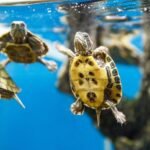
The best food for an aquatic turtle is a correctly sized, life-stage-appropriate staple pellet—not a jar of dried shrimp marketed as a complete diet. Species, age and adult size still matter, and healthy feeding also depends on clean water, appropriate heat, UVB exposure and a usable basking area.

Quick comparison
| Food | Best use | Type | Buying option |
|---|---|---|---|
| Tetra ReptoMin | General aquatic-turtle staple | Floating sticks | Check on Amazon |
| Zoo Med Growth Formula | Growing turtles 2–6 inches | Floating pellets | Check on Amazon |
| Zoo Med Maintenance Formula | Large adults 6 inches and over | Floating pellets | Check on Amazon |
| Fluker’s Buffet Blend | Pellet-based variety | Pellets with dried items | Check on Amazon |
| Saki-Hikari Turtle | Premium daily pellet | Floating pellets | View manufacturer |
Formulas and package sizes can change. Match the label to your turtle’s species and life stage and check the live listing before ordering.
1. Tetra ReptoMin Floating Food Sticks
Best for: a widely available everyday staple for many aquatic turtles.
ReptoMin sticks float, making them easy for surface-feeding turtles to locate and allowing uneaten food to be removed. The stick format can be broken into smaller pieces where appropriate. Treat the label as the starting point and adjust feeding to the animal’s size, condition, activity and water temperature.
The 2025 FDA recall applied only to one lot—951790—of the separate ReptoMin 3-In-1 Select-A-Food product, not to other lots or product lines. Never use a recalled lot, and wash hands and feeding equipment after handling reptile food or aquarium water.
Check ReptoMin on Amazon FDA recall details
2. Zoo Med Natural Aquatic Turtle Food—Growth Formula
Best for: growing aquatic turtles with shells approximately 2–6 inches long.
Zoo Med makes separate hatchling, growth and maintenance formulas. The Growth Formula uses a medium floating pellet and a higher protein level than the adult Maintenance Formula, making the life-stage distinction more useful than a vague “all turtles” label. Choose the package whose product name and pellet size match the animal in front of you.
Check Growth Formula on Amazon Manufacturer guidance
3. Zoo Med Natural Aquatic Turtle Food—Maintenance Formula
Best for: large adult aquatic turtles around 6 inches or more in shell length.
The Maintenance Formula has larger 5/16-inch floating pellets and a manufacturer-listed analysis of 25% minimum crude protein, 5% minimum fat and 1.3–1.7% calcium. It is intended for adult maintenance rather than rapid juvenile growth. Owners of small species or younger turtles should choose the appropriate smaller-pellet formula instead.
Check Maintenance Formula on Amazon Manufacturer nutrition details
4. Fluker’s Buffet Blend Aquatic Turtle Formula
Best for: adding convenient variety while retaining fortified pellets.
Buffet Blend combines vitamin-enriched pellets with freeze-dried shrimp and mealworms. It is preferable to feeding a container of dried shrimp alone because pellets remain part of the mixture. Selective turtles may pick out only the treats, however; if that happens, return to a consistent staple pellet and offer treats separately in limited amounts.
Check Fluker’s Buffet Blend on Amazon
5. Saki-Hikari Turtle
Best for: a premium floating daily diet.
Saki-Hikari Turtle is a balanced floating food with added calcium and vitamin D3. Hikari also includes its Hikari-Germ microorganism culture. Pellet size and the turtle’s feeding behavior still matter more than marketing features, and the product should be stored dry and replaced if it becomes damp, moldy or rancid.
An exact current Amazon offer was not verified, so the link goes to the manufacturer rather than to a similar or incorrect product.
View Saki-Hikari Turtle details
How to choose aquatic turtle food
Start with the species
“Turtle” covers animals with very different natural diets. Sliders, painted turtles, map turtles, musk turtles and softshells do not have identical requirements, and terrestrial box turtles and tortoises should not be fed from an aquatic-turtle roundup. Confirm the species before building a diet.
Match the life stage and pellet size
Young aquatic turtles often consume proportionally more animal matter and protein, while many species become more plant-oriented as they mature. A pellet should be small enough to swallow safely. Do not use rapid growth as the sole sign of good nutrition; steady development, body condition and shell quality are more useful.
Use treats as treats
Dried shrimp, mealworms and similar foods are palatable but should not displace a formulated staple. Suitable leafy greens and aquatic plants may be important for omnivorous adults, while occasional appropriate invertebrates can add enrichment. Avoid processed human food, seasoned meat and wild prey exposed to pesticides or parasites.
How much and how often?
There is no reliable universal scoop size. Follow the exact food’s directions, account for species and age, and remove leftovers promptly. Juveniles generally eat more frequently than adults. Overfeeding causes obesity and rapidly degrades water quality; persistent refusal to eat can indicate low temperature, stress, poor water conditions or illness rather than simple fussiness.
Monitor body condition and weight where practical. If growth, shell shape, buoyancy, eyes, appetite or droppings seem abnormal, consult a veterinarian experienced with reptiles.
Food cannot replace husbandry
Calcium in a pellet cannot compensate for inadequate UVB exposure, incorrect basking temperatures or the absence of a fully dry basking site. Maintain clean, appropriately heated water, powerful biological filtration, a safe heat source and UVB lighting positioned and replaced according to its manufacturer. These factors work together with diet to support shell and skeletal health.
Wash hands with soap after feeding, cleaning or touching a turtle or its habitat. Reptiles can carry Salmonella even when they appear healthy; supervise children and keep turtle equipment away from food-preparation areas.
Frequently asked questions
Can turtles live on dried shrimp?
No. Dried shrimp are better treated as an occasional extra, not a complete staple diet.
Do all aquatic turtles need vegetables?
No single rule fits every species or age, but many commonly kept omnivorous turtles benefit from increasing suitable plant matter as they mature. Research the exact species.
Can fish food be used instead?
A small amount is unlikely to be an emergency, but fish food is not formulated as a long-term complete diet for turtles. Use a suitable turtle staple.
Final verdict
Tetra ReptoMin is the best straightforward general staple here. Zoo Med’s Growth and Maintenance formulas make life-stage selection clearer, while Saki-Hikari is a premium alternative. Fluker’s Buffet Blend is best used by turtles that eat the fortified pellets as well as the dried ingredients—not as permission to select only treats.
Affiliate disclosure: Aquarium Hunter may earn a commission from qualifying Amazon purchases, at no additional cost to you. Recommendations are matched to the exact products discussed.