Yes—bettas should have a filter. Their labyrinth organ lets them breathe air at the surface, but it does not protect them from ammonia, nitrite, debris or unstable water. A gentle filter provides biological filtration, circulation and mechanical waste capture. The goal is low stress and steady water quality, not a powerful current.
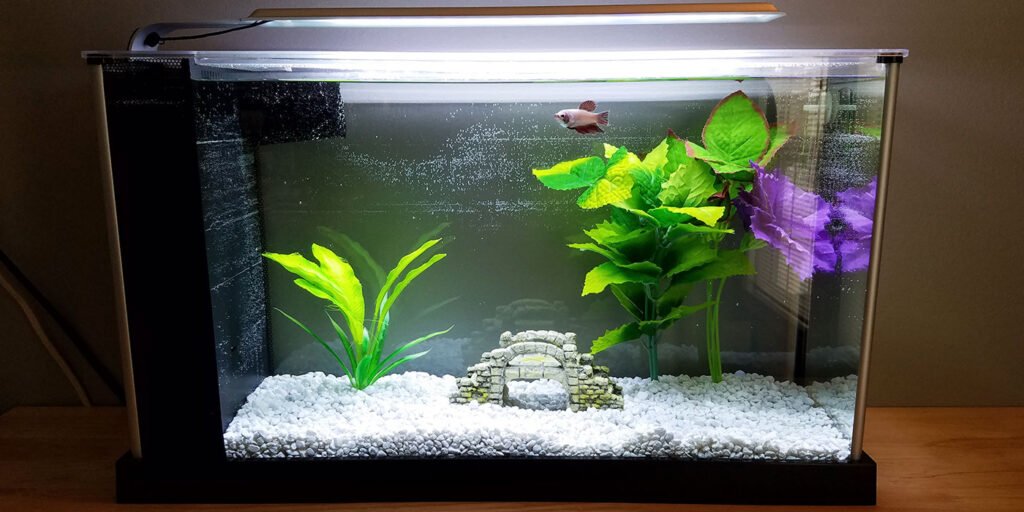
What a filter does for a betta
- Biological filtration: media provides surface area for bacteria that convert toxic ammonia to nitrite and then nitrate.
- Mechanical filtration: sponge or pads capture suspended debris so it can be removed during maintenance.
- Circulation and gas exchange: gentle movement distributes heat and oxygen without exhausting the fish.
- Optional chemical filtration: carbon or specialty media can remove specific dissolved compounds, but is not required continuously in every aquarium.
A filter does not eliminate water changes, testing, substrate cleaning or careful feeding.
Why surface breathing does not replace filtration

Bettas naturally visit the surface to breathe. That adaptation helps in warm, oxygen-variable habitats; it does not make polluted water harmless. Ammonia and nitrite damage fish even when surface air is available.
The nitrogen cycle in plain language
Fish waste and decaying food produce ammonia. Beneficial bacteria convert ammonia to nitrite, then another group converts nitrite to less-toxic nitrate. These bacteria live mainly on filter media, substrate and other wet surfaces—not floating freely in the water.
Cycle the aquarium before adding a betta whenever possible. Confirm that the system can process its ammonia source to zero ammonia and zero nitrite, with nitrate appearing and remaining manageable. A bottled-bacteria dose or a few days of running the filter is not proof that cycling is complete.
Best filter types for bettas
Air-driven sponge filter
A mature sponge filter is gentle, reusable and safe for long fins. It needs an air pump, airline, check valve and correctly sized sponge. Adjust the airflow so the fish can swim and rest normally.
Hang-on-back filter
A small adjustable HOB filter can work when the intake is protected with a sponge and the return is baffled if necessary. Keep the water level high to reduce the waterfall effect. Never block the outlet completely.
Small internal filter
An internal unit can be suitable when it has adjustable flow and a guarded intake. Position it so the aquarium contains calm resting areas and easy surface access.
How much flow is too much?
The fish should be able to hold position, reach food, rest on broad leaves and visit the surface without being pushed sideways. Long-finned bettas usually tire sooner than short-finned forms. Warning signs include constant hiding behind equipment, fins held close, difficulty feeding, frantic swimming or being pinned against the intake.
Reduce an adjustable setting, add a safe intake sponge, direct the return toward glass or use a purpose-made baffle. Check that reducing flow does not cause the filter to overheat or bypass media.
Filter setup checklist
- Choose a unit rated for the aquarium and capable of genuinely gentle flow.
- Protect intakes so fins, shrimp and snails cannot be trapped.
- Install a drip loop and use a GFCI/RCD-protected outlet.
- Seed and cycle the filter, testing ammonia, nitrite and nitrate.
- Keep open access to the surface and create calm resting zones.
- Verify that the filter restarts after cleaning and every power interruption.
Maintaining beneficial bacteria
Rinse reusable sponge and biological media gently in removed aquarium water or conditioned water. Do not replace every piece of media on the same day. Disposable cartridges often contain useful bacteria; replace only what is exhausted or damaged, and preserve other mature media during the change.
Clean the impeller and intake when flow declines. Never use soap or household cleaner on aquarium equipment.
Can a betta live without a filter?
An unfiltered container demands frequent testing and water replacement and offers little protection from sudden ammonia or temperature changes. Survival in an emergency container is not a suitable long-term standard. If the filter fails, add aeration if available, test water, feed lightly and perform conditioned, temperature-matched water changes as results require.
Do live plants replace a filter?
No. Healthy plants can consume some nitrogen and provide cover, but growth varies and dead leaves add waste. Plants complement biological filtration; they do not guarantee zero ammonia or nitrite.
Tank size, heat and filtration work together
A five-gallon or larger aquarium is easier to heat and keep stable than a bowl. Bettas also need a secure lid, a controlled heater where room temperature is insufficient, a thermometer, conditioned water and smooth cover. A filter cannot compensate for an undersized, cold or uncycled enclosure.
Frequently asked questions
Should the filter run all night?
Yes. Biological media needs continuous oxygenated water flow. Switching a filter off nightly can damage the biofilter and destabilize water quality.
Can I turn the filter off while feeding?
A brief pause may be acceptable if the manual permits it, but remember to restart it immediately. It is safer to adjust flow or feed in a calm area.
How often should filter media be replaced?
There is no universal calendar. Rinse mechanical media when dirty, preserve biological media while it remains intact and replace specialty chemical media according to its purpose and manufacturer directions.
Why is my betta resting near the filter?
It may be using a calm ledge, hiding from excessive flow elsewhere or showing illness. Observe breathing and appetite, check temperature and test ammonia, nitrite and nitrate before assuming the behavior is normal.
References and related guides
- Merck Veterinary Manual: filtration and beneficial bacteria
- Merck Veterinary Manual: aquarium management and new-tank syndrome
- Veterinarian-reviewed betta care sheet
- HOB filter selection, setup and maintenance
Final answer
Give a betta a cycled filter with gentle, protected flow. An air-driven sponge filter is often the simplest choice; an adjustable HOB or internal filter can also work. Surface breathing, plants and frequent cleaning do not replace stable biological filtration.