Disclosure: Aquarium Hunter may earn a commission from qualifying Amazon purchases made through links on this page, at no extra cost to you.
New Life Spectrum Naturox Optimum All Purpose Flakes are our best tropical fish food for a typical mixed community tank because they provide a practical complete staple in a form that can be crushed for different mouth sizes. Hikari Micro Wafers are the better choice for many small midwater fish that prefer a compact, slowly sinking bite. No single food suits every “tropical fish,” so match the format and ingredients to the species you actually keep.
Best Tropical Fish Foods: Quick Comparison
| Food | Best use | Format | Amazon |
|---|---|---|---|
| New Life Spectrum Naturox Optimum | Best overall staple | Flakes | Check on Amazon |
| Hikari Micro Wafers | Small community fish | Slow-sinking micro wafers | Check on Amazon |
| TetraMin Tropical Flakes | Widely available everyday option | Flakes | Check on Amazon |
| Aqueon Tropical Flakes | Budget staple | Flakes | Check on Amazon |
| Omega One Freeze-Dried Bloodworms | Occasional supplement only | Freeze-dried worms | Check on Amazon |
Important: Check the current label before purchase. Formulas and package sizes can change, and a food appropriate for one species may be unsuitable for another.
Our Tropical Fish Food Picks
1. New Life Spectrum Naturox Optimum Flakes — Best Overall

New Life Spectrum’s all-purpose flakes are a useful staple for omnivorous tropical community fish. Flakes float initially and then disperse through the upper water, while aquarists can crush them for smaller mouths. The current Naturox product is preferable to retaining a vague, outdated “color food” claim because it is sold as a complete all-purpose formula.
Large flakes can still be missed by nano fish, and bottom dwellers may receive little unless some food sinks. Feed a small pinch, watch which fish actually eat, and supplement with an appropriate sinking food when the community includes corydoras, loaches or other bottom-oriented species.
Pros: complete staple; crushable; useful for mixed communities; current identifiable formula.
Cons: flakes can drift into the filter; not ideal for every bottom feeder; costs more than basic flakes.
Check New Life Spectrum Naturox on Amazon
2. Hikari Micro Wafers — Best for Small Community Fish

Hikari Micro Wafers are small, compact pieces designed for tropical fish with small mouths. Their gradual sinking behavior helps fish feed below the surface and gives shy midwater fish more opportunity than a flake that immediately drifts away.
“Micro” does not automatically mean suitable for fry, and some tiny species may still need the pieces crushed. Observe feeding rather than relying on the package name. Remove uneaten food and use a dedicated species-appropriate diet for strict herbivores, specialized predators or fry.
Pros: small consistent pieces; reaches midwater fish; less easily blown apart than flakes.
Cons: may still be large for fry; sinking pieces can be lost in substrate; not a universal diet.
Check Hikari Micro Wafers on Amazon
3. TetraMin Tropical Flakes — Best Widely Available Option

TetraMin is a familiar complete flake food that is easy to find in multiple container sizes. It works as a straightforward staple for many common omnivorous community fish and is easy to crumble. The broad availability also makes replacing a nearly empty container simpler.
Buy a package your fish can finish while it remains fresh rather than choosing the lowest price per ounce. Repeated opening exposes food to air and moisture. Keep the container tightly closed, cool and dry, and discard food with an unusual smell, visible moisture or mold.
Pros: readily available; complete staple; multiple sizes; easy to crush.
Cons: flakes can create waste when overfed; large tubs may go stale; bottom feeders need another format.
Check TetraMin Tropical Flakes on Amazon
4. Aqueon Tropical Flakes — Best Budget Staple
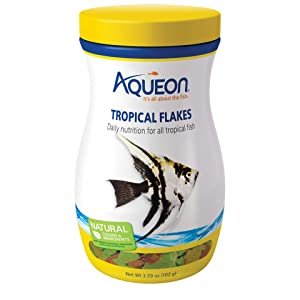
Aqueon Tropical Flakes are a practical budget choice for common tropical community fish. They are easy to portion and crush, and the current Amazon listing remains clearly identifiable. They make more sense in this shortlist than the old article’s duplicate specialty treats and generic search links.
Value depends on the fish eating the food cleanly. An inexpensive flake that is too large, ignored or overfed costs more in wasted food and water-quality problems. Start with a small container and confirm acceptance.
Pros: economical; easy portioning; suitable staple for many omnivorous community fish.
Cons: not specialized for herbivores or carnivores; floats initially; easily overfed.
Check Aqueon Tropical Flakes on Amazon
5. Omega One Freeze-Dried Bloodworms — Best Occasional Supplement

Freeze-dried bloodworms can add variety and encourage feeding in many insect-eating or omnivorous fish. They are shelf-stable and avoid some handling issues associated with live food. However, they are a supplement, not the everyday foundation of a balanced tropical community diet.
Use a small portion once or twice a week if appropriate for the species and reduce the normal meal accordingly. Pre-soaking can make dry pieces easier for some fish to consume. Avoid inhaling dust and wash hands after handling any fish food.
Pros: useful variety; shelf-stable; appealing to many fish.
Cons: not a complete staple; easy to overuse; unsuitable for some herbivores and very small mouths.
Check Omega One Bloodworms on Amazon
How to Choose Tropical Fish Food
Start with the species, not the word “tropical”
Tropical aquariums can contain surface-feeding livebearers, midwater tetras, bottom-feeding catfish, algae grazers and specialized predators. Research each species’ natural feeding strategy and choose a complete staple that reaches its feeding zone. A mixed tank may need two complementary staple formats.
Match the particle to the mouth
Fish should be able to swallow food without repeatedly spitting it out. Crush flakes or choose micro pellets for small fish. Larger pellets are not automatically more nutritious, and uneaten pieces quickly add organic waste.
Read the purpose statement and label
Choose a product labelled as a complete or staple diet for the relevant type of fish. Treats, dried invertebrates and single-ingredient foods should not displace a balanced staple. Ingredient lists are useful, but no one ingredient alone proves quality; digestibility, formulation and species suitability all matter.
Use variety intelligently
Rotation can provide different textures and feeding opportunities, but random variety is not the goal. Keep one reliable complete staple, add a second appropriate format where needed, and use treats sparingly. Sudden changes can cause refusal, so transition gradually.
How Much and How Often to Feed
Feed an amount the fish consume promptly while every individual has a fair chance to eat. For many adult community fish, one or two small meals per day is reasonable, but species, age, health and temperature change the requirement. Fry often need smaller, more frequent meals; some predators eat less often.
Do not rely on a rigid “two-minute rule.” A slow bottom feeder and a fast surface feeder behave differently. Watch body condition and water quality, and reduce food if pieces remain, fish become overweight, or nitrate and detritus accumulate unusually quickly. Ammonia and nitrite should remain at zero in a cycled aquarium.
Frequently Asked Questions
Are flakes or pellets better?
Neither is universally better. Flakes are easy to crush and spread across the surface; pellets provide consistent portions and can target different depths. The better food is the complete diet that fits the species, mouth size and feeding zone.
Do color-enhancing foods change a fish’s natural color?
Some nutrients and pigments support normal coloration, but food cannot create genetic colors a fish does not have. Good water quality, low stress, appropriate lighting and health are equally important. Avoid products promising dramatic transformation.
Can tropical fish eat bloodworms every day?
Usually they should not. Bloodworms are better used as an occasional species-appropriate supplement. A complete staple should provide the foundation unless a qualified aquatic veterinarian designs another diet.
Should uneaten food be removed?
Yes. Siphon accessible leftovers before they decay, then reduce the next portion. Persistent refusal can indicate unsuitable particle size, stress, poor water quality or illness.
Verdict
New Life Spectrum Naturox Optimum Flakes are our best general staple for a mixed tropical community, while Hikari Micro Wafers better serve many small midwater fish. TetraMin and Aqueon offer accessible flake alternatives. Omega One bloodworms can add occasional variety, but should not replace a complete daily food. Match every purchase to the species in the aquarium and feed by observation rather than by package marketing alone.