Disclosure: Aquarium Hunter may earn a commission from qualifying Amazon purchases made through links on this page, at no extra cost to you.
The Jebao DCP-6500 is our best aquarium sump pump for systems that need adjustable DC return flow, while the Eheim Universal 600 is the better choice for a modest-flow setup that values a simple, established AC design. A return pump must be sized at the system’s total dynamic head—not by its zero-head maximum—and must never exceed what the overflow and drains can handle safely.
Best Aquarium Sump Pumps: Quick Comparison
| Return pump | Best for | Control | Amazon |
|---|---|---|---|
| Jebao DCP-6500 | Best adjustable high-flow return | DC controller | Check on Amazon |
| Uniclife 1052 GPH DC Pump | Best compact controllable option | DC controller and feed mode | Check on Amazon |
| Eheim Universal 600 | Established lower-flow AC choice | Fixed-speed AC | Check on Amazon |
| Aqueon QuietFlow Utility 2300 | Midrange submersible utility return | Model-specific adjustment | Check on Amazon |
| KEDSUM Inline/Submersible Pump | Budget high-head utility option | Selected model dependent | Check on Amazon |
Listings may contain multiple sizes. Confirm the selected model’s flow curve, maximum head, inlet and outlet sizes, voltage, wattage and suitability for submerged or external use.
Our Sump Return Pump Picks
1. Jebao DCP-6500 — Best Adjustable High-Flow Return

The DCP-6500 is a controllable sine-wave DC pump intended for return circulation. Its controller lets the aquarist tune flow without relying entirely on a valve, which is useful when matching a return to the overflow or reducing nighttime noise. Its capacity is aimed at larger or higher-head systems rather than a small nano sump.
DC control does not remove the need for sizing. Use Jebao’s curve at your measured head, allow for plumbing friction and keep the selected setting comfortably below the drain system’s safe capacity. The controller and power supply must remain dry and ventilated.
Pros: adjustable output; feed function; soft-start DC operation; useful head capacity.
Cons: too large for many small sumps; controller adds components; maintenance and correct installation remain essential.
Check the Jebao DCP-6500 on Amazon
2. Uniclife 1052 GPH DC Return Pump — Best Compact Controller
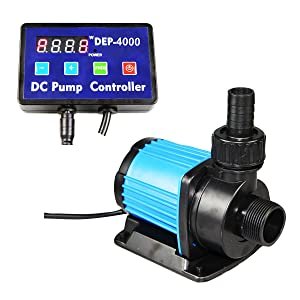
The current Uniclife listing specifies 24-volt DC operation, a controller, feed mode and a maximum zero-head rating of 1052 GPH. It can run submerged or inline according to the listing, making it a flexible choice for a medium system when the actual head-adjusted flow fits.
The controller’s memory and feed mode are convenient, but the return must resume reliably after feeding and a power interruption. Test recovery before leaving the aquarium unattended, and make sure the inline configuration follows every priming and plumbing instruction.
Pros: adjustable; feed mode; compact; submerged or inline listing.
Cons: delivered flow falls with head; controller and power supply need dry placement; verify restart after outages.
Check the Uniclife DC Pump on Amazon
3. Eheim Universal 600 — Best Established AC Design

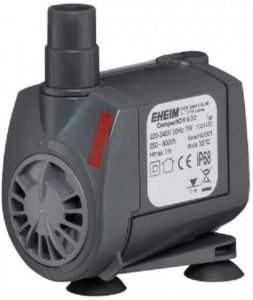
The Eheim Universal 600 is a long-established 120-volt AC aquarium pump for lower-flow applications. It lacks an electronic speed controller, but its simple format appeals to aquarists who prioritize a recognized design and do not need a high-output return.
The “600” is not 600 GPH. Check the current US specifications and curve. Use a correctly installed outlet valve only if Eheim allows it; never restrict the intake. Its physical size and fittings must suit the return chamber.
Pros: established aquarium model; straightforward AC design; suitable for modest returns.
Cons: no DC control or feed mode; model number can be misread; less efficient when substantial throttling is required.
Check the Eheim Universal 600 on Amazon
4. Aqueon QuietFlow Utility 2300 — Midrange Submersible Choice

Aqueon’s QuietFlow Utility Pump 2300 is a conventional submersible option from a familiar aquarium brand. It can serve a moderate sump return when the model’s head-adjusted flow and fittings match the installation.
Do not choose by the “2300” designation alone; confirm whether the specification is expressed in liters per hour, gallons per hour or a series number. Compare the live curve with the return height and plumbing.
Pros: aquarium-focused brand; submersible utility format; practical midrange candidate.
Cons: model designation can confuse; no external DC controller; must remain accessible for cleaning.
Check the Aqueon QuietFlow 2300 on Amazon
5. KEDSUM Inline/Submersible Pump — Budget High-Head Option
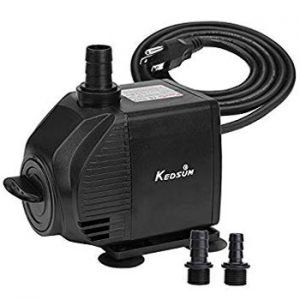
The KEDSUM listing covers an inline/submersible pump family with multiple nozzles and relatively high listed lift. It can be a budget return or utility option where flexible fittings matter.
The current page title can show different GPH variants simultaneously, so verify the selected version rather than copying the headline. A utility pump may also lack the refined control of a dedicated DC return. Size and test it in the completed plumbing.
Pros: multiple fittings; inline or submerged listing; useful lift; competitive price.
Cons: variation selection needs care; fixed output on some versions; less convenient control than a DC return pump.
Check the KEDSUM Pump on Amazon
How to Size a Sump Return Pump
Measure vertical head
Measure from the operating water level in the return chamber to the highest return outlet. This vertical rise is only the starting point.
Add plumbing resistance
Long or narrow pipe, elbows, tees, valves, reactors and return nozzles add friction. Use the manufacturer’s calculator or curve and allow a margin for biofilm and gradual restriction.
Respect the overflow
The delivered return flow must remain below the overflow and drain system’s reliably tested capacity. More turnover is not automatically better. In-tank circulation pumps can provide display flow without forcing excessive water through a noisy sump.
Plan the return chamber
The pump must remain submerged at the lowest normal level, with space for removal and intake cleaning. An ATO can stabilize the level but should not conceal a leak or undersized chamber.
Sump Pump Safety
- Use drip loops and GFCI protection where available; keep DC controllers and power supplies dry.
- Never lift a pump by its cord or use equipment with damaged insulation.
- Secure plumbing and use unions so the pump can be removed safely.
- Fit an intake guard where animals or debris could enter.
- Do not run a wet pump dry unless the manufacturer explicitly permits it.
- Unplug equipment before putting hands in the sump.
- Simulate a power outage: the sump must hold every gallon that drains back without overflowing.
- Prevent a return-line siphon with correct outlet placement and tested plumbing; do not rely on a dirty check valve alone.
Maintenance and Backup Planning
Clean the intake, volute and impeller on a regular schedule using the maker’s instructions. Declining flow, rattling or difficult restarts often indicate deposits or debris. Keep critical spare fittings and, for valuable systems, a compatible backup pump.
A return pump supports circulation, heating distribution and sump filtration but does not guarantee oxygen during an outage. Plan battery or generator-backed aeration appropriate to the livestock. Test every pump after maintenance and power interruption.
Frequently Asked Questions
How many times per hour should water pass through a sump?
There is no universal number. The safe target depends on overflow capacity, filtration design, noise, head loss and livestock. Many systems use moderate sump turnover and separate in-tank circulation.
Is DC better than AC?
DC pumps offer convenient speed control and feed modes. AC pumps are often simpler. Reliability depends on the particular product, installation and maintenance rather than the motor category alone.
Can a return pump be too powerful?
Yes. Excess flow can overwhelm drains, create bubbles and noise, empty the return chamber or stress livestock. Select at operating head and throttle only by an approved method.
Do I need a check valve?
A check valve can reduce drain-back but may fail when fouled. Design the sump to contain the full backflow volume even if the valve does not seal, and keep return outlets positioned to break the siphon safely.
Verdict
The Jebao DCP-6500 is the strongest all-around choice here for an adjustable higher-flow return. The Uniclife 1052 GPH model suits a smaller controllable installation, while the Eheim Universal 600 is a straightforward lower-flow AC alternative. Final selection must be based on the flow curve at total dynamic head and a tested overflow—not the maximum number in a product title.