

Disclosure: As an Amazon Associate, Aquarium Hunter earns from qualifying purchases.
A betta filter should keep ammonia and nitrite at zero without forcing the fish to fight a strong current. For most single-betta aquariums, the best choice is a small adjustable filter or a properly sized sponge filter. Our top pick is the AquaClear 20 for tanks from 5 to 20 gallons because its flow can be reduced and its media basket is easy to customize.
Important: manufacturer tank ratings are only a starting point. Observe your fish after installation. If the betta is pushed sideways, hides constantly, cannot reach food, or has fins pulled toward the intake, reduce or diffuse the flow and fit an intake sponge.
Best Betta Filters: Quick Comparison
| Filter | Best for | Flow control | Amazon |
|---|---|---|---|
| AquaClear 20 | Best overall, 5–20 gallons | Adjustable; may still need a baffle | View on Amazon |
| Penn-Plax Cascade 20 | Compact tanks | Adjustable | View on Amazon |
| Aqueon QuietFlow Internal 10 | Quiet internal installation | Adjustable placement; baffle as needed | View on Amazon |
| Marina S10 | Slim hang-on-back option | Adjustable | View on Amazon |
| Tetra Whisper Internal 5–10 | Simple internal filtration | Fixed; intake sponge/baffle recommended | View on Amazon |
Do Betta Fish Need a Filter?
Yes, a filter is strongly recommended. Bettas can breathe air at the surface with their labyrinth organ, but that does not protect them from ammonia, nitrite, dissolved waste, or unstable water conditions. A filter gives beneficial bacteria a large, oxygen-rich surface where they convert toxic ammonia to nitrite and then nitrate.
A filter does not eliminate routine maintenance. Test the water and perform regular partial water changes based on the results and the tank’s stocking. Never replace all mature filter media at once, and rinse reusable sponge or biomedia gently in removed aquarium water rather than untreated tap water.
1. AquaClear 20 — Best Overall
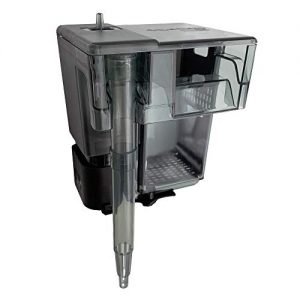
The AquaClear 20 is currently listed for 5- to 20-gallon aquariums. Its roomy media basket lets you use sponge and biological media without relying entirely on disposable cartridges. The output is adjustable, which makes it easier to tune than a fixed-flow filter.
Even at its lowest setting, a long-finned betta may need a sponge on the intake and a simple output baffle. Keep the aquarium water level high so the returning water does not create a steep waterfall.
Pros: adjustable flow, reusable media, flexible media basket. Cons: occupies space behind the tank and may require baffling.
Check the AquaClear 20 on Amazon
2. Penn-Plax Cascade 20 — Best Compact Hang-On Filter
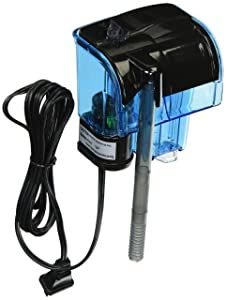
The Cascade 20 is a mini hang-on-back filter with adjustable flow and compact dimensions. It suits a small aquarium where space inside the tank is limited. Its leveling adjustment helps keep the unit positioned correctly, while the intake extension lets you choose where water is drawn from.
The small media area clogs faster than a larger filter, so inspect it frequently. Avoid treating a printed cartridge-replacement schedule as mandatory: preserve established biological media whenever it remains intact, and replace chemical carbon only when it has a specific job.
Pros: compact, adjustable flow, straightforward access. Cons: small media capacity and possible waterfall noise if the water level drops.
Check the Cascade 20 on Amazon
3. Aqueon QuietFlow Internal 10 — Best Quiet Internal Filter

This internal model keeps the motor underwater, which can reduce mechanical and waterfall noise. It is designed for small aquariums and can be positioned to limit surface disturbance. Internal filters also allow the tank to sit closer to a wall.
The tradeoff is that the unit uses swimming space and must be unplugged before maintenance. Protect the intake, position the outlet away from the betta’s preferred resting area, and make a drip loop in the power cord.
Pros: quiet, space-saving outside the aquarium, flexible placement. Cons: uses interior space and may need an intake sponge.
Check the Aqueon QuietFlow 10 on Amazon
4. Marina S10 — Best Slim Hang-On-Back Filter

The Marina S10 is listed for aquariums up to 10 gallons. Its slim body and adjustable flow are useful where a bulky power filter would be awkward. The submerged motor is self-priming, so it should restart without the manual priming required by some hang-on filters.
As with every intake-driven filter, add a prefilter sponge if the slots can catch fins, shrimp, or fry. A prefilter also adds biological surface area, but it must be rinsed when debris restricts the flow.
Pros: slim design, adjustable output, simple restart. Cons: cartridge-based layout and limited media space.
Check the Marina S10 on Amazon
5. Tetra Whisper Internal 5–10 — Best Simple Internal Option
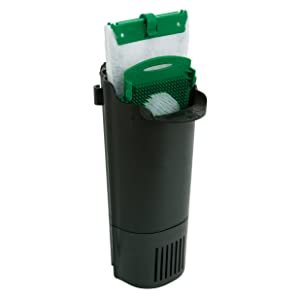
The current Tetra listing covers 5- to 10-gallon aquariums and uses mechanical, chemical, and biological filtration. It clips inside the tank and is easy to access. It is inexpensive and widely supported with replacement media.
Its flow is fixed rather than truly adjustable, and recent buyer feedback includes reports of strong intake and output for small or weak fish. For a betta, we would only use it with a correctly fitted intake sponge and an output baffle if observation shows the fish struggling.
Pros: simple, quiet motor, easy-to-find media. Cons: fixed flow, significant interior footprint, and extra protection may be necessary.
Check the Tetra Whisper Internal on Amazon
What About Sponge Filters?
An air-driven sponge filter is often the gentlest choice for a betta, shrimp, fry, or a hospital tank. Water drawn through the sponge receives mechanical and biological filtration; beneficial bacteria on the sponge process ammonia and nitrite. It is incorrect to say a sponge filter provides only mechanical filtration.
You need a separate air pump, airline, check valve, and usually a control valve. Select a sponge rated for the tank, place the check valve in the correct direction, and keep the pump above the waterline or use a proper anti-siphon arrangement. Because models change frequently, compare current sponge filters on Amazon and verify the included accessories.
How to Choose a Betta Filter
Flow matters more than headline turnover
A filter rated for the tank is not automatically betta-safe. Long fins create drag, and individual fish vary. Adjustable flow, a broad outlet, a spray bar, or a baffle can make the current usable. Do not switch filtration off for long periods to solve a flow problem.
Protect the intake
A coarse prefilter sponge prevents fins, food, shrimp, and plant debris from entering the impeller. It also provides extra bacterial surface area. Choose one that fits securely without starving the pump of water.
Keep biological media mature
Most beneficial bacteria live on surfaces, especially sponge and biomedia. Clean media only when flow drops, using removed tank water. Replacing every cartridge at once can remove much of the biofilter and trigger an ammonia or nitrite spike.
Size the filter to the real aquarium
Use actual water volume after substrate and decor, stocking level, flow tolerance, and media capacity—not marketing alone. A five-gallon aquarium is a practical minimum starting point for one betta because it is easier to heat, filter, and stabilize than a bowl.
Setup and Safety Checklist
- Cycle the aquarium before adding the fish and test ammonia, nitrite, nitrate, and pH.
- Fit an intake sponge where fins could reach the intake.
- Keep a clear route to the surface because bettas breathe atmospheric air.
- Use a lid, heater, and gentle but continuous filtration.
- Make drip loops and use a GFCI-protected outlet where available.
- Unplug electrical equipment before putting hands into the tank.
- After maintenance, confirm the filter restarts and water is flowing normally.
Frequently Asked Questions
How often should I clean a betta filter?
Clean it when debris noticeably reduces flow rather than on a rigid calendar. Many small filters need attention every few weeks, but the interval depends on feeding, plants, stocking, and media size. Rinse reusable media gently in water removed during a water change.
Should I replace the cartridge every month?
Not automatically. If the pad is structurally sound, rinse it and preserve the bacteria. Carbon becomes exhausted and can be replaced when you specifically need chemical filtration, but permanent sponge and biomedia are usually better biological foundations.
Can a filter hurt a betta?
Yes, if the intake traps fins or the current exhausts the fish. Add an intake guard, diffuse the output, and reassess the filter size. Torn fins, persistent hiding, or difficulty feeding are warning signs.
Can a betta live in a bowl without a filter?
A bowl is not a suitable long-term home. Small unfiltered containers accumulate waste quickly and are difficult to heat consistently. Use a cycled, covered aquarium with adequate swimming space, a heater, and gentle filtration.
Final Verdict
The AquaClear 20 is our best overall betta filter for 5- to 20-gallon tanks because it combines adjustable flow with reusable, customizable media. The Penn-Plax Cascade 20 is a compact alternative, while an air-driven sponge filter remains an excellent gentle option when paired with a suitable air pump.
Continue your setup with our guides to why bettas need filtration, betta heaters, safe betta plants, and complete betta tank setup.