Disclosure: Aquarium Hunter may earn a commission from qualifying Amazon purchases made through links on this page, at no extra cost to you.
The Tunze Osmolator 3155 is our best auto top-off system for a reef tank because it combines an optical operating sensor with an independent backup float, controller safeguards and a matched pump. For a compact all-in-one unit, the XP Aqua Duetto is easier to fit into a small sump or rear chamber.
An automatic top-off (ATO) replaces freshwater lost through evaporation. In a saltwater aquarium this helps limit salinity swings; in freshwater it helps maintain water level and equipment operation. An ATO does not perform water changes, remove nitrate or replace evaporated salt. Top off a marine aquarium with appropriate fresh water—normally purified RO/DI water—not mixed saltwater.
Best Aquarium Auto Top-Off Systems: Quick Comparison
| ATO | Best for | Primary sensing | Amazon |
|---|---|---|---|
| Tunze Osmolator 3155 | Best overall reef ATO | Optical plus backup float | Check on Amazon |
| Tunze Nano Osmolator 3152 | Simple nano and small tanks | Float switch | Check on Amazon |
| XP Aqua Duetto | Compact dual-sensor system | Dual optical sensors | Check on Amazon |
| IceCap Dual Optical ATO | Optical backup in a compact kit | Dual optical sensors | Check on Amazon |
| AutoAqua Smart ATO | Minimal sensor footprint | Optical sensor | Check on Amazon |
Before ordering: confirm the current package contents. Some ATO listings include a pump and tubing; controller-only products require a compatible pump. Check maximum lift, sensor mounting thickness and reservoir space.
Our Auto Top-Off Picks
1. Tunze Osmolator 3155 — Best Overall
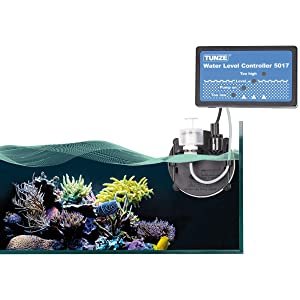
The Tunze 3155 remains the most complete safety-oriented option in this group. Its optical sensor controls the normal water level, while a separate float switch provides high-level backup. The controller also includes time-based protection and an audible alarm, and the package is sold with a low-voltage metering pump.
That redundancy makes sense for a reef system where a large freshwater addition could sharply lower salinity. It costs more and needs room for two sensor components, but the design is easier to justify on a valuable display than a single unprotected switch.
Pros: independent backup sensor; alarm and controller protection; pump included; established model.
Cons: premium price; more components and cables; sensors still require cleaning and correct placement.
Check the Tunze Osmolator 3155 on Amazon
2. Tunze Nano Osmolator 3152 — Best Simple Nano ATO

The 3152 is Tunze’s simpler unit for aquariums under the listing’s stated 55-gallon limit. It uses a float switch and time-based safety shutoff rather than the 3155’s primary optical sensor plus independent high-level float. The included pump makes it a straightforward kit for a small aquarium or sump.
A float can be obstructed by snails, algae or a cable. Use the supplied guard and maintain it. The reservoir should hold only a limited, sensible volume so one failure cannot drastically change salinity or overflow the system.
Pros: complete kit; established brand; simpler and less expensive than the 3155; compact.
Cons: float-based sensing; less redundancy; maximum runtime must be configured for the application.
Check the Tunze Nano Osmolator 3152 on Amazon
3. XP Aqua Duetto — Best Compact Dual-Sensor System
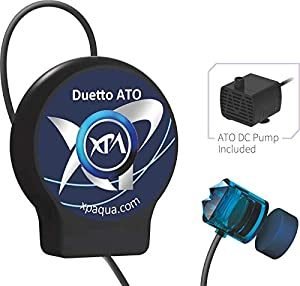
The Duetto places two optical sensors in a compact assembly: one for the operating level and another for high-water protection. It is useful where a large float assembly will not fit, such as an all-in-one aquarium’s rear filtration chamber.
Optical sensors can be affected by algae, salt creep, bubbles or deposits. Mount the unit in a calm chamber whose level actually changes with evaporation, keep the sensor faces clean and test both normal filling and the alarm or shutoff behavior.
Pros: compact; dual optical sensing; pump included in the complete listing; suitable for narrow chambers.
Cons: both sensors share one small assembly; optical surfaces need cleaning; very small chambers can cycle frequently.
Check the XP Aqua Duetto on Amazon
4. IceCap Dual Optical ATO — Compact Optical Alternative
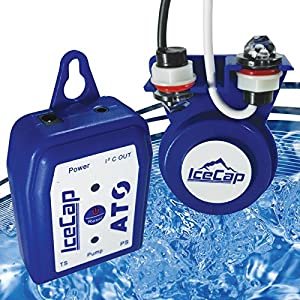
IceCap’s system also uses dual optical sensing and targets aquarists who want a small magnetic mount. The second sensor adds a high-water check that a basic single-sensor controller lacks.
Confirm whether the currently selected package includes every pump, tube and holder you need. Do not mix power supplies or pumps unless IceCap specifically approves them. As with every optical ATO, schedule sensor inspection rather than waiting for a failure.
Pros: dual optical design; compact magnetic mounting; clear high-level backup concept.
Cons: package contents can vary; sensor fouling remains possible; less physical separation than two independently mounted devices.
Check the IceCap Dual Optical ATO on Amazon
5. AutoAqua Smart ATO — Best Minimal Footprint

The original AutoAqua Smart ATO remains available as a very compact optical system. It is easy to fit where bulky float brackets are impractical and includes automatic shutoff logic intended to limit abnormal filling.
Its minimal sensor arrangement does not provide the visibly separated optical-and-float redundancy of the Tunze 3155. Use a limited reservoir, secure the outlet above the destination waterline and test the protection features regularly.
Pros: tiny sensor; simple installation; pump included in the standard system; established compact design.
Cons: less sensor separation; optical face must stay clean; careful outlet placement is essential.
Check the AutoAqua Smart ATO on Amazon
How to Choose an ATO
Sensor design and redundancy
Optical sensors are compact and have no moving float, but deposits or bubbles can interfere. Floats are simple but can jam. The safest systems combine independent high-level protection with a maximum pump runtime or alarm. No sensor is maintenance-free.
Pump lift and reservoir distance
Measure the vertical distance from the lowest reservoir level to the outlet. The pump must deliver water at that lift. Keep tubing short and secure, and never assume a pump’s zero-head flow applies to the installed system.
Reservoir capacity
Choose enough volume to cover normal evaporation between refills, but not so much that a complete discharge creates a catastrophe. Mark the reservoir, monitor daily use and investigate any sudden increase instead of repeatedly refilling it.
Safe ATO Installation
- Mount the operating sensor in the chamber where evaporation changes water level. In a sump, this is usually the return chamber.
- Position any backup sensor at a sensible high-water point.
- Keep the top-off outlet above the maximum waterline and separated from the reservoir water to prevent a siphon in either direction.
- Secure tubing so it cannot fall out and pump water onto the floor.
- Use drip loops and GFCI protection where available; keep controllers and connections dry.
- Fill the reservoir with the correct fresh water. Never use saltwater to replace ordinary evaporation.
- Test the normal sensor, backup shutoff, alarm and maximum runtime before leaving the system unattended.
Maintenance and Failure Prevention
Inspect the ATO whenever the reservoir is refilled. Clean optical faces and float guards using the manufacturer’s method, remove salt creep, confirm the pump intake is submerged and check tubing for kinks. Manually lift or cover sensors only as directed during a test.
Compare daily top-off consumption with the aquarium’s normal pattern. A sudden drop can mean a failed pump or blocked tube; a sudden rise can indicate a leak, unusual evaporation or sensor problem. Verify salinity with a calibrated refractometer or other reliable instrument in marine systems.
Frequently Asked Questions
Does an ATO replace water changes?
No. Top-off replaces evaporated water but leaves dissolved waste and minerals behind. Regular water changes and maintenance remain necessary.
Should saltwater tanks be topped off with saltwater?
No under normal evaporation. Salt does not evaporate, so replacing evaporation with saltwater raises salinity. Use appropriately purified fresh water unless you are deliberately correcting salinity by a measured plan.
Can an ATO overflow an aquarium?
Yes, if a sensor, tubing arrangement, pump or installation fails. Independent backup sensing, runtime limits, a restricted reservoir and siphon-safe outlet greatly reduce the consequence.
Where should the sensor go in an all-in-one tank?
Use the rear chamber where water level falls with evaporation, usually the return-pump chamber—not a display section whose level remains constant. Follow the aquarium and ATO instructions.
Verdict
The Tunze Osmolator 3155 is the best choice here when independent backup protection matters most. The XP Aqua Duetto is easier to fit into a narrow rear chamber, while the Tunze 3152 is a straightforward small-system option. Whichever ATO you choose, safety depends as much on a limited reservoir, a siphon-proof outlet and regular testing as it does on the controller.