How Many GloFish in a 5-Gallon Tank? Species-by-Species Advice

How many glofish in a 5-gallon tank

For GloFish danios, skirt tetras, tiger barbs, corys, rainbow sharks or angelfish, our recommendation for a 5-gallon tank is zero. Their swimming space, social needs or adult size call for a larger aquarium. Buying fewer schooling fish does not solve the space problem.

GloFish is a brand covering different fish, not one species with one stocking rule. A single domestic betta is a separate small-aquarium option; two female bettas are not a safe five-gallon plan. Identify the fish before buying the tank.

Five-gallon suitability by fish type

  • Zebra danios: no. These active schooling fish need a group and room to swim.
  • Skirt tetras, including long-fin forms: no. A suitable group needs more space than five gallons provides.
  • Tiger barbs: no. Their activity and fin-nipping behavior make cramped groups a poor choice.
  • GloFish corys: no. Plan around their group and usable bottom area, not a single “cleanup fish.”
  • Rainbow sharks: no. Research adult size, bottom territory and compatibility before choosing a much larger tank.
  • Angelfish: no. The brand’s own angelfish guide specifies at least 29 gallons for one, with larger options preferred.

The brand now includes fluorescent corys and angelfish as well as the older familiar groups. Do not rely on an old four-species list when planning a purchase.

Why the inch-per-gallon rule fails here

A fish’s length does not describe its swimming behavior, social requirements, body mass or territory. Two small danios may fit physically in a five-gallon aquarium, but they would lack both a proper group and adequate swimming room. A powerful filter cannot create either.

Tank shape matters too. A long footprint provides different space from a narrow, tall container with the same gallon rating. Gravel and decorations also reduce the actual water volume. Choose the species and group first, then an aquarium that supports them as adults.

A practical upgrade for danios or skirt tetras

For a beginner planning one small group of zebra danios or skirt tetras, we recommend considering a 20-gallon long aquarium with six of the same species as a conservative starting plan. This is our planning recommendation, not a universal biological minimum or permission to add six of every type. More fish or additional species require a fresh assessment.

Aqueon’s danio care guide emphasizes a long aquarium, a group of six or more and a secure lid. OATA’s tetra guidance likewise makes group housing and species-specific requirements central to care.

Do not apply this starter plan to rainbow sharks or angelfish. Tiger barbs also need careful consideration of group size and tankmates: OATA notes their potential for fin nipping. Avoid treating a mixed-color display package as a complete stocking plan.

Fluorescent zebra danio
Color does not change a zebra danio’s need for companions and swimming space.

What about one betta in five gallons?

A single domestic betta can be considered for a properly equipped five-gallon aquarium, with a larger tank preferable where practical. The RSPCA recommends about 5.3 US gallons (20 liters) or more where possible, suitable heating and gentle filtration.

Keep one betta, not a pair or a female “sorority,” in this small setup. Sex alone does not remove aggression risk. If you encounter a fluorescent betta, its basic care remains betta care; an older product listing does not establish present availability. See our female and male betta guide for compatibility considerations.

If you already have GloFish in a five-gallon tank

  1. Identify the species and count the fish. Color names alone are not enough.
  2. Do not add more fish to complete a school in the undersized tank. Arrange suitable larger housing first, or discuss a return or responsible rehoming with the seller.
  3. Monitor water quality while making the change. Check ammonia and nitrite, use conditioned replacement water when necessary and avoid overfeeding.
  4. Prepare the replacement aquarium properly. A new filter is not instantly cycled. Preserve established biological media where appropriate and continue testing after the move.

Our filtration guide explains waste processing. If fish are gasping, use the oxygenation guide and seek help for persistent distress. Extra bubbles do not make overcrowding acceptable.

Do GloFish need ultraviolet lights?

No special ultraviolet lamp is required to display them. The GloFish website describes white and blue LED lighting; blue visible light is not the same thing as ultraviolet radiation. Use aquarium lighting as directed and provide a regular dark period. Choose plant-appropriate lighting if keeping live plants.

The fluorescent appearance is an inherited trait, not a reason to change the fish’s basic husbandry. Decorative lights and glowing ornaments should come after appropriate housing, filtration and water testing.

Choose equipment after choosing the fish

A kit’s label does not guarantee suitability for every fish pictured on its box. Compare its actual dimensions, filter, heater requirements and lid with your intended inhabitants. There is no need for a particular branded food or ornament simply to answer the stocking question. Start with the aquarium basics hub and build the setup around the animals.

This is a research-based stocking guide. Tank recommendations reflect cautious beginner planning, not personal product testing.

Fish for a 30-Gallon Tank: Stocking Ideas and Safe Numbers

fish for a 30-gallon tank

A 30-gallon aquarium can support a well-planned community of small fish, but there is no safe universal fish count. Adult size, swimming space, social needs, water chemistry and maintenance matter more than a gallon-per-fish formula. A group of 12 small schooling fish and six suitable cory catfish is a very different proposition from 18 large or territorial fish.

This guide focuses on freshwater stocking. The suggested plans below are alternatives, not shopping lists to combine.

Start with the tank’s dimensions

Check the actual length, width and height of your aquarium. A long rectangular tank provides different swimming and bottom space from a tall cube holding the same volume. Decorations and substrate also reduce the amount of water in the system.

The community examples here assume a conventional rectangular tank with roughly 30–36 inches of length and useful open floor space. For a narrow or unusually tall aquarium, reassess the choices. If you need more footprint, compare a 40-gallon breeder tank before buying livestock.

Good fish choices for a 30-gallon tank

Fish Suggested group to plan around Important consideration
Harlequin rasboras 10–12 Keep a proper group with open swimming space and planted cover
Cherry barbs 8–10 A mixed-sex group with more females than males helps spread courtship attention
Lemon tetras 10–12 Choose compatible water conditions and peaceful companions
Small cory catfish, such as panda corys 6–8 of the same species Research the exact species, temperature range and adult size

These are planning suggestions for individual groups, not a recommendation to add every row. Choose one main shoal first, then assess whether a second group fits.

Harlequin rasboras

Harlequins reach about 2 inches and make an appealing main group in a planted community. Keep the center open for swimming and use plants around the edges for cover. Avoid buying one or two of several different schooling species; a larger group of one species usually makes a more coherent display.

Aquarium Co-Op’s harlequin and lambchop rasbora guide describes their social behavior and approximate adult size. Check the identity at purchase because “rasbora” covers fish with quite different needs.

Cherry barbs

Cherry barbs are a relatively peaceful alternative to more boisterous barb species. Adults are around 2 inches long. Provide planted retreats while leaving space to move between them. They are not interchangeable with tiger barbs simply because both are called barbs.

The Aquarium Co-Op cherry barb care guide recommends including females rather than selecting only the brightest males. Do not assume small shrimp will be safe with them.

Lemon tetras

A group of lemon tetras can be the main attraction rather than a few background fish. Their color and behavior are easier to appreciate when they have cover, suitable water and enough companions. See our lemon tetra care guide for housing, feeding and compatibility details before choosing other inhabitants.

Cory catfish

Choose a smaller species and keep a group of its own kind. Six assorted corys are not automatically equivalent to six members of the same species. Preserve open, clean substrate for foraging and provide sinking food deliberately; bottom dwellers cannot live on whatever other fish leave behind.

Aquarium Co-Op’s cory catfish guide recommends groups of six or more of the same species. Check temperature compatibility especially carefully: different cory species are not all suited to the same warm community.

Three conservative stocking plans

These examples are editorial starting points for a cycled, filtered rectangular 30-gallon aquarium, not guaranteed maximum capacities. Verify the needs of the actual fish available to you.

  • Rasbora community: 12 harlequin rasboras and 6 panda corys, with compatible moderate tropical conditions, planted cover and open bottom space.
  • Cherry barb community: 10 cherry barbs and 6 panda corys. Include more female barbs than males and check that all fish get food.
  • One-species display: 12 lemon tetras, plants and open swimming room. Keeping the plan simple leaves flexibility; an aquarium does not need a fish for every layer.

Add groups in stages after quarantine and allow test results and behavior to guide the pace. Do not break a social species into a long-term group of just one or two to “save space.” If the system cannot support the proper group, choose a different plan.

Why the one-inch-per-gallon rule fails

A deep-bodied fish produces a different waste load from a slender fish of the same length. A fast swimmer needs a different footprint from a quiet bottom dweller. Territorial behavior can make an aquarium unsuitable even when ammonia tests look good.

Use adult size, not the size in the shop. More filtration cannot create turning room or remove aggression. Fish do not safely grow only as large as their aquarium allows.

Fish to leave out of a beginner 30-gallon plan

Oscars, common plecos and other large-growing fish are not suitable permanent choices. Do not buy juveniles on the assumption that an upgrade will somehow happen later. Also avoid mixing unrelated “semi-aggressive” fish merely because the label sounds compatible.

A betta is not an automatic community centerpiece. Temperament varies, and both attacks by the betta and fin-nipping by tankmates are possible. A separate betta tank setup is the simpler option when a betta is your priority.

Cycle the aquarium before stocking

Running a filter in clean water for four weeks does not by itself establish a useful biological filter. Nitrifying microorganisms need an ammonia source. A fishless cycle lets you develop that capacity without exposing fish to the startup process.

Follow a measured method, such as DrTim’s fishless cycling instructions, using the dosing and testing directions for the specific products involved. Never add cycling ammonia to a tank containing fish. Confirm that the system processes the prescribed ammonia input and that ammonia and nitrite return to zero before stocking; a zero reading in unused water proves nothing.

Equipment and maintenance that support the plan

  • Safe support: use a level stand rated for the filled aquarium. Thirty US gallons of water alone weighs about 250 pounds, before glass and decor. Follow the tank manufacturer’s requirements for mats and base support.
  • Filtration and temperature: select a filter for the real livestock load and adjust flow to the inhabitants. Use a heater where needed and verify it with a separate thermometer.
  • Testing: check ammonia, nitrite and nitrate, plus pH and hardness when choosing compatible fish. A clear tank is not proof of safe water.
  • Water changes: begin with a weekly partial change of about 20–30%, then adjust to measured nitrate accumulation, feeding and livestock needs. Match temperature and treat tap water for chlorine and chloramine.
  • Filter care: clean clogged reusable media gently in removed tank water. Do not routinely replace all biological media at once.

How do you know the tank is overstocked?

Warning signs include persistent chasing, fish unable to rest or feed, waste accumulating faster than you can manage it, and deteriorating water tests. Gasping or detectable ammonia or nitrite calls for prompt attention to water quality and aeration, not another purchase.

Stop adding fish while you investigate. The best stocking level is one you can maintain comfortably while giving each species the space and social group it needs.

Betta Fish Tank Setup: A Step-by-Step Beginner Guide

Betta Fish Tank Setup

A good betta fish tank setup starts with a heated, gently filtered aquarium of at least 5 gallons, a secure lid, and a completed fishless cycle. A 10-gallon rectangular tank is an easier long-term choice when you have room: it provides more space for plants, resting places and stable water conditions.

Plan this setup for one domestic Betta splendens. A small cup, decorative vase or unheated bowl is not an appropriate permanent home. Buy and prepare the equipment before bringing the fish home whenever possible.

Betta tank setup checklist

Item What to look for
Aquarium and stand At least 5 gallons; preferably 10, with a level, manufacturer-approved supporting surface
Lid Secure cover with equipment gaps protected and an air space above the water
Heater and thermometer Thermostatically controlled heater sized for the tank and room; a separate thermometer to verify temperature
Filter Gentle, adjustable flow and reusable biological media; protect the intake
Water conditioner A product labeled to treat chlorine and chloramine, dosed according to its instructions
Water tests Ammonia, nitrite, nitrate and pH; make sure ammonia is included rather than assuming every test strip covers it
Habitat and lighting Smooth substrate, safe cover, resting places near the surface and a timed day/night light cycle
Maintenance supplies Dedicated bucket, small siphon, aquarium-safe cleaning tools and suitable betta food

1. Choose a tank with usable swimming space

A rectangular aquarium is straightforward to furnish and maintain. Check usable water volume after substrate and decorations rather than relying only on the number printed on the box. Leave room for the fish to swim around cover instead of filling every inch with ornaments.

Aquarium Co-Op’s betta setup guide identifies 5 gallons as a starting size and recommends gentle filtration and tropical warmth. A kit is convenient only if its tank and equipment actually meet those needs; “betta” on the packaging is not enough.

2. Position and prepare the aquarium

Choose a stable location away from direct sunlight, heating vents and cold drafts. Use a support designed for the filled tank’s weight and follow the manufacturer’s base-support requirements. Do not add a foam pad underneath every aquarium by default; different designs have different requirements.

Inspect the tank and equipment before filling. Rinse a new aquarium with plain water and use a clean, aquarium-only cloth if needed. Keep household soap and cleaning sprays away. Rinse substrate as directed by its manufacturer; some planted substrates should not be rinsed.

Position electrical cables with drip loops and follow each appliance’s installation instructions. Keep connections dry and accessible for maintenance.

3. Set up gentle filtration and steady heat

An air-driven sponge filter is a simple option. A small internal or hang-on-back filter can also work if its current is gentle and its intake is protected. Watch the fish after introduction: it should be able to rest and swim normally without continually fighting the flow.

Run the filter continuously. Its biological media provide surfaces for microorganisms that process waste. For more detail, see why bettas need filtration.

A practical temperature target is 78–80°F, checked with a separate thermometer. Size the heater for both water volume and how far the room temperature falls below the target. Allow it to acclimate to the water before switching it on, following its instructions, and unplug it before a water change exposes it.

A lamp is not a reliable substitute for a heater. See our betta warmth and heater-failure guide for temporary situations. Aquarium Co-Op’s betta care guidance also explains why typical room temperatures can be too cold.

4. Add cover without blocking the surface

Use smooth decorations with openings large enough that the fish cannot become trapped. Soft artificial plants or suitable live plants provide sheltered places to explore. Check ornaments for rough seams, narrow holes and sharp points before adding them.

Anubias or Java fern can be useful beginner plants; keep their thick rhizomes above the substrate. A broad leaf or aquarium-safe resting platform near the surface helps a long-finned fish rest without a long climb. Leave a clear route to the surface and open patches among floating plants.

Bettas use surface air as well as their gills. Keep an air gap beneath the lid and do not make the enclosure airtight. The RSPCA’s betta welfare guidance emphasizes surface access, cover and a lid that prevents jumping.

5. Fill with treated water and cycle before adding fish

Treat tap water for chlorine and chloramine using the conditioner’s label directions. Leaving water out overnight is not a dependable way to remove chloramine. Special bottled “betta water” is not a substitute for understanding your source water, and plain distilled water should not be used as the complete long-term water supply without appropriate remineralization.

A tank is not cycled simply because the filter has been running for a few days. Establishing biological filtration requires an ammonia source and testing. Follow a complete fishless method, such as DrTim’s explanation of fishless cycling, with the instructions for the specific ammonia product used.

Keep the heater and filter operating, record ammonia and nitrite results, and verify the method’s completion criteria before adding the betta. Do not add cycling ammonia once fish are present. Reduce accumulated nitrate with appropriately conditioned water before introduction. The RSPCA recommends fishless cycling when preparing a new aquarium.

If you already have the betta

Do not leave it indefinitely in a tiny shop cup while waiting for a perfect setup. Use the best available heated, conditioned and gently filtered aquarium, and recognize that an uncycled tank needs active management. Test ammonia and nitrite daily initially, feed modestly, and use temperature-matched, conditioned partial water changes as needed to keep both at zero on the test. Seek experienced help if readings persist or the fish is distressed.

6. Introduce the betta carefully

Confirm the temperature and water tests before opening the transport container. Dim the light and follow the supplier’s acclimation instructions, accounting for the journey and the difference between the two water supplies. Long-shipped fish should not automatically undergo a prolonged open-bag acclimation.

Transfer the fish gently with a suitable net or container, avoiding delicate fin damage, and keep transport water out of the aquarium as far as practical. Secure the lid and allow a quiet settling period. Observe breathing, swimming and access to resting areas.

7. Establish a simple maintenance routine

  • Daily: check temperature, filter flow and the fish’s behavior. Offer a modest amount of complete betta food and remove leftovers. Portion sizes depend on pellet size and the fish; do not use a universal pellet count.
  • Weekly: test the water and begin with a partial change of around 20–25%, adjusting frequency and volume to the tank’s results. Use conditioned replacement water close to the aquarium’s temperature.
  • When flow falls: gently clean reusable filter media in removed aquarium water. Preserve established biological media instead of discarding everything on a monthly schedule.
  • As plants grow: trim to preserve swimming space and surface access. Start with about 6–8 hours of aquarium lighting daily and adjust for plant health and algae, leaving a dark night period.

Keep the fish in its aquarium for ordinary partial water changes when you can work safely around it. Avoid dismantling and scrubbing the whole habitat as a routine cleaning method. Evaporation top-ups do not replace water changes.

Bloodworms and similar foods can provide variety but should not replace a complete staple diet. See our guide to feeding bettas bloodworms.

Does a betta need tankmates?

No. One betta in a furnished aquarium is a sensible beginner plan. Do not add another male, a male–female pair, or a female “sorority” to this setup. Other fish require additional space, appropriate groups and a backup plan if aggression occurs.

Shrimp may be hunted even when described as compatible. Read our betta and shrimp compatibility guide before trying them. Tankmates should meet their own needs, not serve as decorations or a replacement for cleaning.

Final check before bringing your betta home

The tank should be cycled, heated, covered and gently filtered, with safe resting places and clear surface access. Have food, conditioner and tests ready, and know who can help if the fish becomes ill. If you notice persistent clamped fins, labored breathing or loss of appetite, check water and temperature first and consult our betta health guide for next steps.

100 Betta Fish Names: Cute, Funny and Color-Inspired Ideas

Betta Fish Names

Looking for a betta fish name? Start with its color, a favorite character or a little habit you notice at feeding time. Below are 100 different ideas, grouped so you can find a shortlist without scrolling through a jumble of repeated names.

You do not have to know your betta’s sex to choose a name. Every suggestion can work for any fish; the male and female sections are simply browsing categories.

Quick picks

If you want… Try…
A classic fish name Finn
A funny name Gillbert
A blue-inspired name Indigo
A warm-color name Ember
A gentle name Willow
A name for an explorer Scout

How to choose a name you will enjoy using

  1. Choose a theme. Color, food, nature, people’s names and wordplay are all easy starting points.
  2. Pick three favorites. Say them aloud and see which feels natural. There is no need to find a name with a complicated meaning.
  3. Give yourself time. Let a new fish settle into its aquarium before deciding that it is shy, bold or especially curious.
  4. Make it personal. A place you love, a family nickname or a favorite story may give you a better choice than any list.

The suggestions below are naming inspiration, not claims about word origins or translations.

Blue betta fish names

For blue, turquoise or violet tones.

  • Indigo
  • Cobalt
  • Azure
  • Sapphire
  • Denim
  • Neptune
  • River
  • Lagoon
  • Blueberry
  • Tide

Red, orange and yellow betta names

Warm colors can suggest fire, fruit or sunshine.

  • Ember
  • Ruby
  • Blaze
  • Copper
  • Peach
  • Mango
  • Saffron
  • Sunny
  • Chili
  • Marigold

White, silver and black betta names

Try a name inspired by light, clouds, stones or the night sky.

  • Pearl
  • Opal
  • Snowy
  • Dove
  • Moon
  • Sterling
  • Onyx
  • Jet
  • Coal
  • Shadow

Multicolor and patterned betta names

For a fish with patches, contrasting fins or a mixture of colors.

  • Mosaic
  • Confetti
  • Kaleidoscope
  • Marble
  • Patch
  • Prism
  • Pixel
  • Splash
  • Freckles
  • Calico

Cute betta fish names

Short, playful names that are easy to say.

  • Bubbles
  • Pip
  • Bean
  • Pebble
  • Button
  • Noodle
  • Pickle
  • Mochi
  • Sprout
  • Pudding

Funny betta fish names

A few fish puns and oversized titles for a small pet.

  • Gillbert
  • Fin Diesel
  • Swim Shady
  • Sir Swims-a-Lot
  • Captain Bubble
  • Professor Fins
  • Bettahalf
  • Gilligan
  • Bubble Boss
  • Tiny Admiral

Male betta fish names

Traditional masculine names and a few favorites from the original collection.

  • Finn
  • Caspian
  • Xander
  • Chester
  • Darius
  • Astor
  • Denzel
  • Leo
  • Jasper
  • Oscar

Female betta fish names

Traditional feminine names, flowers and gentle-sounding choices.

  • Aurora
  • Daisy
  • Wendy
  • Elsa
  • Zelda
  • Coral
  • Iris
  • Luna
  • Cleo
  • Stella

Gender-neutral betta names

Useful if you do not know your fish’s sex—or simply like the sound.

  • Alex
  • Avery
  • Harley
  • Jamie
  • Jordan
  • Riley
  • Willow
  • Rowan
  • Robin
  • Morgan

Names inspired by personality

Choose a name for a familiar habit rather than trying to make the fish perform.

  • Scout
  • Sassy
  • Rowdy
  • Slick
  • Dash
  • Drift
  • Curious
  • Wiggles
  • Velvet
  • Zen

Should a name match the fish’s sex?

Only if you want it to. A fish called Pearl does not need a new name if you later discover it is male. If identification matters to you, our female versus male betta guide explains which features help and why a single trait can be misleading.

Can I change my betta’s name?

Yes. Choose a name you enjoy and change it if another one suits you better. A pet name is for your relationship with the fish; it does not need to be a permanent label or a training command.

What if my betta seems sleepy or unusually quiet?

Enjoy normal resting behavior, but do not assume a sudden change is simply its personality. Check the water, temperature and other signs if the fish becomes persistently inactive or stops eating. Our betta health guide explains practical next steps.

A good home comes before the name

If you are preparing for your first betta, start with our betta tank setup guide. A cycled aquarium with appropriate warmth, gentle filtration and safe cover matters far more than choosing the perfect name. Keep naming games calm—there is no need to provoke fighting or repeated flaring to decide whether “Rowdy” fits.

Choose one favorite from the list, or combine a name with a playful title: Captain Finn, Professor Pearl or Admiral Indigo. The best choice is the one you like saying.

Fish Lying on the Bottom of a Tank: Causes and What to Do

Fish Lying on the Bottom of a Tank: Causes and What to Do

A fish lying on the bottom of the tank may be resting, behaving normally for its species, or showing a problem that needs prompt attention. The important clues are breathing, balance, responsiveness and whether this is a change from its usual behavior.

Act promptly if the fish is gasping, cannot stay upright, has serious injuries, or several fish become unwell together. Start by checking the aquarium environment rather than choosing a medication from the fish’s position alone.

Resting or unwell? What to look for

Observation What it suggests Next step
Normal posture, steady breathing, resumes usual activity Resting or ordinary bottom-dwelling behavior is possible Observe quietly and compare with the species’ normal habits
Rapid breathing, gasping or several fish affected An environmental emergency is possible Check equipment, improve aeration and test the water immediately
Unable to rise, rolling or persistent loss of balance A buoyancy or other health problem Check water conditions and seek an aquatic veterinarian
Hiding with torn fins or repeated chasing Injury or bullying may be involved Stop the harassment and assess injuries
Clamped fins, swelling, sores or reduced appetite Illness or environmental stress is possible Record the signs and water results for professional advice

What to do first

  1. Observe without chasing. Look at gill movement, body position and the other fish. Take a short video if it will help you explain the problem.
  2. Check the equipment. Confirm the filter is moving water, the heater is behaving normally and the thermometer reading suits the species. Look for an unplugged pump, blocked intake or recent power outage.
  3. Improve gas exchange if breathing is difficult. Add an air stone or increase surface movement without blasting a weak fish with current. If supplemental CO2 is running, turn it off while you investigate.
  4. Test the water. Check ammonia, nitrite, nitrate, pH and temperature. For marine fish, check salinity too. Record actual numbers rather than “all fine.”
  5. Correct a confirmed problem carefully. Use properly conditioned, temperature-matched replacement water when a water change is needed. In saltwater systems, match salinity as well. Recheck after taking action.

Our aquarium oxygenation guide explains practical ways to improve surface movement. University of Florida guidance on dissolved oxygen and emergency aeration reinforces the need to act when fish show oxygen distress.

Water quality is the first thing to rule out

A new aquarium, a suddenly increased fish load, overfeeding or damaged biological filtration can allow ammonia or nitrite to accumulate. Aim for zero detectable ammonia and nitrite on aquarium tests. Nitrate has different implications and should not be confused with nitrite.

A clear-looking aquarium can still have a problem. The Merck Veterinary Manual’s water-testing guidance recommends more frequent monitoring when ammonia or nitrite are detected. Test the source water as well if replacement water may be contributing.

For a normally maintained aquarium with elevated waste readings, a substantial partial water change—often 25–50%, depending on the results—can reduce exposure while you investigate filtration and stocking. Do not rinse away or replace all biological media as an automatic response.

A neglected, acidic aquarium needs extra care. Very low pH combined with high total ammonia can make a sudden large chemistry change dangerous. Merck’s discussion of new and old tank syndrome explains why rising pH can increase ammonia toxicity. Seek prompt expert guidance for staged correction rather than adding pH-raising chemicals blindly.

Temperature and oxygen problems

There is no universal 77°F target for every fish. Check the requirements of the actual species and use a thermometer rather than relying on the heater dial. Water that is too cold may reduce activity; overheating can increase oxygen demand while the water holds less oxygen.

Correct temperature gradually and maintain aeration. Do not pour hot water into the aquarium or add ice directly around the fish. Breathing trouble may also involve gill injury or disease, so improvement in temperature does not replace further investigation if signs continue. Merck’s environmental hazards reference shows how several water problems can produce overlapping signs.

Loss of balance is a sign, not a diagnosis

A fish that sinks, rolls or cannot stay upright may have a buoyancy disorder, but its posture does not identify the cause. Injury, infection, organ problems and physical abnormalities can all be involved. It is not always constipation or a malformed swim bladder.

Aquatic veterinarian Jessie Sanders explains the need for environmental assessment and sometimes imaging in her guide to swim bladder disorders. Keep the fish away from abrasive surfaces and strong flow, and obtain help if it cannot move or feed normally.

Peas, salt baths, antibiotics and prolonged fasting are not universal treatments. Diet and treatment must suit the species and the cause. Do not attach homemade floats or weights, squeeze the fish or attempt to puncture its swim bladder.

Stress, bullying and excessive current

Watch the aquarium long enough to notice repeated chasing or a fish being excluded from food. More hiding places may help break lines of sight, but they do not make incompatible tankmates safe. Separate an aggressor when necessary using a secure, suitable arrangement.

A fish taking shelter from strong flow needs calmer areas, not a permanently switched-off filter. Redirect or baffle the outlet while maintaining circulation and biological filtration. Check that an intake is not trapping a weak or long-finned fish.

When bottom resting can be normal

Many catfish and loaches naturally spend time on the substrate. Other fish rest when the lights are off. Normal behavior is judged against that species and individual: the fish should still breathe comfortably and resume its usual swimming and feeding.

Do not repeatedly tap the glass or poke a resting fish to test it. A new fish may seek cover, but persistent immobility, rapid breathing or loss of balance should not be dismissed as “settling in.” Similarly, age is not an explanation for a sudden decline.

What if it is a betta?

Bettas may rest on leaves, decorations or the substrate. Look for a clear change in activity, appetite or breathing rather than assuming every nap is illness. Keep surface access unobstructed and provide safe resting places.

Check the heater and gentle filtration against our betta tank setup guide. If other signs are present, use the betta health guide to organize observations before seeking advice.

Should you move the fish to a hospital tank?

A prepared hospital tank can help with observation, protection from aggression or a treatment that cannot be used in the display. An unheated, unfiltered bowl of different water is not a safer place simply because it is separate.

Match appropriate water conditions, supply aeration and temperature control, and test frequently if the hospital filter is not established. Avoid repeated netting. If several fish are affected, investigate the shared aquarium environment even if one fish has been moved.

When to contact a fish veterinarian

Seek urgent help for severe breathing difficulty, inability to stay upright, significant wounds, rapid deterioration or multiple sick fish. Persistent bottom sitting with appetite loss or other abnormalities also needs assessment after environmental checks.

Provide the species, tank size, how long it has been running, recent additions or treatments, exact water results and a short video. The American Association of Fish Veterinarians is a starting point for finding fish-focused veterinary help in the US. A useful description of the problem is more valuable than guessing a disease name from a photograph.

Rotala Indica Care Guide: Identification, Planting and Trimming

Rotala indica care starts with checking which plant you bought. True Rotala indica, often sold as ‘Bonsai’ or under the older trade name Ammania sp. ‘Bonsai’, has compact, upright stems and small rounded leaves. The name has also been used for Rotala rotundifolia, a different aquarium plant with different growth habits.

This guide focuses on true Rotala indica ‘Bonsai’. Confirm the supplier’s identification before applying care advice intended for another Rotala.

Rotala indica vs. Rotala rotundifolia

Dennerle’s Rotala indica profile explains the longstanding naming confusion. True indica retains closely spaced, oval to round leaves when submerged. Rotundifolia commonly develops longer, narrower underwater leaves, even though its above-water leaves can be round.

Feature Rotala indica ‘Bonsai’ Rotala rotundifolia
Underwater appearance Small rounded leaves on upright stems Usually longer, narrower leaves
Growth expectations Slow, compact growth More readily forms a bushy stem group
Typical use Trimmed foreground accent or midground group Midground or background stems

Leaf shape alone is not a guaranteed identification, especially in a newly purchased plant grown above water. Compare the grower’s label and photographs of submerged growth. Tropica’s rotundifolia profile is a useful comparison.

Care conditions for true Rotala indica

  • Temperature: Dennerle lists approximately 72–82°F.
  • Water: Dennerle lists pH 5–7 and soft to moderately hard water. Choose livestock with compatible requirements; do not abruptly alter an established aquarium to chase a number.
  • Light: Provide an unobstructed position with moderate light. Heavy shade is a poor starting point.
  • CO2: Added CO2 can support compact growth, but stable, controlled delivery matters more than maximizing the dose.
  • Placement: Leave access for trimming and space between the group and taller plants.

Tropica rates ‘Bonsai’ as a slow-growing stem plant with medium light and CO2 demand. Its listed height is roughly 2–8 inches or more, while Dennerle lists taller eventual growth. Treat height as something you manage with pruning, not a fixed limit.

How to plant it

  1. Prepare the portion. Remove the pot, packing material and any bundle weight carefully. For tissue-culture plants, follow the supplier’s directions for rinsing away the growing medium.
  2. Separate the stems. Do not bury an entire tightly packed bunch. Keep healthy leafy tops intact.
  3. Plant individually. Remove only the leaves that would sit below the substrate. Insert the lower stem gently, leaving the remaining foliage exposed.
  4. Leave growing room. Start with a small, spaced group so light can reach the lower leaves. Fill gaps later with established cuttings.

Tropica’s planting guide shows the difference between planting individual stems and other plant types. In an empty tank, shallow water makes placement easier; keep exposed plants damp while working.

Choose a substrate that holds the stems securely and plan how nutrients will be supplied. Our planted-tank substrate guide explains the options. Avoid repeatedly uprooting new stems to check for roots.

Lighting, nutrients and red tips

Lower light does not make this plant more compact: Tropica describes larger leaves and looser growth under lower light. Stronger light may bring reddish tips, but a healthy green plant is not a failure.

For a new planted setup, Tropica’s startup guide suggests six hours of light daily at first, increasing gradually toward eight hours. Use a timer and judge the response; extending the day is not a substitute for suitable light at plant level.

Use an aquarium plant fertilizer according to its label and account for the substrate and other plants. Do not add extra iron solely because leaves are pale, or deliberately starve the aquarium of nitrogen to force color. Review the whole setup before changing several inputs at once. For alternative color accents, see our red aquarium plants guide.

Trimming and propagation

Once growth is established, trim healthy tops with clean aquascaping scissors and replant suitable cuttings among the group. Keep leaves on each cutting; stripping the entire stem is unnecessary. Leave healthy rooted lower sections to produce new growth, and remove deteriorating material.

Prune to keep neighboring plants from shading the group. Because growth is slow, allow recovery between substantial trims rather than cutting to a rigid weekly schedule.

Troubleshooting before buying more equipment

  • Long gaps between leaves: check shading and light reaching the plant.
  • Loose stems: check planting depth, digging fish and the direction of filter flow.
  • Deteriorating leaves: remove decaying material and review recent changes, nutrients and growing conditions. One symptom does not identify a specific deficiency.
  • Unexpected narrow leaves and rapid growth: recheck the plant’s identity before treating it as unhealthy Bonsai.

Take a photo from the same angle each week to judge new growth. If a CO2 system is installed, prioritize animal safety and investigate any gasping promptly; our aquarium oxygenation guide covers immediate support. Never release aquarium plants or trimmings into natural waterways.

Why Is My Fish Lying on Its Side? Causes and Urgent Checks

Why Is My Fish Lying on Its Side? Causes and Urgent Checks

A fish lying on its side needs prompt attention if it cannot right itself, is breathing hard or has suddenly changed behavior. Its position alone cannot tell you whether the problem is water quality, injury, a buoyancy disorder or another illness.

Observe breathing and movement before handling it. A fish resting briefly and then swimming normally is a different situation from one repeatedly rolling over. Do not dismiss persistent loss of balance as laziness, boredom or old age.

First checks: breathing, balance and the other fish

What you notice What to do next
Several fish suddenly distressed, gasping or losing balance Check equipment, improve aeration and test the water immediately; seek urgent help
One fish cannot stay upright or reach the surface Check water conditions and contact a fish veterinarian promptly
Visible injury, severe swelling, raised scales or bleeding Arrange urgent veterinary assessment and prevent further injury
Brief resting followed by normal swimming, breathing and appetite Compare with the species’ usual behavior and monitor for recurrence

If your fish remains upright but spends time on the substrate, our bottom-sitting fish guide addresses that broader situation. This page focuses on sideways posture and loss of balance.

What to do immediately

  1. Watch without chasing. Record a short video showing the whole fish, its breathing and attempts to swim. Check whether tankmates are also affected.
  2. Check equipment. Confirm the filter and air supply are operating. Read a thermometer rather than trusting the heater dial. Note recent power interruptions or maintenance.
  3. Improve gas exchange if breathing is difficult. Add aeration or increase surface movement without pushing the weakened fish around. Turn off supplemental CO2 while investigating distress. See our oxygenation guide.
  4. Test and record the water. Check ammonia, nitrite, nitrate, pH and temperature; include salinity for marine fish. Record actual numbers and the test units.
  5. Act on the findings. Correct an identified water or equipment problem while arranging professional advice. Avoid adding several treatments at once.

The Merck Veterinary Manual’s environmental-hazards table documents that oxygen shortage, temperature problems and toxic exposures can produce serious illness. Similar visible signs can have different causes.

Water problems and careful water changes

Ammonia and nitrite should be zero in an established aquarium. A clear-looking tank can still have harmful chemistry. Check for a failed biofilter, excess food, a dead animal or untreated replacement water, especially when several fish deteriorate together.

When a normally maintained tank has an ammonia or nitrite problem, a partial water change with properly dechlorinated, temperature-matched water can help. Retest afterward; also check the source water. For marine fish, match salinity. Do not scrub or replace all biological filter media as a routine response.

An important exception is a neglected aquarium with very low pH and high ammonia. Raising the pH abruptly can make the ammonia more toxic. Seek urgent expert guidance for controlled correction rather than doing a sudden complete refill. Merck explains this distinction in its new- and old-tank syndrome guidance.

Does lying sideways mean swim bladder disease?

It can indicate a buoyancy problem, but it is not a diagnosis. A fish may float uncontrollably, sink or struggle to maintain orientation. Infection, injury, structural changes and organ problems are among the possibilities; overfeeding is not the explanation for every case.

Aquatic veterinarian Jessie Sanders’ buoyancy-disorder guidance describes checking the environment first and using imaging when needed to identify the cause. Persistent problems need an individual plan. Do not attach homemade floats or weights, squeeze the abdomen or attempt to puncture a swim bladder.

Some affected fish can live with appropriate support, so sideways swimming alone does not establish that a fish is dying. Equally, continuing to eat does not rule out a serious problem.

Injury, illness and changes after maintenance

Tell the veterinarian about recent netting, transport, jumping, aggression, new livestock and any chemicals used nearby. Include the timing of a water change or new product: a sudden change across several fish makes the shared environment especially important to investigate.

Photograph sores, damaged fins, swelling or spots without repeatedly catching the fish. These are clues, not reliable instructions to choose an antibiotic or parasite treatment yourself. For bettas, our betta health guide explains common signs and appropriate next steps.

Support the fish while arranging help

  • Prevent harassment. Separate an aggressor or use a suitable prepared hospital setup if needed. An unfiltered bowl can introduce another water-quality problem.
  • Keep conditions steady. Use the temperature appropriate for the species. Do not raise the tank to 82°F as a universal treatment.
  • Reduce physical strain. Keep useful circulation and aeration while providing a calm area away from a strong outlet.
  • Check food access. If the fish can eat, offer its appropriate food within reach and remove leftovers. Ask for feeding advice if it cannot feed normally; do not force-feed.

Why medication is not the first purchase

Sideways posture does not identify a drug-responsive disease. Salt, essential-oil remedies, antibiotics and antiparasitic products are not interchangeable, and combinations can complicate care. There is no universal pea, fasting or medication protocol for every species and cause.

Use treatment selected for the diagnosed problem, with species compatibility, tank volume and label instructions checked. Merck’s environmental-disease guidance emphasizes how water chemistry itself can cause severe illness. A medication will not repair a failed filter or remove the need to investigate the water.

When to contact a veterinarian

Seek help urgently for persistent inability to stay upright, labored breathing, rapid deterioration, serious injury or multiple affected fish. Do not wait several days for another symptom to appear. Contact a veterinarian experienced with fish; the World Aquatic Veterinary Medical Association can help you look for aquatic veterinary resources.

Have the species, tank size in gallons, temperature in °F, water-test results, symptom timeline, video and names of any treatments ready. Ask the clinic how to transport the fish before moving it. If recovery is uncertain, discuss prognosis and welfare with the veterinarian rather than assuming that a failed home remedy means there is no hope.

Best Fish for a 5-Gallon Tank: Safe Stocking Choices

Best Fish for a 5-Gallon Tank: Safe Stocking Choices

For a typical 5-gallon freshwater tank, our conservative fish recommendation is one domestic betta, kept alone in a heated, filtered and fully cycled aquarium. A planted cherry-shrimp tank is another option if you are happy to keep invertebrates instead of fish. These are separate stocking plans, not a combination.

If you have not bought the tank yet, choose 10 gallons or more when space allows. Five gallons leaves little room for errors, and it is not a good starting size for a mixed community or a school of active fish.

Two practical stocking choices

Plan Starting livestock Main limitation
Single-betta aquarium One domestic Betta splendens No additional fish; provide heat, gentle filtration and surface access
Shrimp-only planted aquarium A small group of Neocaridina cherry shrimp Needs stable, mature conditions and suitable water hardness

A filter’s capacity does not create extra swimming space. Avoid the “one inch of fish per gallon” shortcut: adult size, behavior, social needs and the tank’s footprint all matter.

Option 1: one betta fish

A single male or female domestic betta is the simplest fish choice for this size. Do not keep a pair, divide the tank between two bettas or attempt a female sorority. An active or unusually large individual may need an upgrade even when the water tests look good.

Aquarium Co-Op’s betta setup guide uses five gallons as a starting size and explains the benefits of more room. Our preference for a new purchase is a 10-gallon tank, giving the fish more usable space and the keeper more margin for maintenance.

  • Keep the water around 78–80°F, with a suitable thermostat-controlled heater and a separate thermometer.
  • Use gentle filtration and a secure lid, leaving access to air above the water.
  • Provide smooth hiding places and plants while retaining open swimming space.
  • Offer an appropriate betta diet in controlled portions and remove leftovers.

Our step-by-step betta tank setup covers equipment, cycling and introduction in more detail. Adding another fish is not a solution for an apparently “lonely” betta.

Option 2: a cherry-shrimp tank

Red cherry shrimp, an invertebrate option for a planted nano aquarium

Cherry shrimp (Neocaridina davidi) offer color and interesting grazing behavior without needing a school of fish. A starting group of roughly 6–10 in a mature five-gallon setup is a modest plan, not a guaranteed maximum population. Plan ahead for reproduction and rehome surplus shrimp if necessary.

Use plants and established grazing surfaces, protect filter intakes, and check GH and KH as well as ammonia and nitrite. Do not assume every tap-water supply is suitable or that plain distilled water is a complete habitat. Feed sparingly with appropriate shrimp food; algae and leftovers are not a guaranteed complete diet.

Aquarium Co-Op’s cherry-shrimp guide discusses mineral requirements, mature tanks and protected filtration. Our Blue Velvet shrimp guide covers another color form of the same species.

Keep this as a shrimp-only plan. A betta may hunt shrimp, and a five-gallon tank offers limited retreat space. Snails also need food, suitable water and population management; they are not a substitute for cleaning.

Fish we would leave out of this beginner setup

  • Guppies and Endler’s livebearers: choose more space for their activity and social interactions. Mixed-sex groups can quickly produce more fish than the tank can accommodate.
  • Pygmy corydoras: provide a larger tank for a proper group. Aquarium Co-Op recommends 10 gallons or more to keep a larger, more confident school.
  • Tetras, rasboras and white cloud mountain minnows: do not reduce a social species to one or two fish just to fit this volume. Plan their group and swimming room in a larger aquarium.
  • Mollies, goldfish, angelfish and common plecos: their adult size and space needs make them unsuitable.
  • Generic “killifish” recommendations: this covers many species with different requirements. Specialist breeding setups are not a general beginner stocking plan.

Some experienced keepers maintain other species in carefully designed small aquariums. This guide deliberately favors simple, conservative choices rather than presenting every possible exception as a recommendation. For schooling fish, start with the species you want and buy the appropriate tank.

Set up the tank before buying livestock

Choose a sturdy, level location away from direct sun and temperature extremes. Prefer useful horizontal space over a narrow, tall display. Substrate and decorations reduce the water actually held, so a heavily decorated five-gallon aquarium has less dilution capacity than its label suggests.

Install the filter and complete a fishless cycle using a measured ammonia source and regular tests. Running an empty tank for a day or two is not cycling. Confirm that the filter processes the added waste source and that ammonia and nitrite return to zero before adding animals. Follow the cycling product’s instructions and avoid adding extra livestock to “test” readiness.

The RSPCA aquarium guide explains biological filtration and recommends fishless cycling. A shrimp tank also benefits from time for grazing surfaces to develop after the cycle.

Maintenance: small does not mean effortless

Check the animals, temperature and filter flow daily. Test water regularly, including more often during early stocking or whenever behavior changes. In an established tank, ammonia and nitrite should remain at zero.

Schedule partial water changes and adjust them to test results and feeding. Use dechlorinated replacement water with a similar temperature, siphon debris gently, and protect small shrimp from the hose. Maintain the filter without replacing all its biological media at once. Do not wait for the water to look dirty.

Common questions

Can I keep five fish because the tank holds five gallons?

No. Gallons do not translate into a fish count. For the fish plan here, stock one betta only.

Can plants let me add more fish?

Plants provide cover and take up nutrients, but they do not replace swimming space or a species’ social needs. Leave room for the animal to move and reach the surface.

What if I already have unsuitable fish?

Identify the species and adult requirements, then arrange a larger cycled aquarium or responsible rehoming. Monitor water quality while you make that change. Do not add a “cleaner fish” to an already crowded tank.

How Long Can Betta Fish Go Without Food? Vacation Care Guide

How Long Can Betta Fish Go Without Food? Vacation Care Guide

A healthy adult betta will usually tolerate a missed meal or a short weekend without feeding, but there is no reliable “safe maximum” that applies to every fish. Do not plan a week or two away around a claim that a betta can survive 14 days without food. Arrange appropriate feeding and someone to check its aquarium.

Age, body condition, illness and the stability of the tank all change the risk. A fish refusing food when it is offered is also a different problem from an otherwise healthy adult missing a scheduled meal.

A practical plan for different situations

Situation Recommended approach
One missed meal Resume the normal routine; do not double the next portion
A short weekend, roughly 1–2 days A healthy adult can generally tolerate the gap; arrange an equipment and welfare check where possible
More than a weekend Arrange measured meals and regular human checks, ideally daily
Fry, a thin fish, illness or ongoing treatment Arrange an experienced caregiver and an individual care plan; do not use adult fasting advice

Aqueon’s vacation-care guidance notes that most adult fish can manage a weekend without food, while young fish have different needs. The RSPCA recommends daily checks and planned feeding during vacations. These are care-planning guides, not guarantees about an individual betta’s survival.

Keep a normal feeding routine

Offer a suitable complete betta food in small, controlled meals. Pellet sizes differ, so a universal pellet count is unreliable: follow the food’s directions, watch what your fish actually eats and adjust for its condition. Remove uneaten food rather than repeatedly adding more.

Veterinarian Maria Zayas’ betta care sheet recommends feeding once or twice daily and checking equipment and temperature each day. Treat occasional missed meals as interruptions, not a reason to routinely withhold food for long stretches.

Do not overfeed before leaving or give a catch-up feast when you return. Extra food is not stored in the tank as a safe future meal; uneaten portions can deteriorate and worsen water quality.

The simplest vacation option: pre-portioned meals

Ask a reliable person to check the aquarium and demonstrate the normal feeding routine before departure. Leave each meal in a separate labeled compartment or packet rather than asking them to estimate a pinch from a large container.

  • Write the feeding dates and amounts clearly.
  • Show what normal swimming, breathing and appetite look like for this fish.
  • Point out the thermometer, filter outlet and normal water level.
  • Leave your contact details and an aquarium professional or veterinary contact.
  • Explain that uneaten food is a reason to contact you, not to add a second helping.

A short daily message or photo can help you spot a change. Give the caregiver specific instructions about which maintenance they are comfortable doing and when to seek help.

Can an automatic feeder work for one betta?

It can be useful, but its smallest serving must match the fish’s actual meal. A device that works well for a community aquarium may dispense far too much for one betta.

  1. Test it with the exact food you intend to use, over several days while you are home.
  2. Collect trial portions in a dry container and compare them with normal meals.
  3. Check mounting, battery condition, timer settings and whether moisture makes the food clump.
  4. Observe the fish eating from the dispensing location.
  5. Keep human checks in the plan: a feeder cannot notice a failed heater, blocked filter or sick fish.

If the portions are inconsistent or too large, use a caregiver instead. Do not install an unfamiliar feeder on the morning you leave and assume its programming is enough.

Should you use a vacation food block?

Our recommendation for a single betta is to use measured normal meals instead. The RSPCA advises against holiday feeding blocks because uneaten food can decay. A block advertised for several fish may also be a poor match for a solitary betta in a small aquarium.

Do not assume a product labeled “vacation food” will suit your fish, tank size or absence. There is no need to replace a working feeding routine with a new food just before a trip.

Prepare the aquarium, not just the food

  • Check the water. Confirm the tank is stable and address detectable ammonia or nitrite before leaving. A newly cycling aquarium needs closer attention.
  • Do normal maintenance ahead of time. Allow time to observe the tank afterward. Avoid a last-minute overhaul or replacement of all filter media.
  • Verify temperature. Keep the usual suitable range, around 78–80°F for a domestic betta, and use a thermometer.
  • Keep the usual day/night rhythm. Test the light timer; do not leave the light on continuously.
  • Check the lid and surface access. Bettas need access to air above the water, and the lid should remain secure.

Do not lower the temperature to suppress appetite. Provide a stable, appropriate environment throughout the trip. Our betta setup guide covers heating, filtration and everyday care. Moving a settled fish into a small unfiltered bowl for convenience is not a good vacation plan.

What if your betta has stopped eating?

Start by checking temperature, water quality, food freshness and whether the fish can comfortably take the food. Note any recent move, change in food or treatment. Persistent refusal, weight loss or other signs of illness deserve veterinary advice rather than a countdown to a supposed starvation limit.

Seek prompt help for labored breathing, loss of balance, pronounced swelling, injury or rapid decline. Our betta health guide and loss-of-balance guide explain warning signs and first checks. Do not add medication simply because a meal was refused.

Do betta fry need a different plan?

Yes. Growing fry need age-appropriate food and attentive care; a general adult weekend recommendation does not apply. Have an experienced keeper follow their established feeding and water-care schedule. There is no useful universal “30-hour limit” for all baby fish, and an adult pellet dispenser may not deliver food the fry can eat.

When you return

Observe your betta before feeding, check equipment and water conditions, and resume its normal portions. Remove any accumulated uneaten food. If the fish is thin, lethargic or refusing food, investigate and seek advice instead of trying to make up for missed days with one large meal.

How to Tell if a Molly Fish Is Pregnant: Signs and Care

How to Tell if a Molly Fish Is Pregnant: Signs and Care

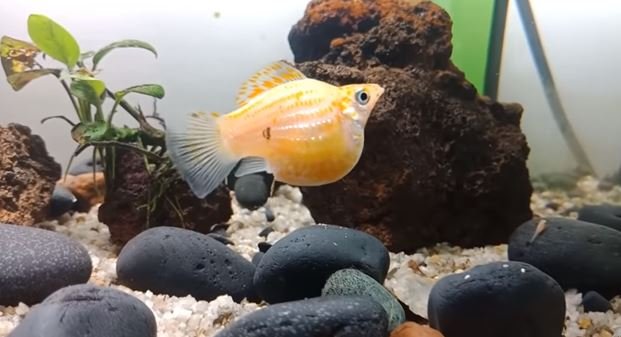
A gradually enlarging belly in a mature female that has been with a male is a useful clue that a molly is pregnant. A dark patch near the rear of the abdomen may also be visible. No single outward sign confirms pregnancy or tells you the exact day she will give birth. Check the fish’s sex, recent history, body shape, and overall health together.

Check that your molly is female

Look at the anal fin underneath the fish, behind the belly. An adult female normally has a fan-shaped anal fin; a mature male has a narrow, rod-shaped reproductive fin called a gonopodium. Color and size alone are less dependable ways to tell them apart. Aqueon’s livebearer guide explains this difference and how these fish give birth to swimming young rather than laying eggs.

A female bought recently may already have mated at the store or breeder. Mollies can store sperm, so the absence of a male in your aquarium does not rule out a later pregnancy. This is documented for sailfin mollies in the University of Florida’s research review of the species (PDF, pages 3–4).

Pregnancy clues—and their limits

What you notice How to interpret it
Belly grows gradually over several weeks Supports pregnancy in an otherwise healthy female with a mating history; swelling has other possible causes.
Darker area toward the rear of the belly A gravid spot can be visible on lighter fish. Pigmentation can hide it on black mollies.
Belly looks more squared near the rear May occur late in pregnancy, but is not a reliable countdown to delivery.
Hiding, reduced appetite, or unusual stillness Check water quality and health. These behaviors are not proof of labor.

Compare photographs taken from the same angle several days apart without catching or handling the fish. Balloon mollies already have a rounded body shape, making a belly-only judgment especially unreliable. Never squeeze the abdomen to check for babies.

How long are mollies pregnant?

Expect several weeks, not a precise deadline. Published estimates vary with the molly species and conditions: the Florida review reports about three to four weeks for sailfin mollies, while Aquarium Co-Op’s aquarium molly guide gives a broader 30–60-day breeding timeframe. A purchase date is not a known fertilization date.

Do not raise the temperature or make abrupt water changes to try to trigger birth. Maintain the fish’s normal, stable conditions. A female becoming distressed needs a health and water-quality check, not a revised due date.

When a swollen belly needs attention

Raised scales, sores, rapid breathing, loss of balance, or persistent refusal to eat should not be dismissed as pregnancy. Test ammonia and nitrite, check the temperature and filter, and observe whether other fish are affected. Seek an aquatic veterinarian’s advice for swelling accompanied by illness or worsening symptoms. Do not start medication solely because a fish looks round.

For a fish resting abnormally or struggling to swim, our bottom-resting fish troubleshooting guide helps organize the initial checks.

Should you separate a pregnant molly?

Choose your fry-raising plan before delivery. In a planted community aquarium, dense cover offers newborns hiding places, but adults—including their mother—may eat them. This approach does not guarantee that every baby survives.

If you want to raise more fry, prepare a separate, fully cycled nursery with gentle filtration and water conditions matching the main tank. A bare container of aquarium water is not a cycled nursery. Protect filter intakes so small fish cannot be drawn in.

Avoid repeatedly chasing a heavily pregnant fish or keeping her confined in a tiny breeding trap for days while guessing her due date. If you cannot provide suitable separate housing, improve cover in the existing aquarium and plan proper grow-out space rather than improvising an unfiltered bowl.

What to do when the babies arrive

Molly fry can take suitably fine food from birth. Offer small portions of finely crushed appropriate fish food or fry food; newly hatched brine shrimp are another option. Feed little and often, remove leftovers, and monitor water quality closely. Extra feeding can quickly overwhelm a small nursery.

In a separate breeding tank, remove the mother once delivery is finished and she can be moved without unnecessary disturbance. Use the fry’s actual size and the mouths of potential tankmates to judge when they can safely join a larger aquarium—not a fixed four- or eight-week rule. See our molly fry care guide for the next stage.

Plan for more than one brood

Decide where growing juveniles will live before trying to save a whole brood. Do not release unwanted aquarium fish outdoors. Arrange suitable homes and discuss sex separation with an experienced fishkeeper; females with a previous mating history may still produce young afterward.

For long-term housing and water requirements, continue with our molly fish care guide.