Best Fish for a 20-Gallon Tank: 3 Practical Stocking Plans

Best Fish for a 20-Gallon Tank: 3 Practical Stocking Plans

Ember tetras, pygmy corydoras, honey gouramis, and male guppies are useful starting points for a 20-gallon freshwater aquarium. They are alternatives to choose between, not a shopping list to combine. Match adult size, social needs, water chemistry, and temperament before deciding how many fish to buy.

Below are three modest stocking plans. Choose one, establish the aquarium first, and leave room to respond if a fish is bullied or the tank needs more maintenance than expected.

20-gallon long vs. 20-gallon high

Both hold a nominal 20 US gallons, but their swimming space differs. Aqueon’s standard 20 long measures 30¼ × 12½ × 12¾ inches; its 20 high measures 24¼ × 12½ × 16¾ inches (length × width × height). Other models vary; check the actual footprint. These measurements come from Aqueon’s aquarium dimensions chart (PDF).

For the small community fish discussed here, the long version provides a longer swimming route and more floor area. A taller tank does not compensate for insufficient swimming length, and substrate and decorations reduce the water volume in either shape.

Three separate stocking plans

Plan Fish Conditions and layout
Small centerpiece community 1 honey gourami + 10 ember tetras About 76–78°F; planted cover, gentle flow, and open swimming space. Soft to moderately hard water suited to both species.
Small schooling community 10 ember tetras + 8 pygmy corydoras About 75–77°F; preferably a 20 long, with smooth substrate, plants, and accessible feeding areas.
Hard-water livebearer tank 6 male guppies About 76–78°F; suitably hard, alkaline water, planted sight breaks, and monitoring for chasing.

These are suggested starting designs, not universal maximum capacities or guaranteed compatible groups. They assume an established filter, appropriate food, and regular maintenance. Do not merge the plans or automatically add another bottom-dwelling group. Check the conditions in which your supplier keeps the fish and confirm that your tap water suits the chosen species.

Why these fish work

Ember tetras: one coordinated group

These small orange fish reach about 0.8 inch and suit peaceful planted aquariums. Keep a group rather than scattering two or three individuals among several tetra species. Ten gives you a useful shoal while leaving space for one compatible addition in the plans above. Choose food small enough for their mouths. Aquarium Co-Op’s ember tetra guide describes their social needs and preference for gentle filtration.

Honey gourami: a modest centerpiece

Confirm the scientific name, Trichogaster chuna. A honey gourami is not a dwarf gourami or the larger thick-lipped gourami sometimes sold under similar color names. One avoids the extra complications of keeping a breeding pair in a small community. Provide cover without blocking surface access, and watch feeding to make sure the fish is not intimidated. See the honey gourami care guide for identification and behavior.

Pygmy corydoras: social fish, not cleaners

Pygmy corydoras stay around an inch long and should live with their own kind. They also swim above the bottom, so do not assume they occupy otherwise unused space. Offer suitable small sinking foods directly; leftovers are not a complete feeding plan. A group of eight is a practical choice here, with quiet tankmates and places to rest. Aquarium Co-Op’s pygmy cory guide covers their group size and feeding needs.

Male guppies: a different water-chemistry option

Guppies are a better starting choice when your water is naturally hard and alkaline. An all-male group avoids deliberately adding breeding females, although males can still chase one another. Ask the seller to confirm their sex and have a separation plan for persistent bullying. Do not continually add fish to distract an aggressor. Read the guppy care guide and our guppy temperature guide before setting up.

How many fish can a 20-gallon tank hold?

There is no dependable single number. The inch-per-gallon rule overlooks body mass, activity, territorial behavior, social grouping, and adult growth. Twenty tiny fish and twenty stocky fish place very different demands on the same aquarium.

Use a complete stocking plan, not spare gallons, to decide what belongs. More filtration can help process waste but cannot create territory or swimming space. Stable test results also do not prove that a crowded or incompatible group has enough room.

Choices that need a different plan

  • Bettas: a 20-gallon aquarium can provide good space for one, but compatibility varies by individual. Do not add one to the gourami plan or assume it will tolerate small fish and shrimp.
  • Mollies and swordtails: do not substitute them for guppies without checking the exact variety, adult size, activity, and breeding needs. Larger varieties need more room; see our molly guide.
  • Goldfish and common plecos: leave these out of the small tropical communities above. Buying a juvenile does not solve its eventual housing requirements.
  • Unspecified “cichlids” or “barbs”: those labels cover very different fish. Identify the species before making any compatibility decision.

Prepare the aquarium before buying fish

Cycle the filter using a fishless method with a controlled ammonia source and testing. Simply running an empty tank for a few weeks does not demonstrate that it can process fish waste. Confirm completion of the chosen cycling method, including ammonia and nitrite returning to zero, before stocking. The RSPCA aquarium environment guide explains why this matters.

Use a suitable heater, thermometer, filter, and secure lid. Add fish in planned stages while preserving each species’ social group, and test after additions. Keep an established alternative available if fish must be separated; an uncycled bowl is not a useful backup.

Keep the plan manageable

Feed measured portions and check that every species eats. Inspect the equipment and fish daily. Use water tests and the tank’s condition to guide regular partial water changes; condition replacement tap water and avoid abrupt temperature changes. Fish, snails, and shrimp do not replace this work.

Give the aquarium a consistent day/night schedule rather than leaving the light on continuously. Adjust lighting to the plants and algae response. If maintenance becomes difficult, address feeding, filtration, and stocking before buying a supposed cleanup fish.

Start with one of the three plans, learn how that group behaves, and allow the aquarium to settle. An attractive 20-gallon tank does not need a specimen of every fish on the store’s small-fish shelf.

Amano Shrimp Care: Tank Setup, Feeding and Breeding

Amano Shrimp

Amano shrimp (Caridina multidentata) are freshwater grazers that need a mature aquarium, appropriate food, and peaceful tankmates. They can help with soft algae, but they do not remove the need for water changes or solve the cause of an algae outbreak. Their transparent bodies and busy feeding behavior make them interesting animals in their own right.

Amano shrimp care at a glance

Requirement Practical starting point
Adult size About 1.5–2 inches; females usually grow larger
Aquarium Established 10-gallon or larger tank with covered openings
Temperature 68–80°F; keep conditions stable and suitable for all inhabitants
Water pH around 6.5–7.5; measurable mineral hardness, not untreated pure RO water
Food Natural grazing plus small portions of suitable sinking food
Breeding Adults live in freshwater; larvae require a separate saline rearing stage

The size and water ranges above follow Fluval’s Amano shrimp profile (PDF). They are care guidelines, not targets to reach by abruptly changing your aquarium.

Identification and buying

Amanos have translucent grayish bodies with a row of dark markings along each side. Males tend to show dots; females often have more elongated marks. Older labels may use the name Caridina japonica. Similar-looking shrimp are sold under broad common names, so ask for the scientific name when buying.

Choose active shrimp that are grazing or moving normally. Ask whether they are captive-bred or collected, how long the store has held them, and what water they are in. A bargain price is less useful than healthy animals and clear acclimation advice. Do not select a fixed male-to-female ratio unless you have a specific breeding project.

Set up a mature, escape-resistant aquarium

A 10-gallon tank is a useful minimum starting size for this guide; more space helps when adding fish. Start with a modest group, such as four to six, in an appropriately maintained tank rather than applying a rigid shrimp-per-gallon formula. Food supply, cover, and existing inhabitants matter.

Use established biological filtration and confirm that ammonia and nitrite are undetectable. Waiting six weeks is not a substitute for testing. Shrimp benefit from a tank that has developed grazing surfaces as well as a functioning filter. Aqueon’s freshwater shrimp guide recommends mature aquariums and protected filter intakes.

Add plants, wood, and sheltered spaces. Fit a sponge guard to an exposed intake and close gaps around hoses and cables without blocking ventilation. Good surface movement supports oxygen exchange; a powerful extra pump is not automatically necessary. Use a heater if the room cannot maintain suitable conditions.

Water changes, minerals, and acclimation

Condition replacement tap water for chlorine and chloramine and match temperature closely. Make regular partial water changes, guided by tests and feeding, rather than allowing waste to build up between major cleanouts. Keep a record of pH and general hardness (GH) so you can recognize a change.

Do not add crushed coral or mineral supplements simply because a shrimp is hiding. Test first: additives can change more than one water parameter. If using reverse-osmosis water, prepare and verify an appropriately remineralized supply before use.

Ask the supplier for acclimation instructions suited to the shipping method and water difference. Avoid sudden changes and prolonged exposure to deteriorating transport water. Check every medication’s label for invertebrate safety; copper-based fish treatments can be dangerous to shrimp. Treat fish separately when a product is unsuitable for the shrimp aquarium.

Feed the shrimp, not just the algae

Offer small amounts of sinking shrimp food and observe whether all animals can reach it. An occasional small piece of softened vegetable can provide variety; remove leftovers before they foul the water. Spread food between a few locations if large shrimp monopolize a pellet.

Amanos graze biofilm and some filamentous algae, but results vary with the algae present and other food available. Do not starve them to make them clean. Manually remove troublesome growth and review lighting, feeding, and plant health. Eating waste food still produces shrimp waste.

Molting: what is normal?

An empty, translucent shell can be a shed exoskeleton. Hiding afterward is normal while the new shell hardens. Leave an obvious empty molt for the shrimp to graze, but do not assume every pale, motionless shape is a shell. Check for tissue inside and look for the living shrimp before deciding.

If several shrimp become inactive, try to climb out, or die close together, promptly check ammonia, nitrite, temperature, aeration, and anything recently added to the water. Repeated losses or failed molts need investigation; adding minerals blindly may make conditions worse.

Tankmates: peaceful does not always mean safe

Small fish such as ember tetras may share suitable water conditions with adult Amanos. Avoid fish large enough to swallow them and species that hunt crustaceans. Newly molted shrimp are especially vulnerable. Bettas vary individually: planted cover reduces exposure but does not guarantee safety. See our betta and shrimp compatibility guide.

A shrimp-only aquarium removes fish predation risk. If mixing Amanos with blue velvet shrimp, make sure the smaller shrimp also get food.

Why eggs do not produce a freshwater colony

A female may carry eggs beneath her abdomen and release tiny larvae. Unlike cherry shrimp, Amanos do not normally complete this life cycle in an ordinary freshwater aquarium. Aquarium Co-Op’s Amano guide explains the larvae’s need for highly brackish or salt water.

Do not salt the community tank or move the adult female into seawater. Successful rearing needs a separate planned system, measured salinity, suitable microscopic food, and a managed return to freshwater after development. It is a specialist project, not a quick change to normal care. For most keepers, enjoying healthy adults is a better starting goal than attempting to raise every batch of eggs.

Red-Tail Black Shark Care: Tank Size, Diet and Mates

Red Tail Shark

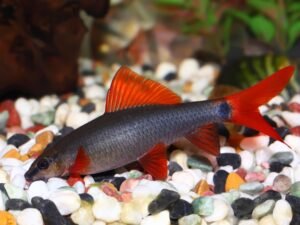
Red-tail black sharks (Epalzeorhynchos bicolor) are territorial freshwater cyprinids—not sharks. They reach about 5–6 inches (13–15 cm), spend much of their time near the bottom and are best kept as the only red-tail or rainbow shark in a long, mature aquarium. A 55-gallon tank with a four-foot footprint is a sensible minimum starting point for one adult, but layout and tank mates matter as much as volume.

Adult red-tail black shark in a planted freshwater aquarium
A mature red-tail black shark needs a defined territory, visual barriers and open swimming room.

Red-tail black shark care at a glance

Scientific name Epalzeorhynchos bicolor
Adult length About 5–6 in (13–15 cm)
Temperature 72–79°F (22–26°C)
pH Approximately 6.5–7.5; stability matters
Social behavior Solitary and territorial, especially when mature
Minimum starting point 55 US gal with a four-foot footprint for one adult
Diet Omnivorous grazer; varied prepared and fresh/frozen foods
Difficulty Intermediate because of territorial behavior

These figures are practical husbandry guidance, not permission to overcrowd. Upgrade when the fish cannot patrol without continually encountering tank mates.

Species, appearance and conservation

Red-tail black shark showing its black body and red caudal fin
Only the tail is red; rainbow sharks normally show red on several fins.

The red-tail black shark belongs to the carp and minnow family. Its solid dark body and red caudal fin distinguish it from the rainbow shark (E. frenatum), which has red on more fins.

FishBase lists the wild species as Critically Endangered and reports that ornamental exports are now captive bred. That does not make husbandry unimportant: buy clearly identified, captive-bred stock from a responsible seller and never release an aquarium fish.

Tank size and layout

Floor space is more useful than a tall, narrow tank. Start with a four-foot-long aquarium around 55 gallons for one adult and use a larger footprint when keeping active or bottom-oriented companions. Juveniles may appear peaceful in small shop tanks, but territorial behavior generally strengthens with age.

  • Create several sight breaks with anchored wood, smooth rock and sturdy plants.
  • Provide at least one roomy retreat without a narrow dead end.
  • Leave an open route for swimming and feeding.
  • Use a secure lid; startled fish can jump.
  • Protect heater glass and filter intakes from impacts and entrapment.

Water conditions and filtration

Maintain a fully cycled aquarium with zero ammonia, zero nitrite and nitrate controlled by stocking, feeding, plants and regular water changes. A stable temperature of roughly 72–79°F and pH around 6.5–7.5 fit the species’ commonly reported range. Avoid chasing a precise pH with repeated chemical adjustment.

Use filtration that provides strong biological capacity and good gas exchange without turning the whole tank into exhausting current. Rinse reusable media in removed aquarium water or conditioned water, and never replace all mature biological media at once.

Substrate and plants

Use smooth sand or rounded fine gravel because this fish spends time grazing and searching near the bottom. Sharp rock can damage the mouth and barbels. Robust plants such as Anubias and Java fern can be attached to wood or rock; ensure decorations cannot collapse when the fish pushes underneath them.

Diet and feeding

Red-tail black shark foraging near aquarium substrate
Red-tail black sharks forage low in the aquarium but are not a substitute for algae control or tank maintenance.

Feed a varied omnivorous diet. A quality sinking or slow-sinking staple can be supplemented with algae-based foods, blanched vegetables and appropriately sized frozen or live invertebrate foods. Do not rely on leftover flakes or expect the fish to live on aquarium algae.

Offer measured portions once or twice daily, watching that the fish receives food without dominating every feeding station. Remove uneaten food and adjust the amount to body condition and water-test results.

Temperament and tank mates

Keep one red-tail black shark per ordinary home aquarium. Do not combine it casually with another red-tail, a rainbow shark, flying foxes or similarly shaped bottom fish. A very large specialist display is not evidence that the same combination is safe in a normal tank.

Potential companions are robust midwater or upper-water species of suitable adult size that share the temperature and water chemistry. Avoid slow, long-finned, timid, tiny or bottom-territorial fish. Compatibility is never guaranteed: have a divider, spare cycled enclosure or rehoming plan ready before problems begin.

Signs the arrangement is failing

  • Repeated chasing that prevents another fish from feeding or resting
  • Torn fins, missing scales or fish pinned in corners
  • Rapid breathing, persistent hiding or loss of appetite
  • Continuous glass surfing or frantic jumping

Test ammonia, nitrite, nitrate and temperature immediately. Separate injured or relentlessly targeted fish; adding more decorations does not reliably solve an established attack pattern. Seek an aquatic veterinarian when injuries, swelling, ulcers or breathing difficulty persist.

Acclimation and quarantine

Quarantine new fish in a fully cycled, covered system with dedicated equipment. Match temperature, then acclimate according to the transport-water difference without prolonging exposure to dirty bag water. Observe appetite, feces, skin, fins and breathing before introducing the fish to a community.

Breeding

Home-aquarium breeding is uncommon and should not be attempted by placing an adult pair together in a normal tank. Commercial production uses controlled methods and space unavailable to most keepers. Sex cannot be identified reliably from color alone.

Frequently asked questions

Can a red-tail black shark live in a 20- or 30-gallon tank?

Not as a permanent adult. These sizes do not provide enough patrol distance and territorial separation. Plan around at least a four-foot, roughly 55-gallon footprint for one, with more room when the community is busy.

Can it live with a rainbow shark?

Not in a typical home aquarium. Their similar shape and use of the lower tank make conflict likely.

Does it need to live in a school?

No. Unlike bala sharks and roseline sharks, adult red-tail black sharks are normally maintained singly in aquariums.

Will it clean the tank?

No fish replaces maintenance. It may graze surfaces, but it still needs a complete diet, clean substrate, water changes and appropriate filtration.

How long do red-tail black sharks live?

Several years is realistic with good care, but lifespan figures vary and should not be treated as a guarantee. Buy only if you can provide adult housing for the fish’s entire life.

Related guidance and references

Final recommendation

A red-tail black shark can be an impressive single territorial fish for an experienced keeper with a mature four-foot aquarium. Choose it for its natural behavior—not as an algae solution—and avoid it when the planned community contains timid, long-finned or competing bottom-dwelling fish.

Ember Tetra Care: Tank Size, Feeding and Tank Mates

Ember Tetra

Ember tetras are small, peaceful fish best kept in a group in an established, planted aquarium. Their orange color looks striking against greenery, but their small size is not a reason to crowd them into a tiny container. Give them swimming space, gentle filtration, and food they can actually swallow.

Ember tetra care at a glance

Requirement Practical guidance
Scientific name Hyphessobrycon amandae
Adult size About 0.8–1 inch
Group Start with 8–10 of their own species
Tank 10 gallons for a focused group; 20 gallons gives more community options
Temperature About 76–78°F is a useful everyday target
Water Soft to moderately hard; slightly acidic to neutral conditions are a useful starting point
Diet Small complete flakes or pellets, with appropriately sized frozen or live foods for variety

Published ranges are wider than these everyday targets. Fluval’s species profile (PDF) lists 76–82°F, pH 5.5–7.0, and hardness of 1–12 degrees. Aquarium Co-Op describes a broader range for aquarium-kept fish. Ask about your supplier’s water and avoid abrupt adjustments to chase a particular number.

Appearance and behavior

Embers come from Brazil’s Araguaia drainage. They have small, somewhat translucent orange bodies; they are a different species from glowlight tetras. Mature females may look fuller than males, but color and body shape are not foolproof sexing methods.

They often spread into a loose shoal rather than swimming in a tight formation all day. A relaxed group browsing around plants is not necessarily failing to school. Constant hiding, isolation, rapid breathing, or a fish being excluded from food deserves closer attention.

Tank size and group size

Our recommendation is a 10-gallon or larger aquarium for a dedicated group of 8–10. Some care sheets allow smaller tanks, but the extra room makes planting, swimming space, and maintenance easier to balance. Choose a rectangular footprint rather than relying on height alone.

Keep one proper group instead of buying a few individuals from several tetra species. Similar-looking fish do not replace companions of their own species. A larger group also needs a larger overall stocking budget; “small fish” does not mean unlimited numbers.

For a community, see our 20-gallon stocking plans. Those are separate example combinations, not lists to merge.

Build the habitat before adding fish

Complete a fishless cycle and confirm the filter processes the chosen ammonia source, with ammonia and nitrite returning to zero. Merely running a filter in clean water for a set number of weeks is not enough. The RSPCA’s aquarium setup guidance explains why biological filtration must be established first.

Plant around the sides and back while leaving an open swimming area. Wood and suitable plants provide cover; a dark background can make the fish easier to see. Floating plants can shade part of the surface, but leave room for gas exchange and access for feeding.

Use a filter with adjustable or gentle flow and protect exposed intakes. Embers should not have to fight a jet of water continuously. Fit a lid, thermometer, and an appropriately sized heater where needed. Give the aquarium a regular light/dark schedule.

Leaves and wood may tint water, but they are not a reliable substitute for measuring hardness and pH. Do not pour in acidifying products to force soft-water conditions. If your tap water is very hard, consider a fish better suited to it or learn a controlled water-preparation method before buying embers.

Feeding tiny mouths

Offer a small complete food formulated for tropical fish: crush flakes finely or choose truly small pellets. Watch an individual take and swallow food. Repeatedly spitting out large pieces can mean the particle size is wrong, not that the fish needs more food.

Suitable small frozen or live foods can add variety. Offer modest meals once or twice a day and reduce the portion if food reaches the bottom uneaten. A good prepared food is not inherently harmful; the old claim that flakes and pellets necessarily cause digestive problems is unsupported.

Feed away from pushy tankmates and check that the smallest fish gets a share. Aqueon’s tetra guide supports a varied diet and controlled portions.

Choosing tankmates

  • Small peaceful fish: pygmy corydoras or a carefully chosen honey gourami can be options in a suitably sized community with compatible water.
  • Shrimp: adult Amano shrimp can be an option, but tiny shrimplets of other species may be eaten.
  • Bettas: compatibility depends on the individual. Have a suitable separation plan rather than assuming a peaceful outcome.
  • Larger or boisterous fish: avoid predators and persistent chasers. Even a fish described as peaceful may swallow an ember if it fits in its mouth.

Check the needs of every species separately. Do not add another shoal or a bottom-dweller simply because that area of the aquarium looks empty.

Water changes and signs of trouble

Inspect feeding, swimming, and equipment daily. Test regularly, especially after adding animals or changing filtration. Carry out partial water changes with conditioned, temperature-matched water and remove accumulated debris without replacing all biological filter media at once.

Color alone is not a diagnosis. Newly introduced fish can look pale, but prolonged fading together with weight loss, clamped fins, sores, or unusual breathing calls for investigation. Check water quality first and seek aquatic veterinary advice if illness persists. Our abnormal bottom-resting guide covers initial checks.

Breeding: eggs, not pregnancy

Ember tetras scatter eggs and do not provide parental care. A female holding eggs is not pregnant in the livebearing sense. Adults may eat eggs or fry, so an occasional baby in a planted tank is different from a dependable breeding method.

For a deliberate attempt, prepare a separate mature breeding setup with gentle filtration, protection for the eggs, and very small first foods ready before spawning. Newly swimming fry may need infusoria or appropriately fine fry food before they can take larger items. Raising them requires frequent observation and careful water management.

Do not sharply change pH or temperature to force spawning. Learn routine adult care first; a healthy, settled shoal is already a rewarding aquarium.

Bamboo Shrimp Care: Feeding, Flow and Tank Setup

Bamboo shrimp

Bamboo shrimp are peaceful freshwater filter feeders, but they need more planning than an ordinary cleanup crew. Their fans catch tiny food particles carried by the current. A tank can look healthy and still provide too little food for them.

This guide focuses on Atyopsis moluccensis, often sold as wood shrimp or Singapore flower shrimp. Choose this species if you can provide a mature aquarium, reliable water movement and a deliberate feeding routine.

Bamboo shrimp care at a glance

Care point Practical guidance
Adult size About 3 inches; identification matters because common names overlap
Tank recommendation A mature 20-gallon or larger aquarium gives useful room for feeding perches and sheltered areas
Temperature A stable 75–80°F is a practical target within their broader tolerated range
Water chemistry Approximately pH 6.5–7.5 and 6–15 dGH; avoid abrupt changes
Water quality Undetectable ammonia and nitrite; keep nitrate low
Main challenge Delivering enough fine food without polluting the aquarium

These are setup targets, not instructions to rapidly alter an established aquarium. Ask the seller about its water before bringing shrimp home.

Build a feeding station, not just a decorated tank

Place a secure piece of aquarium wood or rock where filter outflow passes across it. Add quieter crevices nearby. The shrimp should be able to feed in moving water and retreat without being swept around the tank. Keep the surface moving for gas exchange; our guide to aquarium oxygenation explains why surface movement matters.

Aquarium size alone cannot guarantee success. Our 20-gallon recommendation is a planning choice that provides room to separate those feeding and resting areas. Adding more shrimp also adds competition for suitable perches and suspended food.

Use a mature biological filter and guard exposed intakes. Aqueon’s freshwater shrimp guidance emphasizes established aquariums and undetectable ammonia and nitrite. A newly filled aquarium is not ready simply because its water looks clear.

How to feed bamboo shrimp

Finely powdered aquarium food can supply particles small enough for the fans to collect. Whole pellets dropped on the bottom are not an equivalent feeding method. Mix a small amount of suitable powder with aquarium water, then gently release it upstream of an occupied perch using a pipette. Watch whether the shrimp captures it and brings its fans to its mouth.

Begin with very small portions and observe several feeding opportunities through the day. Record what you offer so you can adjust consistently. Avoid clouding the entire tank or deliberately stirring dirty substrate. Uneaten food still becomes waste.

Neale Monks’ bamboo shrimp guide explains the importance of targeted feeding. Do not assume that a planted tank or fish leftovers will provide a complete diet.

Why is my shrimp picking at the bottom?

Occasional exploration is not a diagnosis. Persistent scraping instead of fan feeding is a reason to review the setup: does food actually reach the perch, is another animal displacing the shrimp, and is the current useful at that spot? Increasing the amount poured into the tank without answering those questions can make water quality worse.

Tank mates and molting

Choose small, peaceful companions that suit the same conditions. Avoid animals that hunt shrimp or nip their fans. A tank designed around very still water is a poor starting point for this species. If you want a grazing shrimp, compare the different feeding needs in our Amano shrimp care guide.

After shedding its shell, a shrimp may hide while its new covering hardens. Leave it undisturbed and provide shelter. An empty, translucent shell is not the same as a dead shrimp. Check carefully before removing anything; remove a confirmed dead animal and test the water.

The Practical Fishkeeping shrimp FAQ discusses molting and chemical sensitivity. Check medication compatibility with the manufacturer before use, particularly for copper treatments. Do not assume that a fish-safe treatment is safe for shrimp.

Can bamboo shrimp breed in freshwater?

Adults live in freshwater, but their larvae require saline conditions to develop. Eggs therefore do not mean a freshwater colony will follow. Breeding is a separate specialist project; do not add salt to the display aquarium in an attempt to raise larvae.

Before you buy

  • Confirm the aquarium is established and water tests are satisfactory.
  • Prepare an accessible feeding perch and nearby shelter.
  • Have suitable fine food and a way to deliver measured portions.
  • Observe the animal feeding if possible, and ask how it has been fed.
  • Plan for ongoing observation rather than treating it as a maintenance tool.

Molly Fish Care: Tank Setup and Balloon Molly Advice

Molly Fish

Molly fish do best when their aquarium matches their adult size and preference for mineral-rich water. They are active livebearers, so a successful setup also needs room for social behavior and a plan for unexpected fry.

Balloon mollies are selectively bred, short-bodied forms with rounded bellies. Their shape does not make them suitable for tiny tanks. This guide covers everyday molly care and the extra observations that matter if you already keep balloon mollies.

Molly fish care at a glance

Care point Practical guidance
Tank size 20 gallons is a starting point for smaller varieties; choose 29–55 gallons or more for larger mollies and communities
Adult size Varies by species and strain; many common mollies reach 4–5 inches
Temperature 75–80°F, kept stable with a heater when needed
Water Hard, alkaline freshwater; test your source water and ask about the seller’s conditions
Diet Complete omnivore food with plant ingredients, plus varied supplementary foods
Mixed-sex group At least two or three females per male, with enough space and a breeding plan

Aquarium Co-Op’s molly guide explains the differences between common varieties and their housing needs. A small juvenile or a short-bodied balloon strain should not be used to justify crowding.

Choose the tank around the adults

Leave open swimming space and use plants or decorations to break up lines of sight. A secure lid, working filter and thermometer are basic equipment. Position the outlet so water circulates without forcing every fish to swim against a strong jet.

There is no useful rule allowing two mollies per gallon. A proposed group must fit the tank as adults, alongside any other fish and future offspring. For a mixed group, a larger aquarium gives more flexibility than stocking a 20-gallon tank to its limit. Our 20-gallon stocking guide can help compare alternatives before you buy.

Establish the biological filter before adding fish. The RSPCA’s aquarium guidance explains how filtration processes toxic waste and why partial water changes remain necessary. Keep ammonia and nitrite undetectable. Test regularly, remove uneaten food, and use conditioned, temperature-matched replacement water. Adjust maintenance to the tank’s measured waste buildup rather than waiting for cloudy water.

Do mollies need aquarium salt?

Do not automatically add salt to a freshwater molly aquarium. Many mollies can live in hard freshwater. Salt tolerance and a requirement for salt are different things, and other residents or plants may not tolerate an addition.

Check pH, general hardness (GH) and carbonate hardness (KH), not just temperature. Sodium chloride is not a substitute for calcium and magnesium hardness. If your tap water is very soft, discuss a measured remineralization plan with an experienced retailer, or choose fish better matched to it. Avoid trying to correct everything with a sudden chemical adjustment.

Ask whether new fish were held in freshwater or brackish water before purchase. A large difference between the shop and your aquarium needs a planned transition, not guesswork.

What should mollies eat?

Use a complete flake or small pellet appropriate for omnivorous tropical fish, including plant ingredients. Offer modest portions once or twice daily and watch all the fish eat. Occasional suitable frozen foods can add variety; bloodworms or brine shrimp do not need to be the staple diet.

Aqueon’s livebearer care sheet supports a mixed diet rather than a vegetables-only menu. Grazing on algae does not eliminate the need to feed your mollies. Remove uneaten supplements before they decay and reduce portions if food routinely reaches the bottom untouched.

Balloon molly shape and welfare

A balloon molly’s rounded outline is a bred body form, not proof of pregnancy. Do not assume every change in its belly is normal, either. Compare the fish with its own usual appearance and behavior.

When choosing fish, prioritize comfortable swimming, normal feeding and an ability to hold position. Our recommendation is to favor standard-bodied mollies over exaggerated body shapes. The RSPCA’s guidance on extreme conformations explains the broader welfare concern with breeding animals for altered physical features; it is not a diagnosis of any individual molly.

If you already own balloon mollies, give them accessible feeding areas and resting space outside the strongest flow. Persistent floating, sinking, gasping or refusal to eat warrants prompt investigation. Test the water and seek qualified fish-health advice if symptoms continue; body shape alone does not identify the cause.

Social behavior, tank mates and breeding

Males have a narrow, rod-like anal fin called a gonopodium; females have a broader, fan-shaped anal fin. Do not use the dorsal fin alone to sex them. More females can spread courtship pressure, but a numerical ratio cannot fix an undersized tank or relentless harassment.

Choose similarly sized, peaceful companions with matching water needs. Slow, long-finned fish and very small shrimp can be poor choices. Watch interactions after any introduction and have a way to separate incompatible animals.

Mollies give birth to live fry, and adults may eat them. Plan accommodation and responsible rehoming before deliberately breeding. Dense plants offer cover, but they do not create extra stocking capacity. See our guides to molly pregnancy and raising molly fry for the next steps.

A useful weekly check

  • Confirm temperature, filter operation and water-test results.
  • Watch each fish swim and eat, rather than checking the group from a distance.
  • Look for persistent chasing and fish hiding from others.
  • Count new fry and reassess available space.
  • Record changes before adding remedies or more livestock.

Betta Fish Care: Tank Size, Feeding and Daily Care

Betta Fish Care

A betta needs a warm, filtered freshwater aquarium, safe places to rest and a consistent care routine. Its ability to breathe air does not protect it from ammonia, dirty water or an unsuitable tank.

This guide covers the domestic Siamese fighting fish, Betta splendens. Wild betta species can have different requirements. For a first betta, a single fish in its own properly equipped aquarium is the simplest starting point.

Betta fish care at a glance

Requirement Recommended starting point
Tank At least 5 gallons; a 10-gallon aquarium offers more room and a larger water buffer
Temperature 78–80°F, checked with a separate thermometer
Filtration A cycled filter with gentle flow
Water quality 0 ppm ammonia and nitrite on aquarium tests; control nitrate with maintenance
pH Roughly 6.5–7.5 is a useful target; avoid sudden chemical adjustments
Housing One betta per aquarium is our recommendation for beginners
Food A complete betta diet, with occasional suitable frozen foods for variety

Set up the aquarium before buying the fish

A rectangular tank with usable swimming space is a better choice than a vase or tiny bowl. Add a secure lid while leaving an air gap and unobstructed access to the surface. Bettas breathe surface air through their labyrinth organ and can jump.

Provide smooth decorations, sheltered areas and soft or live plants. A broad leaf or safe resting platform near the surface can be useful, especially for a long-finned fish. Check openings for places where a fish could become trapped. RSPCA Australia’s betta guidance explains the importance of cover, surface access and a suitable heated environment.

Use a thermostatic heater rated for the tank and verify its performance with a thermometer. Choose a filter that does not push the fish around; a sponge filter or an adjustable-flow filter can work. Keep open swimming routes and position equipment so it remains accessible for cleaning. See our betta tank setup guide for the full equipment and cycling sequence.

Cycling and water quality

Cycling establishes the microorganisms that process fish waste. Simply leaving new water standing overnight does not establish a biological filter. Complete a fishless cycle and confirm that the system can process its ammonia source before adding a betta.

The RSPCA’s aquarium environment guide describes biological filtration and the need for ongoing water changes. Clear-looking water can still contain harmful waste, so use tests rather than appearance to judge it.

If the fish is already in an uncycled aquarium, test ammonia and nitrite daily and use partial water changes with conditioned, temperature-matched water whenever either is detected. Keep filtration running and obtain help with establishing the cycle. Do not add extra fish while the tank is unstable.

Treat tap water for chlorine and chloramine according to the conditioner label. Avoid unmineralized distilled or reverse-osmosis water as a direct replacement for a suitable freshwater supply. Ask the seller about its water if your source differs substantially.

What and how often to feed

Choose a complete food made for bettas and give a small daily ration, optionally divided into two meals. Pellet sizes vary, so a fixed number of pellets is not a reliable rule for every brand or fish. Watch the fish take the food, remove leftovers and adjust portions to maintain a healthy body condition.

Suitable frozen invertebrate foods can provide variety, but treats should not displace a balanced staple. Bettas cannot live on plant roots. Our bloodworm feeding guide explains how to use that food as a supplement. The Unusual Pet Vets care sheet also emphasizes daily feeding and avoiding overfeeding.

A manageable maintenance routine

  • Daily: check temperature, filter operation, appetite and swimming. Remove uneaten food.
  • Weekly: test the water and begin with a partial water change of about 20–25%. Adjust the amount or frequency to waste levels and the tank’s needs.
  • When flow slows: gently clean clogged filter media in removed aquarium water. Preserve the biological media instead of replacing everything at once.
  • During cleaning: siphon accessible waste and wipe algae with aquarium-only tools. Keep soap and household cleaners away from the tank.

Leave the fish in the aquarium during routine maintenance when practical. Follow equipment instructions for safely switching off and restarting the heater or filter during a water change.

Can bettas live with other fish?

Do not keep two male domestic bettas together or keep a male and female together as permanent companions. Female groups can also develop aggression; they are not a beginner shortcut to keeping several bettas.

A community aquarium is an optional, more complicated project. It needs enough space for every species at adult size, compatible water conditions and a ready separation plan. Avoid fin-nippers and fish that provoke or overwhelm the betta. Shrimp may be eaten. A calm first introduction does not guarantee lasting compatibility.

Normal behavior versus warning signs

Resting on a leaf or briefly flaring can be normal. Persistent gasping, loss of balance, clamped fins, wounds or a marked change in appetite deserves attention. Check water quality, temperature and equipment first. Seek fish-veterinary advice for severe or continuing symptoms instead of adding several medications without a diagnosis. Our betta health guide explains useful observations to record.

Bubble nests and breeding

A male may build a bubble nest without a female present. It is not a reason to buy him a mate or proof that every aspect of his care is correct. As described in Aqueon’s breeding overview, the male tends the nest after spawning. Raising offspring requires a separate, planned setup and suitable tiny foods; this care guide does not recommend casual breeding in a community tank.

Plan for several years of care. Consistent observation, suitable housing and stable water matter more than chasing a promised maximum lifespan.

Amazon Sword Plant Care: Planting, Feeding and Pruning

Amazon Sword Plant

Amazon sword plants make impressive green focal points, but their adult size and root nutrition deserve more attention than their reputation as an easy plant. Give one enough room, keep the crown above the substrate and supply nutrients at the roots.

They can grow successfully without injected carbon dioxide (CO2). A simple planted aquarium with suitable lighting and steady maintenance is often enough; stronger lighting is not automatically better.

Amazon sword care at a glance

Care point Practical guidance
Common trade names Amazon sword; several related forms are sold under this name
Placement Background or a spacious central focal point
Adult size Often 12–20 inches tall; some forms exceed 20 inches and spread widely
Light Low to moderate aquarium lighting
Substrate Enough depth for the roots, with an appropriate nutrient source
CO2 injection Optional, not essential for a basic setup
Propagation Separate rooted plantlets produced on a stalk

Identify the plant and leave room to grow

The name Amazon sword is not a precise guarantee of size. Plants commonly labeled Echinodorus amazonicus or Echinodorus bleherae are also discussed under Echinodorus grisebachii in aquarium references. Ask the grower which form you are buying rather than relying on the small size of the plant in its pot.

Tropica’s profile of ‘Bleherae’ describes an undemanding plant that can become about 8–20 inches tall. Allow width as well as height. Our practical preference is a 20-gallon or larger aquarium for a typical full-size sword, with more space for large forms. A compact cultivar is a better choice when permanent space is limited.

Position the plant where it will not shade every smaller neighbor or block access to equipment. Compare its role with smaller species in our aquascaping plant guide.

How to plant an Amazon sword

  1. Remove the nursery basket and gently work packing material away from the roots. Rinse away loose debris and inspect for damaged tissue or unwanted hitchhikers.
  2. Choose a permanent location with space for the mature rosette. Avoid repeatedly uprooting an established plant.
  3. Make a planting hole and bury the roots. Keep the crown—the point where the leaves emerge—at or just above the substrate surface.
  4. Gently firm the surrounding substrate without burying the leaf bases.
  5. If using plain sand or gravel, add aquarium root fertilizer according to its label and keep it properly buried.

Aquarium Co-Op’s planting instructions illustrate the distinction between burying the roots and covering the crown. Sand and gravel can both work; neither supplies a complete nutrient program by itself. Our planted-tank substrate guide compares the main approaches.

Root feeding and fertilizer

A sword develops a substantial root system. Nutrient-rich planted substrate can support it, while inert or depleted substrate usually needs supplementation. Liquid fertilizer can support the wider aquarium, but do not ignore nutrition around the roots.

Follow the particular fertilizer’s dose, placement and replacement schedule. Tablet size and formulation differ, so a universal number of root tabs per month is not useful. Keep a simple record of when you fertilize and compare new leaves over time before increasing the dose.

Aquarium Co-Op’s plant-selection guide highlights the regular root-feeding needs of sword plants. Choose aquarium products appropriate for the animals you keep and use the labeled dose. Do not add iron automatically whenever a leaf changes color.

Lighting, CO2 and water conditions

Use a controllable aquarium light and start with a modest schedule, such as six to eight hours daily. Treat that as an adjustment point, not a requirement for every fixture. Increase light cautiously only when healthy growth and the rest of the setup support it.

Watts per gallon is a poor way to compare modern LED fixtures: electrical power alone does not tell you how much useful light reaches the leaves. Tank depth, shading and fixture placement also matter. Keep the light on a timer so changes are deliberate and repeatable.

No injected CO2 does not mean no carbon dioxide. Plants still use dissolved CO2 already present in the aquarium. Adding a gas system is optional and introduces another variable to manage; it is not the first response to an unhealthy leaf.

Amazon swords tolerate a range of tropical freshwater conditions. David Manthei’s species profile in Tropical Fish Hobbyist notes differences between forms, including their tolerance of harder water. Match conditions to your livestock and avoid changing pH simply to reach a supposed universal sword-plant number.

Melting, yellow leaves and holes: what to check

What you see Useful first check
Older leaves fade after planting Transition to submerged growth may be involved. Watch for new growth from a firm crown before assuming the whole plant has failed.
Continuing pale or weak new growth Review the overall nutrient supply, light and planting depth. Color alone does not identify a specific deficiency.
Holes or scraped leaf surfaces Check for physical damage and grazing, including plecos, as well as nutrient history.
Algae coating leaves Review light duration, shading and maintenance. Avoid increasing brightness as an automatic fix.
Plant repeatedly comes loose Check root anchoring and whether digging fish are disturbing it.

Remove deteriorating tissue and judge recovery by healthy new leaves. Take a weekly photo from the same angle; it makes gradual improvement easier to see than checking repeatedly through one afternoon.

Pruning and propagation

Remove damaged or oversized outer leaves near their base without cutting into the crown. Do not shear all the leaf tips to make a permanently undersized plant. Tropica’s trimming guide recommends selective removal of outer or shading leaves for Echinodorus.

A mature sword may send out a long stalk carrying daughter plants. Wait until a plantlet has its own leaves and roots, then carefully detach and plant it. A loose leaf is not a stem cutting that will reliably produce another sword.

If the parent repeatedly overwhelms the aquarium, move or rehome it and choose a smaller plant. Regular pruning can manage some shade, but it cannot change the mature growth habit you selected.

African Dwarf Frog Care: Tank Setup, Feeding and Health

African Dwarf frog

African dwarf frogs are fully aquatic amphibians that breathe air at the surface. Their small size does not make them suitable for an unfiltered bowl: they need stable, clean water, an escape-proof aquarium and deliberate feeding.

This guide covers Hymenochirus species. For a first setup, choose a quiet, species-only aquarium where you can check that every frog eats. They are interesting animals to observe, rather than pets to handle.

African dwarf frog care at a glance

Requirement Practical starting point
Aquarium 10 gallons or larger for a pair; choose a larger, wide tank for a bigger group
Temperature A stable 76–78°F
Water quality 0 ppm ammonia and nitrite; keep nitrate low, ideally below 20 ppm
pH Approximately 6.5–7.5; avoid sudden changes
Equipment Cycled gentle filter, thermometer, heater as needed and secure ventilated lid
Food Small sinking aquatic-frog foods and varied, appropriately sized meaty foods
Commitment Several years of daily observation and regular maintenance

These are planning guidelines, not a stocking formula. Confirm the conditions your frogs are accustomed to before bringing them home. Flip Aquatics’ frog care guide provides additional species-specific water and feeding guidance.

Check that you are buying the right frog

African dwarf frogs and African clawed frogs are different animals. Dwarf frogs have webbing on all four feet; African clawed frogs have unwebbed front feet and grow much larger. Ask the seller to identify the species rather than relying on its size as a juvenile.

The OATA aquatic amphibian care sheet explains this distinction and recommends a broad aquarium footprint, gentle filtration and unobstructed access to air.

Set up an aquarium they can navigate easily

Choose a long, relatively shallow tank rather than a tall display. Leave a clear route to the surface and provide sturdy plants or smooth resting places near it. Frogs should not have to struggle through dense floating plants or a strong filter current to breathe.

A secure lid must cover gaps around equipment while allowing ventilation. Leave air above the water. These frogs do not need a dry land area, and an open aquarium creates an escape risk.

Use smooth decorations without sharp edges or narrow traps. A bare bottom makes feeding and waste removal easy; if using substrate, avoid loose pieces small enough to swallow. Provide several shaded hiding places so one frog cannot monopolize the only shelter. Keep lighting on a regular day/night schedule.

Cycle the aquarium before adding frogs. A gentle sponge filter is one option; protect other filter intakes from small limbs. Check temperature with a separate thermometer and use an appropriately sized aquarium heater if the room cannot maintain it. Petco’s care sheet also covers enclosure security and equipment.

Feed every frog, not just the aquarium

Offer a small daily meal and watch each animal eat. Place food close enough for it to find, using a feeding dish or a clean aquarium feeding pipette if helpful. Do not squirt food into its mouth or force-feed with tweezers.

Choose sinking foods formulated for aquatic frogs, with particles that fit their small mouths, and vary the diet with suitable thawed frozen invertebrates such as brine shrimp or daphnia. For example, Zoo Med’s aquatic frog food is a sinking micro-pellet formulation; this is an example of the food type, not a claim of personal testing.

A frog may not immediately recognize pellets as food. Offer familiar foods while gradually introducing alternatives, and confirm swallowing rather than assuming missing food was eaten. Remove leftovers after the feeding session. Adjust portions to body condition and waste rather than repeatedly adding food for a fixed number of minutes. Fish flakes, algae and occasional scraps do not constitute a reliable frog diet.

Aquarium Co-Op’s feeding guidance highlights their difficulty competing with faster fish. A frog that consistently misses meals needs a change in feeding arrangements.

Tank mates: a dedicated frog tank is easier

Keep similarly sized frogs together with enough space and shelters. A species-only setup makes it easier to monitor appetite and prevent harassment. Community fish can steal meals, nip limbs or intimidate frogs; very small animals may be eaten.

Do not assume a betta is compatible simply because both animals are small. If you try a community arrangement, have a fully suitable separate aquarium available and move the animals if feeding or behavior deteriorates.

Maintenance and signs of trouble

Test water at least weekly and whenever behavior changes. Start with a roughly 25% weekly water change, adjusting to test results and waste levels. Treat replacement tap water for chlorine and chloramine, match its temperature, and siphon debris carefully while keeping track of every frog. Our water test kit guide explains what to measure.

Loss of appetite, weight loss, wounds, persistent abnormal floating, swelling or fuzzy growth deserve prompt attention. Check water and temperature immediately and contact a veterinarian experienced with amphibians. Do not diagnose a disease from appearance alone or add fish medication, copper treatments or salt without species-appropriate professional advice.

Handling, hygiene and breeding

Avoid routine handling. When relocation is necessary, guide the frog into a suitable container of aquarium water without trapping its limbs. Keep it submerged and secure during the move.

The CDC warns that healthy-looking amphibians and their tank water can carry Salmonella. Wash hands with soap after contact with the tank or supplies. Keep equipment away from food preparation areas. Young children and people at higher risk of serious infection need particular precautions; these are not hands-on children’s pets.

Breeding and raising tadpoles require separate planning, suitable tiny foods and protection from adult predation. Do not deliberately neglect water changes or create unstable conditions to stimulate breeding. Establish healthy adult care before attempting it.

Best Algae Eaters: 5 Choices for Freshwater Aquariums

Best Algae Eaters For Your Tank

The best algae eater is one that fits your aquarium for its entire life. Nerite snails, Amano shrimp, Otocinclus, bristlenose plecos and Siamese algae eaters can all be useful, but they eat different growths and have very different care needs.

None replaces water changes, filtration or glass cleaning. Adding animals also adds waste. If your tank is already fully stocked or its water quality is unstable, tackle the algae without buying more livestock.

Compare five useful algae eaters

Animal Useful for Main limitation
Nerite snail Surface algae, including stubborn green spots Needs food and suitable shell-supporting water; may leave white eggs
Amano shrimp Picking at soft growth and some filamentous algae Vulnerable to predators; does not reliably remove every algae type
Otocinclus Soft films and brown diatoms on leaves and surfaces Needs a mature aquarium and reliable feeding
Bristlenose pleco Grazing algae and biofilm on larger surfaces Needs floor space, shelter and a proper diet; produces substantial waste
Siamese algae eater Some hair algae and black beard algae Active fish reaching about 6 inches; unsuitable for small tanks

This is a shortlist, not a claim that every individual will eat a particular growth. Tank-size suggestions below are conservative planning recommendations; aquarium footprint, existing stock and available food still matter.

1. Nerite snails: a good option for surface algae

A nerite can be useful when glass, rocks or broad leaves develop a persistent coating. They are among the better choices for hard green spot algae. Start conservatively rather than buying several snails to strip the tank quickly.

Choose an established aquarium with enough grazing area and water that supports healthy shells. Very soft, acidic water is a poor starting point. Keep the tank covered and check openings around equipment. Confirm the needs of the particular nerite species sold to you.

Females may deposit conspicuous white egg capsules on decorations. Common aquarium nerites do not establish a growing population of young in ordinary freshwater, but the capsules can remain visible. See Aquarium Co-Op’s algae-eater overview for their feeding role and reproductive limitations.

2. Amano shrimp: useful grazers for a peaceful planted tank

Caridina multidentata can work through plant leaves and narrow gaps that larger fish cannot reach. They are a useful choice for soft algae and some hair-like growth, provided their tank mates will not eat them.

A mature 10-gallon or larger aquarium is a practical starting point for a small group. Keep ammonia and nitrite undetectable, protect filter intakes and avoid abrupt water changes. A tank that has completed its cycle still needs time to develop useful grazing surfaces.

Provide shrimp food when natural grazing is insufficient and remove excess before it decays. Do not withhold food to make shrimp attack a difficult patch of algae. Aqueon’s freshwater shrimp guide covers water quality, feeding and compatibility; our Amano shrimp care guide explains their setup in more detail.

3. Otocinclus: soft-algae specialists with feeding needs

These small catfish graze soft green films, biofilm and brown diatoms. They are not a dependable answer to hard green spots, long hair algae or black beard algae.

Plan a mature, peaceful planted aquarium with plenty of grazing area. A 20-gallon or larger setup is a useful starting point for a group, rather than treating one tiny fish as a cleaner for a tiny tank. Plan for six only when the aquarium and feeding routine can support them; adding a group to an almost spotless tank can leave them hungry.

Choose alert fish with comfortably rounded bellies and check that they actually accept supplementary food. Suitable sinking foods and vegetables may help, but an untouched wafer does not feed a fish. Avoid competing heavily for the same limited algae supply. Aquarium Co-Op’s Otocinclus guide explains why nutrition is central to keeping them successfully.

4. Bristlenose plecos: choose the species carefully

Common aquarium bristlenose plecos, Ancistrus species, are a more manageable option than large common or sailfin plecos. Many reach about 4–5 inches. For one, plan around a 29-gallon or larger aquarium with adequate floor space, filtration, wood and sheltered resting places.

Feed a suitable sinking diet with plant material and variety; do not expect algae alone to sustain the fish. Remove leftover vegetables and monitor waste buildup. A pleco can make a surface look cleaner while still increasing the aquarium’s maintenance needs.

Ask for an identification before buying a juvenile labeled simply “pleco.” Adult size and diet vary considerably across the family, as Aqueon’s plecostomus care guide explains. Multiple males may also compete for shelters, so one fish is the simpler starting point.

5. Siamese algae eaters: reserve space for an active adult

True Siamese algae eaters sold as Crossocheilus species can graze hair algae and sometimes black beard algae. That makes them useful in an appropriate larger aquarium, not an automatic solution for every planted tank.

Plan about 55 gallons for a single adult, with swimming room, a secure lid and compatible companions. Groups require additional space and attention to social behavior. Continue a balanced diet even if the fish spends much of its day grazing.

Check identification carefully: Chinese algae eaters and flying foxes are different fish. Aquarium Co-Op’s Siamese algae eater guide shows the distinctions and adult housing requirements. Never buy one on the promise that it will definitely eliminate black beard algae.

Animals not to buy simply for algae removal

  • Bamboo shrimp: filter feeders that collect suspended food, not a dependable algae-cleaning crew. See our bamboo shrimp guide.
  • Large plecos: adult housing needs can greatly exceed the tank where they are sold as juveniles.
  • Chinese algae eaters: their size and potential aggression make them a poor default recommendation for a peaceful community.
  • Specialist shrimp or hillstream fish: buy them only if you can meet their particular water, feeding and flow requirements.

Fix the conditions that encourage excessive algae

  1. Identify the growth. A wipeable brown film, hard green dots and suspended green water need different approaches.
  2. Remove what you can manually: scrape appropriate surfaces, trim badly affected leaves and siphon loosened material.
  3. Review the lighting schedule and direct sunlight. Make a measured adjustment, then observe rather than changing everything daily.
  4. Check feeding, trapped debris, stocking and maintenance. Test water with a suitable aquarium test kit.
  5. Keep plant nutrition balanced. Do not starve plants or animals in an attempt to starve algae.

Aqueon’s nuisance algae guide explains the roles of light, nutrients and maintenance. Green water cannot be solved by expecting bottom grazers to eat it away. The right animal may help maintain surfaces once conditions are under control; it should also be an animal you want to keep after the algae improves.