There is no reliably miniature koi variety. Butterfly koi, standard-fin koi, and the named color varieties sold by breeders are all ornamental common carp (Cyprinus carpio) with the potential to become large, long-lived fish. A koi sold at 3 or 4 inches is a juvenile—not a small adult.
If your pond cannot support full-sized koi, the responsible choice is a smaller pond fish such as a shubunkin or comet goldfish, not a koi whose growth is expected to be restricted by limited space. This guide explains why, what “small koi” listings really mean, and how to plan for the fish’s adult needs.
What is the smallest koi fish?
No recognized koi color or fin variety can be depended upon to remain small enough for an aquarium or a tiny decorative pond. Genetics affect final size, body shape, and growth rate, but husbandry, stocking density, water quality, temperature, and nutrition also influence growth. You cannot choose a named koi pattern and know that the adult will stop at 12 or 15 inches.
Koi are selectively bred common carp. The U.S. Geological Survey describes koi as ornamental domesticated carp, while its common-carp species profile records a potential size of 122 cm—about 48 inches. Most backyard koi will not reach that extreme, but adults around 24 inches are entirely realistic and some grow beyond 30 inches.
The important planning rule is simple: buy for the fish’s adult potential, not its current sales size.
Are butterfly koi smaller?
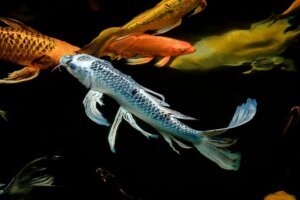
No. Butterfly koi—also called longfin koi—have elongated fins and a more flowing outline, which can make the body appear slender. That does not make them a dwarf form. They still require a purpose-built pond, robust filtration, oxygenation, and space to swim and grow.
Color names such as Kohaku, Sanke, Showa, Ogon, and Bekko describe patterns or lineage, not a dependable small-adult-size category. “Mini koi,” “small koi,” and “aquarium koi” are commonly sales descriptions for young fish rather than biological varieties.
Does a small pond keep koi small?
A cramped environment may suppress growth, but that is not a safe husbandry strategy. High stocking density increases the load of ammonia, suspended waste, pathogens, and oxygen demand. A 2024 review of koi cultivation found that increasing fish density reduces growth ratio, weight gain, and body length; that finding should not be interpreted as a method for producing healthy miniature pets.
Stunting can accompany chronic stress and poor water quality. Even if a koi remains shorter than expected, it can still develop a heavy body, produce substantial waste, and live for many years. The pond and filter must be designed for the eventual biomass—not merely the fish’s length on purchase day.
Can koi live in an aquarium?
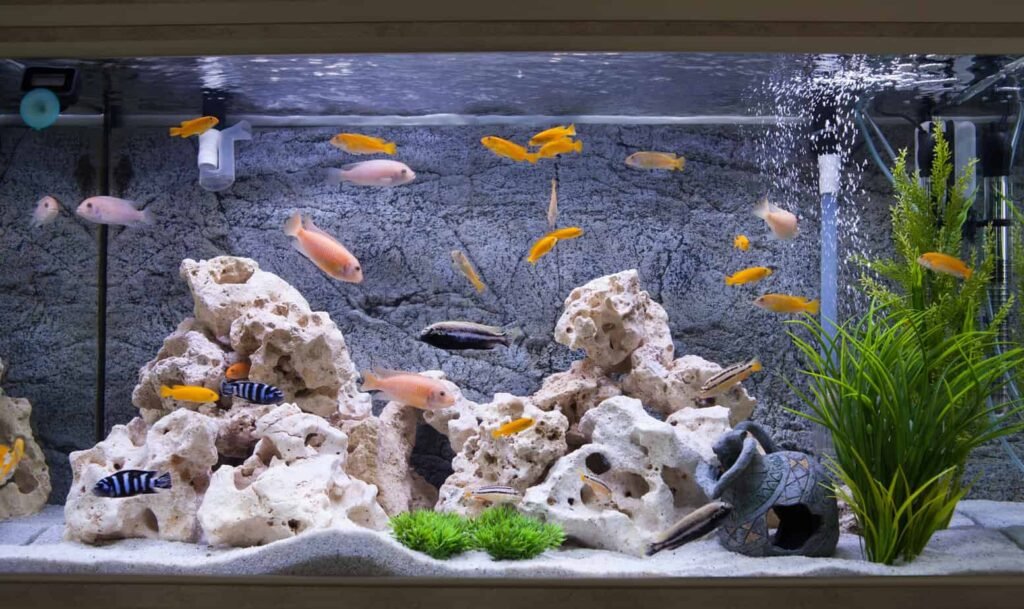
An aquarium can be useful temporarily for quarantine, medical observation, or raising very young koi when the keeper already has an appropriate pond ready. It is not a responsible permanent home for ordinary koi.
Koi need more than a nominal number of gallons. They need swimming length, depth, stable temperature, high dissolved oxygen, mechanical removal of solid waste, biological filtration, and enough reserve capacity for equipment or power problems. For more detail, see our guide to keeping koi in a fish tank.
How large should a koi pond be?
There is no universal gallon figure that makes every koi stocking plan safe. Climate, adult fish count, pond shape, filter capacity, water-change schedule, and winter conditions all matter. However, the old suggestion that 300 gallons is adequate for two koi is far too small for permanent care.
For a small group of koi, plan in the range of at least 1,000–1,500 gallons, with substantially more water preferred as the group grows. Many successful dedicated koi ponds hold several thousand gallons. A practical pond should also provide:
- Depth: commonly at least 3–4 feet, with climate-specific planning for winter heat and freezing.
- Large horizontal swimming area: avoid narrow tubs with little usable length.
- Bottom drainage or effective solid-waste removal: koi continually produce waste and disturb settled material.
- Mechanical and biological filtration: sized for the eventual number and size of the fish.
- Continuous aeration: especially in warm weather and around biological filters.
- Safe edges and predator protection: without sharp objects or inaccessible traps.
- Overflow and drainage planning: so heavy rain cannot release koi into natural waterways.
Koi Organisation International emphasizes that filtration must support the number and eventual size of the fish. A pond’s advertised volume alone does not establish its safe stocking capacity.
How many koi can a pond hold?
Simple rules such as “one koi per 250 gallons” can be misleading because two ponds with the same volume may have completely different filtration and maintenance capacity. Begin conservatively and allow room for every fish to reach adult size.
A lightly stocked 1,500-gallon pond with excellent filtration may support a few koi, but seven growing koi can become an excessive load as they mature. Monitor actual performance: ammonia and nitrite must remain at zero, dissolved oxygen must remain adequate, and nitrate and suspended solids must be controlled through filtration and water changes.
Do not treat persistent algae, odor, cloudy water, rising nitrate, gasping, or recurring disease as normal features of koi keeping. They are signs that stocking, equipment, feeding, or maintenance needs correction.
Water-quality priorities
Koi tolerate a range of temperatures, but rapid changes are stressful and warmer water holds less oxygen. Instead of chasing one “perfect” pH, prioritize stability and sufficient alkalinity to support biological filtration. Test at least:
- Ammonia
- Nitrite
- Nitrate
- pH
- KH (carbonate hardness)
- Temperature
Ammonia and nitrite should be undetectable in an established pond. New ponds and newly cleaned filters require particularly close monitoring. Feed lightly when biological filtration is immature or water quality is deteriorating.
Do koi need plants?
Plants can provide shade and absorb nutrients, but they are not a substitute for filtration. Koi may uproot or eat plants and stir the substrate while foraging. Protect plant baskets or use a separate planted bog filter if vegetation is part of the design.
Never release unwanted koi into a lake, stream, drain, or public pond. Penn State Extension notes that Japanese koi belong in ornamental ponds rather than wildlife ponds, and common carp are invasive in many regions. Rehome fish through a pond club, retailer, rescue, or experienced keeper.
Better fish for a small pond
If the pond is too small for adult koi, consider fish whose normal adult size and waste production are better suited to the space.
Shubunkins
Shubunkins are single-tailed goldfish with calico coloration. Their mix of blue, red, orange, black, and white can provide some of the visual appeal people seek from koi, while their adult size is usually more manageable. They still need filtration, oxygen, swimming room, and winter planning.
Comet and sarasa comet goldfish
Comets are active, long-bodied goldfish. Sarasa comets have red-and-white patterns that can resemble Kohaku koi at a glance. They are not tiny fish, but they are generally a more realistic option than koi for a modest ornamental pond.
Native or locally appropriate pond fish
Where regulations and pond goals allow, a locally appropriate species may be the better ecological choice. Verify local laws and never move fish between natural waterways.
Avoid delicate fancy goldfish in outdoor ponds with strong currents, fast competitors, or predators. Their body shapes and fins can make feeding and escape more difficult.
What to ask before buying juvenile koi
- What are the parent fish’s approximate adult sizes?
- Is the fish standard-fin or longfin?
- Has the stock been health screened or quarantined?
- What temperature and water chemistry is it currently kept in?
- Can your pond and filter support the fish at 24 inches or more?
- Do you have a quarantine plan and a long-term rehoming option?
Online live-fish listings are not necessary for an educational guide and can encourage impulse purchases. Buy only after the pond is cycled, measured, and ready.
Frequently asked questions
What koi stays under 12 inches?
No common koi variety can be guaranteed to stay under 12 inches as a healthy adult. A fish advertised at that size is normally young, slow-growing, or already affected by its conditions.
Are Japanese koi smaller than domestic koi?
No. “Japanese,” “domestic,” and named color varieties do not provide a dependable small-size guarantee. Individual genetics and husbandry vary, and many Japanese bloodlines are selected for substantial growth.
Can I keep one koi alone in a small pond?
Koi are social fish, and keeping one alone does not solve the space, waste, filtration, or long-term welfare problems of a small pond.
How fast will a juvenile koi outgrow its pond?
Growth varies with genetics, temperature, nutrition, and water quality, but juveniles can grow quickly during warm seasons. Read our detailed guide to how fast koi grow and plan before purchase.
Bottom line
The smallest responsible koi is not a particular variety—it is a juvenile that still needs an adult-sized plan. Do not rely on butterfly fins, a seller’s “mini koi” label, or restricted space to keep the fish small. Build a properly filtered pond for full-sized koi, or choose shubunkins or comet goldfish for a genuinely smaller setup.