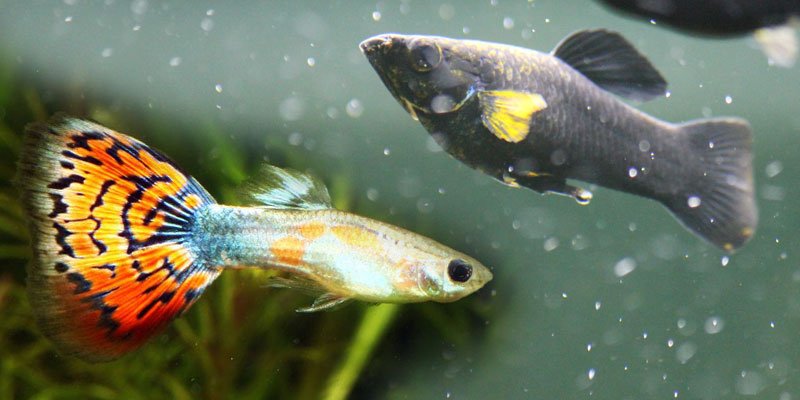
Molly fry need stable, cycled water, protection from adult fish, gentle filtration, and several small meals of appropriately sized food. Mollies are livebearers: the female releases free-swimming young rather than laying eggs in the aquarium, and the adults provide no parental care. Adults may eat fry that they can catch.
You can raise fry in a separate cycled nursery aquarium or allow some to remain in a densely planted, mature community tank. A separate nursery usually gives more control and higher survival, but only when it is already biologically established and closely monitored.

Do molly fry need a separate tank?
Not always, but separation improves the number that survive. Adult mollies and other community fish may eat newborns. Choose between these approaches before the female gives birth:
- Cycled nursery aquarium: offers the best control over feeding, water quality, and observation. It needs mature biological filtration—not newly filled water and a new filter.
- Planted main aquarium: floating plants, fine-leaved plants, moss, roots, and spawning mops provide refuge. Some fry will still be eaten.
- Breeder box or net: useful for short-term collection or observation, but cramped boxes can have poor circulation, collect waste, and stress the female. They are not a long-term grow-out system.
Avoid confining a heavily pregnant female in a tiny box for days. Stress can interfere with normal behavior and welfare. If using a nursery aquarium, move the fry after birth or give the female ample space and remove her promptly once birthing has finished.
Set up the nursery before the fry arrive
Use mature biological filtration
A sponge filter driven by an air pump is a practical choice because it provides biological filtration and gentle water movement without an exposed intake. An internal or hang-on-back filter can also work when its intake is securely covered with fine sponge and the current is not overwhelming.
Seed the nursery with established filter media from a healthy aquarium. Filling it with old tank water does not cycle it, because most nitrifying bacteria live on filter media and other surfaces rather than in the water column.
Match water conditions
Use conditioned water and match the birth tank’s temperature, pH, and hardness as closely as practical. Mollies generally prefer mineral-rich water, but different molly species, strains, and source populations vary. Stability is more important than chasing a single universal number.
Do not add aquarium salt routinely just because the fish is a molly. Some mollies tolerate brackish conditions, but salt is not required for every captive strain and can harm plants or tank mates. Use it only as part of a deliberate species-appropriate plan.
Provide safe cover
Dense live plants, floating roots, Java moss, and spawning mops give fry places to rest and forage. Secure every decoration and avoid gaps where tiny fish can become trapped. Leave open areas so you can observe feeding and remove debris.
Water quality for molly fry
Fry are vulnerable to rapid changes and poor water quality. Test frequently, particularly in a small nursery or after increasing food. Keep:
- ammonia at 0 ppm;
- nitrite at 0 ppm;
- nitrate controlled with partial water changes;
- temperature stable and appropriate for the parent strain;
- chlorine and chloramine at 0 through correct water conditioning.
Make small, regular water changes guided by testing and stocking density. Match replacement water carefully. Use a narrow siphon, airline tube, or intake guard and inspect the waste bucket so fry are not accidentally removed.
What to feed molly fry
Newborn mollies are free-swimming and can eat soon after birth. Offer food small enough to fit their mouths. Suitable options include finely crushed quality flake, a reputable powdered or micro-pellet fry food, and appropriately sized live or frozen foods from safe sources.
Because mollies are omnivorous grazers, include a balanced food with plant material rather than relying only on bloodworms or other rich animal foods. Newly hatched brine shrimp can provide useful variety but should not be the sole diet.
How often should fry eat?
Offer very small portions several times a day when practical. Each portion should be consumed quickly. Remove leftovers before they decay. Frequent feeding supports growth only when filtration and water changes keep pace with the extra waste.
Do not attempt to force faster growth through excessive food or high temperature. Steady growth in clean, stable water is safer than rapid growth accompanied by obesity or deteriorating water quality.
How many fry can a molly have?
Brood size varies with species, female size, age, condition, genetics, and environment. FishBase reports that Poecilia sphenops may produce about 20–150 young after roughly 28 days of gestation, while sailfin mollies have also been reported with broad brood ranges. These figures are context—not a prediction for an individual fish.
Female livebearers can store sperm and may produce later broods after separation from males. Plan space and rehoming before breeding; one pregnancy can quickly become many fish.
When can fry return to the main tank?
Do not use a fixed number of weeks. Move them only when they are too large for every tank mate to swallow, swim strongly, compete successfully for food, and tolerate the main aquarium’s flow. Size differences between fry mean they may not all be ready together.
Before moving them:
- confirm both aquariums have 0 ppm ammonia and nitrite;
- compare temperature, pH, and hardness;
- acclimate gradually if conditions differ;
- move fry with a cup or smooth container when possible rather than chasing them repeatedly with a net;
- watch feeding and aggression after release.
Sex separation and population control
Mollies can mature while still relatively small. Learn to distinguish the male’s gonopodium—the modified anal fin used in reproduction—from the fan-shaped anal fin of females. Separate sexes before young males can breed if you do not want another generation.
Do not release unwanted mollies into drains, ponds, streams, or other waterways. Mollies have established invasive populations outside their native range. Arrange responsible homes through experienced aquarists or local aquarium organizations.
Common problems
Fry disappear overnight
Check filter intakes, gaps behind equipment, and adult predation. Add dense cover or move survivors to a cycled nursery. Do not assume every expected embryo was born alive; brood sizes vary.
Fry gather at the surface
Test ammonia and nitrite immediately, check temperature, and improve gas exchange. Surface gathering can reflect low oxygen or gill stress, although mollies also naturally use the surface film. Behavior must be interpreted alongside test results.
Fry are thin or growing unevenly
Confirm that food reaches every fish, review food quality and particle size, reduce crowding, and check for bullying or disease. Separate much larger juveniles if they monopolize meals. Persistent wasting needs assessment by an aquatic veterinarian.
Fry have clamped fins or spots
Test water before adding medication. Temperature stress, ammonia, nitrite, parasites, and infection can produce overlapping signs. Avoid treating the entire nursery with multiple products without a diagnosis.
Do molly fry need special lighting?
No special high-intensity lamp is required for the fry themselves. Provide a consistent day-night cycle and enough light to observe them and grow any live plants. Allow a dark rest period and avoid 24-hour lighting, which can stress fish and encourage algae.
Frequently asked questions
Do mother mollies care for their fry?
No. Mollies do not provide parental care, and the mother may eat fry after giving birth.
Can molly fry stay in a breeder box?
Only temporarily. A box has limited space and can trap waste or restrict circulation. A cycled nursery aquarium provides better long-term grow-out conditions.
Can fry eat adult fish food?
Yes, when it is nutritionally suitable and crushed into particles they can swallow. A purpose-made fry food or micro-pellet may be easier to portion consistently.
Should I medicate fry preventively?
No. Good quarantine, clean water, appropriate food, and observation are safer than routine medication. Treat only a diagnosed or strongly suspected problem with a product suitable for the species and age.
Key takeaway
Successful molly-fry care depends less on special products than on preparation: a cycled nursery or dense cover, intake-safe filtration, stable water with zero ammonia and nitrite, tiny balanced meals, and a plan for growth and population control. Protect the fry without stressing the mother, and seek aquatic-veterinary help when abnormal behavior persists after husbandry is corrected.
This article provides general aquarium-care information and does not replace diagnosis or treatment by a qualified aquatic veterinarian.