
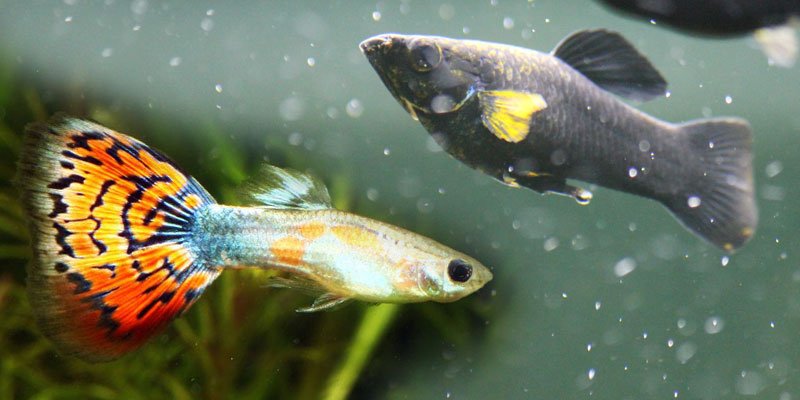
Guppy–molly hybrids have been reported in research, but they are not a predictable result of keeping guppies and mollies together. The molly species involved matters, and unusual-looking fry are not proof of a cross.
If you found babies in a mixed aquarium, the useful first step is to check the parents’ history and care for the fry. Do not assume that a molly fertilized a guppy simply because no male guppy is currently in the tank.
Can guppies and mollies crossbreed?
Guppies (Poecilia reticulata) and mollies belong to the genus Poecilia. That relationship does not mean every species or pairing can produce viable offspring. “Molly” also covers more than one species and many aquarium strains.
A 1996 study by Rodionova, Nikitin, and Borodin examined chromosomes in P. velifera × guppy hybrids and found extensive problems with chromosome pairing during sperm-cell development. The study’s research abstract provides evidence for that particular cross; it does not establish an easy home-breeding method.
By contrast, a 2017 experiment involving sailfin mollies, P. latipinna, and guppies reported no pregnancies or larvae in its cross-species treatments. One unsuccessful trial does not prove all crosses impossible, but it does undermine blanket promises that these fish readily hybridize.
The practical answer: do not buy a mixed group expecting a dependable hybrid breeding project. Reports about one molly species cannot automatically be applied to every fish sold as a molly.
What are “muppies” and “gollies”?
These are informal hobby names for claimed guppy–molly hybrids. They are not scientific species names, certified pedigrees, or reliable descriptions of which parent was the guppy. Sellers and hobbyists may use the terms differently.
Ask for the actual parent species and breeding records. A label, video title, body shape, or unusual color does not establish ancestry. Nor does a resemblance to both fish demonstrate that an offspring is fertile.
Why unexpected fry are often misidentified
Females can store sperm
Research on female sperm storage in guppies shows that stored sperm can remain relevant to reproduction for months. A female purchased from a mixed-sex tank may therefore produce young after moving into a tank with no male of her own species.
This makes “she has only lived with a male molly since I bought her” insufficient evidence of hybrid parentage. Separating an adult female for a few weeks does not establish that she had never mated.
Appearance is not a parentage test
Domestic strains vary, and juvenile proportions and colors change as fish grow. A short body, unusual tail, or mixed color pattern is not a diagnostic hybrid feature. A deformity should be assessed as a welfare concern, not promoted as evidence of a rare cross.
Convincing identification requires a documented breeding history that rules out earlier matings and accidental mixing. Where a firm conclusion matters, specialist genetic work may be needed. Most home aquarium observations can support only “parentage uncertain.”
Are all guppy–molly hybrids sterile?
Do not make an absolute claim about every alleged hybrid. The chromosome findings above indicate reproductive difficulties in a particular researched cross; they do not verify the ancestry, sex, lifespan, or fertility of an unidentified aquarium fish.
There is likewise no sound basis here for promising that all offspring will be male, that every fish will die young, or that hybrids will grow to a fixed size. Those claims require evidence about the exact cross and fish being discussed.
Can guppies and mollies live together?
They may share an appropriately planned aquarium, but peaceful behavior, adult size, and suitable water matter more than whether a cross is theoretically possible. A male chasing another species is not proof of successful breeding.
- Identify the molly. Larger sailfin types need more swimming space than small guppies. Choose tank size for the adults and the complete stocking plan, rather than using a fish-per-gallon rule.
- Check water requirements before combining them. Review your stock’s temperature and mineral needs with its breeder or supplier. Our guppy temperature guide explains temperature management; do not assume that one setting suits every molly strain and every tank mate.
- Watch individual behavior. Provide plants and broken sightlines. Separate fish if chasing prevents feeding or resting, or causes injury. Adding more fish to distract a persistent male can create another stocking problem.
- Plan for ordinary livebearer babies. Keep filtration mature and monitor water quality. Mixed-sex groups may produce more fish than the aquarium can accommodate, regardless of hybridization.
We do not recommend confining mismatched fish together or removing all same-species partners to force a cross. There is no dependable “one male plus two females” recipe for producing these hybrids.
What to do if you already have suspected hybrid fry
- Protect them without sacrificing water quality. Use a suitable established nursery if necessary, with a protected filter intake and gentle circulation.
- Feed for their size. Offer small amounts of suitable finely sized fry food and remove leftovers. Our molly fry care guide covers practical nursery care.
- Keep records. Record purchase dates, known adults, births, and photographs as the fish grow. Preserve uncertainty rather than guessing a pedigree.
- Rehome honestly. Describe them as fish of uncertain parentage unless the cross is established. Never release aquarium fish into local waterways.
Healthy housing and honest identification are more useful than a catchy hybrid name. If your main goal is learning to breed livebearers, start with a known species and a manageable plan for its offspring.