5 Best Aquarium Backgrounds: Styles and Installation

5 Best Aquarium Backgrounds: Styles and Installation

The best aquarium background is the one that fits your glass exactly, installs cleanly, and complements the fish and hardscape without becoming visual clutter. For most aquariums, a simple black, frosted, or natural printed background attached outside the rear glass is safer and easier to maintain than a bulky decoration placed inside the tank.

Disclosure: Aquarium Hunter may earn a commission from qualifying Amazon purchases, at no extra cost to you. Availability, sizes, and prices can change.

Quick Comparison

Background Style Best for Buy
Two-Sided River/Lake Laminated print Flexible natural scenes Check on Amazon
Driftwood/Plant Print Two-sided print Planted-tank look Check on Amazon
SPORN Tropical Static cling Removable installation Check on Amazon
Silver Rock Print Neutral stone scene Unobtrusive texture Check on Amazon
Underwater Forest Self-adhesive vinyl High-depth visual effect Check on Amazon

Measure the actual rear glass before ordering. Product names can cover several dimensions, so select by width and height—not by a seller’s gallon label.

How We Chose

A background is mainly a design product, so there is no meaningful laboratory winner. We compared attachment method, sizing flexibility, reversibility, glare, visual detail, maintenance, and whether the material stays outside the water. We excluded duplicate designs and did not use invented star ratings or temporary prices.

1. Two-Sided River and Lake Background — Best All-Round Print

Two-sided river and lake aquarium background print

This reversible laminated design gives two natural-looking options without requiring a second purchase. It works well when you want more detail than a solid color but still want a background that can be trimmed and taped outside the glass.

Pros: reversible, easy to trim, and simple to remove. Cons: tape can show if applied untidily, and any air gap can create reflections.

Check sizes on Amazon

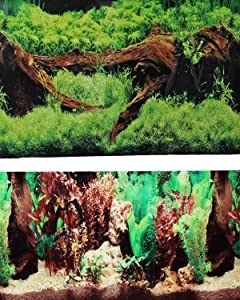
2. Driftwood and Plant Background — Best for a Planted Look

Driftwood and aquatic plant aquarium background

Deep greens and brown driftwood can visually extend a planted aquascape or add structure behind a lightly decorated tank. Because the print is busy, it works best when the foreground layout is simple enough to remain readable.

Pros: natural palette and useful depth. Cons: may compete with dense real plants or patterned fish.

Check sizes on Amazon

3. SPORN Tropical Static Cling — Best Removable Option

Tropical static-cling aquarium background

A static-cling background is useful if you rent, redesign tanks frequently, or want to avoid permanent adhesive. Careful wet application helps you position the sheet and push bubbles toward the edges.

Pros: removable and generally low-mess. Cons: installation shows bubbles and dust easily; thin film can tear if handled roughly.

Check sizes on Amazon

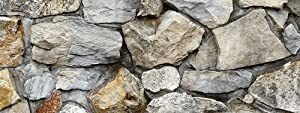
4. Silver Rock Background — Best Neutral Texture

Silver rock aquarium background print

A gray stone pattern adds texture without the strong blues and greens of many photographic backgrounds. It can suit freshwater, marine, and paludarium-style displays, provided it is installed outside the enclosure and kept dry.

Pros: restrained color and easy coordination. Cons: a low-resolution print may look artificial at close range.

Check sizes on Amazon

5. Underwater Forest Adhesive Background — Best Depth Effect

Underwater forest self-adhesive aquarium background

The receding forest scene creates a pronounced sense of depth. Self-adhesive vinyl can produce a close, low-glare finish, but installation needs patience because trapped dust or creases are difficult to correct after the adhesive sets.

Pros: strong depth illusion and clean finish when installed well. Cons: less reversible than tape or static cling.

Check sizes on Amazon

Printed, Static-Cling, Adhesive, or Painted?

Laminated printed sheets

These are inexpensive, easy to trim, and often reversible. Tape only the top and sides for quick removal, or use a purpose-made clear background gel for closer glass contact. Avoid household products that may damage the print, seals, stand, or nearby equipment.

Static-cling film

Static film is reusable and has no permanent glue. It needs very clean glass and careful smoothing. Follow the maker’s wet- or dry-application instructions because films differ.

Self-adhesive vinyl

Vinyl can look seamless but is the least forgiving. Measure twice, clean thoroughly, align an edge, and apply gradually with a soft squeegee. Never install an exterior-only adhesive sheet inside the water.

Solid paint or removable board

Matte black or dark blue paint on the outside rear panel reduces visual clutter, but it is a commitment. A cut sheet of black foam board or plastic is reversible and often gives a similarly calm result.

How to Measure Correctly

  1. Measure only the visible rear glass, not the advertised tank volume.
  2. Record width and height in the same units used by the listing.
  3. Allow a small trimming margin.
  4. Check for braces, filter pipes, cords, and overflow boxes.
  5. If joining sheets, place the seam behind hardscape or plants where possible.

Installation Guide

  1. Move electrical plugs away from the work area and create drip loops.
  2. Clean the outside rear glass and remove dust, grease, and mineral deposits.
  3. Hold the uncut background in place and mark the final size.
  4. Cut with a straightedge on a protected surface—not against the aquarium.
  5. Apply it using the exact product instructions.
  6. Push bubbles outward gently and wipe away moisture.
  7. Check that tape or film does not obstruct ventilation or equipment.

Do not use blades against a filled aquarium or near silicone seams. Do not spray cleaners where mist can enter the water.

Does a Background Help Fish?

An opaque rear background can reduce visual distraction and reflections from behind the tank, and it hides cords and filters. It does not replace plants, caves, shade, or species-appropriate cover. Fish responses vary, so watch for persistent glass surfing, hiding, faded color, or aggression after a design change.

Highly reflective films can worsen reflection-related behavior. If a betta or territorial fish reacts to the glass, try a matte exterior background, adjust room and tank lighting, and add appropriate cover. A photograph of habitat is decoration for the viewer; it is not functional habitat for the animal.

Frequently Asked Questions

Should an aquarium background go inside or outside?

Most printed, cling, and adhesive products belong outside the rear glass unless the manufacturer explicitly certifies them for permanent underwater use. Exterior mounting is easier to clean and avoids introducing unknown materials.

Is black the best aquarium background color?

Black is popular because it hides equipment and lets fish and plants stand out, but it is not universally best. Dark blue, frosted, and natural prints can also work. Choose a matte finish and observe the animals’ behavior.

Can I use ordinary window film?

Only if it is suitable for the glass, heat, humidity, and installation method. Never allow adhesives, sprays, or films of unknown composition to contact aquarium water.

How do I remove bubbles?

Follow the film instructions. For products designed for wet application, use the recommended liquid and work from the center outward with a soft card or squeegee. Do not puncture bubbles next to aquarium glass.

Verdict

The two-sided river and lake print is the most flexible all-round choice. Pick the static-cling option if reversibility matters, the rock print for a calmer texture, or the underwater forest for a dramatic depth effect. Accurate measurement and careful installation matter more than the image name.

Continue with our guides to aquascaping plants, aquarium gravel, and artificial aquarium plants.

Latest Top 15 Best Fish Tanks in 2022[Buying Guide]

Latest Top 15 Best Fish Tanks in 2022[Buying Guide]

Fish tanks play an important role, providing a safe place to live your pet. If you love your fish, of course you want them to always have a comfortable environment.

This requires choosing the best possible aquariums with impressive features that will make your plan a success.

Comparison Table

Choosing the best fish tank will make the whole experience boring and will easily kill the fish because they will not receive proper care.

Many manufacturers try to include many different features to help you get the best aquarium for betta, for goldfish, for beginners …

It can be confusing if everyone tends to have the same characteristics. Avoid all the hassle and see the benefits of these high-end aquariums and tips for choosing the right aquarium below.

If you want to become a fish owner or if you have or will receive a turtle or other animal that can live in a glass aquarium, you may be looking for an aquarium. Fish tanks are available in a variety of sizes and shapes: there are small starter kits for those who have a betta fish or some goldfish, large aquariums that can hold 100 or more liters of water and all the rest.

We have analyzed dozens of aquariums of various sizes to help you find the best size you need. We analyzed the quality of the tanks, the extras that came with it and what critics had to say about it. We narrowed it down to the best fish aquariums of all size categories. If you are purchasing a variety of supplies for your new fish, we also recommend that you take a look at our lists of the best aquarium lights and best aquarium pumps.


The 15 Best Fish Tanks on the Market


Advantages of having a Best fish Tanks at home

Whenever you enter a room with an aquarium, you always feel at home. Aquariums are not only created to house pets, but also to add more style and decorations to a room.

It is not necessary to go to a large aquarium, a small one with an impressive design will still provide a nice decoration.

You can put it on your desk or at home and watch the fish tank when you feel bored or need that perfect relaxation. Below are other benefits of having an aquarium indoors.

Help reduce stress

If you didn’t know it, now you know it. This is considered to be one of the most surprising advantages of owning an aquarium.

Whenever you feel stressed, just look at your beautiful aquarium and your mind will be on a different journey. There have been some studies, covered here, in support of the theory that exceptional relaxation is achieved by observing an aquarium.


It can calm children

Several studies show that hyperactive children tend to calm down around an aquarium. It is important that young children calm down to sleep soundly.

Maybe that day earlier, the boy was exposed to a shocking event, or something else that stressed them out, but watching the fish move in the tank could help him calm down again.

Aquariums are generally fun for children, although they may find fish life in the water and other types of nature too curious.


Increased labor productivity

An aquarium can provide excellent health benefits when working in a stressful work environment. Having an aquarium in the office will help lower blood pressure through stress reduction.

In addition to reducing stress levels, it will also help you focus better on your work. With this advantage, you should be able to get more done in any work environment.


It can be useful for Alzheimer’s patients

People with Alzheimer’s disease tend to have difficulty eating and taking medications, among other things.

Some studies show that if these people are given an aquarium or any other small aquarium in their environment, they tend to be calmer, eat more, and also require less supplements than normal.

For best efficacy in such patients, it is best to put the fish tank in the dining room. They will also show less aggressive behavior.


Sleep better with the tank by your side

We now have fish tanks that have amazing LED aquarium lights which can be of great help for sleeping. This has led some people to place aquariums in their rooms.

If you watch the fish in the aquarium under the extraordinary LED lighting, you should be able to sleep soundly without worry or insomnia. Basically, it provides a hypnotic effect on a person for a perfect night’s sleep.


Best Fish Tanks Review


1. MarineLand Portrait Glass LED Aquarium Kit

Setting the daylight and moonlight using LED lights is something different that not many manufacturers have tried to do before. Today it is common to find aquariums with LED lights, but it is the way they are used that makes some models stand out.

Some manufacturers go out of their way to make your aquarium instead of someone else’s. In this case, white LEDs are used to create an intense light on the water, while blue LEDs are used to provide a relaxed moonlight light.

Setting up this product should only take a few minutes. The manufacturer documents all the necessary steps to follow to easily assemble the product. To facilitate access to the tank, the manufacturer also includes a hinged glass cover that can slide sideways for access.

Check Price On Amazon

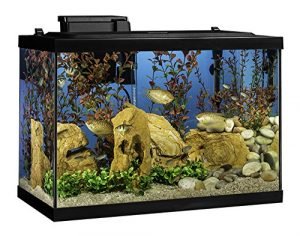
2. Best 20-Gallon Fish Tank: Aqueon LED Aquarium Kit


The best 20 gallon aquarium we have found is the Aqueon LED Aquarium Kit. This is a glass aquarium that comes with a variety of equipment needed for your fish. It has a low profile hood with LED lighting, a silent filter with an LED indicator to let you know when it’s time to change the cartridge and a heater and thermometer that make it a good choice for tropical fish.

It also includes a fish net, fish feed and water conditioner. These will get you started if you don’t know fish. It also includes a guide to help you navigate your new habitat setup for the first time. The aquarium itself is made of glass and measures 20-1 / 4 ″ x 10-1 / 2 ″ x 12-9 / 16 ″.

Check Price On Amazon

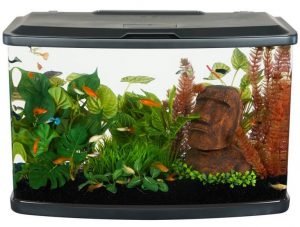
3. FLUVAL VISTA

This aquarium kit comes with almost everything you need to create a healthy environment for your fish.

Includes a filter hanging on the back, a heater, a hinged hood with a hinged power port and LED lighting on a timer.

One of the reasons this aquarium caught my attention is the resulting Aqua Clear 30 filter. This is an excellent silent filter.

In addition to being silent, it includes three filter configurations, including a biological biological filter, in which the filter captures bacteria from your aquarium and makes it good for your aquarium.

The general lighting of the Fluval Vista aquarium kit is also amazing. It is not too bright and shows your aquarium well.

It’s also on a timer, ensuring it doesn’t provide too much lighting to your aquarium (you can also help by adding some floating plants).

While the lighting is fantastic, it’s close to the water, just for what you know. This can cause condensation and will eventually ruin the lights, so if there is something to budget for, it will after a while be new lighting.

A heater is also included in the kit. It is an adjustable heater, which gives you control of the temperature in your aquarium.

What made me choose this kit as the best aquarium is the robust and practical design.

The glass is thick and curved. A plastic bottom ensures that your aquarium stays flat. This is a great option if you are looking for good aquariums.

You can also save a lot of time thanks to the design. There is a hinged lid and a hinged feeding area. Make feeding your fish and tank cleaning super easy.

The design does not include hidden cracks that are difficult to clean. It is an excellent configuration and easy to maintain.

Check Price On Amazon

4. Best 30-Gallon Fish Tank: SeaClear Acrylic Aquarium Combo Set


The Sea Clear combination aquarium set is our best choice for 30 gallon aquariums. This combo set includes the aquarium itself, a reflector and a 24 “lamp. It is safe for both freshwater and saltwater fish and comes with a comprehensive warranty.

An acrylic aquarium is lighter than glass. It is also lighter and much more impact resistant. Customers say it doesn’t deform at all when water is poured into it. Also, note that the lamp does not include a light bulb; You will need to purchase one separately. If you are heating your aquarium, the temperature could be kept more constant in an acrylic tank than in a glass tank. In addition, it has a modern look that will complement any decor.

Check Price On Amazon

5. TETRA COMPLETE KIT


I would like to start by saying that Tetra has been around for a long time. They are known for making resistant and convenient aquarium kits.

They also don’t skimp on the products they include in the aquarium kits.

If you are looking for an aquarium that allows you to move relative to a nano aquarium, then a 20 gallon aquarium is a good place to start.

It’s a great option for a school of small fish. You could also use it as a tank for a betta and add a great decoration for the aquarium (although it may be too large for a little betta).

The reason why I chose it as the best 20-gallon tank for beginners is because it comes with everything you need. Tetra offers you some fantastic products in this kit.

Check Price On Amazon

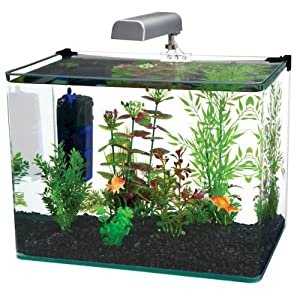
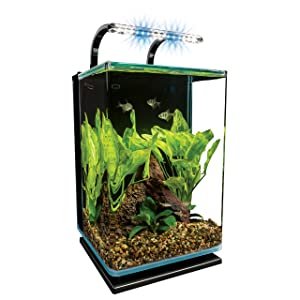
6. Marineland Contour Glass Aquarium Kit with Rail Light

This Marineland kit is another designed to be the perfect home for your fish, while maintaining an elegant and elegant appearance to be a centerpiece in your living room or office.

Too often, aquariums are childish or boring. This aquarium really changes your perception of how beautiful an aquarium can be.

A really interesting feature of this aquarium is the lighting. The lighting arm is arched and includes blue and white LED lights. This allows you to create wonderful day and night light effects that give your tank a glow over the ocean. The glass is curved, so there are no wrinkles or angles to interrupt the view.

The filter is hidden behind the black rear wall so as not to hinder the landscape or the fish and not obstruct the view at all. It provides three-stage filtration with a cartridge insert that performs mechanical and chemical filtration and a foam sponge that serves as a home for all the good bacteria the aquarium needs to maintain itself.

The system is easy to access and maintain and the hidden area offers space for a heater. You also have flow control so you can give your bettas the calm waters they prefer.

Check Price On Amazon

7. Best 100-Gallon Fish Tank: JAJALE Aquarium Fish Tank

If you are looking for a 100-gallon aquarium with its own holder, you should consider the JAJALE aquarium fish tank. It is made of high-strength glass and reinforced with an aluminum frame. The aquarium and frame are resistant to corrosion and erosion of salt water, making this product the ideal choice for a salt water tank.

The filter for this aquarium can be placed under the attached cupboard, giving your aquarium an aerodynamic appearance. You will purchase the filter separately depending on whether you need a salt or fresh water filter, but it comes with the filter media. It also comes with LED lighting and a water pump. It is also scratch-resistant and the reinforced glass is four times stronger than normal glass, which is necessary for such a large fish tank.

Check Price On Amazon

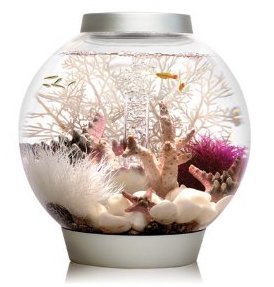
8. BIORB CLASSIC

El BiOrb Classic 15 Aquarium is one of the best acuarios for the best parts.

This is an acronym for 5 galones that comes with many extras for the first time, including a 5 etapas filter system. No expert menos de biOrb.

Establish the first part of my message list, based on an excellent choice for the first part of another.

On apariencia redonda en realidad me recuerda a los juegos justos. Ya sabes, aquel en el que arrojas una pelota en una pecera y ganas un pez dorado. However, with todos los elementos imprescindibles para su pecera.

No suggestions on El Pez Dorado Justo en un tanque tan pequeño. Algunos de ellos pueden crecer bastante grandes. La También produces a large choir of desecos, and in fact makes it a pequeña sheep. No sería la mejor pecera para un pez dorado.

Check Price On Amazon

9. Marina LED Aquarium Kit

This Marina kit is available in 5, 10 and 20 gallon sizes so you can find one that fits your desk perfectly or looks large enough to be a focal point in your home.

It has a simple rectangular shape accentuated by a neon bulb that emits the right amount of light to show your fish without disturbing them.

As far as filtration is concerned, a clip filter is included which is intended to be attached to the back of the aquarium. These filters have adjustable flow rates so you can adapt the environment to your fish. These filters are really cool for maintenance because they have four different slots for filter media.

This means that it is possible to exchange and clean them without disturbing all the colonies of good bacteria that have grown and are essential for the correct balance of the tank.

Fish cannot survive in tap water due to chemicals and bacteria, but with the conditioner and supplement included in this kit, you can treat tap water to be closer to your fish’s natural environment.

Overall, this is a simple and versatile tank that fits perfectly on someone’s first aquarium.

Check Price On Amazon

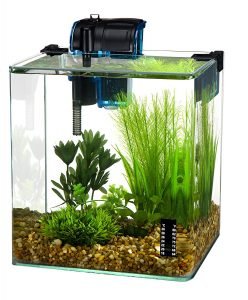
10. PENN PLAX VERTEX

The construction of this desktop fish tank is durable and also looks good. It has a frameless curved corner glass design, which gives you the best view of the aquarium interior. It is made of thick and thick glass. “

Penn Plax includes an adjustable water filter to hang with this aquarium kit.

Although it is an adjustable filter, the current may be too strong for some fish. You can easily solve that problem: just put a piece of sponge near the flow. This will help reduce the current coming from the filter downwards.

Unfortunately, with this kit you won’t get LED lighting or a filter. That’s why I chose it as the best nano aquarium on a budget.

With a lower price, you will have leeway for essential items not included.

Check Price On Amazon

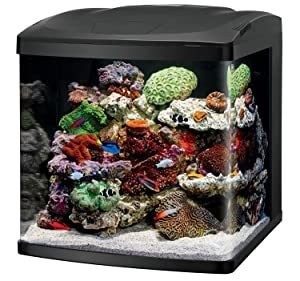
11. Coralife LED Biocube Aquarium

Best Fish Tanks

The Coralife Fish Tank LED BioCube Starter Kit for aquariums is designed with an elegant appearance and clean lines and has several advanced features that allow you to create an atmosphere reminiscent of a mini coral reef. This kit includes everything you need: a light filter, a filter pump, LED lighting and more.

This tank has a top hinged design which keeps the tank elegant and all cables and pipes hidden. There is a 24-hour timer on the top of the lid that allows you to set an automatic daylight / night light sequence, alternating between white, sun-like LED lighting and blue lights to resemble moonlight. Not only that, it actually has an automatic sunset and sunrise cycle to mimic natural light patterns.

You’ll also have a temperature control feature to make sure that the water stays at the right temperature for your fish and corals to thrive. It even has cooling fans to counter the heat generated by the filter and LED lights.

The filter system has three rear chambers: one for the growth of bacteria and algae, one for a heater and a bag of phosphorus filter material, and one for the pump.

Check Price On Amazon

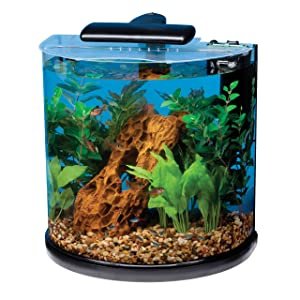
12. Tetra 29234 Half Moon Aquarium Kit

Best Fish Tanks

For a uniquely shaped aquarium and an unobstructed view of your fish and their surroundings, the Half Moon Tetra 29234 aquarium kit is a great choice. It is a seamless semicircle, without corners, created by one of the most reliable brands in the pet supplies sector.

This aquarium uses Tetra whisper filtration. It is silent and does not have a powerful current, which makes it ideal for bettas who prefer water that does not have many currents.

Tetra Whisper filtration uses three-stage filtration. The Bio-Bag is made with a double-sided mesh that filters large pieces of debris and debris with one side, while the other side contains activated carbon to remove odors and impurities. Bio-Scrubber provides biological filtration which is so important for maintaining a healthy environment.

It has an anti-clogging design which results in less maintenance. The back of the Bio-Scrubber is solid, running water over the bristles to keep colonies of bacteria healthy.

The submersible filter is filled with sand and the heater keeps the tank in a narrow range from 74 to 78 degrees, an ideal temperature for tropical fish. Also, you don’t have to worry about the heater getting in the way, as it fits the filter housing and keeps the aesthetics of the tank intact.

There are hook LED lights on the back and top of the tank which create a pleasant glow and provide an ideal environment for any plant life you grow. The height of this tank also makes it a good choice for live plants as they have more than enough room to grow.

Check Price On Amazon

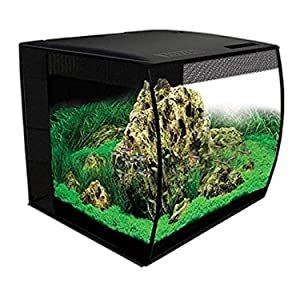
13. Hagen HG Fluval Flex Aquarium

Best Fish Tanks

If you are looking for an aquarium that does it all, Fluval Flex is the one for you. It is a 15 gallon freshwater tank that incorporates multi-stage filtration and brilliant lighting. In addition, it has a contemporary design and a variety of features that you will love.

Its aquatic atmosphere will stand out because there are 6 RGB and 48 adjustable white LEDs. There is also a 7,500 K LED lamp, which can promote plant growth.

With the flexible panel remote control, you can easily change the color combinations to suit your needs or wishes of the day. Of course, this is a glass tank, so the infrared sensor will pass through and hit the eye without problems.

There is a three stage filtration system to help you get the best water quality. Filtration options include biological, chemical and mechanical options. You also have the option to control the flow of water with two multidirectional outlets.

While the appearance may not be important to you, this aquarium uses a curved facade. Therefore, you have the illusion of a wider aquatic environment. It also becomes the focal point of any room.

Check Price On Amazon

14. Fluval Edge Aquarium with LED Light

Best Fish Tanks

This aquarium is inspired by the architectural style to create something that stands out from its competitors. Thanks to the exceptional design, you can expect the visual effect to capture your attention and emotion the moment you look at it.

The wiring to the LED light is well hidden to ensure a complete view of the fish tank. The compact design makes this product extremely versatile for various applications. You can use the product in different environments, such as the desk or simply at home.

This aquarium is designed to complement many modern decorations. The product is available in three elegant colors: silver, white and black. You can choose a small 6 gallon aquarium or a large 20 gallon aquarium if you have more space available.

Check Price On Amazon

15. Penn Plax Curved Corner Glass Aquarium Kit

Best Fish Tanks


The curved glass design of the Penn Plax Curn Corner aquarium kit for corner glass provides an unobstructed view while maintaining a rather traditional square shape.

The lid is a simple acrylic sheet that is hinged together. This maintains the clear appearance of the tank because there is no distracting cover that does not adapt to the aesthetics. It’s a really simple design that looks uniform and uncluttered.

The included waterfall filter is easy to use and very effective. It comes with floss pads to filter large debris and particles and a carbon bag to remove impurities and odors. For biological filtration, a thick sponge provides an ideal surface for essential bacterial growth.

The filter consists of a series of trays so you can add additional supports if desired. Flow can be controlled by rotating the inlet and outlet nozzles and the jet nozzle and spray bar. This is great for bettas because they don’t like rough water.

The light isn’t very bright and doesn’t have a power switch, so you need to turn it off to turn it off. This may not be a great feature for other types of fish, but if you use this aquarium for bettas it produces the perfect amount of light.

Check Price On Amazon

5 Best Refugium Lights for Healthy Macroalgae Growth

5 Best Refugium Lights for Healthy Macroalgae Growth

Disclosure: Aquarium Hunter may earn a commission from qualifying Amazon purchases made through links on this page, at no extra cost to you.

A refugium light has one main job: grow macroalgae reliably in a small, humid space. The best choice depends less on headline wattage than on the refugium footprint, mounting distance, spectrum, heat management, and how much control you want.

For most dedicated refugiums, the Kessil H160 Tuna Flora is our top premium choice because its spectrum and controls are designed for plant and algae growth. Smaller chambers can often use a compact rear-mounted light such as the Innovative Marine ChaetoMax, while budget clamp lights can suit simple setups when carefully positioned.

Quick comparison

Refugium light Best for Mounting style
Kessil H160 Tuna Flora Best overall / larger refugiums Overhead; mount sold separately
Innovative Marine ChaetoMax All-in-one rear chambers External bracket or hook-and-loop mounting
JBJ Nano Glo Compact refugiums Magnetic external mounting
NICREW Clip-On Budget clamp-light setups Adjustable clamp
Lominie LED Flexible positioning and dimming Gooseneck clamp

Best refugium light reviews

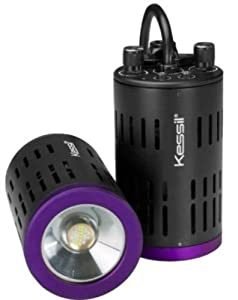
1. Kessil H160 Tuna Flora — Best overall

Kessil H160 Tuna Flora refugium grow light

The H160 is a purpose-built horticultural fixture with four tunable spectrum positions—Blue, Grow, Bloom, and Red. Kessil states that its output spans wavelengths from 380 to 780 nm and includes UV-A and far-red chips. That makes it a strong option for aquarists who want more control than a basic white or red grow lamp provides.

Its concentrated output is most useful over a medium or larger refugium where you can adjust mounting height. Start conservatively: intense light placed too close can pale or bleach macroalgae. A suitable gooseneck or hanging mount and a timer should be included in your budget.

Pros: dedicated grow spectrum; adjustable intensity and spectrum; strong, compact output.
Cons: premium price; mounting hardware may be separate; can be excessive for a tiny chamber.

Check price on Amazon   View manufacturer specifications


2. Innovative Marine ChaetoMax — Best for all-in-one rear chambers

Innovative Marine ChaetoMax refugium LED light

The ChaetoMax is designed for compact refugium compartments, particularly the rear chambers found in all-in-one aquariums. Its slim shape lets the light sit outside the chamber rather than taking up valuable water volume. This design also keeps the electrical fixture out of the water.

It is a practical match for a shallow, narrow chamber holding chaetomorpha. Measure the illuminated window before buying: a small panel will not spread light evenly across a broad sump refugium.

Pros: slim profile; purpose-built for compact macroalgae chambers; simple external positioning.
Cons: limited coverage; chamber compatibility must be checked carefully.

Check price on Amazon


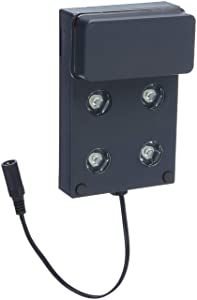
3. JBJ Nano Glo — Best magnetic compact light

JBJ Nano Glo LED refugium light

The JBJ Nano Glo is another space-saving option for a small refugium. Its magnetic mounting system allows the lamp to sit against the outside of a clear chamber wall, keeping the wet side uncluttered. The compact four-LED format is intended for a small target area rather than a full-size sump.

Confirm that the chamber wall and surrounding clearance suit the magnetic mount. Clean salt creep from the outside surface regularly because deposits can reduce usable light and trap moisture around equipment.

Pros: compact; tidy magnetic mounting; little obstruction inside the chamber.
Cons: small coverage area; less adjustable than an overhead fixture.

Check price on Amazon


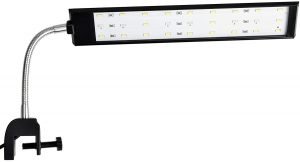
4. NICREW Clip-On LED — Best budget clamp option

NICREW clip-on LED aquarium light

This adjustable clip-on light can be useful when a simple bracket fits the sump rim and the refugium needs modest coverage. The flexible arm makes it easier to aim the beam than a fixed rear-chamber panel.

Because this is a general aquarium light rather than the most specialized macroalgae fixture in this list, results depend heavily on distance, photoperiod, and the size of the algae bed. It is best for a modest budget setup, not as a guaranteed substitute for a high-output horticultural light.

Pros: affordable; flexible positioning; easy to remove for maintenance.
Cons: general-purpose spectrum; clamp compatibility varies; lower output than premium options.

Check price on Amazon


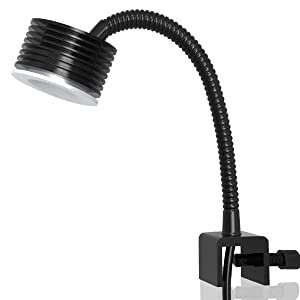
5. Lominie LED Aquarium Light — Best for flexible positioning

Lominie gooseneck LED aquarium light

The Lominie’s gooseneck and dimming control make it easier to adjust intensity and beam position over an open refugium. This is valuable when you are acclimating a new ball of chaetomorpha or trying to avoid spilling bright light into the cabinet.

Check the exact model and spectrum on the listing before ordering, as Lominie sells several visually similar aquarium lights. Choose a plant-oriented spectrum for macroalgae rather than a coral-blue model.

Pros: adjustable arm; dimmable; compact form.
Cons: model variants can be confusing; clamp needs a secure, dry mounting point.

Check price on Amazon

How to choose a refugium light

Match the light to the footprint

Measure the actual algae-growing area, not the total sump volume. A small chamber needs focused, modest output; a broad algae bed benefits from wider, more even coverage. Also check clearance for the fixture, mount, cables, and access during maintenance.

Use a plant-friendly spectrum

Macroalgae use photosynthetically active radiation, but spectrum and intensity both matter. Purpose-built refugium lights usually emphasize red and blue wavelengths. A balanced grow spectrum is generally more useful than decorative moonlight alone.

Control intensity and photoperiod

More light is not automatically better. Begin with a moderate schedule—often around 8 to 12 hours—and adjust according to growth, colour, nutrient readings, and temperature. Many reef keepers run the refugium on a reverse schedule, lighting it while the display lights are off. This can help moderate overnight pH movement, but it will not guarantee stable pH.

Remember that light is only one input

Chaetomorpha also needs suitable water movement and available nutrients. If nitrate or phosphate becomes extremely limited, adding light may not improve growth. Harvest algae regularly so the centre does not become shaded or collect detritus.

Prioritize electrical safety

Use a drip loop, keep plugs and controllers away from splash and salt creep, and connect aquarium equipment to a GFCI/RCD-protected outlet. Never submerge a fixture unless the manufacturer explicitly identifies that exact model for submerged use.

Frequently asked questions

Does a refugium need its own light?

Yes, if you expect it to grow macroalgae or plants. Light from the display tank is rarely positioned or strong enough to illuminate a separate sump chamber effectively.

Should a refugium light run 24 hours?

Continuous lighting is usually unnecessary and may stress some macroalgae. A daily dark period is a sensible starting point. Monitor the algae and the aquarium’s nutrient and pH trends, then adjust gradually.

Can a refugium replace other filtration?

No. A healthy refugium can export nutrients when algae is harvested, but it does not replace appropriate mechanical filtration, biological filtration, water changes, testing, or good feeding practices.

Final verdict

The Kessil H160 Tuna Flora is the strongest all-round choice here for aquarists who want a dedicated, controllable grow light. For a compact all-in-one aquarium, the Innovative Marine ChaetoMax is easier to fit, while the JBJ Nano Glo offers a tidy magnetic alternative. Whichever light you choose, match it to the chamber dimensions and adjust the schedule based on actual algae growth rather than leaving it at maximum power.

7 Best Floating Aquarium Plants for Beginners

Floating aquarium plants can soften bright light, create cover for fish and fry, and take up dissolved nutrients—but they grow quickly and are not legal to own or transport everywhere. The best beginner choices are Amazon frogbit, red root floater, common duckweed, water spangles, dwarf water lettuce, Azolla, and hornwort used as a free-floating submerged plant.

Always confirm the scientific name and your local biosecurity rules before buying. Never release aquarium plants, fragments, or water into drains, ponds, streams, or wetlands. Compost or seal unwanted plants according to local guidance.

Quick Comparison

Plant Growth Best feature Main caution
Amazon frogbit Moderate to fast Long hanging roots Dislikes wet leaf tops and strong flow
Red root floater Moderate Red color under suitable conditions Needs stable light and nutrients
Common duckweed Very fast Tiny leaves suit small tanks Difficult to remove completely
Water spangles Fast Textured paired leaves May be regulated; verify species
Dwarf water lettuce Fast Large rosettes and roots Often unsuitable for small covered tanks
Azolla Fast Fine fern-like surface mat Some species are prohibited
Hornwort Fast Submerged cover without planting Can shed brittle leaves

Before Adding Any Floating Plant

  • Check legality: restrictions vary by country, state, and even species within a genus.
  • Quarantine: inspect for snails, eggs, algae, duckweed hitchhikers, pesticides, and decay.
  • Protect equipment: use a floating ring or corral to keep plants away from filter intakes and feeding areas.
  • Leave open surface: do not allow a solid mat to block gas exchange, feeding, or access for labyrinth fish.
  • Match light and flow: floating leaves often scorch close to strong lights and are damaged by splashing.

1. Amazon Frogbit (Limnobium laevigatum)

Amazon frogbit floating at the aquarium surface

Amazon frogbit forms round floating leaves and long branching roots that offer attractive cover. It is easier to handle than duckweed because each rosette is larger, but healthy plants can still multiply quickly.

Keep the upper leaf surfaces mostly dry, provide gentle circulation, and thin crowded plants before they overlap heavily. Long roots may need occasional trimming with clean scissors if they obstruct the tank, but never remove every root from a rosette.

2. Red Root Floater (Phyllanthus fluitans)

Red root floater leaves and roots in an aquarium

Red root floater can develop reddish leaves and roots when light, nutrition, and other conditions suit it. Color is not guaranteed, and pushing light intensity merely to force red growth can overheat or unbalance a tank.

This plant prefers calm water and consistent access to nutrients. Pale new growth may indicate a nutrient or lighting problem, but diagnose the whole aquarium before adding fertilizer. Excess fertilizer can harm livestock and encourage algae.

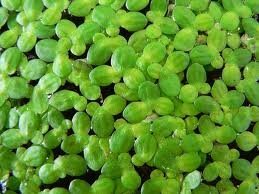
3. Common Duckweed (Lemna minor and Related Species)

Small duckweed fronds covering part of an aquarium surface

Duckweed is tiny, adaptable, and extremely quick to spread. It can provide shade and nutrient uptake, but it enters filter compartments, sticks to tools, and is notoriously difficult to eradicate. Choose it only if you are comfortable removing handfuls regularly.

Keep a clear feeding opening and rinse equipment over a container—not a sink. Never flush excess duckweed or discard it outdoors.

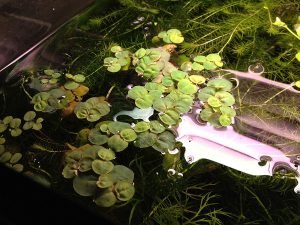
4. Water Spangles (Salvinia minima)

Water spangles Salvinia minima floating plant

Water spangles have paired, textured floating leaves and a submerged leaf that resembles roots. They make an attractive surface mat and usually tolerate a range of aquarium conditions when the surface is calm.

Correct identification is essential. The Salvinia genus includes highly invasive and regulated species, and plants can be mislabeled or mixed in trade. Do not order or transport any Salvinia until local authorities confirm it is permitted.

5. Dwarf Water Lettuce (Pistia stratiotes)

Dwarf water lettuce forms velvety rosettes with long roots. Despite the trade name, it is the same species as larger water lettuce and size depends strongly on conditions. It can outgrow small tanks and may struggle when condensation repeatedly wets the leaves under a close-fitting lid.

Pistia stratiotes is invasive or prohibited in various regions. Buy only from a legal local source, keep it fully contained, and dispose of trimmings securely.

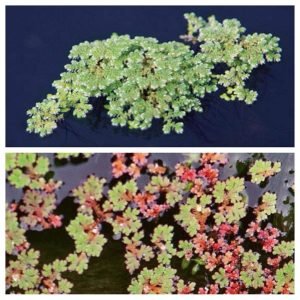
6. Azolla or Mosquito Fern (Azolla Species)

Azolla mosquito fern forming a floating surface mat

Azolla is a tiny floating fern that can shift from green toward red or bronze in response to conditions. Its delicate branching mats provide shade but break into small pieces during maintenance and spread rapidly.

Confirm the exact species. Some Azolla species are regulated weeds, and common names are unreliable. Treat every fragment as live material when disposing of it.

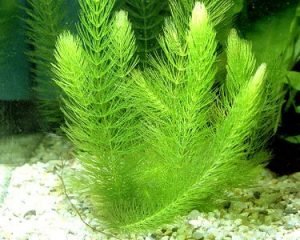
7. Hornwort (Ceratophyllum demersum)

Hornwort stems growing free-floating below the water surface

Hornwort is different from the surface plants above: its stems float below the water rather than carrying leaves in air. It provides dense submerged cover without substrate and can be useful for fry or shrimp tanks.

Growth can be fast, and stressed stems may shed needle-like leaves that collect around filters and décor. Thin it from the base of the mass so the remaining stems receive light and flow. Check local rules because it can behave invasively outside its native range.

Plants Commonly Misclassified as Floaters

Java moss, water wisteria, and Cabomba can survive unattached or drift temporarily, but they are not true free-floating surface plants. Java moss normally performs better attached to wood or rock. Water wisteria and Cabomba are stem plants that usually grow more predictably when planted or deliberately anchored. Calling every unplanted stem a floating plant makes care advice confusing.

How to Quarantine New Plants

  1. Confirm the scientific name and legal status before purchase.
  2. Place new plants in a separate, fish-free container with suitable light and temperature.
  3. Inspect leaves and roots for snails, eggs, insects, algae, and damage.
  4. Remove packing material and rinse with conditioned water.
  5. Observe long enough to detect hitchhikers or pesticide damage before introducing plants to sensitive shrimp or fish.

Do not use bleach, alum, copper, or pesticides casually. Concentrations, exposure times, and plant tolerance vary, and residues can harm invertebrates. Physical inspection and quarantine are safer starting points.

Managing Surface Coverage

Aim for a patchy surface with open areas for feeding, gas exchange, and light to submerged plants. There is no universal percentage because fish behavior, lighting, filtration, and plant density differ. Thin plants when they stack, block equipment, trap excessive debris, or cause shaded plants below to decline.

Floating corrals made from airline tubing can preserve openings around the filter and feeding zone. During water changes, remove excess plants first so fragments do not enter drains.

Do Floating Plants Remove Nitrate?

Growing plants take up nitrogen and other nutrients, and removing harvested plant mass exports some of those nutrients from the aquarium. They do not replace a cycled filter, testing, appropriate stocking, or water changes. If ammonia or nitrite is detectable, address the cause immediately instead of adding plants as a cure.

Frequently Asked Questions

Why are my floating plants turning yellow?

Possible causes include inadequate or imbalanced nutrients, overly intense light, wet leaf tops, strong flow, temperature stress, or newly imported plants adjusting. Test water and change one factor at a time.

Are floating plants good for bettas?

They can provide shade and cover, but leave open access to the surface because bettas breathe atmospheric air. Avoid a dense mat and keep plants away from the filter return.

Can floating plants stop algae?

They may compete for light and nutrients, but they are not a guaranteed algae treatment. Control excess light, feeding, waste, and unstable maintenance as well.

Can I throw excess plants in the garden?

Not safely in every climate. Fragments may reach waterways through rain or drainage. Follow local invasive-species disposal guidance; sealed household waste or thoroughly dried material may be required.

Best Choice for Beginners

Amazon frogbit is a manageable first choice where it is legal and the tank has gentle flow. Red root floater suits keepers willing to provide more consistent light and nutrition. Duckweed is easy to grow but hard to remove. Whichever plant you choose, verify its identity, quarantine it, keep part of the surface open, and dispose of every trimming responsibly.

Continue with our guides to aquascaping plants, cold-water aquarium plants, and low-light aquarium plants.

Biosecurity Sources

5 Best 10-Gallon Fish Tanks and Starter Kits

5 Best 10-Gallon Fish Tanks and Starter Kits

A 10-gallon aquarium can be a practical first tank, but it is not automatically suitable for every small fish. Our best all-round kit is the Aqueon Rectangle LED 10 because it combines a standard glass footprint with a hood, filter, heater, thermometer, net, and setup supplies. The Marina LED kit is a simpler alternative, while the Fluval Flex 9 prioritizes integrated design.

Disclosure: Aquarium Hunter may earn a commission from qualifying Amazon purchases, at no extra cost to you. Availability and prices change.

Quick Comparison

Tank Actual capacity Best for Buy
Aqueon Rectangle LED Kit 10 US gal Best complete starter kit Check on Amazon
Marina LED Kit 10 US gal Traditional kit layout Check on Amazon
Fluval Flex 9 US gal Integrated filtration and lighting Check on Amazon
Penn-Plax Curved Corner Kit Check exact listing Panoramic viewing Check on Amazon
All-Glass/Aqueon Tank 10 US gal Custom equipment build Check on Amazon

Confirm the exact package before ordering. Similar listings may include different filters, lights, heaters, or accessories, and a heater included in a tropical kit may be unsuitable for cool-water livestock.

How We Compared These Tanks

We compared usable capacity, footprint, included filtration, heating, lighting, lid design, replacement media, equipment access, and whether a beginner can maintain the system without proprietary obstacles. We did not treat food samples or decorative extras as important value.

1. Aqueon Rectangle LED 10 Kit — Best Overall

Aqueon 10-gallon rectangle LED aquarium starter kit

Aqueon’s current Rectangle LED 10 kit includes a glass aquarium, low-profile LED hood, QuietFlow LED Pro filter, cartridge and ammonia pad, preset heater, thermometer, net, food and conditioner samples, and setup guide. The standard rectangular footprint makes equipment access and future replacement relatively straightforward.

The included preset heater is convenient only when its fixed temperature suits the chosen species and room. The hood light is designed for viewing; demanding plants may need a different lighting plan.

Pros: genuinely comprehensive kit and conventional footprint. Cons: preset heater and cartridge-based filter may limit customization.

Check the Aqueon kit on Amazon | Official specifications

2. Marina LED Aquarium Kit — Best Simple Alternative

Marina 10-gallon LED aquarium kit

The Marina LED kit uses a familiar rectangular glass tank, hood light, and clip-on filter. It is a sensible format for a basic freshwater setup when the exact listing includes the equipment you need.

Do not assume every package includes a heater, and do not replace all filter media on a calendar if doing so would discard the biological colony. Rinse reusable media gently in removed aquarium water and replace only exhausted or damaged components according to the manual.

Pros: straightforward layout and accessible filter. Cons: package contents and replacement cartridges require checking.

Check the Marina kit on Amazon

3. Fluval Flex 9 — Best Integrated Design

Fluval Flex 9-gallon curved-front aquarium kit

The Fluval Flex is a 9-gallon aquarium, not a 10-gallon tank. Fluval lists a curved front, integrated three-stage rear filtration, adjustable output nozzles, cover, and customizable 7500K LED. The current 9-gallon version measures about 14 by 13 by 13 inches.

The hidden rear compartment creates a clean appearance but reduces the open display footprint and uses dedicated media shapes. Flow can be strong for long-finned fish unless adjusted or diffused. A heater is sold separately.

Pros: tidy integrated equipment and capable light for many low-to-medium-light plants. Cons: only 9 gallons, reduced display space, and less equipment flexibility.

Check the Fluval Flex on Amazon | Official specifications

4. Penn-Plax Curved Corner Kit — Best Panoramic View

Penn-Plax curved-corner glass aquarium kit

A curved-corner tank offers a wide viewing angle and a polished appearance. This kit style suits buyers who value design and included filtration, but the nonstandard shape deserves extra measuring before purchase.

Confirm the exact capacity and contents because marketplace variants share similar names. Check access for cleaning the corners, replacing the light, reaching the filter, and fitting a heater guard if required.

Pros: distinctive panoramic viewing. Cons: model ambiguity and less conventional equipment fit.

Check the Penn-Plax kit on Amazon

5. All-Glass/Aqueon 10-Gallon Tank — Best Custom Build

Standard rectangular 10-gallon glass aquarium

A tank-only purchase lets you choose a filter, adjustable heater, lid, and light around the animals you intend to keep. It can be better value for an experienced aquarist who already owns equipment, but it is not a complete starter kit.

Inspect seams and glass before filling, verify whether a lid is included, and use a level stand rated for the filled weight. Never rely on furniture that bows, twists, or leaves the frame unsupported.

Pros: maximum equipment choice and familiar dimensions. Cons: every essential component may cost extra.

Check the tank on Amazon

What a 10-Gallon Setup Still Needs

  • A filter with gentle, suitable flow and mature biological media.
  • A lid where the species can jump or evaporation is a concern.
  • A heater only when required, plus a separate thermometer.
  • Water conditioner that treats the disinfectant used by your supplier.
  • Liquid tests for ammonia, nitrite, nitrate, and species-relevant chemistry.
  • A siphon, dedicated bucket, net, and maintenance tools.
  • Species-appropriate substrate, cover, and feeding equipment.

Cycle the Aquarium Before Adding Fish

Running a new filter for a few days does not establish a safe biological cycle. Build and verify the nitrifying community using a controlled ammonia source, then test until the system can process ammonia and nitrite to zero consistently. Add livestock gradually and keep testing.

Bottled bacteria may help, but it does not replace measurement. Never use fish deliberately to endure toxic ammonia during cycling.

What Can Live in a 10-Gallon Tank?

Stock by adult size, activity, social needs, behavior, waste output, and tank footprint—not the one-inch-per-gallon myth. A 10-gallon tank may suit a single domestic betta, a carefully planned shrimp colony, or a species-appropriate group of genuinely tiny fish, but many schooling fish need more swimming length and larger groups than this tank provides.

Goldfish, common plecos, most gouramis, turtles, and many active community species are unsuitable. Research the exact species before purchase and plan for its adult requirements.

Setup and Safety Checklist

  1. Place the tank on a level, purpose-suitable stand away from direct sun and drafts.
  2. Leak-test it in a safe location according to the manufacturer.
  3. Rinse substrate and décor with plain water; never use soap.
  4. Install equipment and create drip loops below electrical outlets.
  5. Fill with conditioned water and begin a fishless cycle.
  6. Confirm stable temperature and zero ammonia and nitrite before stocking.
  7. Acclimate animals to both temperature and water chemistry; never pour store water into the tank unnecessarily.

Frequently Asked Questions

Is a 10-gallon tank good for beginners?

It can be, but larger tanks often change temperature and chemistry more slowly. Ten gallons demands consistent stocking and maintenance decisions.

How much does a filled 10-gallon tank weigh?

Water alone weighs about 83 pounds, and the aquarium, substrate, rock, and equipment add more. Use a stand rated for the complete load and follow the tank maker’s support requirements.

How often should the water be changed?

Use test results, stocking, feeding, and plant growth to set a schedule. Many tanks benefit from weekly partial changes, but there is no universal percentage. Always match temperature and condition replacement water.

Does a kit light grow plants?

Some kit lights support low-light plants, while others are mainly for viewing. Check output, photoperiod control, tank depth, and each plant’s needs.

Verdict

The Aqueon Rectangle LED 10 is the strongest complete starter package here. Choose the Marina for a simple conventional kit, the Fluval Flex 9 for integrated design, the Penn-Plax for curved viewing, or a tank-only model when you want to select every component yourself. The best purchase is the one that fits a researched stocking plan—not the kit with the longest accessory list.

Continue with our guides to fishless cycling, 10-gallon stocking, and aquarium heaters.

Best HOB Filters: Selection, Setup and Maintenance

Best HOB Filters: Selection, Setup and Maintenance

Short answer: the best hang-on-back (HOB) filter is one that provides enough real flow, reusable biological media and safe intake/output conditions for your livestock. Our three current reference choices are AquaClear 110 for flexible media, Marineland Penguin 350 for cartridge convenience and Fluval C4 for staged media access.

Hang-on-back aquarium filter installed on a fish tank
A HOB filter should be sized for the aquarium’s livestock, head height and maintenance routine—not only the gallon number on the box.

Three current HOB filter designs compared

Product Best for Media design Where to buy
AquaClear 110 Large freshwater aquariums and custom media Open reusable basket; adjustable flow Check on Amazon
Marineland Penguin 350 Straightforward cartridge-based maintenance Cartridges plus rotating Bio-Wheels Check on Amazon
Fluval C4 Separated mechanical and biological stages Multi-stage baskets and biological chamber Check on Amazon

Verify the model and voltage on the retailer page. As an Amazon Associate, Aquarium Hunter earns from qualifying purchases.

How this guide differs from our power-filter roundup

This page focuses specifically on HOB design, installation, media arrangement and troubleshooting. For a shorter product-first comparison across current power filters, see our best aquarium power filters guide.

Current recommendations

1. AquaClear 110 — best for customizable media

The AquaClear’s open basket lets you choose reusable foam and biological media instead of relying only on disposable cartridges. Its flow control is useful for feeding or calmer livestock, though even reduced flow may be too strong for a small aquarium. The 110 is a large model; choose an appropriate AquaClear size rather than assuming bigger is always safer.

Check AquaClear 110 on Amazon · Manufacturer specifications

2. Marineland Penguin 350 — best for cartridge simplicity

The Penguin 350 uses replaceable cartridges and rotating Bio-Wheels. It is easy to understand, but replacing all media at once can discard useful bacteria. Keep the Bio-Wheels wet during maintenance, never scrub them under chlorinated tap water and change only the media that actually needs replacing.

Check Marineland Penguin 350 on Amazon

3. Fluval C4 — best staged-media design

The C4 separates coarse and fine mechanical filtration from chemical and biological stages, making it easier to service one section without disturbing everything. It still needs enough clearance behind the aquarium and sufficient water depth to restart reliably after maintenance or a power interruption.

Check Fluval C4 on Amazon

How to size a HOB filter

Manufacturer gallon ratings are screening tools, not guarantees. Stocking level, fish size, feeding, plants, prefilters and maintenance all affect the required capacity. Published gallons-per-hour figures are commonly measured under favorable conditions; lift height, dirty media and restricted intakes reduce real flow.

  • Choose for the aquarium’s adult livestock and waste production.
  • Provide gentle areas for bettas, long-finned fish, fry and shrimp.
  • Use an intake sponge where small animals could be drawn in.
  • For heavily stocked or critical systems, use two independent filters or another form of redundancy.
  • Confirm that the aquarium rim, lid and wall clearance accept the filter.

Media order and maintenance

Water should generally meet coarse mechanical media before finer pads and biological media, although the filter’s manual takes priority. Carbon is optional for routine freshwater use; it is most useful for specific dissolved contaminants or removing medication when the medication instructions call for it.

  1. Unplug the filter before placing hands in the water or removing the motor.
  2. Rinse reusable sponges and biological media gently in removed aquarium water or conditioned water.
  3. Do not replace every biological surface on the same day.
  4. Clean the impeller and intake when flow declines.
  5. Refill or prime the chamber exactly as the manual directs before restarting.
  6. Test ammonia and nitrite after major maintenance, medication or a prolonged outage.

Setup and outage safety

Keep the aquarium water level high enough to reduce splashing and restart problems. Form a drip loop below a GFCI/RCD-protected outlet, keep plugs dry and never run a HOB filter without water. After a power cut, verify that the filter has restarted rather than assuming the motor recovered.

If media remained stagnant during a long outage, smell and inspect it before returning the water to the tank. When in doubt, discard foul water, rinse media in conditioned water, restore aeration and monitor ammonia and nitrite closely.

Common HOB filter problems

The filter is noisy

Top up the water, clean the impeller well, remove trapped air and confirm that the unit sits level. A rattling impeller may be worn or obstructed.

Flow has fallen

Check the intake sponge, tube, impeller and mechanical media. Do not compensate by discarding all biological media.

The current is too strong

Use the model’s flow control, raise the water level or fit a safe output baffle. Never block the outlet completely.

Water is clear but tests are unsafe

Clarity is not proof of biological filtration. Test ammonia, nitrite and nitrate and correct the underlying cycle, stocking or maintenance problem.

Frequently asked questions

Can a HOB filter be the only filter?

Yes, when correctly sized and maintained for the aquarium. High-waste livestock or systems needing redundancy may benefit from a second filter.

Should I replace cartridges every month?

Follow the manufacturer, but do not automatically discard useful biological media. Mechanical pads can often be rinsed until damaged; carbon has a limited service life when used for a specific chemical-filtration job.

Is more turnover always better?

No. Enough circulation and filtration are essential, but excessive current can exhaust weak swimmers and disturb plants or substrate. Match both filtration capacity and flow pattern to the inhabitants.

Verdict

Choose AquaClear when reusable, customizable media is the priority; Penguin for a simple cartridge-and-Bio-Wheel layout; or Fluval C4 for clearly separated stages. Whichever design you use, mature biological media and consistent maintenance matter more than disposable-cartridge marketing.

Best Freshwater Aquarium Fish: 8 Practical Choices

Best Freshwater Aquarium Fish: 8 Practical Choices

The best freshwater fish for an aquarium are not simply the brightest fish in a shop. A good choice must fit the tank’s footprint, temperature and water chemistry, and social species need enough companions. This guide gives eight practical starting points with published care ranges so you can build a compatible plan rather than buy fish one at a time.

Before buying: cycle the aquarium, test ammonia and nitrite, and compare the adult needs of every species. The minimums below are starting points for a correctly maintained tank, not permission to crowd several groups together.

Quick comparison

Fish Suggested minimum footprint Temperature Social need Best fit
Betta 45 × 30 cm 22–30°C Usually kept singly Planted, gentle-flow tank
Harlequin rasbora 60 × 30 cm 21–28°C 8–10 or more Peaceful tropical community
Zebra danio 90 × 30 cm 18–25°C 8–10 or more Long, active cooler aquarium
Bronze cory 80 × 30 cm 21–27°C Group Peaceful tank with fine substrate
Ember tetra 45 × 30 cm 20–28°C Group Quiet planted aquarium
Platy 60 × 30 cm 20–26°C Social livebearer Moderately hard or hard water
Guppy 45 × 30 cm 17–28°C Social livebearer Moderately hard or hard water
Kuhli loach 60 × 30 cm 21–26°C Group Soft sand, cover and subdued light

Footprints and ranges are species-specific reference values. Stocking capacity also depends on filtration, aquarium maturity, layout and the other inhabitants.

1. Betta: a single centrepiece fish

Domestic Betta splendens suit aquarists who want one conspicuous fish rather than a busy community. A planted aquarium with gentle filtration, surface cover and a secure lid suits their behaviour. Long-finned varieties should not be placed with fin-nipping tankmates, and two males must not share a tank.

The published reference footprint is 45 × 30 cm, with a broad 22–30°C temperature range. That is very different from a cup or unfiltered bowl. A heater may be necessary where room temperature is unstable. Read our betta care guidance before choosing tankmates.

2. Harlequin rasbora: a calm tropical shoal

Harlequin rasboras are peaceful mid-water fish whose copper bodies and dark wedge markings look best in a proper group. Keep at least 8–10, provide plants and shaded areas, and leave open swimming space. Their reference range is 21–28°C and pH 5.0–7.5, making captive-bred fish suitable for many established tropical community tanks.

A 60 × 30 cm footprint is the smallest published starting point. Choose similarly peaceful companions that cannot swallow them.

3. Zebra danio: active fish for a longer tank

Zebra danios are often described as easy, but their constant swimming makes tank length important. A group of at least 8–10 reduces nervousness and lets their social behaviour develop. The published footprint is 90 × 30 cm, larger than many buyers expect for a 5 cm fish.

The 18–25°C maintenance range can suit an unheated aquarium in a stable room. Avoid combining them with slow, long-finned fish simply because both species tolerate the same pH.

4. Bronze cory: a bottom forager, not a cleaner

Bronze cories are peaceful armoured catfish that forage along the bottom. They still need their own sinking food; they do not live on waste and should never be purchased as a substitute for maintenance. Keep a group over fine sand or very smooth, clean gravel and provide shaded cover.

The reference footprint is 80 × 30 cm, with a temperature range of 21–27°C. Match them with fish that will not monopolise every meal before food reaches the substrate.

5. Ember tetra: a tiny fish for a quiet planted tank

Ember tetras reach only about 2 cm standard length, but they remain social fish and need companions of their own species. Their small mouths require suitably sized food. Plants, floating cover and gentle filtration help them feel secure and display their orange colour.

The published starting footprint is 45 × 30 cm, with temperatures of 20–28°C and pH 5.0–7.0. Do not house them with fish large enough to treat them as prey.

6. Platy: a colourful choice for harder water

Platies are peaceful livebearers that suit moderately hard or hard water. They are a poor choice for a soft, acidic aquarium even though they may survive there temporarily. A planted 60 × 30 cm tank is a sensible starting point, with a published range of 20–26°C and pH 7.0–8.2.

Males can persistently court females, so mixed groups need more females than males and enough cover. Expect fry when both sexes are present; do not rely on a shop to take unwanted young.

7. Guppy: attractive, prolific and water-dependent

Guppies are adaptable feeders and widely sold, but modern ornamental strains vary in robustness. They do best in moderately hard or harder water, with a published pH range of 7.0–8.5. Avoid aggressive fin nippers and strong current, especially with large-tailed varieties.

A 45 × 30 cm footprint is a published starting point. Mixed-sex groups reproduce quickly, so plan the sex ratio and future capacity before purchase.

8. Kuhli loach: peaceful but not a beginner impulse buy

The common aquarium “kuhli” is often Pangio semicincta or a related species. These loaches need companions, soft sand for digging, abundant cover, subdued lighting and a tightly fitted lid. Protect filter intakes because slender fish can enter small openings.

The reference footprint is 60 × 30 cm and the published range is 21–26°C. Feed sinking foods after lights dim so the loaches are not expected to survive on scraps. See our detailed kuhli loach care guide.

How to choose among these fish

  1. Test the source water. Guppies and platies favour harder, alkaline conditions; ember tetras and kuhli loaches are better candidates for softer water.
  2. Measure the tank footprint. Active zebra danios need more length than their body size suggests.
  3. Choose one social plan. Budget space for the whole shoal or group before adding a centrepiece fish.
  4. Compare temperature overlap. A shared temperature does not prove that temperament, flow, substrate and water hardness are compatible.
  5. Quarantine new arrivals. Observe appetite, breathing and external signs before introducing fish to an established aquarium.

Fish omitted for good reason

Goldfish, oscars and angelfish are popular, but they are not interchangeable beginner community fish. Goldfish need substantial cool-water space and filtration. Oscars become large, powerful cichlids with heavy waste output. Angelfish are cichlids whose size and territorial behaviour require a purpose-planned aquarium. A short “best fish” list should not disguise those commitments.

Sources

Top 10 Best Quiet Aquarium Air Pumps – (Reviews & Guide)

Top 10 Best Quiet Aquarium Air Pumps – (Reviews & Guide)

When it comes to owning an aquarium, you need the right tools. There are, of course, many things to consider, including the aquarium itself. Once you have it in place you will need an air pump.

Today we are going to talk about the best air pumps for aquariums. This will help you choose the right one for your tank and your needs.

Comparison Table

CustomSiteStripe ImageTitleReviewBuy
Top PerformanceHygger Quiet High Output Aquarium Air Pump4.1/5.0Check Price
cheapestTetra Whisper Air Pump For Deep Water Applications4.6/5.0Check Price

With so many products on the market, it can be helpful to know about a handful of air pumps. That way, you can make an informed purchasing decision.

The best air pumps for aquariums are seen and not heard. There is nothing worse than trying to enjoy your tank, and all you can hear is EERRRRRRRRR …

If you’ve ever had a poor quality air pump, you know what I mean.

Now air pumps are not 100% necessary for a successful aquarium, but they can provide some nice benefits for you, your fish and your plant life.

We’ve done quite a bit of research looking at the benefits that an air pump can bring. At the end, we’ll share with you some of the Best Quiet Aquarium Air Pumps currently available.

If you’re a novice hobbyist, you probably start to feel overwhelmed by all the equipment you need to buy. The good news is that on this website we give you all the information you need so you can get the best equipment for your budget.


Advantages of using the best air pumps

We know that air pumps are not 100% necessary. There are many aquarists who never use them and are very successful.

But there are still some benefits your tank will receive from using a high-quality air pump. Let’s take a look at them …

Increased oxygen levels

The main purpose of an air pump is to supply the water in your aquarium with oxygen. Some people think this is because of the bubbles passing through the water, but this has little effect.

It’s actually due to the extra surface movement the bubbles create.

The more movement on the surface, the more contact the water will have with the air. This results in more oxygen entering your tank.

Having elevated oxygen levels will benefit all aspects of your aquarium. Live plants, fish, and beneficial bacteria thrive with higher oxygen levels.

This can be especially beneficial in the hot summer months.

Just like when water is heated, its ability to retain oxygen decreases. Air pumps are good for adding that extra something.

Improved water circulation

The movement of water is essential for maintaining a healthy aquarium. There are many invisible processes that take place while the water is circulating in your tank.

We know that more exercise will help oxygenate the water, but it also helps:

  • Ensure an even temperature
  • Promote gas exchange
  • Filtration supplement
  • Help create currents for your fish.


Decoration and games

You may just want to have bubbles in your tank, they can add extra aesthetic qualities. And they can be great to watch! It’s best to remember that they are harmless and fish tend to enjoy bubbles.

They love to play with them: raise the bubbles and then come back down and do it again; it’s almost like a rollercoaster for them. Some even use them to massage themselves.

Having an air pump can only benefit your fish and aquarium.


Top 10 Best Air Pumps for Aquariums

There are many types of Best Quiet Aquarium Air Pumps on the market with many different features. It is not difficult to find one, but it may be difficult to find the best one.
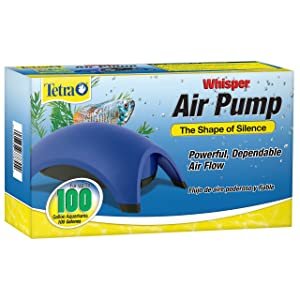
 

1. Tetra Whisper Easy to Use Air Pump for Aquariums

The air pumps produced by Tetra are probably the most powerful pumps available on the market today. They are one of the best pumps to use in deep tanks and tanks with a lot of air stones in them.

Oxygen and water movement are added to your tank which helps keep the water clean and also improves the well-being of the fish in your tank.

Tetra air pumps produce some bubbles that enhance the look of your aquarium, which looks great when paired with decorations, beautiful fish and lights. The interesting arc shape of the air pump is pleasing to the eye and the elastic feet at the base prevent it from slipping.

In addition, the arc shape flattens the wave frequencies, so that the air pump does not create any reflection on the existing furniture, such as shelves and tables. This also means less noise from the air pump, so that no one in the room in which the aquarium is placed is disturbed.

This Tetra Aquarium Air Pump is backed by a Limited Lifetime Warranty to assure the customer that this organization stands behind the quality of its air pumps. You will have serious problems finding another pump with the performance and power of Tetra air pumps.

Benefits

  • Is very cheap
  • It comes with an air valve.
  • It is very quiet
  • Backed by a limited lifetime warranty

Cons

  • Hoses are not included so you will need one to run the air pump
Check Price On Amazon

2. Hygger Quiet High Output Aquarium Air Pump

This Hygger air pump is specially designed for small to medium sized aquariums, regardless of the type of residents your aquarium has, salt water and fresh water. The sound is extremely low, but there is a vibration that can still be felt.

A buzz can be heard five feet away, but the bells are considerably louder. This is one of the air pumps with the largest volume. Also, most importantly, one of the quietest.

The dark outer jacket encloses another container inside that houses the 12V air conditioning motor, making it a container in a box, which probably adds a lot to how quiet it is.

You hear some noise from these air pumps; it’s just a matter of what level of buzz is acceptable to you. If you are looking for an air pump device that can reduce the volume to an extremely low noise level, give this model a try.

The Hygger air pump comes with two air vents that simultaneously supply oxygen to two or more aquariums. You can also mount them in an aquarium to produce more bubbles based on your requirements. This air pump is built for ultra-quiet operation and reliability for years of use.

Benefits

  • Quiet compared to other large and small air pump models
  • Quiet with regard to air volume
  • Pumps a large amount of air

Cons

  • Lacks sustainability
Check Price On Amazon

3. Tetra Whisper Air Pump for Deep Water Applications


Whisper air pumps are the most powerful and most popular air pumps from the Tetra company. Air pumps come in seven different sizes, so you can choose the one that best fits your tank size.

The Tetra Whisper Air Pump keeps your aquarium’s oxygen levels high and also helps keep your fish happy and healthy by producing water circulation and vibration. This will help improve the condition of the water in the tank in general. The underwater bubbles produced by the air pump also add a nice touch to enhance the look of your aquarium.

This air pump has a unique dome design and rubber feet to stick on your tank glass. Thanks to this special design, the sound wave frequencies created by the air pump are flattened.

This prevents them from bouncing off other surfaces such as tables and shelves, etc. This feature helps the pump to produce a minimum noise level, making it very quiet during operation.

This air pump is powerful enough for use in deep tanks (up to 2.4 meters deep), drives long decorative air stones or even several air stones at the same time and activates protein skimmers for seawater aquariums.

While it is generally a very good air pump, there is a problem with it. This product is designed to be quiet, but there is an expiration date for everything. After long use, even if the pump is still working properly, it may get a little louder.

So if you don’t mind the noise, don’t worry about the life of this product.

Benefits

  • Limited Lifetime Warranty
  • Unique domed design
  • Powerful vibration
  • Produces fascinating bubbles underwater
  • It comes in different sizes

Cons

  • It gets louder with age
Check Price On Amazon

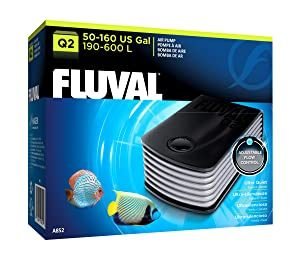
4. Fluval Q Air Pump

This product is a small and compact air pump. It has a simple rectangular box-shaped design. It measures just 3.2 x 7.8 x 6.4 inches and weighs just 2.1 pounds. The Fluval air pump is a powerful series and the Q2 is the second in this series.

Despite its size, this air pump is surprisingly powerful and strong. It is efficient enough for any 50 to 160 gallon tank.

This air pump has a smart and efficient design. With the advanced diaphragm and swing arm design, the air pump can produce a constant flow of air which is not only strong but also stable.

Thanks to this air flow, the water in the tank gets more air, circulates and aerates. This helps improve the oxygen levels of your fish and aquatic plants.

The air pump is also built with a double wall construction design. In addition, the product is integrated with an excellent pump and designed with a sound-absorbing baffle. Thanks to all these features, the Q2 is quieter.

Overall, this air pump is built with quality and can provide long lasting and reliable performance for your aquarium, especially considering its small size. However, the measure can be a double edged sword. This product is not available in different sizes, so as a customer you only have one size to choose from.

While effective in 50 to 160 gallon tanks, a pump will not suffice if you have a larger aquarium. In that case you need several pumps at the same time.

Benefits

  • Small and compact design
  • Efficient and powerful
  • Designed with special technology for quieter performance
  • Cheaper price than many others in the market.

Cons

  • No variation in size
  • May be too small for a larger tank
Check Price On Amazon
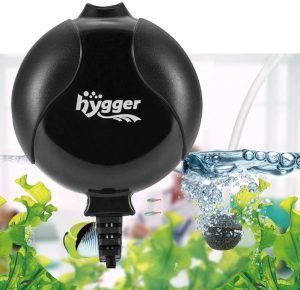
5. Hygger Quiet Mini Air Pump for Aquarium

The Hygger brand offers a variety of aquarium products, and the mini air pump is a great option. It is very quiet and can improve the wellbeing and health of your fish by providing more oxygen.

It is not a traditional size air pump. The mini pump works thanks to the thin piezoelectric ceramic plate. This means there is no motor or mechanism to reduce noise.

This product has a compact design and is only 2.4 inches in diameter. Therefore it is lightweight and can be easily “hidden” in the back of the tank.

Its smallness of course ensures that it does not consume much energy. With only 1.5 watts, you get something that saves energy while still producing a flow rate of 420 ml / min. So it is an excellent mini air pump for 1-15 gallon tanks and hydroponic systems.

You will like that it comes with the necessary air pump accessories you need. Of course you get the air pump and the power adapter. Plus, you get a 0.9-inch air stone, 3.6-foot air hose, and a double-sided suction cup.

Benefits

  • Can be attached to the tank
  • too quiet
  • Provide constant air pressure
  • It comes with the correct accessories.

Cons

  • Does not take in much air
  • There is no way to organize the airlines
  • Very short cord
Check Price On Amazon

6. Pawfly Commercial Air Pump for Aquarium Pond

If you are looking for something that can run multiple aquariums or ponds, Pawfly’s commercial air pump is the right choice for you. Provides 16 l / min of air for fish and plants to receive sufficient oxygen. In addition, it consumes only 7 watts, so there is low power consumption.

Although some brands offer “silent” models, it is almost silent. You don’t hear anything because of the internal muffler, which has several levels. There are also rubber pads to keep it from vibrating on the table or glass.

It is designed to run all the time, but you can choose between high and low flow. Set it on low when it’s time to sleep, or you’re in the room with the aquarium that way, you won’t hear it at all.

This product is of course designed to last. It has an artificial rubber membrane to prevent vibration. This ensures a longer shelf life.

Benefits

  • High and low output
  • Three sound level settings
  • Output distributor allows four outputs

Cons

  • Not as powerful as described
  • Bulky design
  • It can be challenging to set up
Check Price On Amazon
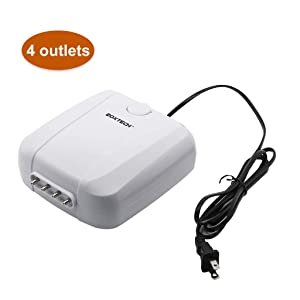
7. Upettools Aquarium Air Pump

With the Upettools brand you get a product that is designed to add more oxygen to the water. It works at around 2.5 l / min and delivers more gas volume than other brands. You will find that it is compatible with 10 cm air stones with a depth of 1 meter.

It requires a bit more power to run at 10 watts, but it’s still quite low. So it doesn’t consume much power when it works. It is of course designed to be quiet, although you can hear it a bit.

You will also find that you can adjust the output of the air pump. This is ideal so you can use it with almost any size tank. It is also easy to adjust by turning the volume knob.

The holes in the suction filter are quite small. This is essential so that your fish are not absorbed by it. It also produces smaller, smoother bubbles due to the small holes in the filter.

Benefits

  • Easy to set up
  • You can adjust the amount of bubbles
  • Powerful yet quiet design

Cons

  • Various settings but no pressure changes
  • No supply caps on air outlet
Check Price On Amazon
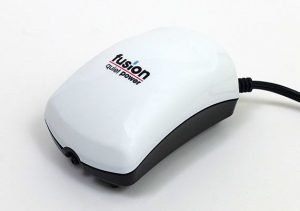
8. Plug-in air pumps

This type is the most common aquarium air pump. Just plug it into your power strip, turn it on and it will continuously pump air into your tank.

Plug-in air pumps do not have an on / off button. Once plugged into your outlet, they work until unplugged.

Check Price On Amazon

9. EcoPlus

EcoPlus offers a well-made product line that is quite durable. Made with quality materials, the cost of production is reflected in a higher selling price. All models have an adjustable flow rate. They also offer a heavier duty line designed for hydroponic rigs and commercial aquariums. This line is also suitable for pond applications. The complete line of EcoPlus products is as follows:

EcoPlus AIR-1 Plus air pump with single outlet
EcoPlus AIR-2 air pump with double outlet
EcoPlus AIR-4 four exhaust air pump
EcoPlus AIR-8 Eight exhaust air pump
EcoPlus Commercial 1 Hydroponic / Aquarium air pump
EcoPlus Commercial 3 Aquarium / Hydroponic Air Pump
EcoPlus Commercial Air Single Output 5 to 80 Watt
EcoPlus Commercial 7 Hydroponic / Aquarium air pump

Check Price On Amazon
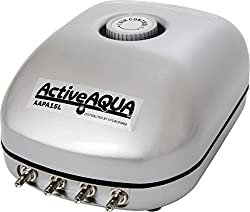
10. Active Aqua Air Pump

The Active Aqua air pump features a multi-level silencer and keeps noise disturbances to a minimum.

The synthetic rubber construction makes it ideal for constant air flow and pressure.

The energy efficient pump is powerful and certainly strong enough to circulate enough water in your tank.

On the top is a pressure control knob so you can adjust the airflow and make sure it is suitable for the size of your tank.

You can choose from four different sizes:

  • 1 output: 2 watts: 3.2 liters per minute: 50 GPH: maximum decibels is 40
  • 2 outputs: 3 watts: 7.8 liters per minute: 125 GPH: maximum decibels is 40
  • 4 outputs: 6 watts: 15 liters per minute: 240 GPH: maximum decibels is 45
  • 8 outputs: 12 watts: 25 liters per minute: 400 GPH: maximum decibels is 45

Benefits

  • Multi-level silencer makes it very quiet (max. Decibel is 45)
  • Options for 1-8 outputs
  • Adjustable air flow
  • Low energy consumption

Cons

  • Wide housing takes up a lot of space
Check Price On Amazon

Advantages of using the aquarium air pump

As mentioned above, an air pump is not absolutely necessary for your fish tank or fish tank. Without an air pump, your fish and aquatic plants can naturally still have enough oxygen. However, an air pump helps a lot with the circulation of the water.

Hence, it also aids in the release of carbon dioxide from the water and the absorption of oxygen from the air for the fish. If you have an air filter installed, the filter should be able to do this on its own, but for larger tanks, an air pump will help a lot in the process.

In addition to water circulation, an aquarium air pump is sometimes required for more specific purposes. If you have accessories that can only work with an air pump, then of course you should have an air pump.

For example, every aquarium setup should have filters and some filters need an air pump to work. Since the filter is essential, if you need an air pump to run the filter, you will need to purchase an air pump.

Other types of accessories may not need air pumps to operate, but they work more efficiently with them. Those accessories include the protein skimmers in salt water tanks, the casters for decoration or any decoration that has to lift objects or turn valves.

Air pumps work especially well with air stones, a type of decoration used to create tiny bubbles underwater.


Types of air pumps for aquariums

There are a few ways to classify Best Quiet Aquarium Air Pumps. One of those ways is based on the functionality and features depending on what you are looking for. Here are some types of aquarium air pumps available.

  • Turning on the Gravel Filter: If you need an aquarium air pump to power the filter from underneath the gravel in your aquarium, then depending on the size of your aquarium, you can choose the type of air pump that is suitable for that size of the aquarium.
  • Driven by size: Sometimes air pumps can be sized not by the tank, but by the pump itself. The size of the tank is a factor, but you also need to consider the accessories and objects in the tank. If an air pump is needed to run many accessories, you need a larger pump than if you don’t need it to power so many objects.
  • Deep Water Application – Most air pumps are designed for standard purposes unless otherwise stated. If you have a large/deep tank that is at least 18 to 20 inches long, you will need a special deep water air pump. Air pumps of this type will be advertised with the correct functions and features to pump air much further below the surface of the water.  Having a regular air pump for a deep aquarium is likely to cause uneven oxygen distribution in the tank, including a lack of oxygen at the bottom of the tank.
  • Power Source: You can also choose an air pump according to your power source. Most standard air pumps are plug-in type, meaning they must be plugged into an outlet for power at all times. However, there is also a battery-operated air pump that is more portable but requires external battery packs.

In many cases, air pumps offer dual options: both plug-in and battery-powered. This dual power option is very useful. In some cases, you can plug them in, but there is still a battery backup option in case there is a power outage.


What Is The Best Air Pump For Aquariums?

This is a difficult question to answer. Since there are many factors that come into play when evaluating an air pump, it is unfair to compare air pumps when their outlets are different. Therefore, the question should be read as “What is the best aquarium air pump for you?”

The above list contains the seven best aquarium air pumps and we stand behind their quality. However, the choice that is best for you is more of a personal choice. In the next section, we’ll show you some tips to help you choose the right air pump for you.


How do you choose an air pump for your aquarium?

There are some factors that are important and very relevant in finding the right aquarium air pump. Please consider these factors carefully before choosing knowing that you are getting a perfect fit for your aquarium, your fish and your aquatic environment.

1. Tank Dimensions: The rule for this step is clear and simple. If you have larger tanks, you will need stronger air pumps or you will have more than one pump at a time to supply enough air to the tank. Check the tank dimensions of your air pump to find one that will fit.

If you are using an air pump to only run a filter under gravel, then the tank dimensions on your air pump are also very relevant. If you buy an air pump that is too strong, it can blow the gravel out of the floor.

If you have a tank that is not a standard size (too big or too high compared to standard sizes), the tank dimensions on the pump don’t mean much anymore. You will have to test and see how efficient a pump is for your entire tank and adjust if necessary.

2. Objects and Decorations: The more things your air pump uses, the bigger and stronger an air pump needs. The less you run your air pump, the less capacity an air pump needs.

Before deciding what level of resistance the air pump needs, remember to consider everything that needs to be driven or pushed by an air pump.

3. Resistance of objects: In addition to the amount of objects and decorations that require the support of an air pump in your tank, you must also consider the “quality” of the objects. That means the more resistance there is in the objects and decorations that the air pushes through, the bigger an air pump will be.

For example, a large air stone provides more resistance than a smaller air stone, which is why you need a stronger air pump for larger stones. Each air stone also provides more resistance than any air stone.

In some cases, the different materials that make up the stones, and their shapes, can provide different levels of resistance, even if they are the same size.

4. Special Need: As mentioned above, a deep tank often requires a more special type of air pump. If your tank is over 18 to 18 inches long, you will need a special deep water air pump that can pump air much further below the surface of the water. Otherwise, your tank may not have a sufficient and uniform amount of oxygen.


How to configure an aquarium air pump?

There are several ways to configure your air pump, depending on the air pump you have. One of the best ways to configure your air pump is to follow the manual carefully. Do not take the manual lightly, as fish are at stake if you do not properly install an electronic device in the tank.

In addition to the manual, here are some tips to help you better configure your aquarium air pump.

  • Think about where you will place the air pump. It must be a solid surface. Do not place the air pump in a hollow container as it resonates with the pump and amplifies the pump noise.
  • Place this in the middle. Regardless of the surface on which you place the air pump, place it in the center of the surface. This is so that when the pump is rotating and vibrating, it will not fall off the edge of the surface.
  • Do not place it on top of the aquarium or on a shelf hanging from the aquarium. Even if you attach the air pump firmly to the shelf or tank lid so that it doesn’t vibrate and fall into the water, the vibrations from the air pump will pass through the shelf and tank and into the water with the fish. The water will vibrate, causing stress to your fish.


conclusion

While an aquarium air pump is not absolutely necessary, it is beneficial. Many users can rely on the additional positive effects Best Quiet Aquarium Air Pumps can have on their tank. So what are you waiting for to give your fish and aquatic plants a more comfortable and happier life? Do your research and buy a good aquarium air pump now!

Best UV Clarifiers for Koi Ponds: Sizing and Selection

Best UV Clarifiers for Koi Ponds: Sizing and Selection

A UV clarifier can be useful when a koi pond repeatedly turns green, but it is not a complete pond filter and it is not a cure for sick fish. The right unit exposes free-floating organisms to ultraviolet-C light at a controlled flow rate. The affected algae can then clump together and be removed by mechanical filtration.

This guide compares four current pond-specific UV families supported by manufacturer documentation. The aim is to help you match the unit to pond volume, fish load, flow, plumbing, and the job you expect it to perform. We do not use invented star ratings or temporary retailer prices.

Affiliate disclosure: Aquarium Hunter may earn a commission if you buy through a marked Amazon link, at no additional cost to you. Manufacturer links remain available for specification checking. Models and electrical standards vary by region.

Clear koi pond water supported by correctly sized UV clarification and filtration
UV clarification targets water passing through the chamber; the pond still needs mechanical and biological filtration, circulation, aeration, and routine maintenance.

Quick Comparison: Current Pond UV Options

Product family Best fit Strength Watch for Buying option
OASE Vitronic Small-to-medium ponds and matched OASE filter systems Simple pre-clarifier with inspection window and service access Choose the regional wattage and verified system pairing Check Amazon
Vitronic 18 affiliate link
OASE Bitron C / Bitron Eco Larger ponds and high-capacity OASE systems Higher-output family with integration options More expensive and must be matched to compatible plumbing and flow Read review
No verified exact Amazon match
Aqua Ultraviolet Classic / Twist Standalone pond systems needing several wattage and plumbing choices Detailed freshwater sizing charts distinguish clarification and sterilization flow The intended treatment level depends on real flow, not wattage alone Check Amazon
57-watt affiliate link
TetraPond GreenFree Straightforward green-water control in smaller and medium garden ponds Pond-specific range with replaceable lamps External installation only; use the current model chart and manual Check Amazon
GreenFree 18-watt affiliate link

UV Clarifier vs. UV Sterilizer

The hardware may look similar, but the labels describe different treatment goals. A clarifier is typically selected to control free-floating algae and improve water clarity. A sterilizer requires a higher effective UV dose to reduce a broader range of waterborne organisms passing through the chamber.

Effective dose depends on more than lamp wattage. It is influenced by:

  • water flow through the chamber;
  • lamp output and age;
  • distance from the lamp;
  • chamber and quartz-sleeve cleanliness;
  • water clarity and UV transmission;
  • the target organism and required exposure.

A unit can be sold with separate maximum flows for clarification and sterilization. Aqua Ultraviolet’s freshwater charts, for example, publish different flow and pond-volume guidance for the two goals. Use the figure that matches your intended result.

What UV Can and Cannot Do

UV Can Help With

  • free-floating algae that make the water look green;
  • some waterborne organisms that pass through the chamber at an adequate dose;
  • improving clarity when paired with effective mechanical filtration;
  • reducing recurring algae pressure in a correctly sized and maintained system.

UV Cannot

  • remove feces, leaves, sludge, or uneaten food;
  • convert ammonia or nitrite;
  • oxygenate the pond;
  • remove string algae attached to rocks and liner;
  • correct excessive nutrients, overfeeding, crowding, or poor circulation;
  • treat parasites or infections already living on or inside a fish;
  • replace quarantine, diagnosis, or veterinary care.

Most beneficial nitrifying bacteria live on filter media, liner, and other surfaces rather than freely suspended in the water. A UV unit therefore does not normally “kill all beneficial bacteria.” It treats only what passes close enough to the operating lamp.

How to Size a Pond UV Unit

1. Measure Pond Volume

For a rectangular pond, average length × average width × average depth × 7.48 estimates US gallons. Use a water meter during filling when possible. Irregular shapes, shelves, streams, and connected chambers make rough measurements less accurate.

2. Define the Goal

If the objective is green-water clarification, use the manufacturer’s clarifier rating. If broader waterborne-organism reduction is required as part of a professionally designed system, use the sterilization chart and seek appropriate fish-health advice. Do not assume a clarifier rating provides a sterilizing dose.

3. Account for Fish Load and Sun

Koi ponds typically have more nutrients and suspended material than lightly stocked water gardens. Full sun, heavy feeding, warm water, and dense stocking can increase algae pressure. Manufacturer pond-volume ratings may need to be reduced for these conditions.

4. Verify Actual Flow

Pump labels show flow before real plumbing resistance. Pipe diameter, length, bends, elevation, valves, filters, and the UV chamber reduce output. Calculate operating head and compare the pump curve with the UV unit’s permitted flow range.

5. Match the Plumbing

Check inlet and outlet diameter, pressure rating, unions, bypass requirements, vertical or horizontal orientation, and access for removing the lamp and quartz sleeve. Undersized hose can waste pump performance.

6. Confirm Electrical Compatibility

Buy a model designed for your country. Voltage, frequency, plug, certification, and weather protection vary. Outdoor pond equipment should use a ground-fault protected supply installed to local electrical code.

Current Pond UV Shortlist

OASE Vitronic: Simple Pre-Clarifier

The Vitronic family is designed to sit before a pond filter. OASE lists 18- and 36-watt units in matched US BioSmart systems and publishes compatible pumps, filters, and fish-load ratings. The Vitronic includes a function window and quick-release access for quartz cleaning and lamp replacement.

Choose it when: you are assembling or already use a compatible OASE flow-through system and want a straightforward green-water clarifier.

Watch for: current availability and ratings differ by region. Use the exact country page and system chart rather than importing a model with incompatible electrical specifications.

Check OASE Vitronic 18 on Amazon (affiliate link)

Official OASE Vitronic specifications

OASE Bitron C or Bitron Eco: Larger Matched Systems

OASE pairs Bitron models with larger BioTec ScreenMatic² and ProfiClear systems. The Bitron Eco family uses automatic output regulation on selected models, while Bitron C is offered in multiple higher-output sizes.

Choose it when: the pond is large, the filter is already part of an OASE system, or the required wattage exceeds entry-level units.

Watch for: confirm compatibility, bypass configuration, minimum and maximum flow, and the specific filter-system combination. A high-output lamp is not useful if plumbing sends water too quickly or the sleeve becomes fouled.

Official OASE Bitron Eco specifications

Aqua Ultraviolet Classic or Twist: Detailed Dose-Based Sizing

Aqua Ultraviolet offers multiple freshwater UV sizes and publishes separate clarification and sterilization values. Its current documentation includes a 57-watt Twist option and larger configurations for higher flows.

Choose it when: you want a standalone inline unit with a detailed sizing table and several plumbing choices.

Watch for: do not copy a pond-volume number without also checking the matching flow and treatment column. Installation orientation, pressure, unions, bypasses, and lamp access must follow the manual.

Check Aqua UV 57-Watt on Amazon (affiliate link)

Official Aqua Ultraviolet specifications

TetraPond GreenFree: Basic Garden-Pond Clarification

GreenFree is a pond-specific clarifier family intended to control green water. Tetra publishes model-specific instructions and identifies it as an external unit rather than a submersible light.

Choose it when: the goal is straightforward algae clarification in a smaller or medium garden pond and the selected model matches the real volume and flow.

Watch for: install it outside the pond as directed, protect it from unsafe flooding, and leave enough space for lamp and sleeve service.

Check TetraPond GreenFree 18-Watt on Amazon (affiliate link)

Official TetraPond GreenFree specifications

Where Should a UV Clarifier Be Installed?

Follow the specific manual. Many pond clarifiers are installed after the pump and before a mechanical/biological filter so treated algae can be captured. Other complete systems specify a different position. The unit may require a bypass to keep flow within limits and allow service without shutting down the entire pond.

  • Never operate an exposed UV-C lamp or look directly at it.
  • Disconnect power before opening the housing.
  • Do not run the lamp without water flow unless the manufacturer explicitly permits it.
  • Protect electrical connections from rain, splash, and flooding.
  • Use unions and isolation valves for safe removal.
  • Do not place an external-only unit underwater.

Maintenance Schedule

Inspect Flow Regularly

A falling flow rate can indicate a blocked prefilter, dirty pump intake, kinked hose, or accumulating debris. Reduced flow changes UV exposure and overall circulation.

Clean the Quartz Sleeve

Mineral deposits and biofilm block UV transmission even when the lamp still glows. Clean the sleeve at the interval in the manual and more often in hard water. Handle quartz carefully and replace damaged seals.

Replace the Lamp by Output Life

A lamp can illuminate after useful UV-C output has declined. Follow the manufacturer’s replacement-hour or seasonal schedule instead of waiting for the lamp to go dark. Record the installation date.

Check Seals and Leaks

Inspect O-rings, unions, housing, and cable condition during service. Lubricate seals only with a manufacturer-approved product and never force a brittle quartz sleeve.

Maintain the Rest of the Pond

Keep mechanical and biological filtration working, test ammonia and nitrite, remove accumulated solids, avoid overfeeding, and maintain aeration. Clear water is not proof of safe water.

Troubleshooting Green Water

The Lamp Appears On but the Pond Is Still Green

  • Confirm the unit has been running long enough for the system to capture treated algae.
  • Check actual flow against the clarification range.
  • Clean the quartz sleeve.
  • Review lamp age and correct replacement model.
  • Confirm pond volume and fish-load assumptions.
  • Inspect mechanical filtration and clean it as directed.
  • Reduce excess feeding and remove decaying organic matter.
  • Check whether water is bypassing the UV chamber.

Water Is Clear but Fish Are Unwell

Test ammonia, nitrite, nitrate, pH, alkalinity, temperature, and oxygen immediately. Observe breathing, appetite, swimming, skin, and gills. UV clarity can hide serious water-quality or disease problems. Consult an aquatic veterinarian or qualified fish-health professional when symptoms persist.

Frequently Asked Questions

Should a koi pond UV run continuously?

Many units are designed for continuous seasonal operation, but follow the manual and local climate guidance. Turn the unit off before service and never operate it without the specified water conditions.

How long before green water clears?

It varies with pond volume, algae density, lamp condition, flow, sunlight, nutrients, and filter capture. Avoid universal “clear in five days” promises. Investigate sizing or maintenance if there is no improvement after the manufacturer’s expected period.

Will UV remove string algae?

No. String algae is attached to surfaces and normally does not pass through the chamber. Control requires nutrient management, physical removal, appropriate shade or planting, and overall pond maintenance.

Can UV replace a koi pond filter?

No. Review our koi pond filter guide for mechanical and biological filtration options.

Does a bigger UV unit always work better?

No. Oversizing can waste energy and complicate plumbing, while excessive flow can still produce inadequate exposure. Use a documented unit and flow combination.

Our Selection Method

We retained only pond-specific product families with a current manufacturer page or manual. We compared stated use, treatment goal, wattage range, flow guidance, plumbing, serviceability, replacement parts, electrical safety information, and system compatibility. We removed aquarium-only devices, unverifiable brands, temporary prices, retailer star ratings, and mismatched product links.

References and Manufacturer Documentation

Freshwater Aquarium Sharks: Species, Sizes and Care

Freshwater aquarium “sharks” are not true sharks. They are unrelated cyprinids and catfish with a shark-like outline. The best realistic choices for a suitably large home aquarium are rainbow sharks, red-tail black sharks and—only with substantially more swimming room—a properly sized school of roseline or bala sharks. Several fish sold under the shark label grow far too large for ordinary aquariums.

Freshwater shark suitability at a glance

Common name Approximate adult length Social need Home-aquarium verdict
Rainbow shark About 6 in (15 cm) Usually one per tank; territorial Reasonable with a large footprint and compatible fish
Red-tail black shark About 6 in (15 cm) Usually solitary; territorial Reasonable for experienced keepers
Roseline shark / Denison barb About 6 in (15 cm) Active school Needs a long, oxygen-rich aquarium
Bala shark 12–14 in (30–35 cm) Schooling Only for very large, long aquariums
Silver Apollo shark About 10–12 in (25–30 cm) Fast-moving school Specialist, very large aquarium
Iridescent shark Can exceed 3 ft (1 m) Large, nervous schooling catfish Not suitable for normal home aquariums
Black sharkminnow Can approach 3 ft (90 cm) Large and increasingly territorial Not suitable for normal home aquariums

Adult size varies with species, sex and conditions. Never use a small juvenile’s shop size as the housing standard.

1. Rainbow shark

Rainbow shark Epalzeorhynchos frenatum in an aquarium
Rainbow sharks need floor space and visual barriers because adults defend territories.

The rainbow shark (Epalzeorhynchos frenatum) is one of the more manageable “sharks,” but it is not a peaceful algae-cleaning tool. Adults often defend caves, wood and the lower part of the aquarium. Use a long tank with multiple sight breaks, and avoid similarly shaped bottom-dwellers that cannot escape its territory.

2. Red-tail black shark

Red-tail black shark Epalzeorhynchos bicolor
The red-tail black shark is striking but commonly becomes territorial as it matures.

The red-tail black shark (Epalzeorhynchos bicolor) has similar husbandry challenges and is usually kept as the only member of its species. Provide secure caves without dead ends, open swimming space and robust tank mates that occupy other areas. Do not combine it casually with a rainbow shark.

3. Roseline shark (Denison barb)

Schooling roseline sharks or Denison barbs
Roseline sharks are active schooling barbs, not solitary centerpiece fish.

The roseline shark (Sahyadria denisonii) is a streamlined barb from flowing waters. Keep a genuine group in a long aquarium with strong oxygenation, clean water and uninterrupted swimming space. Buy captive-bred stock where available and check local sourcing rules because wild populations have faced collection pressure.

4. Bala shark

Bala shark Balantiocheilos melanopterus
Bala sharks become large, fast schooling fish and need far more room than juveniles suggest.

Bala sharks (Balantiocheilos melanopterus) are peaceful but frequently mis-sold for medium community tanks. They grow to roughly 12–14 inches, should not be kept singly and can injure themselves when startled. A very long aquarium with a tight lid is essential; many owners will be better served by a smaller schooling barb.

5. Silver Apollo shark

Silver Apollo shark Luciosoma species
Silver Apollo sharks are fast surface-oriented schooling fish for specialist large systems.

Fish sold as silver Apollo sharks are typically Luciosoma species. They are rapid, open-water swimmers that need a group, a long covered aquarium and high dissolved oxygen. Confirm the scientific name before purchase because common names are used inconsistently.

Species that ordinary home aquariums should avoid

Iridescent shark catfish

Juvenile iridescent shark catfish Pangasianodon hypophthalmus
Juvenile iridescent sharks are small in shops, but adults are public-aquarium-scale fish.

The iridescent shark (Pangasianodon hypophthalmus) can exceed a meter, is powerful and easily panicked, and is not a responsible purchase for a normal home tank. Restricted space does not safely keep it small. Do not buy one on the assumption that a larger home will be easy to find later.

Colombian shark catfish

Colombian shark catfish Ariopsis seemanni
Colombian shark catfish require a planned transition from freshwater toward brackish or marine conditions.

The Colombian shark catfish (Ariopsis seemanni) is often sold in freshwater when young, but its natural life history involves increasingly saline water. It grows large, is social and has venomous fin spines. It belongs with an experienced brackish-to-marine keeper, not in a standard freshwater community.

Black sharkminnow

Large black sharkminnow Labeo chrysophekadion
The black sharkminnow becomes extremely large and territorial.

The black sharkminnow (Labeo chrysophekadion) can approach 3 feet and becomes a formidable fish. It is inappropriate for ordinary home aquariums. A shop label that omits the scientific name is a reason to pause, not guess.

Tank setup for suitable species

  • Prioritize length and footprint. Active schooling species need distance; territorial species need distinct zones.
  • Cycle before purchase. Ammonia and nitrite should remain at zero, with nitrate managed by stocking, plants and water changes.
  • Provide oxygen and flow. Keepers of riverine species need strong gas exchange without creating areas where fish cannot rest.
  • Use a secure lid. Bala, roseline and Apollo sharks can jump or collide with covers when startled.
  • Build safe retreats. Anchor rocks and wood securely and avoid narrow caves that a growing fish may become trapped in.

Feeding

Most aquarium “sharks” are omnivores or specialized grazers rather than tank cleaners. Offer an appropriate quality staple plus plant material and small invertebrate foods where the species requires them. Make sure schooling and bottom-dwelling fish actually receive food, remove leftovers and judge portions by body condition and water quality.

Choosing tank mates

Match adult size, temperature, water chemistry, swimming speed and temperament. Avoid slow, long-finned fish with boisterous schools, and avoid combining multiple territorial Epalzeorhynchos in a modest footprint. Any fish small enough to swallow may become prey for larger species.

Before buying: five essential questions

  1. What is the verified scientific name?
  2. What adult length and social group does it require?
  3. Can the current enclosure house the adult for its full life?
  4. Is the species freshwater throughout life?
  5. Is captive-bred, legally sourced stock available?

Frequently asked questions

Can freshwater sharks live in a 20- or 30-gallon tank?

Not the species covered here as permanent adults. Even the smaller rainbow and red-tail sharks need a substantially larger footprint and territorial space.

Do freshwater sharks eat algae?

Some graze surfaces, but none should be purchased as a maintenance shortcut. They still need species-appropriate food, and algae is controlled by light, nutrients and aquarium care.

Can bala sharks be kept alone?

No. They are schooling fish, but providing a proper group greatly increases the required aquarium size. A smaller schooling species is the ethical choice when space is limited.

Are freshwater sharks dangerous to people?

Most listed cyprinids are not, although large fish can bite or thrash. Exercise normal care when netting or handling any unfamiliar species, and check whether it has defensive spines.

References and further checking

Final recommendation

For most capable home keepers, a single rainbow shark or red-tail black shark is more realistic than a large schooling “shark.” Roseline sharks suit long, oxygen-rich group setups. Bala sharks demand genuinely enormous space, while the largest and migratory species should be left to specialist-scale systems.