Best HOB Filters: Selection, Setup and Maintenance

Best HOB Filters: Selection, Setup and Maintenance

Short answer: the best hang-on-back (HOB) filter is one that provides enough real flow, reusable biological media and safe intake/output conditions for your livestock. Our three current reference choices are AquaClear 110 for flexible media, Marineland Penguin 350 for cartridge convenience and Fluval C4 for staged media access.

Hang-on-back aquarium filter installed on a fish tank
A HOB filter should be sized for the aquarium’s livestock, head height and maintenance routine—not only the gallon number on the box.

Three current HOB filter designs compared

Product Best for Media design Where to buy
AquaClear 110 Large freshwater aquariums and custom media Open reusable basket; adjustable flow Check on Amazon
Marineland Penguin 350 Straightforward cartridge-based maintenance Cartridges plus rotating Bio-Wheels Check on Amazon
Fluval C4 Separated mechanical and biological stages Multi-stage baskets and biological chamber Check on Amazon

Verify the model and voltage on the retailer page. As an Amazon Associate, Aquarium Hunter earns from qualifying purchases.

How this guide differs from our power-filter roundup

This page focuses specifically on HOB design, installation, media arrangement and troubleshooting. For a shorter product-first comparison across current power filters, see our best aquarium power filters guide.

Current recommendations

1. AquaClear 110 — best for customizable media

The AquaClear’s open basket lets you choose reusable foam and biological media instead of relying only on disposable cartridges. Its flow control is useful for feeding or calmer livestock, though even reduced flow may be too strong for a small aquarium. The 110 is a large model; choose an appropriate AquaClear size rather than assuming bigger is always safer.

Check AquaClear 110 on Amazon · Manufacturer specifications

2. Marineland Penguin 350 — best for cartridge simplicity

The Penguin 350 uses replaceable cartridges and rotating Bio-Wheels. It is easy to understand, but replacing all media at once can discard useful bacteria. Keep the Bio-Wheels wet during maintenance, never scrub them under chlorinated tap water and change only the media that actually needs replacing.

Check Marineland Penguin 350 on Amazon

3. Fluval C4 — best staged-media design

The C4 separates coarse and fine mechanical filtration from chemical and biological stages, making it easier to service one section without disturbing everything. It still needs enough clearance behind the aquarium and sufficient water depth to restart reliably after maintenance or a power interruption.

Check Fluval C4 on Amazon

How to size a HOB filter

Manufacturer gallon ratings are screening tools, not guarantees. Stocking level, fish size, feeding, plants, prefilters and maintenance all affect the required capacity. Published gallons-per-hour figures are commonly measured under favorable conditions; lift height, dirty media and restricted intakes reduce real flow.

  • Choose for the aquarium’s adult livestock and waste production.
  • Provide gentle areas for bettas, long-finned fish, fry and shrimp.
  • Use an intake sponge where small animals could be drawn in.
  • For heavily stocked or critical systems, use two independent filters or another form of redundancy.
  • Confirm that the aquarium rim, lid and wall clearance accept the filter.

Media order and maintenance

Water should generally meet coarse mechanical media before finer pads and biological media, although the filter’s manual takes priority. Carbon is optional for routine freshwater use; it is most useful for specific dissolved contaminants or removing medication when the medication instructions call for it.

  1. Unplug the filter before placing hands in the water or removing the motor.
  2. Rinse reusable sponges and biological media gently in removed aquarium water or conditioned water.
  3. Do not replace every biological surface on the same day.
  4. Clean the impeller and intake when flow declines.
  5. Refill or prime the chamber exactly as the manual directs before restarting.
  6. Test ammonia and nitrite after major maintenance, medication or a prolonged outage.

Setup and outage safety

Keep the aquarium water level high enough to reduce splashing and restart problems. Form a drip loop below a GFCI/RCD-protected outlet, keep plugs dry and never run a HOB filter without water. After a power cut, verify that the filter has restarted rather than assuming the motor recovered.

If media remained stagnant during a long outage, smell and inspect it before returning the water to the tank. When in doubt, discard foul water, rinse media in conditioned water, restore aeration and monitor ammonia and nitrite closely.

Common HOB filter problems

The filter is noisy

Top up the water, clean the impeller well, remove trapped air and confirm that the unit sits level. A rattling impeller may be worn or obstructed.

Flow has fallen

Check the intake sponge, tube, impeller and mechanical media. Do not compensate by discarding all biological media.

The current is too strong

Use the model’s flow control, raise the water level or fit a safe output baffle. Never block the outlet completely.

Water is clear but tests are unsafe

Clarity is not proof of biological filtration. Test ammonia, nitrite and nitrate and correct the underlying cycle, stocking or maintenance problem.

Frequently asked questions

Can a HOB filter be the only filter?

Yes, when correctly sized and maintained for the aquarium. High-waste livestock or systems needing redundancy may benefit from a second filter.

Should I replace cartridges every month?

Follow the manufacturer, but do not automatically discard useful biological media. Mechanical pads can often be rinsed until damaged; carbon has a limited service life when used for a specific chemical-filtration job.

Is more turnover always better?

No. Enough circulation and filtration are essential, but excessive current can exhaust weak swimmers and disturb plants or substrate. Match both filtration capacity and flow pattern to the inhabitants.

Verdict

Choose AquaClear when reusable, customizable media is the priority; Penguin for a simple cartridge-and-Bio-Wheel layout; or Fluval C4 for clearly separated stages. Whichever design you use, mature biological media and consistent maintenance matter more than disposable-cartridge marketing.

4 Best HOB Protein Skimmers for Saltwater Aquariums

4 Best HOB Protein Skimmers for Saltwater Aquariums

A hang-on-back protein skimmer is useful when a saltwater aquarium has no sump or cabinet space for an in-sump model. It mixes air and water to create foam that carries dissolved organic compounds into a collection cup before some of that material breaks down. A skimmer supports filtration, but it does not replace water changes, biological filtration or sensible feeding.

Our top pick is the AquaMaxx HOB-1.5 for its narrow profile, current manufacturer support and realistic bioload-based ratings. The Reef Octopus Classic 100-HOB suits aquarists who want a larger external-pump design, while the Coralife Super Skimmer offers flexible hang-on or in-sump installation.

Disclosure: As an Amazon Associate, Aquarium Hunter earns from qualifying purchases.

Quick comparison

Skimmer Best for Important fit detail
AquaMaxx HOB-1.5 Best overall HOB skimmer About 3.5 inches front-to-back; 4 inches needed above the cup
Reef Octopus Classic 100-HOB Larger systems and external pump layout Check rear clearance and the wet pump section
Coralife Super Skimmer 65 Flexible HOB or in-sump use Visible pump and bubble diffuser require tank space
Bubble Magus QQ1 Nano saltwater aquariums Compact capacity; do not size from tank volume alone

Best HOB protein skimmers reviewed

1. AquaMaxx HOB-1.5 — Best overall

AquaMaxx HOB-1.5 hang-on-back protein skimmer

The HOB-1.5 is a slim external skimmer driven by an upgraded Sicce-based AquaMaxx SHARK 1.0 pump. AquaMaxx lists the unit at 7.5 × 3.5 × 17 inches, with 11-watt power consumption. It fits rims up to 3/4 inch thick and needs about 4 inches of clearance above the collection cup for removal.

Most useful is the manufacturer’s split rating: up to 75 gallons with a light bioload or 40 gallons with a heavy bioload. That is more informative than a single maximum-volume claim. A heavily stocked reef, frequent feeding and nutrient-sensitive corals all justify sizing conservatively.

Advantages: narrow body, realistic bioload guidance, replaceable supported pump and responsive cup adjustment.

Limitations: premium price, substantial height and mandatory rear/upper clearance. As with any external skimmer, careful assembly and leak checks are essential.

Check price on Amazon

See manufacturer specifications

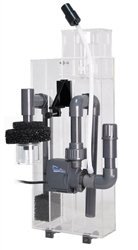
2. Reef Octopus Classic 100-HOB — Best external-pump option

Reef Octopus Classic 100-HOB protein skimmer

The Classic 100-HOB uses an Aquatrance AQ-1000S pinwheel pump and an acrylic skimmer body. Reef Octopus lists 8 to 9 watts depending on mains frequency, about 92 GPH maximum water flow and a broad 13- to 105-gallon tank-volume range.

That upper number should not be treated as a promise for every 105-gallon reef. Actual performance depends on bioload, feeding, air draw, salinity, tuning and maintenance. For a heavily stocked aquarium, leave a generous margin rather than selecting solely by the largest number on the box.

Advantages: current manufacturer documentation, efficient purpose-built pump, external HOB format and accessible replacement information.

Limitations: larger and more visually prominent than nano units; installation still places a wet pump section in the aquarium. Measure the complete footprint before ordering.

Check price on Amazon

See manufacturer specifications

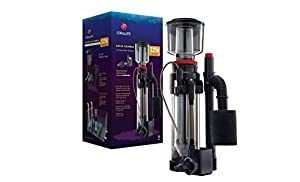
3. Coralife Super Skimmer 65 — Best flexible installation

Coralife Super Skimmer 65 with pump

Coralife’s Super Skimmer can be mounted on the aquarium or used in a sump, which makes it useful if the system may later be upgraded. The current Coralife catalogue lists 65-, 125- and 220-gallon models; this review and Amazon link refer specifically to the 65-gallon version.

The design uses a needle-wheel system, wide collection-cup neck and large air intake. The included pump and bubble diffuser occupy visible space when used as a HOB, so measure inside and behind the aquarium. Treat the 65-gallon label as a nominal model designation and size down for a demanding reef.

Advantages: two mounting options and an established product line.

Limitations: more equipment is visible inside the display than with a fully external body; water level, diffuser position and adjustment affect microbubbles and consistency.

Check price on Amazon

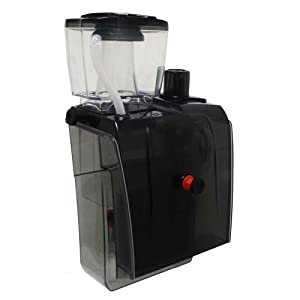
4. Bubble Magus QQ1 — Best for nano tanks

Bubble Magus QQ1 nano HOB protein skimmer

The QQ1 is the compact option in this comparison. Its small body is easier to accommodate on a nano marine aquarium, but small tanks change quickly and leave less room for tuning errors. Confirm the seller’s current dimensions and rating against your rim, lid and water level before ordering.

Advantages: compact HOB format and a lower-capacity choice for systems where larger skimmers will not fit.

Limitations: less headroom for heavy feeding or future stocking, and nano tanks can make fluctuating water levels more obvious. An automatic top-off can improve consistency.

Check price on Amazon

How to choose a HOB protein skimmer

Size for bioload, not just water volume

Manufacturers do not all calculate capacity the same way. A lightly stocked fish-only tank produces a different organic load from a crowded reef fed several times a day. Use the heavy-bioload rating when supplied, or choose below the advertised maximum. Oversizing excessively can also make a skimmer cycle between producing foam and doing very little, so bigger is not automatically better.

Measure the complete installation

Check body height, rear clearance, rim thickness, lid cut-outs and the space needed to lift the cup straight up. Allow room for hoses, the power cord and maintenance access. Make sure the mounting surface is sound and level; a HOB unit full of water is heavier than its dry specification suggests.

Consider water-level stability

Protein skimmers respond to water depth and salinity. Evaporation changes both in a small aquarium. Keep the water level stable, ideally with an automatic top-off, and tune the unit only after salinity and water height are correct.

Noise and microbubbles

Air intake, vibration and splashing all create noise. A silencer helps, but a clean venturi, correctly seated pump and level installation matter too. New skimmers may release microbubbles during break-in. Check assembly, water depth and outlet sponges rather than assuming weeks of bubbles are always normal.

Setup and tuning

  1. Rinse the skimmer components with fresh water. Do not use soap or household cleaners.
  2. Follow the model-specific manual, fit every O-ring and hose correctly, and confirm that the aquarium rim is within the stated limit.
  3. Position a drip loop below the electrical outlet and use a protected aquarium circuit. Keep plugs and connections dry.
  4. Start with the collection cup relatively high so the skimmer produces drier foam and is less likely to overflow.
  5. Watch the system closely after startup, feeding, additives, water changes or placing hands in the tank. These can temporarily collapse or increase foam.
  6. Adjust in small steps and allow time between changes. Darker, drier skimmate usually means a higher cup; paler, wetter skimmate means a lower cup.

A new skimmer often needs a break-in period while manufacturing residues and surface films clear, but there is no universal three-week waiting rule. If it continually overflows, unplug it, check water depth and assembly, clean the cup and air intake, and review the manual.

Maintenance and safety

Empty and rinse the collection cup before waste reaches the air path or drain fitting. Wipe the cup neck regularly because buildup reduces foam rise. Inspect the air line and venturi for salt creep, and clean the pump and impeller on the manufacturer’s schedule.

HOB skimmers carry water outside the aquarium, so leaks deserve immediate attention. Check O-rings, unions, brackets and hoses after every service. Never run a damaged cord or pump. Unplug equipment before putting hands in the water, and arrange cords with drip loops.

A skimmer removes some dissolved organics, but it does not remove every pollutant and cannot replace testing. Continue regular water changes and monitor salinity, temperature, ammonia, nitrate, phosphate and alkalinity as appropriate for the system.

Frequently asked questions

Does every saltwater aquarium need a protein skimmer?

No. Some lightly stocked nano tanks succeed with careful feeding, biological filtration and frequent water changes. A skimmer becomes more valuable as bioload and feeding increase, and it can improve gas exchange and provide a useful margin for reef systems.

Can a protein skimmer be too large?

Yes. A greatly oversized unit may struggle to maintain a stable foam head when there are not enough organics, leading to inconsistent operation. Choose for the real bioload and follow the manufacturer’s light- or heavy-load guidance when available.

Why did my skimmer suddenly overflow?

Common triggers include a changed water level, additives, epoxy, conditioners, oily foods, a blocked air intake or incorrect cup setting. Switch the unit off if overflow threatens the floor or aquarium, identify the cause and restart with the cup raised.

Should I run a protein skimmer all day?

Continuous operation is common and helps maintain aeration. Some aquarists schedule it around feeding or supplements, but frequent on-off cycling can reduce consistency. Follow livestock needs and the instructions for any medication or additive that specifically requires the skimmer to be paused.

Our verdict

The AquaMaxx HOB-1.5 is our best overall recommendation because its current documentation gives clear dimensions, rim clearance and separate light- and heavy-bioload ratings. The Reef Octopus Classic 100-HOB is a strong alternative for a larger external-pump format, while the Coralife Super Skimmer 65 provides flexible mounting. Measure carefully and choose conservatively: fit, maintenance access and actual bioload matter more than the largest advertised gallon number.