Low-Light Aquarium Plants: 8 Reliable Choices

Low-Light Aquarium Plants: 8 Reliable Choices

Low-light aquarium plants are species that can maintain healthy growth under modest aquarium lighting, not plants that can live indefinitely in darkness. The most dependable choices grow slowly, tolerate shade and do not require injected carbon dioxide. Anubias, Java fern and several Cryptocoryne varieties are useful starting points, but their placement and planting method still matter.

Planted freshwater aquarium with fish and low-light growing areas
Plant choice and placement matter as much as the headline wattage of an aquarium light.
Before choosing plants: identify the light model and daily schedule, measure the aquarium height, and check whether your fish dig, graze or uproot plants. Start with a consistent six-to-eight-hour photoperiod and adjust gradually rather than leaving the light on longer to compensate for poor growth.

Quick comparison

Plant Typical position How to plant it Growth in low light Main caution
Anubias barteri var. nana Foreground to midground Attach to wood or rock Slow Do not bury the rhizome
Java fern Midground Attach to wood or rock Slow Do not bury the rhizome
Cryptocoryne wendtii Midground Plant roots in substrate Slow to moderate May shed leaves after a move
Cryptocoryne beckettii ‘Petchii’ Foreground to midground Plant roots in substrate Slow to moderate Needs time to establish
Java moss Hardscape or cover Attach in a thin layer Slow to moderate Traps debris if allowed to become dense
Bolbitis heudelotii Midground to background Attach to hardscape Slow Prefers clean water and gentle movement
Bacopa caroliniana Background Plant individual stems Moderate Can become tall and sparse in weak light
Amazon sword Background or specimen plant Plant roots; keep crown exposed Slow in modest light Becomes too large for small aquariums

The table compares practical roles rather than declaring one plant universally “best.” Light reaching the leaves is affected by aquarium depth, floating plants, tannins, hardscape and shading from taller growth. A plant beneath a piece of wood receives less usable light than one directly under the same fixture.

1. Anubias barteri var. nana

Anubias nana is one of the most reliable shaded-aquarium plants. It develops firm, dark leaves from a horizontal rhizome and grows well attached to wood or stone. Tropica describes it as an easy plant that thrives in shady positions. Its slow growth makes it suitable for small layouts and tanks where frequent pruning is undesirable.

Keep the rhizome above the substrate. The fine roots may reach into gravel, but burying the thick rhizome can cause it to deteriorate. Slow leaves can collect algae, so avoid placing the plant directly under an intense beam and remove debris gently during water changes.

2. Java fern

Java fern is commonly sold under the name Microsorum pteropus; current botanical databases may place it under Leptochilus pteropus. Whatever name appears on the label, its care differs from that of a rooted sword plant. Secure the rhizome to rock or wood and allow the roots to grip the surface.

Java fern tolerates modest light and grows without injected CO2, although growth is slow. Older leaves may develop dark reproductive plantlets. That is not automatically a disease. Remove badly damaged leaves at the rhizome and allow healthy plantlets to develop before separating them.

3. Cryptocoryne wendtii

Cryptocoryne wendtii is a rooted rosette plant available in green and brown cultivated forms. Tropica rates its light demand as low and notes that it can grow in hard water. Plant the roots in the substrate while keeping the central crown clear.

Cryptocoryne leaves sometimes break down after transport or a major environmental change, a response aquarists call “crypt melt.” Stable conditions are more useful than repeatedly moving the plant. Remove decomposing leaves, keep the crown undisturbed and watch for new growth before discarding an established root system.

4. Cryptocoryne beckettii ‘Petchii’

This smaller Cryptocoryne is useful where C. wendtii would become too broad. Commercial growers classify it as an easy beginner plant. It can form a compact group in the foreground or midground when it is given time to establish.

Like other rooted rosette plants, it benefits from nutrients in the substrate. Low light reduces its rate of nutrient use; adding more fertilizer than the plants can consume does not correct inadequate placement or an unstable aquarium.

5. Java moss

Java moss, usually sold as Taxiphyllum barbieri, can cover wood, rock or mesh under modest lighting. Attach a thin layer with thread or aquarium-safe fastening material. Thick clumps shade their own lower growth and collect uneaten food, so trim them and siphon loose debris.

Moss is useful as cover for shrimp and fry, but it is not a replacement for filtration or maintenance. Inspect purchased moss carefully because fragments, snails and other organisms can arrive with it. Quarantine or rinse plants according to the needs of the animals already in the aquarium.

6. Bolbitis heudelotii

African water fern grows from a rhizome and should be attached to hardscape rather than buried. It suits a shaded midground or background, particularly where there is gentle water movement. Mature plants need more space than Anubias nana, so check the expected size before placing one in a small aquarium.

Bolbitis is slow under low light. Give it stable, clean water and avoid repeatedly uprooting or relocating it. Remove deteriorating fronds without cutting into the rhizome.

7. Bacopa caroliniana

Bacopa is a stem plant rather than a rhizome plant. It can tolerate modest light, but its shape reveals whether the position is adequate: weakly lit stems may stretch upward with wide gaps between leaves. Plant individual stems with space between them so lower leaves receive light and water circulation.

Trim healthy tops and replant them when the group becomes leggy. Choose Bacopa when you want a faster-growing background plant, not when the aquarium receives only incidental room light.

8. Amazon sword

Amazon sword is a trade name used for large Echinodorus plants, commonly forms associated with Echinodorus grisebachii. It can persist in a modestly lit aquarium, but it is a large rooted plant rather than a compact nano-tank choice. Give it adequate floor space and keep the crown above the substrate.

A sword plant can consume substantial root-zone nutrients once established. Yellowing is not proof of one specific deficiency, so check new versus old leaves, water conditions, root health and the fertilizer label before adding extra products.

What “low light” should mean

Fixture wattage alone is a poor comparison because LED efficiency, spectrum, optics, aquarium depth and mounting height differ. A practical low-light setup provides enough usable light for slow green growth without demanding high CO2 injection or daily fertilizer adjustment. Plant response over several weeks is more informative than a marketing label on the lamp. Our aquarium plant-light spectrum guide explains why spectrum and intensity should be considered together.

  • Pale or stretched new growth: check shading, light coverage, nutrition and whether the species is genuinely suited to the position.
  • Algae on slow leaves: shorten an excessive photoperiod, improve maintenance and review nutrient balance rather than intensifying the light immediately.
  • Leaves deteriorating after purchase: distinguish normal transition from continuing damage caused by a buried rhizome, unstable water or unsuitable temperature.

Planting mistakes to avoid

Burying rhizomes

Anubias, Java fern and Bolbitis grow from rhizomes. Attach them to hardscape or position the roots without covering the rhizome.

Expecting a carpet in deep shade

Dense foreground carpets generally need more light, carbon availability and maintenance than the plants in this guide. A low Anubias or Cryptocoryne group is more realistic than promising a rapid lawn.

Leaving the light on all day

A longer schedule is not a substitute for suitable intensity and distribution. Use a timer, begin conservatively and change the schedule in small steps while observing plants and algae.

Buying regulated or invasive plants

Plant legality varies by country and state. Hygrophila polysperma, included in the former version of this article, is documented as invasive in the United States and may be regulated. Check local rules, buy from responsible suppliers and never release aquarium plants or water into drains or natural waterways.

Do low-light plants need fertilizer or CO2?

They still need carbon and essential nutrients, but slow growth usually means slower demand. Fish waste is not a complete or reliably balanced fertilizer. Use a product intended for aquariums, follow its label and adjust from observed growth and measured conditions; the aquarium plant fertilizer guide compares four current options and their dosing approaches. Injected CO2 can improve growth but is not required for the core plants above when the aquarium is stable and the light is modest.

Rooted Cryptocoryne and Echinodorus species obtain substantial nutrition through their roots; rhizome plants and mosses use nutrients from the water column. Avoid assuming that every yellow leaf requires the same treatment.

Choosing a safe first group

For a simple beginner layout, attach one or two Anubias or Java ferns to hardscape, plant a small Cryptocoryne group in the substrate and leave open space for maintenance and fish movement. This combination supplies different leaf forms without mixing incompatible planting methods. Add more species only after the first plants produce healthy new growth.

Sources and further reading

Editorial note: plant names in the aquarium trade do not always follow the latest botanical classification. Match the label, growth form and planting method rather than relying on a common name alone.

Best Betta Water Conditioners: 5 Current Options

Best Betta Water Conditioners: 5 Current Options

Short answer: a good betta water conditioner must neutralize both chlorine and chloramine at a dose you can measure accurately. For most filtered betta aquariums, Seachem Prime is our best-value choice; Tetra BettaSafe is easier to measure for very small water changes.

Betta water conditioner bottles for treating aquarium tap water
Choose a conditioner for your tap-water disinfectant and measure it for the actual volume being replaced.

Best betta water conditioners at a glance

Product Best for Important distinction Where to buy
Seachem Prime Best overall value Very concentrated; accurate small-volume dosing matters Check on Amazon
Tetra BettaSafe Small betta tanks Betta-labelled, less concentrated format Check on Amazon
API Stress Coat General freshwater use Conditions tap water; includes aloe Check on Amazon
Aqueon Betta Bowl Plus Simple small-volume changes Convenient bottle, but still measure the dose Check on Amazon
Seachem Betta Basics Betta-and-plant setups Also buffers toward pH 7; not ideal when you want to preserve a different stable pH Check on Amazon

Product formulas and directions can change. Read the current label before dosing. As an Amazon Associate, Aquarium Hunter earns from qualifying purchases.

Our five current picks

1. Seachem Prime — best overall value

Prime is a practical choice when you maintain more than one aquarium or make regular water changes. It removes chlorine and chloramine and is extremely concentrated, so a bottle lasts a long time. That concentration is also its main drawback in a nano tank: use a marked syringe or dropper instead of guessing.

The manufacturer also says Prime temporarily detoxifies ammonia, nitrite and nitrate. Treat that as a short-term safety measure, not a substitute for a cycled filter, testing and water changes. Total-ammonia tests may still register bound ammonia.

Check Seachem Prime on Amazon · Manufacturer information

2. Tetra BettaSafe — best for small, straightforward changes

BettaSafe is designed for betta aquariums and neutralizes the common tap-water disinfectants. Its small bottle and betta-specific directions suit an owner who changes only a few gallons at a time. Confirm the dose on your bottle and calculate it from the replacement-water volume.

Check Tetra BettaSafe on Amazon

3. API Stress Coat — best multipurpose freshwater option

API Stress Coat removes chlorine, neutralizes chloramine and heavy metals, and contains aloe. It is suitable for bettas, but aloe is not a cure for infection, fin damage or poor water quality. Diagnose illness separately instead of relying on a conditioner as medicine.

Check API Stress Coat on Amazon · Manufacturer information

4. Aqueon Betta Bowl Plus — best for simple small-volume dosing

This is another easy-to-find betta-labelled conditioner for tap-water changes. It can be convenient for one small aquarium, although the cost per treated gallon is usually higher than a concentrated general-purpose conditioner. A betta still needs a heated, filtered and cycled aquarium; conditioner does not make an unfiltered bowl self-sustaining.

Check Aqueon Betta Bowl Plus on Amazon

5. Seachem Betta Basics — best when neutral buffering suits your water

Betta Basics removes chlorine and chloramine and, according to Seachem, buffers water toward pH 7. That can be useful in some betta-and-plant setups, but it is not automatically better than a non-buffering conditioner. A stable, appropriate pH is generally safer than repeatedly forcing a particular number.

Check Seachem Betta Basics on Amazon · Manufacturer information and directions

How to choose safely

  • Check your utility report. Water that contains chloramine needs a product explicitly labelled for chloramine, not merely chlorine.
  • Prioritize measurable dosing. In a small aquarium, a syringe or graduated pipette is much more reliable than an unmarked cap.
  • Avoid unnecessary additives. If your pH is already stable, a simple dechlorinator may be preferable to a buffering product.
  • Calculate the replacement volume. Follow the current label; do not assume every brand uses the same concentration.

How to condition water for a betta

  1. Measure how much old water you removed.
  2. Fill a clean, aquarium-only bucket with replacement tap water.
  3. Measure the label dose for that volume. Do not mix conditioners unless a veterinarian or manufacturer directs you to.
  4. Match the replacement water reasonably closely to the aquarium temperature.
  5. Add the treated water gently and keep the filter running normally.
  6. Test ammonia, nitrite and nitrate on schedule. Conditioner does not complete the nitrogen cycle.

If you add tap water directly to a large aquarium, follow the manufacturer’s instructions for that method. Severe overdosing of reducing conditioners can lower available oxygen, so never use an arbitrary “extra-safe” dose; increase aeration and seek product-specific advice if a major mistake occurs.

What conditioner cannot fix

Dechlorinator does not remove all dissolved minerals, lower nitrate caused by poor maintenance, correct an unsuitable temperature, or replace biological filtration. It also cannot make distilled or reverse-osmosis water nutritionally complete; those waters generally require remineralization before routine freshwater use.

Frequently asked questions

Can I add my betta immediately after conditioning tap water?

Most conditioners act quickly when correctly dosed, but safe water also needs the right temperature and a cycled aquarium. For a new setup, dechlorination is only one part of preparation.

Does leaving tap water out overnight make it safe?

Not reliably. Free chlorine may dissipate, but chloramine is designed to remain stable. Use a conditioner labelled for the disinfectant in your supply.

Can I use bottled, distilled or RO water instead?

Bottled water varies, while distilled and RO water lack minerals fish need for stable chemistry. They are not automatic substitutes for properly conditioned tap water.

How often should I add conditioner?

Use it whenever untreated tap water enters the aquarium, following the product label. Do not add routine extra doses to compensate for missed water changes or an uncycled filter.

Is betta conditioner different from ordinary aquarium conditioner?

Often the main differences are concentration, bottle size and dosing instructions. A standard freshwater conditioner that handles both chlorine and chloramine can be suitable for bettas when measured correctly.

Verdict

Seachem Prime offers the best value for most established aquariums, while Tetra BettaSafe is an approachable choice for accurately measured small water changes. Whichever you choose, the label, your tap-water disinfectant and precise dosing matter more than the word “betta” on the bottle.

Best Pond Lights: 4 Options and a Safe Buying Guide

Best Pond Lights: 4 Options and a Safe Buying Guide

The best pond lights depend on what you want to illuminate: a small waterfall, several edges of a pond, a single feature, or the outlet of a decorative fountain. Start with a documented pond-lighting system whose fixtures, power supply, and cable layout suit the job.

For a straightforward warm-white setup, the Aquascape 3-Light Spotlight Kit is a useful starting point. The Pond Guy LEDPro 6-Watt kit offers three higher-wattage fixtures, while a separate Aquascape spotlight suits a compatible system you already own. A fountain-ring light serves a different purpose and should be chosen only after checking the fountain fitting.

How these recommendations were selected: This is a research-based comparison of manufacturer specifications and instructions, not a hands-on test. The products below were listed by their US suppliers when checked in October 2026. Stock, package contents, and prices can change; confirm the exact model before buying.

Recommended pond lights by purpose

Complete kits and individual fixtures are not interchangeable purchases.
Option Best fit Check before buying
Aquascape 3-Light Spotlight Kit, 84030 A small pond or water feature needing warm-white accents Pre-wired spacing must fit your layout
The Pond Guy LEDPro 6-Watt, 3-Pack, 120817 Several larger features needing separate light positions Keep splitter, transformer, and photocell out of water
Aquascape 3-Watt Spotlight A targeted accent in a compatible low-voltage system Individual light requires a suitable transformer
Aquascape Color-Changing Fountain Light Kit, 84055 Color at the outlet of a decorative fountain Fountain and tubing must fit the integrated connection

1. Aquascape 3-Light Spotlight Kit: a simple complete setup

The 84030 kit combines three pre-wired 1-watt spotlights, a 6-watt transformer, and a photocell with digital timer. Its 3000K warm-white output suits an understated waterfall or planted pond edge.

The fixtures can be used submerged or on land, with stands and landscape stakes included. That flexibility lets you mix water and bank accents instead of placing every light on the pond bottom.

Why choose it: The supplied components reduce the number of separate parts to select. Tradeoff: The linked fixtures constrain spacing, so measure the route first. This is accent lighting, not a promise to illuminate an entire large pond evenly. Aquascape lists a five-year limited warranty; check its conditions with the seller.

2. The Pond Guy LEDPro 6-Watt kit: three larger accents

The LEDPro 6-Watt, 3-Pack Light Kit includes three warm-white 6-watt lights, weighted bases, ground stakes, an outdoor transformer, photocell, and splitter. The fixtures can be placed in or out of water.

Why choose it: It is a complete option for lighting several features rather than buying each fixture separately. Tradeoff: Higher wattage alone does not establish better brightness or coverage than another brand. Placement, beam spread, and water clarity still matter.

The supplier says replacement bulbs are not available for this 6-watt model, although replacement light fixtures can be purchased. It lists a three-year warranty. The product page gives inconsistent overall cord-length figures, so confirm the current wiring diagram and reach with the supplier before ordering for a tight installation.

The LEDPro manual requires the transformer, splitter, plug, and photocell to remain out of the water. It also requires removal and protected storage during freezing conditions and excludes swimming pools and swimming ponds. Those restrictions are part of the buying decision, not optional installation details.

3. Aquascape 3-Watt Spotlight: add one focused light

The Aquascape 3-Watt Spotlight is an individual fixture for a compatible 12-volt lighting system. The manufacturer lists 3000K warm-white light, 150 lumens, and a 30-degree beam angle.

It is approved for submerged or landscape placement and includes an adjustable stand and a stake. A focused beam makes it more suitable for a rock, waterfall, or planting group than broad area lighting.

Why choose it: You can add a targeted accent without buying another complete three-light kit. Tradeoff: Budget for a compatible transformer and any required cable, splitter, or control accessories. Verify the available transformer capacity and connection type before adding it to an existing installation; “low voltage” does not mean every brand’s parts work together.

4. Aquascape Color-Changing Fountain Light Kit: for a fountain outlet

The 84055 fountain kit includes one fountain light, a 12-volt transformer, and a wireless remote. It offers color settings as well as warm-white light.

Why choose it: The integrated barbed fitting places illumination at the top of a compatible decorative fountain, where water passes through the light. Tradeoff: This is not a general-purpose pond-floor spotlight. Check fitting dimensions, tubing, and the fountain opening in the linked instructions before ordering. It will not substitute for lights positioned around a large pond.

How to choose the right lighting system

Decide what needs light

Sketch the pond, waterfall, viewing position, and accessible power location. Start with one or two features you want to emphasize. Aim beams away from seating and neighboring windows, and avoid using underwater accent lights as the only illumination for steps or walking routes.

A light shining into cloudy water may highlight suspended particles more than the feature behind them. Deal with water-quality and debris problems first; our guides to pond filters and pond vacuums explain the different jobs those tools perform.

Check each component’s water rating

“Outdoor,” “weatherproof,” and “waterproof” in a listing are not enough to establish suitability for continuous submersion. Read the manufacturer’s permitted use and depth for the exact fixture. The light head may go underwater while its transformer, controller, or splitter must stay dry.

Do not use indoor strip lights or a general landscape fixture underwater unless its own instructions expressly allow that use. Adding sealant yourself does not establish a safe underwater rating.

Measure the full cable route

Measure along the bank and around obstacles, including the drop to the intended light position. A total cord-length figure may include several branches; it does not necessarily describe the distance from the outlet to every light. Leave enough accessible slack for maintenance without creating loops across paths.

Use extensions and connectors specified for the system. For an expandable setup, add up fixture wattage and follow the transformer’s loading limits and cable-length instructions. Do not assume a physically matching plug guarantees electrical compatibility.

Choose controls that fit your evening routine

A photocell responds to darkness; a timer controls operating time. They are different functions. If you want the lights to switch off after a short viewing period, check whether the included controller provides that option or requires a compatible additional timer.

Solar lights can suit a site without a convenient outlet, but runtime depends on the panel’s sun exposure, season, battery condition, and load. Treat an advertised runtime as conditional. Buy only a clearly identified model with appropriate submersion instructions, rather than assuming any solar garden spotlight is suitable for a pond.

Installation and maintenance essentials

Use the exact product manual for installation. These are ornamental pond-lighting recommendations, not instructions for swimming pools or places where people enter the water.

  • Use GFCI protection. Both the Aquascape kit instructions and LEDPro manual call for a GFCI-protected outlet. Have a qualified electrician handle a new outdoor electrical supply or questionable existing wiring.
  • Disconnect power before handling components. Do not install, reposition, or service energized lights. Stop using equipment with a damaged cord, cracked lens, or water inside a component intended to remain dry.
  • Keep non-submersible parts out of water. Place them according to their own instructions and account for rain, splashes, and rising pond levels. Provide the specified drip loop at the power connection.
  • Follow cable instructions. Do not improvise underwater splices or adopt a generic burial depth from a shopping article. Cable protection and routing depend on the system and installation requirements.
  • Clean the lenses. Disconnect power and remove algae or deposits using the manufacturer’s recommended method. Avoid adding cleaning chemicals to pond water.
  • Plan for winter. Follow the model’s freezing restrictions. The LEDPro manual specifically requires removal before freezing conditions.

Common buying questions

How many pond lights do I need?

There is no reliable lights-per-gallon rule. A small feature may need one accent; a long waterfall may need several positions. Choose according to the features, beam angles, depth limits, cable reach, and viewing direction.

Should the lights stay on all night?

For decorative use, schedule them for the hours you enjoy the pond and allow an unlit period afterward. Keep the lighting schedule separate from essential pumps or aeration so switching off the lights does not interrupt life-support equipment.

Why are the lights dim or not switching on?

With power disconnected, check for dirty lenses and visibly damaged or loose connections. A shaded photocell or unsuitable cable run can also affect operation. Follow the manual’s troubleshooting steps. If the GFCI trips repeatedly, stop using the system and have the fault investigated instead of repeatedly resetting it.

The most useful purchase is a system with a clear manual, suitable cable layout, and accessible replacement parts. A short list of correctly specified fixtures is more valuable than a long list of unverified “waterproof” bargains.

Best Aquarium Sand: 5 Current Options Compared

Best Aquarium Sand: 5 Current Options Compared

The best aquarium sand depends on the animals, plants and water chemistry. Smooth inert sand suits many freshwater community fish and bottom-dwellers. Mineral-rich clay sand can support planted layouts. Aragonite sand is useful only where harder, more alkaline water is appropriate, while marine live sand is formulated for saltwater and reef systems rather than ordinary freshwater aquariums.

Freshwater aquarium with a smooth natural sand substrate
Match sand grain, chemistry and depth to the aquarium’s livestock and maintenance routine.

Affiliate disclosure: Aquarium Hunter may earn a commission from qualifying Amazon purchases, at no extra cost to you. Products are included for suitability and current availability rather than commission.

Quick comparison

Sand Best use Water effect Buying option
AquaNatural Galaxy Sand Dark freshwater aquascapes Decorative natural substrate; verify against target parameters Check on Amazon
CaribSea Moonlight Sand Fine light-colored freshwater displays Super Naturals freshwater sand Check on Amazon
Seachem Flourite Black Sand Freshwater planted tanks Stable porous clay; does not alter pH Check on Amazon
CaribSea African Cichlid Sahara Sand Hard-water African cichlid systems Buffers alkalinity and pH Check on Amazon
CaribSea Arag-Alive Fiji Pink Marine and reef aquariums Aragonite; supports marine alkalinity and calcium chemistry Check on Amazon

Choose by aquarium type

Freshwater community tanks

Use a smooth aquarium-safe sand that does not push the water away from the species’ target pH, KH and GH. Fine sand supports natural foraging in many Corydoras, loaches and cichlids, but it should not contain sharp fragments. Research the exact species because some fish need open gravel, leaf litter or a mixed habitat.

Planted aquariums

Sand anchors plants, but plain decorative sand is not complete plant nutrition. Root feeders may need root tabs; stem and epiphyte plants may depend more on water-column nutrients. Very fine material can make planting difficult, while a stable porous clay sand offers a darker, heavier alternative.

African cichlid tanks

Many Lake Malawi and Lake Tanganyika fish are maintained in hard, alkaline water. An aragonite-based cichlid sand can resist declining alkalinity, but it is unsuitable for soft-water South American cichlids. Test the source water before choosing a buffering substrate.

Marine and reef tanks

Marine aragonite sands are designed for saltwater chemistry. “Live sand” contains moisture and microbial material, but it does not make a new aquarium instantly cycled. Confirm ammonia and nitrite are zero before adding animals and follow a complete marine cycling and stocking plan.

Five current aquarium sands

AquaNatural Galaxy Sand

Best for: a dark freshwater aquascape where contrast and natural appearance are priorities.

The current ten-pound Galaxy Sand listing is a practical full-substrate product rather than a tiny decorative packet. Dark sand can make plants and pale fish visually prominent and hides some surface discoloration.

Tradeoffs: a dark color does not establish chemistry or livestock safety by itself. Rinse according to the current bag instructions, confirm the composition is suitable for the intended water parameters, and protect the filter intake from loose grains.

Check AquaNatural Galaxy Sand on Amazon

CaribSea Super Naturals Moonlight Sand

Best for: a bright, fine-grained freshwater display.

CaribSea lists Moonlight Sand at approximately 0.25–0.75 mm. That fine grain is suitable for many sifters and keeps waste visible on the surface, where it can be siphoned away. The verified Amazon option contains two five-pound bags.

Tradeoffs: very fine light sand can show detritus, compact if installed too deeply, and shift under strong flow. Use a manageable depth, direct outlets above the bed and stir only accessible surface areas during maintenance.

Check CaribSea Moonlight Sand on Amazon | Manufacturer specifications

Seachem Flourite Black Sand

Best for: freshwater planted tanks needing a stable, dark mineral substrate.

Seachem describes Flourite Black Sand as a porous clay material that is not chemically coated and does not alter pH. It can be used alone, retains its physical integrity and does not require scheduled replacement.

Tradeoffs: shipping friction can create dust. Rinse thoroughly, fill slowly over a bowl or plate and use mechanical filter floss while the water clears. Plant nutrition still needs to match plant demand.

Check Seachem Flourite Black Sand on Amazon | Manufacturer specifications

CaribSea African Cichlid Sahara Sand

Best for: a hard-water African cichlid or compatible Synodontis setup.

CaribSea lists Sahara Sand at approximately 0.5–1.5 mm and formulates its African Cichlid range to help resist downward pH drift. The grain supports digging and nesting more naturally than a coarse cichlid mix.

Tradeoffs: buffering is not appropriate for every cichlid. Test pH, KH and GH before and after installation, and avoid using it for fish whose care requires soft, acidic water.

Check CaribSea African Cichlid Sahara Sand on Amazon | Manufacturer specifications

CaribSea Arag-Alive Fiji Pink

Best for: marine and reef aquariums requiring a fine aragonite bed.

Fiji Pink is a twenty-pound moist aragonite product sold for marine and reef tanks. Its chemistry and grain make it a different product category from inert freshwater sand.

Tradeoffs: it should not be recommended as a general freshwater substrate. Live-sand bacteria do not replace cycling, quarantine or stable salinity, alkalinity, calcium and nutrient management.

Check CaribSea Arag-Alive Fiji Pink on Amazon

How much aquarium sand do you need?

Calculate from the tank’s length, width and desired depth rather than gallons alone. Many fish-focused aquariums use a shallow bed of roughly one to two inches, while rooted layouts may need planned deeper zones. Density varies, so use the manufacturer’s calculator or coverage guidance. Avoid an unnecessarily deep uniform bed that is difficult to maintain.

Installation

  1. Confirm the sand suits the animals and desired water chemistry.
  2. Follow the product instructions. Rinse dry sand unless the manufacturer explicitly says not to rinse that product.
  3. Place heavy rocks on stable supports before adding loose sand around them.
  4. Fill slowly onto a plate or plastic sheet to limit clouding.
  5. Keep filter intakes above the bed and consider a prefilter sponge.
  6. Cycle the aquarium and test until ammonia and nitrite are both zero before stocking.

Cleaning aquarium sand

Hover the siphon just above the surface so debris rises while most sand remains in place. Pinch the hose if too much substrate is lifted. Clean open sections during routine water changes and gently disturb only accessible areas. Do not stir deeply around plant roots, burrows or structural supports.

Common mistakes

  • Using marine or cichlid aragonite in a soft-water aquarium.
  • Assuming all black, white or “natural” sands have the same chemistry.
  • Resting heavy rocks on loose sand where digging fish can undermine them.
  • Allowing grains into impellers, magnetic glass cleaners or pump shafts.
  • Adding fish because a bag says “live” without confirming the nitrogen cycle.
  • Replacing the entire established bed during normal cleaning.

Frequently asked questions

Is sand better than gravel?

Sand better supports natural sifting in many bottom fish and keeps waste visible on top. Gravel is easier to vacuum deeply and may stay put under stronger flow. Neither is universally better.

Can aquarium plants grow in sand?

Yes. Choose plants suited to the setup and provide appropriate root or water-column nutrition. Plain sand anchors roots but should not be assumed to supply every nutrient.

Does aquarium sand change pH?

Inert silica, quartz and stable clay sands generally do not. Aragonite and crushed-coral sands can raise alkalinity and influence pH. Check the material, not merely the product color.

How often should sand be replaced?

Stable aquarium sand does not require routine replacement. Clean it in sections and replace it only for deterioration, contamination or a planned habitat change.

Bottom line

Choose Galaxy or Moonlight for general freshwater displays, Flourite Black Sand for a planted layout, Sahara Sand for a tested hard-water African cichlid system, and Fiji Pink only for marine or reef use. Grain size, chemistry, animal behavior and maintenance access matter more than color or marketing labels.

Best Aquarium Return Pumps: 6 Current Options

Best Aquarium Return Pumps: 6 Current Options

Disclosure: Aquarium Hunter may earn a commission from qualifying purchases made through links on this page, at no extra cost to you.

The best aquarium return pump is not simply the model with the highest advertised flow. It is the pump that can deliver the flow your system needs after vertical lift and plumbing resistance, while staying within the safe capacity of the overflow. For many sump-based aquariums, a controllable DC pump is the most flexible choice.

Aquarium return pump for moving water from a sump back to the display tank
Choose a return pump from its flow curve at your system’s actual head height—not from its zero-head rating alone.

Quick comparison

Return pump Maximum advertised flow Best for Buying option
Sicce Syncra SDC 6.0 1,450 GPH Best all-round controllable choice Check on Amazon
EcoTech Vectra S2 1,400 GPH Premium connected reef systems Manufacturer details
hygger 800 GPH DC Pump 800 GPH Budget compact sumps Check on Amazon
Jebao DCP-10000 2,640 GPH Budget higher-flow applications Check on Amazon
Fluval Sea SP4 1,822 GPH (US model) Simple AC reliability Manufacturer details
EHEIM Universal 1200 About 317 GPH Low-flow or specialist small systems Check on Amazon

Important: maximum flow is measured with little or no head pressure. Real flow will be lower. Confirm the current model, voltage, fittings and manufacturer flow curve before ordering.

Best aquarium return pumps

1. Sicce Syncra SDC 6.0 — best overall

The Syncra SDC 6.0 is a strong all-round choice for a medium sump system. Sicce lists a controllable range up to 1,450 GPH, a maximum head of 11.5 feet and 10–40-watt operation. It can run submerged or inline and includes local control plus app connectivity.

Its broad adjustment range makes it easier to tune the return rate without relying entirely on a valve. As with any connected pump, decide whether the app features are useful to you; core circulation should remain easy to control locally.

Check the Sicce Syncra SDC 6.0 on Amazon · See Sicce specifications

2. EcoTech Vectra S2 — best premium connected option

The Vectra S2 is aimed at aquarists who value refined control and integration. EcoTech lists up to 1,400 GPH, 11.5 feet of maximum head, Mobius wireless control, and submerged or inline operation. Its 1-inch inlet and 0.75-inch outlet should be planned into the plumbing before purchase.

This is a premium choice rather than a necessity. We are linking directly to EcoTech because we did not find a reliable exact current Amazon listing during this review.

See the EcoTech Vectra S2 specifications

3. hygger 800 GPH DC Pump — best budget compact option

The 24-volt hygger model is a practical option for a small sump where the required operating flow fits its performance curve. The manufacturer lists the 25-watt version at up to 800 GPH and 9.8 feet of head, with adjustable control and submerged or inline installation.

Its low price is appealing, but size it conservatively and consider how quickly you could source a replacement if the return pump is critical to heating, filtration or gas exchange.

Check the hygger 800 GPH pump on Amazon · See hygger specifications

4. Jebao DCP-10000 — budget high-flow choice

The DCP-10000 offers an advertised maximum of 2,640 GPH with electronic speed control. It can suit a larger system that needs substantial flow after head loss, but it should not be chosen from the headline number alone. Check the pump curve, plumbing sizes, available sump space and overflow capacity.

For a critical life-support role, keep a clean spare pump or a tested contingency plan. Do not assume that a high maximum rating makes the pump appropriate for a small overflow.

Check the Jebao DCP-10000 on Amazon

5. Fluval Sea SP4 — best straightforward AC option

The Fluval Sea SP4 is a conventional AC sump pump that can be installed submerged or inline. Fluval lists the US model at up to 1,822 GPH, 11.5 feet of maximum head and 90 watts, with 1.25-inch fittings. Regional electrical specifications differ, so use the documentation for the exact model sold in your country.

An AC pump does not offer the same electronic adjustment as a DC model. If the selected operating point allows it, flow can be reduced with a valve on the outlet; never restrict the inlet.

See the Fluval Sea SP4 specifications

6. EHEIM Universal 1200 — best low-flow AC option

The long-running EHEIM Universal 1200 is a modest-flow alternative for a small or specialist system. EHEIM lists approximately 1,200 liters per hour (about 317 GPH) and 2 meters of maximum head for the 50 Hz version, with submerged or external installation. Actual regional specifications should be checked before purchase.

Its flow is too low for many larger reef returns once head loss is included, but it can be a sensible fit where a deliberately low return rate is required.

Check the EHEIM Universal pump on Amazon · See EHEIM specifications

How to size a return pump

1. Set a realistic return-flow target

A common starting point is roughly three to five display-tank volumes per hour through the sump, but the correct rate depends on the overflow, drain noise, sump contact time and equipment. The return pump is not expected to provide all reef-tank circulation; dedicated wavemakers usually handle in-tank flow more efficiently.

2. Calculate total dynamic head

Measure the vertical rise from the sump water level to the return outlet, then account for pipe diameter, pipe length, elbows, valves, manifolds and other restrictions. Use the manufacturer’s flow curve to find delivery at that head. A pump advertised at 1,500 GPH may deliver much less in the installed system.

3. Respect the overflow limit

The operating return flow must stay below the safe capacity of the overflow and drains. Test the complete system under supervision. A controllable pump makes tuning easier, but it does not correct undersized or unsafe drainage.

4. Plan the plumbing

Use the largest practical plumbing size recommended by the manufacturer, avoid unnecessary sharp bends, and install unions so the pump can be removed for cleaning. Flexible sections and vibration-isolating feet can reduce transmitted noise. A valve on the outlet is useful for isolation and careful adjustment.

DC versus AC return pumps

DC pumps offer speed control, soft start and often feed modes or monitoring. They are useful when you want to tune flow without wasting energy across a restriction. AC pumps are simpler and can be durable, but flow adjustment normally depends on selecting the right model or throttling the outlet. Either type can be reliable when correctly sized, installed and maintained.

Installation and safety

  • Use a GFCI/RCD-protected outlet and form drip loops in every power cord.
  • Never run a water-cooled pump dry unless its instructions explicitly allow it.
  • Keep the sump operating level high enough to prevent air being drawn into the pump.
  • Set the return outlet and sump capacity so a power outage cannot flood the sump.
  • Do not rely on a check valve as the only flood protection; check valves can foul.
  • Leak-test external plumbing and unions before leaving the system unattended.

Maintenance and redundancy

Inspect the intake regularly and clean the impeller and volute on the manufacturer’s schedule. Calcium deposits, algae, sand and snail shells can reduce flow or stop a pump. Track normal operating sound and flow so changes are noticed early.

If the return pump is essential to heating, oxygenation or filtration, keep a tested spare or a rapid replacement plan. During an outage, battery-supported circulation or aeration may matter more than maintaining full return flow.

Frequently asked questions

Can a return pump be too powerful?

Yes. Excess return flow can overwhelm the overflow, create noise and bubbles, or drain the return chamber faster than water arrives. Select from the pump curve and tune within the drainage system’s safe capacity.

Can I use a valve to reduce return flow?

A suitable valve on the pump outlet can reduce flow. Never restrict the inlet. With a controllable DC pump, reducing the electronic speed is normally the first adjustment.

Should a return pump run continuously?

Most aquarium return pumps are intended for continuous operation. A brief feed mode can be useful, but extended stoppages may reduce heating, gas exchange and filtration and can allow sump equipment to behave differently.

Our verdict

The Sicce Syncra SDC 6.0 is the best balanced choice here for a controllable medium system. The EcoTech Vectra S2 suits a premium connected setup, while the hygger 800 GPH offers a lower-cost route for a compact sump. Whatever the model, the correct operating point and safe plumbing matter more than the zero-head GPH printed on the box.

Best Aquarium Magnet Cleaners: 4 Current Options

Best Aquarium Magnet Cleaners: 4 Current Options

Disclosure: Aquarium Hunter may earn a commission from qualifying purchases made through links on this page, at no extra cost to you.

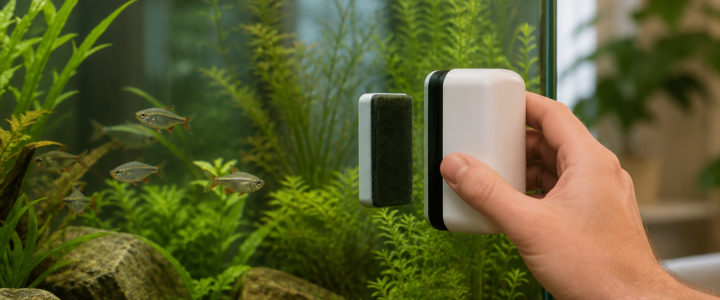
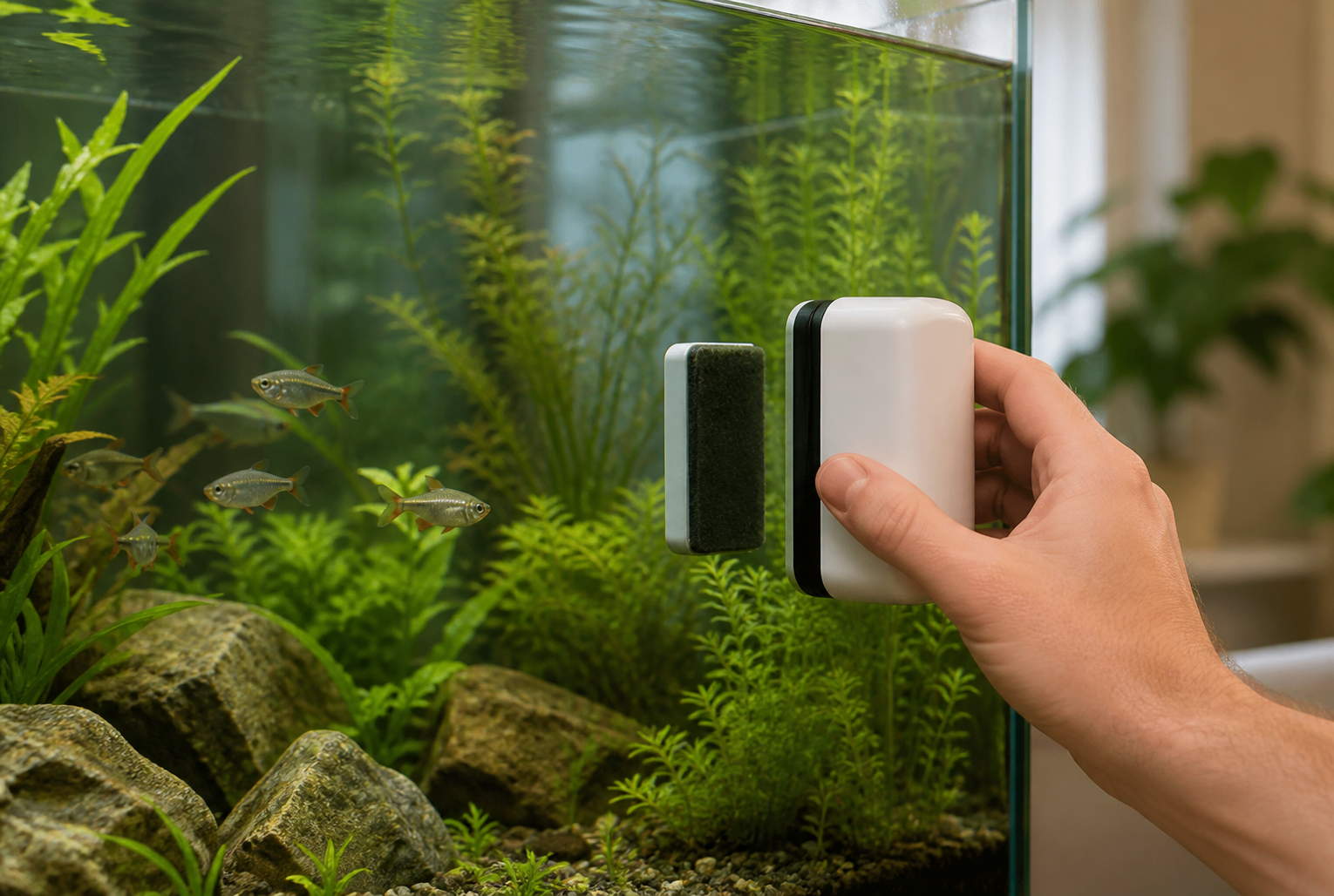
A magnetic aquarium cleaner lets you wipe algae from the inside of the viewing panel without putting your hand in the water. The best model is the one rated for your tank’s actual panel thickness and material. A cleaner that is too weak disconnects constantly; one that is unnecessarily strong can be awkward to move and easier to mishandle.

Using a floating magnetic algae cleaner on the front glass of a planted aquarium
Keep the wet-side pad away from sand and grit: one trapped grain can scratch an aquarium panel.

Quick comparison

Magnetic cleaner Rated panel Best for Buying option
FLIPPER Float Standard Glass or acrylic up to 1/2 in (12 mm) Best versatile scrubber and scraper Check on Amazon
Mag-Float Medium Glass Glass up to 3/8 in Best simple floating cleaner Check on Amazon
Tunze Care Magnet Long Glass 10–15 mm Best for thicker glass and sand clearance Check on Amazon
hygger Magnetic Cleaner, Medium Confirm current size chart Budget cleaner with scraper Check on Amazon

Before buying: measure the panel at an exposed edge and check the exact manufacturer range. Tank capacity is only a rough guide; two aquariums of similar volume can use different glass or acrylic thicknesses.

Best aquarium magnet cleaners

1. FLIPPER Float Standard — best overall

The FLIPPER Float Standard combines a scrubber with interchangeable scraper blades and changes sides when the handle is rotated. The manufacturer rates it for glass and acrylic panels up to 1/2 inch (12 mm). It includes a stainless-steel blade for glass and a plastic blade for acrylic, so it is the most versatile option in this group.

The wet half floats toward the surface if it disconnects, which can make retrieval easier. The blade side is useful for stubborn spot algae, but a metal blade must never be used on acrylic and should be kept clear of silicone seams.

Check the FLIPPER Float Standard on Amazon · See the manufacturer specifications

2. Mag-Float Medium Glass — best simple floating cleaner

The Mag-Float Medium Glass is a straightforward pad-style cleaner for glass aquariums. Mag-Float lists it for tanks up to 125 gallons or glass up to 3/8 inch thick, but panel thickness is the more dependable selection criterion. The inner half floats if separated.

This version is intended for glass. Mag-Float also makes material- and size-specific variants, so do not assume one Medium model is interchangeable with another. A scraper is not included with this standard version.

Check the Mag-Float Medium Glass on Amazon · See the Mag-Float size guide

3. Tunze Care Magnet Long — best for thicker glass

The Tunze Care Magnet Long uses narrow plastic blades rather than a broad pad resting directly against the pane. Tunze says the inner magnet sits more than 3 mm away from the glass, reducing the likelihood that sand becomes trapped. The Long model is rated for 10–15 mm glass and includes a stainless-steel blade plus spare plastic blades.

This is a strong choice for an appropriately thick glass aquarium, especially where substrate near the viewing panel is a concern. Match the exact Care Magnet version to the glass thickness; the Nano, Long, Strong and Strong+ are not interchangeable sizes.

Check the Tunze Care Magnet Long on Amazon · See Tunze specifications

4. hygger Magnetic Cleaner, Medium — budget option

The medium hygger cleaner combines a floating inner half, cleaning pad and scraper at a lower price than the premium alternatives. It can be a practical choice for routine film algae on a compatible glass tank.

Confirm the current listing’s thickness guidance before ordering, because this cleaner is sold in several sizes and marketplace titles can change. Inspect the pad and scraper before every use and stop if the halves drag harshly or disconnect repeatedly.

Check the hygger Medium Magnetic Cleaner on Amazon

How to choose safely

Match the aquarium material

Glass is harder to scratch than acrylic, but neither is scratch-proof. Only use a metal blade when the manufacturer explicitly approves it for glass. Acrylic needs an acrylic-safe plastic blade or pad, and even those can scratch if grit is trapped underneath.

Use panel thickness, not only gallons

Magnetic strength must reach through the aquarium panel. Measure the glass or acrylic at a visible edge, then choose a model whose stated range includes that measurement. Bow-front and curved panels can reduce contact area, so check the cleaner manufacturer’s guidance for curved tanks.

Decide whether you need a scraper

A soft cleaning pad handles routine film algae. A blade can make hard green spot algae or coralline algae easier to remove, but it increases the need for careful material selection and seam clearance. Never force a blade across damaged glass or acrylic.

Consider retrieval

A floating wet side is convenient if the halves separate. A sinking model is not automatically inferior, but retrieval can be awkward in a deep or heavily decorated tank. Floating does not make a cleaner safe to leave in place indefinitely.

How to use a magnetic cleaner without scratching the tank

  1. Inspect both halves and remove every grain of sand, shell fragment or hard deposit.
  2. Place the wet half against the inside pane and bring the dry half toward it gradually to avoid a hard snap.
  3. Move slowly in overlapping passes. Stop if you feel grinding, unusual resistance or repeated disconnection.
  4. Stay above the substrate line. Clean the final lower strip separately with an appropriate handheld tool.
  5. Keep scraper blades away from silicone seams and decorative film.
  6. Separate the halves after use, rinse them, dry the outer felt and store them with a spacer between the magnets.

Common mistakes

  • Dragging through sand: trapped quartz or gravel can leave a permanent scratch.
  • Using the wrong blade: stainless steel is not acrylic-safe.
  • Buying by tank volume alone: the actual panel thickness determines magnetic performance.
  • Leaving the cleaner attached: debris can collect under it, and the dry-side surface can mark the outside pane.
  • Snapping strong magnets together: this can pinch fingers or damage the cleaner.

Magnet precautions

Powerful magnets can pinch fingers and may affect magnet-sensitive medical devices, electronics, magnetic cards and storage media. Keep the separated halves and packaged cleaner away from children and follow the manufacturer’s safety instructions. People with implanted medical devices should follow their device manufacturer’s advice about safe distances from magnets.

Frequently asked questions

Can magnetic cleaners scratch aquarium glass?

Yes. Glass cleaners most often scratch when sand or another hard particle is trapped between the wet side and the pane. Inspection and careful technique are essential.

Can I use a glass cleaner on acrylic?

Only when the exact cleaner and its installed pad or blade are explicitly rated for acrylic. Never use a metal scraper blade on acrylic.

Will a magnetic cleaner remove every type of algae?

No. Routine film algae is usually easy, while hard spot algae or coralline algae may need a suitable scraper. Algae growing on silicone seams, textured backgrounds or decorations needs a different cleaning method.

Our verdict

The FLIPPER Float Standard is the most versatile option because it combines scrubbing, material-specific blades and floating retrieval. The Mag-Float Medium Glass is a simpler choice for compatible glass aquariums, while the Tunze Care Magnet Long stands out for thicker glass and its deliberate clearance from substrate.

Best Aquarium Power Filters: 5 Current HOB Filters Compared

Best Aquarium Power Filters: 5 Current HOB Filters Compared

Disclosure: Aquarium Hunter may earn a commission from qualifying purchases made through links on this page, at no additional cost to you. Recommendations are based on filtration design, maintainability, current manufacturer documentation, and suitability—not commission size.

The best aquarium power filter is one that fits the tank, supports a stable biological filter, offers enough mechanical media for the fish’s waste load, and remains easy enough to maintain consistently. For most freshwater community aquariums, a hang-on-back (HOB) power filter is a practical balance of performance, access, and price.

After removing discontinued, mismatched, and poorly supported choices from the old list, these five current filters remain worth comparing. Our most flexible recommendation is the Fluval AquaClear/AC platform; the Fluval C4 is the stronger choice for clearly separated filtration stages, while the Aqueon QuietFlow is convenient when automatic restart is a priority.

Best aquarium power filters: quick comparison

Filter Best for Media style Flow control Main tradeoff
Fluval AquaClear 110 Large aquariums and reusable media Open media basket Yes Large unit; must be primed after service
Fluval C4 Organized multi-stage filtration Separate mechanical, chemical, and biological stages Yes More parts to clean
Aqueon QuietFlow 75 LED PRO Easy restart and cartridge convenience Cartridge plus biological grid Model-dependent More reliance on proprietary consumables
Tetra Whisper 60 Basic filtration for a larger community tank Cartridge-based Limited Less media customization
Marina Slim S15 Small tanks with limited rear clearance Compact cartridge system Yes Lower media capacity

Manufacturer tank ratings are starting points, not stocking guarantees. Choose from the exact model’s specifications and increase filtration capacity for messy fish, heavy stocking, or unusual tank dimensions. Never use a stronger current that prevents fish from resting or swimming normally.

1. Fluval AquaClear 110: best for flexible reusable media

The AquaClear 110 is the established large-tank version of Fluval’s HOB platform. Its open basket holds foam, activated carbon, and BIOMAX separately, allowing each stage to be accessed without discarding everything at once. That is an important advantage: biological media can remain established while mechanical foam is rinsed.

Fluval rates the AquaClear 110 for 60–110 US gallons and provides adjustable flow. The official AquaClear line includes smaller models, so select the version matched to your aquarium rather than buying the 110 for every setup. The waterfall return improves surface movement, but the water level must be kept high to reduce splashing and noise.

Best features

  • Large, accessible media basket.
  • Reusable foam and separate biological media.
  • Adjustable output for different fish and feeding conditions.
  • Replacement parts and media remain documented by the manufacturer.

Limitations

  • The 110 requires substantial clearance behind the aquarium.
  • Like many conventional HOB filters, it may need to be refilled and primed after cleaning or a power interruption.
  • Its intake requires a sponge prefilter for shrimp, fry, or long-finned fish.
Fluval AquaClear 110 hang-on-back aquarium power filter
The AquaClear 110 uses a large basket with independently serviceable filter media.

Check AquaClear 110 on Amazon

2. Fluval C4: best organized multi-stage filter

The Fluval C4 separates filtration into two mechanical stages, one chemical stage, and two biological stages. Fluval rates it for aquariums up to 70 US gallons, with a stated 120-volt circulation rate of 264 US gallons per hour. A cleaning indicator helps identify a clogged mechanical pad, although it does not replace routine visual checks.

The C4 is a good match for keepers who want each filtration role clearly defined. Its wet/dry biological area receives oxygen-rich water, and the adjustable output can extend media contact time. The tradeoff is complexity: more trays, pads, screens, and channels require careful cleaning than a simple open basket.

Best features

  • Clearly separated mechanical and biological stages.
  • Adjustable flow and documented model specifications.
  • Mechanical pad slides out for rinsing.
  • Good choice when you prefer organized media rather than a single cartridge.

Limitations

  • Higher maintenance complexity than simpler HOB filters.
  • Replacement pads and parts must match the C-Series model.
  • Maximum rim thickness should be checked before purchase; Fluval lists 1 1/8 inches for the C4.
Fluval C4 multi-stage aquarium power filter
The Fluval C4 separates mechanical, chemical, and biological filtration into accessible stages.

Check Fluval C4 on Amazon

3. Aqueon QuietFlow 75 LED PRO: best for automatic restart

The Aqueon QuietFlow 75 LED PRO uses an internal pump that is designed to self-prime and restart automatically after power returns. That convenience is useful for an aquarium that may experience short outages, although every filter should still be checked after power restoration.

Aqueon describes five filtration stages, including floss, activated carbon, a biological holder and grid, and space for a specialty pad. The LED indicator responds to restricted water flow through the cartridge; it is a maintenance reminder, not a water-quality monitor.

Best features

  • Self-priming internal pump.
  • Simple cartridge removal and broad model range.
  • Permanent biological surfaces are separate from the disposable floss cartridge.
  • Current manufacturer documentation and replacement media.

Limitations

  • Ongoing cartridge cost.
  • Replacing all media together can remove useful bacteria; keep the permanent biological grid wet and do not replace it routinely.
  • The LED does not measure ammonia, nitrite, nitrate, or filter maturity.
Aqueon QuietFlow 75 LED PRO aquarium power filter
Aqueon’s QuietFlow LED PRO emphasizes automatic restart and cartridge-based maintenance.

Check Aqueon QuietFlow 75 LED PRO on Amazon

4. Tetra Whisper Power Filter 60: best straightforward large-tank option

The Tetra Whisper 60 is a basic three-stage HOB filter marketed for aquariums up to 60 US gallons. Its simple cartridge system is approachable for a new keeper, and the model remains available through major retailers.

This filter works best for someone who values straightforward replacement media over customization. The downside is reduced flexibility and the temptation to replace a complete cartridge on a calendar. When the cartridge contains an established bacterial population, rinse reusable portions gently in removed aquarium water and avoid changing every biological surface at once.

Best features

  • Simple installation and familiar replacement cartridges.
  • Twin-sided design on the 60-gallon model distributes intake and return flow.
  • Widely available consumables.

Limitations

  • Less media flexibility than AquaClear or Fluval C-Series baskets.
  • Cartridge costs accumulate.
  • Model rating may be optimistic for heavily stocked or high-waste aquariums.
Tetra Whisper 60 hang-on-back aquarium power filter
The Tetra Whisper 60 is a straightforward cartridge-based filter for larger community aquariums.

Check Tetra Whisper 60 on Amazon

5. Marina Slim S15: best for a compact aquarium

The Marina Slim S15 has a narrow body and adjustable flow, making it useful when rear clearance is limited or a gentler current is needed. Its compact size is also its main constraint: media volume is modest, so it suits an appropriately stocked small aquarium rather than a messy or crowded tank.

Confirm the exact S15 model, voltage, aquarium rating, and included cartridges on the retailer page before buying. Product variants and regional electrical specifications can differ.

Best features

  • Slim profile.
  • Adjustable flow.
  • Easy access for routine cleaning.

Limitations

  • Small media capacity.
  • Cartridge-dependent design.
  • Not appropriate as the only filter for large, messy fish.
Marina Slim S15 compact aquarium power filter
The Marina Slim S15 trades media volume for a compact profile and adjustable flow.

Amazon listing currently unavailable; review retained for readers comparing an existing or locally available unit.

How we selected these filters

We prioritized models that remain available, have current manufacturer or retailer documentation, and represent meaningfully different use cases. We compared:

  • Mechanical and biological media capacity.
  • Ability to service one stage without discarding the entire bacterial colony.
  • Flow adjustment and suitability for delicate livestock.
  • Restart behavior after cleaning or power loss.
  • Availability of compatible media, parts, and instructions.
  • Clear limitations, including clearance, noise, cartridge cost, and maintenance complexity.

We removed the old Marineland Emperor and Penguin listings because their linked versions were not reliably available, the Penn-Plax entry lacked enough verified detail to outrank the current choices, and the Aqueon internal filter did not belong in a HOB comparison. The Green Killing Machine was also removed because a UV sterilizer is a specialized water-clarifying device, not a general substitute for a properly sized mechanical and biological filter.

How to size a power filter

Do not choose by tank gallons alone. Consider adult fish size, stocking, feeding, plant debris, substrate, and how often you can service the filter. A lightly stocked planted aquarium and a goldfish aquarium of the same volume have very different waste loads.

Manufacturer “up to” ratings are useful for comparing models within a product line, but they assume conditions that may not match your tank. When uncertain, choose more media capacity and distribute the flow safely. Two filters can provide redundancy and better circulation in a long aquarium, but both still require maintenance.

Check physical fit

Measure the aquarium rim, distance to the wall, hood openings, and the vertical distance from the intake to the substrate. Keep the water level high enough for the return and follow the manufacturer’s leveling instructions.

Protect small animals

Add a sponge prefilter over the intake for shrimp, fry, snails, and delicate fins. Rinse it regularly because a clogged sponge reduces flow.

Understanding filter media

Mechanical filtration

Foam, floss, and pads trap uneaten food, waste, and plant fragments. Rinse reusable mechanical media in removed aquarium water before it becomes severely clogged. Replacing dirty mechanical media is not a substitute for removing waste from the substrate.

Biological filtration

Porous foam, ceramic media, and permanent grids support nitrifying bacteria that process ammonia and nitrite. Keep biological media wet in dechlorinated aquarium water during service. Never replace all mature media at once unless contamination makes it unavoidable.

Chemical filtration

Activated carbon can remove some dissolved organic compounds, odors, discoloration, and medications, but it is not required continuously in every aquarium. It becomes exhausted and must be replaced when used for a specific purpose. Chemical media cannot compensate for an uncycled tank or overdue water changes.

Power filter maintenance

  1. Unplug the filter and heater before lowering the aquarium water level.
  2. Remove and rinse mechanical media in discarded tank water.
  3. Swish biological media gently only when debris is restricting flow.
  4. Clean the intake, impeller well, and return channel according to the manual.
  5. Reassemble, refill the HOB chamber if required, and restore power.
  6. Confirm normal flow and restart before leaving the aquarium.
  7. Test ammonia and nitrite after major maintenance or any loss of filter bacteria.

Clean according to flow and waste accumulation rather than an inflexible calendar. Never wash mature biological media under chlorinated tap water, and never allow it to dry during maintenance.

Frequently asked questions

Is a HOB filter enough for an aquarium?

Yes, for many appropriately stocked freshwater aquariums. It must provide adequate media capacity, circulation, and oxygen exchange. Large fish, marine systems, very long tanks, or specialized aquascapes may benefit from canister filters, sumps, sponge filters, or multiple units.

Does a higher flow rate mean better filtration?

No. Flow must carry waste to the media and distribute oxygen, but water moving too quickly can bypass fine debris or exhaust fish. Media volume, contact, maintenance, and tank circulation matter alongside gallons per hour.

Should I replace a filter cartridge every month?

Replace disposable media when it is damaged or cannot be cleaned enough to restore flow—not merely because a date has passed. Preserve established biological media whenever possible. If a cartridge combines carbon and floss, consider whether the design offers a separate permanent biological surface.

What happens during a power outage?

Keep media wet and restore oxygenation as soon as possible. After power returns, confirm that the filter has restarted; conventional HOB units may need manual priming. For a long outage, discard foul stagnant water from the filter chamber, restart with conditioned water, and monitor ammonia and nitrite.

Final recommendation

Choose the Fluval AquaClear/AC platform when reusable media flexibility and easy access are your priorities. Choose the Fluval C4 for organized multi-stage filtration, or the Aqueon QuietFlow 75 LED PRO for convenient automatic restart. The Tetra Whisper 60 and Marina Slim S15 are simpler choices for their respective tank sizes, but their cartridge systems offer less customization.

Whichever filter you buy, correct sizing, mature biological media, routine cleaning, and water testing matter more than the brand name.

Best Reef Salt Mixes: 5 Current Options Compared

Best Reef Salt Mixes: 5 Current Options Compared

The best reef salt is the mix whose freshly prepared alkalinity, calcium and magnesium closely match the parameters you intend to maintain. A high-alkalinity mix is not automatically better for SPS or LPS corals; stability and compatibility with your dosing method matter more than the marketing category on the bucket.

Reef aquarium maintained with consistently mixed synthetic sea salt
Choose a salt mix that matches the aquarium’s target chemistry, then verify every new batch before use.
Quick recommendation: Fritz RPM is the best balanced general reef mix here for aquarists targeting roughly 8–9 dKH. Brightwell NeoMarine and Tropic Marin Pro-Reef suit lower-alkalinity approaches, while Red Sea Coral Pro is specifically for systems intentionally maintained at elevated foundation-element levels.

Quick comparison

Salt mix Best fit Approximate alkalinity character Buying option
Fritz RPM Balanced mixed reef 8–9 dKH at 35 ppt Check on Amazon
Brightwell NeoMarine Natural-seawater-style parameters About 7.5 dKH Check on Amazon
Tropic Marin Pro-Reef Lower-alkalinity reef systems Confirm current bucket label Check on Amazon
Red Sea Coral Pro Deliberately elevated parameters About 11.5–12.5 dKH at 35 ppt Check on Amazon
Instant Ocean Sea Salt Value and fish-focused systems Test and adjust for the reef target Check on Amazon

Published values depend on salinity, temperature, source water, batch and test method. Always verify a newly mixed batch with calibrated equipment.

1. Fritz RPM Reef Pro Mix

Best for: a balanced mixed reef maintained near natural-seawater alkalinity.

At 35 ppt, Fritz lists quality-control ranges of 400–450 ppm calcium, 1300–1400 ppm magnesium and 8–9 dKH alkalinity. This makes RPM a practical match for many mixed reefs and SPS systems that are already dosed around that alkalinity range.

Fritz recommends using low-TDS RO/DI water at 70–75°F, adding salt slowly to the water and following its mixing directions. Source water can noticeably affect the finished alkalinity.

Check Fritz RPM on Amazon   Manufacturer parameters

2. Brightwell Aquatics NeoMarine

Best for: aquarists targeting chemistry closer to natural seawater.

Brightwell formulates NeoMarine for approximately 1.025 specific gravity, pH around 8.3 and alkalinity around 7.5 dKH when prepared according to its directions. That lower alkalinity can suit tanks already controlled near natural-seawater values, but it may create an unwanted step down if the display normally runs much higher.

Measure the finished salinity first; calcium and alkalinity readings cannot be compared meaningfully when samples are mixed to different salinities.

Check NeoMarine on Amazon

3. Tropic Marin Pro-Reef

Best for: lower-alkalinity reefs using calcium reactors or balanced dosing.

Pro-Reef is commonly chosen where aquarists want a premium mix without a large alkalinity spike during water changes. It is a better fit for a deliberately controlled reef than for someone expecting water changes alone to raise depleted calcium and alkalinity.

Package specifications and sizes change, so confirm the current bucket label and mixing directions. Do not assume values from an older review apply to a new batch.

Check Tropic Marin Pro-Reef on Amazon

4. Red Sea Coral Pro Salt

Best for: reefs intentionally maintained at elevated alkalinity, calcium and magnesium.

Red Sea lists approximately 11.5–12.5 dKH alkalinity, 450–480 ppm calcium and 1350–1430 ppm magnesium at 35 ppt for SPS-dominant use. Those are high values and should not be introduced abruptly to a low-alkalinity aquarium.

Red Sea instructs users to add salt to RO water near 68°F, mix vigorously without aeration for 30 minutes to two hours and avoid mixing for more than four hours. The company also discourages storing mixed Coral Pro for more than 12 hours because precipitation can reduce the elevated parameters.

Check Red Sea Coral Pro on Amazon   Manufacturer guidance

5. Instant Ocean Sea Salt

Best for: value, fish-focused marine systems and aquarists comfortable testing and adjusting.

Instant Ocean is widely used and readily available. It can support reef aquariums when the finished batch is tested and matched to the display, but buyers seeking elevated reef parameters may prefer the manufacturer’s Reef Crystals formula or another mix closer to their dosing target.

The exact Amazon link below is for Instant Ocean Sea Salt, not Reef Crystals. Check the package name and stated yield before ordering.

Check Instant Ocean Sea Salt on Amazon

How to choose reef salt

Match alkalinity before brand

A large water change with 12 dKH salt in an aquarium maintained at 7.5 dKH creates a rapid chemistry change. Choose a mix near the display’s stable target or adjust the new water carefully before use. “SPS salt” is not a substitute for this calculation.

Compare at the same salinity

Major-element concentrations rise and fall with salinity. Compare mixes at 35 ppt—or at the exact salinity you maintain—using a calibrated seawater refractometer or conductivity meter. Specific gravity changes with temperature and should not be confused with ppt.

Consider the dosing system

Two-part dosing, kalkwasser and calcium reactors already replace alkalinity and calcium. A salt mix should complement that program, not cause each water change to overshoot. Water changes are not a precise correction method for serious parameter imbalances.

How to mix reef salt safely

  1. Use a clean, dedicated, food-safe container and purified RO/DI water.
  2. Add salt to water—not water onto a pile of dry salt—and follow that product’s temperature and order instructions.
  3. Use a pump for circulation and observe the manufacturer’s required mixing time; longer is not always better for elevated mixes.
  4. Measure salinity only after the mix is fully dissolved and at a known temperature.
  5. Test alkalinity on a new brand or batch, and check calcium and magnesium when results or livestock response are unexpected.
  6. Match temperature and salinity to the display before the water change.
  7. Never mix dry salt directly in an aquarium containing animals.

Storage and batch consistency

Keep dry salt tightly sealed away from humidity. Components can separate during transport, especially in partially used large containers; follow the manufacturer’s advice on homogenizing the dry mix. Record the lot number and first-batch test results. If a value is surprising, first verify salinity, source-water quality and the test kit before correcting the mix.

Frequently asked questions

Is high alkalinity better for coral growth?

Not universally. Some well-fed, higher-nutrient systems tolerate elevated alkalinity, while low-nutrient systems may be managed lower. Stability and a coherent nutrient, light and dosing strategy are more important.

Can marine salt be used in freshwater aquariums?

Not as routine “tonic salt.” Marine mixes alter salinity and add many ions. Use them only for a deliberately researched marine or brackish setup.

Can different salt brands be mixed?

Dry mixes can sometimes be blended, but the result must be tested and stored safely. Transitioning through several smaller water changes is usually more predictable than making one abrupt switch.

Final verdict

Fritz RPM is the best balanced all-round choice in this group. NeoMarine and Tropic Marin Pro-Reef suit lower-alkalinity strategies, while Coral Pro is specifically for intentionally elevated parameters. Instant Ocean remains a practical value option when the aquarist tests and adjusts the finished water rather than assuming the bucket matches the display.

Affiliate disclosure: Aquarium Hunter may earn a commission from qualifying Amazon purchases, at no additional cost to you. Recommendations are matched to the exact salt mixes discussed.

Best Betta Fish Tanks: 4 Safe Current Options

Best Betta Fish Tanks: 4 Safe Current Options

Disclosure: Aquarium Hunter may earn a commission from qualifying purchases made through links on this page, at no extra cost to you.

The best betta tank is a heated, filtered aquarium with a secure lid and enough room for stable water quality. For most keepers, a standard 10-gallon tank is the easiest starting point. A well-designed 5-gallon aquarium can work, but tiny bowls and novelty tanks do not provide the swimming space, temperature stability or waste dilution a betta needs.

Betta fish swimming in a planted aquarium with open horizontal space
A betta aquarium should combine calm swimming space, warm stable water, gentle filtration and easy access for maintenance.

Quick comparison

Tank or kit Size Best for Important note Buying option
Aqueon Rectangle LED Kit 10 gal Best overall betta starter kit Confirm current kit contents Manufacturer details
Tetra Complete LED 20 20 gal Best larger setup Protect intake and manage flow Check on Amazon
Fluval Spec 16 16 gal Best premium planted display Heater normally sold separately Check on Amazon
Marineland Portrait 5 5 gal Best compact option Minimum practical size; tune flow carefully Check on Amazon

Best betta fish tanks

1. Aqueon Rectangle LED Kit — best overall

A conventional 10-gallon rectangular aquarium is our strongest general recommendation. It gives one betta useful horizontal swimming space, more stable temperature and water chemistry than a desktop bowl, and room for plants and hides without crowding the fish. The current Aqueon 10-gallon rectangle kit is listed with a glass tank, LED hood, QuietFlow filter, heater, thermometer, net, food, water conditioner and setup guide.

Kit contents can change, so confirm the exact package. The filter may need a prefilter sponge or other gentle adjustment if the intake or current is too strong. We are linking to the manufacturer because we did not find a sufficiently reliable exact current Amazon listing for this kit.

See the current Aqueon Rectangle LED kits

2. Tetra Complete LED 20 — best larger setup

A 20-gallon tank is easier to keep stable and provides more aquascaping room. The Tetra Complete LED 20 includes a rectangular glass aquarium, LED hood, Whisper PF20 filter and 100-watt heater. It can make a spacious home for one betta and carefully researched compatible livestock, but a larger tank does not automatically make every tank mate safe.

Check the filter intake and current around the surface where a betta breathes and rests. Add broad-leaved plants or a dedicated resting leaf near the surface without blocking access to air.

Check the Tetra Complete LED 20 on Amazon · See Tetra specifications

3. Fluval Spec 16 — best premium planted display

The Fluval Spec 16 has a clean display profile, integrated three-stage rear filtration and a plant-capable 7000K LED. Its 16-gallon volume offers a useful safety margin over nano tanks while keeping equipment out of the main display.

A heater is normally an additional purchase. The return flow should be adjusted or diffused if it pushes the betta around, and openings around a lid or equipment must not provide an escape route.

Check the Fluval Spec 16 on Amazon · See Fluval specifications

4. Marineland Portrait 5 — best compact option

The Marineland Portrait is a five-gallon glass kit with concealed three-stage filtration, adjustable flow and an LED light. It can support one betta when properly heated, cycled and maintained, and its small footprint suits spaces that cannot take a standard 10-gallon tank.

Five gallons is much less forgiving than 10 or 20 gallons. Test the water consistently, keep up with maintenance and avoid adding fish tank mates. Vertical volume does not replace horizontal swimming length, so this is a compromise for limited space rather than the overall best choice.

Check the Marineland Portrait 5 on Amazon · See Marineland specifications

What a betta tank needs

At least 5 gallons, preferably 10

Five gallons is a practical minimum for a permanent single-betta aquarium, while 10 gallons is easier to heat, filter and maintain. Prioritize a rectangular footprint over a tall, narrow shape because bettas use horizontal space and regularly visit the surface.

A secure lid

Bettas can jump. Use a fitted lid and check gaps around cables, filters and feeding openings. Leave an air space between the water surface and lid so the fish can use its labyrinth organ, and keep the air above the water warm rather than exposing the fish to cold drafts.

A reliable adjustable heater

Bettas are tropical fish. A useful general target is around 78–80°F (25.5–26.5°C), but use a separate thermometer and avoid sudden changes. Choose a heater appropriate for the aquarium volume and room temperature, position it where water circulates, and never operate it dry.

Gentle, established filtration

A filter processes waste and moves oxygenated water, but the current should not force a betta to fight continuously. Sponge filters, baffled outlets and prefilter sponges can help. Preserve mature biological media during maintenance; replacing every cartridge and washing the filter in untreated tap water can disrupt the nitrogen cycle.

Resting places and safe cover

Use live or soft silk plants, caves without sharp edges and at least one resting place near the surface. Avoid rough plastic decorations that can snag fins. Keep enough open space for swimming and make sure the fish cannot become trapped.

Set up and cycle the tank before the betta arrives

  1. Rinse the empty tank and equipment with water only; do not use household soap.
  2. Add rinsed substrate, safe decorations, plants, heater and filter.
  3. Fill with tap water and add a conditioner that treats chlorine or chloramine as appropriate.
  4. Run a fishless cycle using an ammonia source and a reliable liquid test kit.
  5. Add the betta only when the cycle can process ammonia and tests show zero ammonia and zero nitrite, with nitrate being produced.
  6. Acclimate the fish carefully, keep the light low at first and test frequently after introduction.

Maintenance

Test ammonia, nitrite and nitrate and perform regular partial water changes based on the results and livestock load. Vacuum accessible waste from the substrate, wipe algae as needed and rinse reusable filter media gently in removed aquarium water. Match new water temperature closely and always use conditioner.

Do not replace all water, deep-clean every surface and replace all filter media together. That removes much of the biological stability the aquarium depends on.

What to avoid

  • Unheated bowls, vases and tanks under five gallons as permanent homes
  • Divided tanks that allow fish to see and flare at one another continuously
  • Sharp plastic plants and rough decorations
  • Strong unprotected intakes or relentless current
  • Adding a fish to an uncycled aquarium
  • Assuming a “self-cleaning” planter or small ecosystem replaces filtration and water changes
  • Adding tank mates without researching temperament, space and backup separation

Frequently asked questions

Can a betta live in a bowl?

A bowl is not a suitable permanent home. It is difficult to heat and filter reliably, holds little water and usually provides inadequate swimming space.

Does a betta tank need a filter?

Yes, a gently filtered aquarium is the most dependable setup. Bettas can breathe atmospheric air, but that does not remove ammonia or make dirty water safe.

Does a betta tank need a heater?

Usually yes. Unless the room keeps the aquarium consistently within an appropriate tropical range day and night, use a correctly sized aquarium heater and a separate thermometer.

Can I keep two bettas together?

Two male bettas should not share a tank. Female groups are advanced, risk-prone setups that need substantial space, cover, close observation and a separation plan; they are not a beginner recommendation.

Our verdict

A conventional 10-gallon rectangular kit such as the Aqueon Rectangle LED Kit is the best overall starting point for one betta. The Tetra Complete LED 20 provides the most stability and space, while the Marineland Portrait 5 is the smallest option here that we would consider for a permanent, carefully maintained setup.

Top 25 Best Aquarium Decorations

Top 25 Best Aquarium Decorations

Best Aquarium Decorations: It’s hard to define what the best aquarium decorations are, with so many to choose from, including rocks, caves, driftwood, coral, and more.

Regardless of the type of decoration you are looking for, it is important to choose a high quality product.

Comparison Table

CustomSiteStripe ImageTitleReviewBuy
Top Performance DRIFTWOOD By DRIFTWOOD4.5/5.0Check Price
cheapestPENN-PLAX NICKELODEON SPONGEBOB AQUARIUM ORNAMENT By PENN4.5/5.0Check Price

Make sure your water chemistry is not affected so your fish can enjoy it as much as you do.

If you are looking for good options, we have found some of the best decorations and have divided them into different categories so you can find exactly what you are looking for.

If you, as an in-house designer, don’t go out and play, choosing your tank decor can be a frustrating process.

That is why I created this guide to make it easier for you.

In this article you will learn:

Seven simple things to consider before choosing your decorations.
We will talk about 10 types of decorations that you can use as inspiration.
At the end I will present some of my favorite ideas for decorating aquariums.

Regardless of which form of the best aquarium decor you are looking for, it is more important to carefully select the highest quality products that are safe for your aquarium residents. In other words, only consider aquarium decorations that are specifically designed for this purpose.

Actually, it might be difficult to determine which decorations are suitable for aquariums as many of them are available in the market and generally consist of corals, caves, rocks, floating woods and the like. That’s why you may end up buying a worthwhile investment if you choose a credible brand.

Whatever you choose, always make sure the decor doesn’t negatively affect the chemistry of the tank water, so that your pet fish enjoys a safe, clean and natural haven. In short, go for those made just to hold and beautify aquariums.

The good news for you today is that the following aquarium decorating reviews and some buying guides covered in this article can provide you with informative information so you get exactly what you fish for.


Top 25 Best Aquarium Decorations – Aquarium & Tank Decor


1. Aquarium Ohko Dragon Stone Rock Mixed Sizes

The dragonstone gets its name because it resembles dragon scales. It has an interesting green-brown color and a layered appearance with lots of cracks and crevices.

This is a great decoration because it is light, durable and stackable without affecting the chemistry of the water.

They come in different sizes and shapes and each pack is different. Since it is 100% natural stone, there may be differences in color and size.

Check Price On Amazon

2. Driftwood

Natural drift wood is a popular addition to many aquariums and can help create a natural and simple feel. It is also a great hiding place for shy fish.

Driftwood can be bought in many stores and is generally very safe. However, you can fish floating wood from rivers and streams and add it to your tank without spending money.

You should be careful and make sure to quarantine wood from wild sources. If you don’t, you risk adding harmful microbes and parasites, which could seriously make your fish sick.

Check Price On Amazon

3. Penn-Plax Nickelodeon SpongeBob Aquarium Ornament

Are you looking for unique aquarium decorations that don’t have a big hole in your pocket? Then you are absolutely right with us. Try this cool decoration and give your pet fish a great place to hide and enjoy life in the tank.

This ornament is harmless for marine and freshwater applications. It is built on a solid base, so it will not tend to float when immersed in water. Its size is good enough to fit almost any home aquarium right away. This does not require a lot of maintenance since you only need to clean it thoroughly and wash it with warm water.

What makes it a smart choice is that it specifically serves as an ideal accent for any aquarium, regardless of size. Please note that the use of chemical based detergents is not recommended when cleaning to avoid damaging the fish.

However, some disadvantages of decorating this aquarium are the slightly faded color. The edges of these jewels must be sanded thoroughly to avoid damaging your pet fish.

Check Price On Amazon

4. Marina Naturals Rock Outcrop

This large and beautiful piece simulates a natural environment for your fish. It is made of a safe, non-toxic material that does not change the chemistry of the water, looks like a natural rock, and is suitable for any aquarium environment.

At 20cm in size, this piece works well as a standalone decoration, but it can also be useful for adding texture and interest when combined with other plants and decorations.

Check Price On Amazon

5. Aquarium Stones And Rocks

There are many attractive stones, pebbles, and stones on the market that serve as a great addition to many aquariums. They are also ideal for natural themed tanks that comfort fish by mimicking their natural habitat.

You can also add wild stones to your aquarium. However, before doing this, it is important that you cook the stones for an hour before adding them to avoid the introduction of harmful substances / organisms.

Also note that some stones, such as spike rocks, are sharp and can harm your fish and should be avoided.

Attractive rock options include glass rocks, ice rocks, river rocks, zebra stones, and rainbow rocks.

Check Price On Amazon

6. Penn Plax Squidward Easter Island Home Aquarium Ornament

Large aquarium decorations are definitely a must-have if you have a large tank in which your most valuable fish swim, play, and move. It’s nice to know that the decor on this fish tank is a decent size where your fish can comfortably move around and enjoy their new incubator.

This is fairly easy to set up and will not shake when positioned correctly. It is a point of attraction that all children will love. In fact, this may be one of the best gifts you can give a child interested in keeping fish or aquariums.

Interestingly, its price is quite cheap considering its fresh and distinctive appeal. This is a great center when you have a Betta fish.

Be that as it may, the safety of this decoration is somewhat questionable since the paint seems to be toxic and peel off easily, which can be dangerous for fish. The eye holes and inner edges of these jewels must be properly polished to avoid injury to fish or entrapment.

Check Price On Amazon

Aquarium Decorations Castle

7. uxcell Aquarium Resin Turtle Ramp Rock Basking Stone Decor

This giant stone is not only the perfect match for a turtle shell, but can also be used for aquarium design.

It comes with suction cups so you can place it anywhere on the tank and rest assured it stays in place. Because this stone looks so realistic, you may be surprised at how light it really is.

Check Price On Amazon

8. Caves

Caves can give your aquarium an interesting and natural look and give fish an ornament under which they can swim and interact.

In keeping prey, many hobbyists recommend adding items under which these fish can hide for safety reasons: caves serve as an attractive hiding place for such species.

While natural stones in the wild can be used as caves, you should cook these stones for at least an hour before adding them to your aquarium to kill harmful microbes and parasites.

PVC pipes can also be used. Make sure all plastics are quarantined before adding them to your tank to ensure they are safe and that there are no chemicals leaking.

Check Price On Amazon

9. Marina Décor

This is a little expensive aquarium decoration, but it looks elegant and real. It appears to be more ideal for turtle and reptile setups where it would not be completely submerged in water.

Aquarium holders should lightly sand this decor, especially around the edges to avoid damaging the fish. It can serve as the center of the aquarium and your pet fish would love to play and swim through this cool decor. This could be best seen under a bright LED lighting system.

This decoration can immediately sink and anchor at the bottom of the tank and may bubble a little for a while. However, it appears impeccably organic when immersed in water. This is useful for larger tanks as it can be a fascinating piece and a lovely addition to the aquarium.

Two minor issues that you should watch more carefully when you decide to buy this tank decoration are the strange smell once you have unwrapped it and put it in the tank. This jewelry also seems to be more prone to fungal problems.

Check Price On Amazon

10. Penn Plax Castle Aquarium Decoration Hand Painted

If you want to add something to your aquarium that really creates an underwater kingdom for your fish, take a look at this hand painted castle.

The great gray castle sits on a rocky hill above a flowing waterfall and offers its fish plenty of hiding places.

This castle has a conical roof, arches, and stone accents that make it look surprisingly realistic. It is a large decoration that measures more than 20 cm in height.

Check Price On Amazon

11. Ships

Sunken ships can be purchased from most commercial retailers. If you want to create a natural, sea-like theme, sunken ships are a safe and fish-friendly option that complements most tank structures well.

The boats also offer excellent hiding places for fish, so types of prey can be hidden for safety and comfort.

Check Price On Amazon

12. Penn-Plax Wizard’s Castle Aquarium Decoration

Have you stopped looking for realistic aquarium decorations? Well, there is no reason for you to frown when you look at the exciting design and features of these aquarium jewelry. It is large enough and can add a standout attraction to the aquarium.

As you can see, you can see that this decoration could promote visual interest for you and your pet fish. This could add a very exquisite piece of jewelry that you, your fish, and your guests would like to look at. If you want your fish to stay active and happy, this castle can help them combat boredom as they might have a place to play, move and swim.

In fact, you need to pay attention to the sharp edges found in the openings of this decoration and which need to be gently sanded, and there is a tendency for algae to accumulate in the upper tower of the castle. Therefore, a thorough and regular cleaning is essential.

Check Price On Amazon

13. Sunyiny Aquarium Decorations Ornament

Here’s another great lock that’s perfect for any tank with a capacity of 5 gallons or more.

This double-sided design can be stored anywhere in your tank and is made of high-quality resin that can be used in salt or fresh water without worrying about color fading.

There are many places where your fish can hide and holes for you to swim. The weighted base keeps it upright where you put it.

Check Price On Amazon

14. Ruins

The ancient ruins are a great addition to the Atlantis / Mermaid motif tanks and serve as perfect places where fish of prey can hide.

When adding ruins of any kind, make sure they are specially built or otherwise quarantined or safely decontaminated before use.

Check Price On Amazon

15. NICREW Aquarium Volcano Ornament Kit

You might be wondering where to buy extra large aquarium decorations and whether they are the ideal option worth buying. This volcanic tank decoration is big enough, but it doesn’t make the aquarium look overloaded.

As soon as you have purchased the kit, it already consists of the airline hose, bubble maker with built-in LED light, power supply and decoration. This consists of harmless resin, which is not a danger to the inhabitants of your aquarium and the environment. It is undemanding to install and works fairly reliably to enhance the artistic appeal of the tank.

It is important to know the negative points associated with the decoration of this tank. These consist of its unreliable durability, as it can be easily damaged and the volcano works. You have to buy an air pump separately.

Check Price On Amazon

16. SLOCME Aquarium Ornaments Resin Castle Decorations

The SLOCME resin lock is made of an environmentally friendly and non-toxic material that does not change the chemistry of the water in your aquarium. It is double-sided, so it can be placed anywhere on your tank in any direction.

You’ll love looking at the little bricks and stairs and the detailed green, and your fish will adore every hiding place and corner you can swim through. This is the perfect size for a 10 gallon tank.

Check Price On Amazon

17. Statues

The human and animal statues look great in aquariums with a marine theme and serve as attractive decorative options that give a standard moor aquarium a creative and unique feel.

The statues can be purchased from many aquatic retailers. When buying larger figures make sure your tank doesn’t get too full and follow the design and style guidelines above.

Check Price On Amazon

18. Miracliy Aquarium Decorations Castle

Sometimes it can take a long time to decide which freshwater or saltwater aquarium decor to choose, keeping in mind that there are countless options in both local and online stores. If you want to narrow down your options, you can find out what this tank decoration has to offer.

Once you have installed this decoration on your tank, your pet fish would open beautifully through the openings. It is designed for dynamic colors and the acrylic lock is made of robust acrylic material. The painting and details of this piece are out of this world. It could certainly make the aquarium look like a great sight that you would love.

Two major flaws that need to be thoroughly checked if you want to get this tank decoration are larger than expected and appear to be crooked as there is a small stain on the bottom of one edge of the decoration that was not completely solid. Before buying, be sure to check the dimensions of your tank.

Check Price On Amazon

Aquarium Decorations Driftwood

19. GEOsystem Fluval Mopani Driftwood

Wood is one of the most natural decorations you can add to your aquarium, and this Mopani floating wood is an amazing choice.

The curves, knots and holes in this wood are fun and give your tank an interesting sculptural element.

This is a natural Mopani root that has been sandblasted to prevent water contamination. It can be used alone or as an anchor for live plants.

Check Price On Amazon

20. Bubble Makers

Bubble boxes, underwater rivers, and air stones not only look attractive, but are often an essential addition to densely populated aquariums.

If you keep one or more highly active fish in a single tank, it is important that they have an adequate supply of oxygen.

Busy fish need more than slower species. Therefore, it is important that you keep oxygen levels high by adding decorations that produce air.

When installing bubble makers in your aquarium, make sure they are not too strong for your fish. If the water flow is too high, the fish will have a hard time swimming and despair, which often leads to disease.

A high flow of water can be compensated by adding dense objects such as floating wood.

Check Price On Amazon

Aquarium Decorations Plants

21. CNZ Fish Tank Decoration Ornament Artificial Plastic Plant Green

The best aquarium decorations are those that look natural, even though they are artificial. Like this ornament, it looks like a real aquatic plant that you can’t even say is made of plastic. It is exciting to buy something good for a very reasonable price.

You will find that the decoration of this tank is a practical element, since it makes the aquarium look more alive and does not endanger the health of your fish. This does a great job when it comes to breaking lines of sight in a larger aquarium. Surprisingly, it would be confusing to determine if it is real due to its natural look and style or not.

The only things that give this tank decor some negative comments are its pale stem, which doesn’t mix well with the rest of the decor, and some leaves warp.

Check Price On Amazon

22. Yizhi Miaow Aquarium Decorations Tree Log/Driftwood

If you prefer to avoid natural wood because you fear it will color the water, this resin float is an excellent alternative.

It has realistic looking artificial plants along the top and some fun nooks for your fish to explore.

The safe and non-toxic resin is ecological and does not change the chemistry of the water. It’s great in an aquarium, but it would also be a great addition to a reptile tank.

Check Price On Amazon

23. Nature’s Ocean Coral Base Rocks for Aquarium

While it is obviously true that these cool aquarium decorations are overpriced, there is no denying that they offer absolute value for money. You could help make the tank look like a natural, oceanic environment that your pet fish will thank you for.

In addition to aquariums, these products are great for many different purposes as they can also be used to grow live corals, develop live stones, and the perfect choice for growing corals. They are also of the highest quality in terms of habitat and have no negative effect on your tank cycle. Note that they must be soaked in deep water to effectively prevent leaks.

These coral beds need to be rinsed desperately as they are laden with sand and dust that must be removed completely to avoid problems once added to the reefs. And it’s expensive, which could surely hurt your budget. These are some of the minor problems that should be considered before making a final purchase decision.

Check Price On Amazon

24. Bonsai Driftwood Aquarium Tree

This floating bonsai wood tree is made from natural wood that has been transformed into a beautiful work of art. This wood is safe for fish and shrimp and nice when mixed with stones, moss, and air plants.

Since this wood contains natural tannic acid, it conditions the water and can lower the pH of your tank.

For best results, the wood should be boiled for 20 minutes to sterilize it before adding it to the tank.

Check Price On Amazon

Aquarium Decorations Caves

Aquarium Decorations Wood


25. Hygger Betta Log Resin Hollow Tree Trunk Ornament

Whether decorating saltwater or freshwater aquariums, this tank decor is a good option so you don’t waste your hard-earned money. This is one of the best picks for small and medium aquariums that need adorable decorations to entertain various species of fish that live in them.

If you look at this log, you will find that there are holes big enough for your pet fish to pass through. You’ll love the view when your water lover explores and enjoys the new cave. When you add this to your tank, you will be amazed at the transformation of the aquarium.

Two factors to consider are the various rough spots on the inside and outside of the tree trunk. The inner part of the tree trunk has very sharp edges and bumps that must be sanded to smooth them out.

Check Price On Amazon

How to choose decorations for an aquarium?

The good news is that there is no right or wrong way to decorate an aquarium. As long as you use high-quality materials that won’t change the water or harm your fish, anything is possible.

When choosing decorations, you must first decide how the overall image should look, and this can actually be very difficult because there are so many options.

Here are some things to think about when deciding which direction to go.

Natural vs Not Natural

The first thing to decide is whether you want a purely natural theme or something fantastic and fun.

What do you like more, driftwood and rocks or magnificent castles and plants that glow in the dark?

Of course, there are no strict rules for decorating aquariums, so you can mix everything if you want. However, choosing whether to stick with a natural underwater scene or create something completely different is a good place to start.

Color scheme

There are two ways of thinking about color.

First, ask yourself if you want to follow a color scheme. Do you prefer a natural interior with lots of browns and greens? Or would you also like to add some bright colors?

Then ask yourself what kind of fish you will keep in the aquarium. If you have a lot of bright and colorful fish, the best way to highlight them is to use a white substrate with natural green plants. If your fish are lighter in color, a dark substrate and dark decorations can really help them stand out.

plants

Live plants in your aquarium have many advantages, but artificial plants are much easier. There is no maintenance at all and some of them look so realistic that you can’t tell the difference.

If you choose live plants, there are many great natural decorations that can help them take root and establish themselves effectively. Adding driftwood can really help.

Design or how to make it look good

You can honestly set up your tank the way you want, but there are some design rules that need to be followed to get a more natural look.

First, choose a primary focus. It is a good idea to choose something with some holes or corners and angles to give the fish a place to hide and play.

Next, consider the height of your decorations. So think about it. Different types of fish prefer different parts of the tank. They have the best swimmers, the bottom residents and those who hang out somewhere in between.

Aquarium owners often spend a lot of time placing plants, stones, wood, or castles at the bottom of the tank, but don’t think much about height.

You must decorate the three areas where the fish like to walk. This may mean that some tall plants reach the top of the tank or a large piece of floating wood that covers the tank from the bottom up. Just be sure to add some height.

Another thing to consider is how many decorations to include. You don’t want to go overboard because your fish still need room to swim. However, the tank should not look too tight.

A good rule of thumb is to fill about 50% of the tank with decoration to ensure there is still ample room for fish to swim. Spread things out in even groups so there is a place for fish who like open spaces and areas where shy fish can hide when they need it.


conclusion

When it comes to decorating your aquarium, there are no right or wrong answers. As long as you use quality products that do not adversely affect water, you can choose any decoration.

In a way, make the decision to do what you want more difficult. Take a look at the decorations we recommend and make suggestions on how to choose the one that’s right for you. Both you and your fish are the way to a happy and beautiful aquarium.