Best Substrate for Planted Tanks: 4 Current Options

Best Substrate for Planted Tanks: 4 Current Options

The best substrate for a planted aquarium depends on the plants, livestock, source water and maintenance plan. Nutrient-rich aquasoils are useful for demanding rooted plants and can lower pH, but they may release ammonia during setup and eventually deplete. Stable mineral substrates such as Flourite or Eco-Planted last much longer and do not need routine replacement, although additional root and water-column fertilizer may be required.

Nature-style planted aquarium with layered plants rooted in dark substrate
A planted substrate should support roots while matching the aquarium’s water chemistry, livestock and long-term maintenance plan.

Affiliate disclosure: Aquarium Hunter may earn a commission from qualifying Amazon purchases, at no extra cost to you. Products are included for suitability and current availability rather than commission.

Quick comparison

Substrate Type Best use Important tradeoff Buying option
CaribSea Eco-Planted Black Porous basaltic mineral substrate General planted community tanks Broad grain range; nutrients still need management Check on Amazon
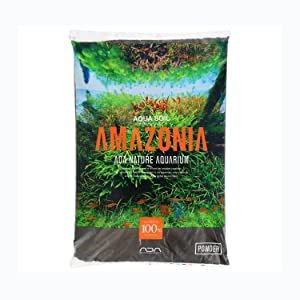
ADA Aqua Soil Amazonia Ver.2 Active nutrient-rich aquasoil High-growth aquascapes with compatible soft-water livestock Can lower pH and release ammonium during startup Official product details
Seachem Flourite Black Stable porous clay gravel Long-term planted tanks where pH should remain unchanged Dusty preparation; fertilizer may still be needed Check on Amazon
Fluval Plant and Shrimp Stratum Lightweight volcanic-soil granules Planted shrimp and soft-water community aquariums Light grains move easily and should not be heavily vacuumed Check on Amazon

Active aquasoil or inert mineral substrate?

Active aquasoil

Granulated soils such as ADA Amazonia are designed to supply nutrients and create mildly acidic water. They are valuable for demanding plants, but they change the aquarium chemically. Fresh soil can release ammonium, lower carbonate hardness and alter pH. It must be cycled and tested before animals are added, and it is unsuitable for livestock that require hard alkaline water.

Stable mineral substrate

Porous clay or basaltic substrates provide root structure and surfaces that hold nutrients without aggressively controlling pH. They can last for the life of the aquarium. Their mineral content does not mean plants receive every required nutrient automatically, so root tabs and balanced water-column fertilization remain part of the plan.

Plain sand or gravel

Many plants grow well in inert sand or fine gravel when the grain anchors roots and nutrients are supplied correctly. This is often the best choice for bottom-dwelling fish needing a smoother bed. Avoid very coarse material that traps waste and very deep fine sand that is difficult to maintain.

Four current planted-substrate options

CaribSea Eco-Planted Black

Best for: a low- to medium-tech planted community tank needing a durable dark substrate.

CaribSea renamed Eco-Complete Planted as Eco-Planted. The Black version uses a porous basaltic base containing several mineral elements, with no artificial dyes, paints or chemical coatings. The existing exact Amazon listing may still show the former Eco-Complete name.

Tradeoffs: the published particle range is broad, so check it against delicate bottom-dwellers. Bacteria packaged with substrate do not instantly cycle a tank; verify zero ammonia and zero nitrite before stocking. Root-feeding plants may still need root tabs.

Check CaribSea Eco-Planted/Eco-Complete Black on Amazon | Manufacturer specifications

ADA Aqua Soil Amazonia Ver.2

Best for: a plant-focused aquascape where nutrient availability and mildly acidic water are deliberate goals.

ADA’s current Ver.2 uses natural black soil and includes a separate Amazonia Supplement. ADA documents that the substrate can create slightly acidic water and that ammonium, nitrite and nitrate can be measurable during startup. This makes it a strong plant substrate but also one that demands patient cycling and water testing.

Tradeoffs: do not rinse the granules; ADA warns that washing can break them down and cloud the water. Pour water gently over a plate, perform water changes as required during setup, and do not add fish or shrimp until ammonia and nitrite are zero. The previously linked Amazon listing was for an older unavailable generation, so no Amazon button is shown.

View ADA Amazonia Ver.2 specifications | Read the official instructions

Seachem Flourite Black

Best for: a long-lived planted substrate that does not alter pH.

Seachem describes Flourite Black as stable porous clay gravel that is not chemically coated, can be used alone and does not need scheduled replacement. It provides a durable root bed without the initial ammonia behavior of nutrient-rich soil.

Tradeoffs: shipping can create dust. Rinse thoroughly, fill slowly and use fine mechanical media while the water clears. Flourite is not a complete fertilizer, so fertilize according to plant demand and water-test results.

Check Seachem Flourite Black on Amazon | Manufacturer specifications

Fluval Plant and Shrimp Stratum

Best for: a planted shrimp or soft-water community aquarium needing lightweight granulated substrate.

The verified 17.6-pound listing is the exact Fluval Plant and Shrimp Stratum product rather than a small accessory bag. The porous granules make planting straightforward and provide extensive surface area.

Tradeoffs: the lightweight grains shift when plants are moved or when a siphon is pushed deeply into the bed. Hover above the surface rather than gravel-vacuuming aggressively. Test pH, KH and GH before choosing livestock, and cycle fully before adding sensitive shrimp.

Check Fluval Plant and Shrimp Stratum on Amazon

Match substrate to plant type

  • Heavy root feeders: Cryptocoryne, Echinodorus and many bulb plants benefit from root-zone nutrients.
  • Stem plants: often use both root and water-column nutrients; substrate alone is not enough.
  • Epiphytes: Anubias, Java fern and Bucephalandra should be attached to rock or wood with the rhizome exposed.
  • Carpeting plants: benefit from fine stable grains, strong appropriate light, balanced nutrients and, for demanding species, carbon dioxide supplementation.

How much substrate?

Calculate from tank length, width and desired depth rather than gallons alone. A common planted layout uses roughly two to three inches, often sloped higher toward the back. Follow the product calculator or coverage instructions because density varies substantially between clay gravel and lightweight aquasoil.

Installation and cycling

  1. Test tap water and define livestock pH, KH and GH requirements.
  2. Read the exact product instructions. Rinse stable mineral substrates when directed; do not rinse granulated aquasoil unless the manufacturer says to.
  3. Place structural rocks on stable supports before building loose substrate around them.
  4. Create the planned slope and plant heavily from the start where practical.
  5. Fill slowly onto a plate or bag to prevent disturbance.
  6. Start filtration, lighting and carbon-dioxide equipment according to the planting plan.
  7. Test ammonia and nitrite frequently. Perform water changes during active-soil startup as needed.
  8. Add animals only after the biofilter is established and parameters are stable and appropriate.

Maintenance and replacement

Remove visible debris from the surface without repeatedly churning plant roots. Use root tabs in depleted zones rather than dismantling a mature aquarium. Stable clay and basaltic substrates can remain indefinitely. Aquasoil granules gradually soften and their nutrient and buffering effects decline; replacement is based on physical breakdown, plant performance and water chemistry, not a universal calendar.

Common mistakes

  • Adding livestock before fresh aquasoil has completed its ammonia and nitrite cycle.
  • Choosing an acidic active soil for hard-water fish or snails without checking compatibility.
  • Assuming a nutrient-rich substrate replaces light, carbon, water-column fertilizer and maintenance.
  • Rinsing aquasoil that the manufacturer says must remain unwashed.
  • Using terrarium soil or unknown garden soil in an aquarium.
  • Installing a bed so deep that routine cleaning and planting become impractical.

Frequently asked questions

Do planted tanks need special substrate?

No. Many plants grow in inert sand or gravel when roots are anchored and nutrients are supplied appropriately. Special soil is helpful for demanding rooted plants and aquascapes but introduces additional chemistry and startup requirements.

Can aquasoil harm fish?

Fresh active soil can release ammonium and change pH or KH. It is safe only after cycling and once the resulting water chemistry matches the species.

Does planted substrate need replacement?

Stable mineral substrates generally do not. Active aquasoil eventually loses buffering and nutrient capacity and may break down; refresh nutrients or replace sections based on actual performance.

Can I cap aquasoil with sand?

Some designed soil systems can be capped, but loose layers often mix during planting and maintenance. Follow the manufacturer’s system instructions rather than combining products at random.

Bottom line

Choose Eco-Planted or Flourite Black for durable, lower-risk long-term beds; choose ADA Amazonia Ver.2 for a deliberately active high-growth aquascape; and choose Fluval Stratum for a lightweight planted shrimp setup. The best result comes from matching substrate chemistry to the livestock, cycling patiently and managing light, carbon and nutrients as a complete system.

Best Filters for Turtle Tanks: 5 Current Options

Turtle in a 10-gallon tank

Disclosure: Aquarium Hunter may earn a commission from qualifying purchases made through links on this page, at no extra cost to you.

Aquatic turtles produce much more solid waste than a lightly stocked fish aquarium. The best turtle-tank filter therefore needs generous mechanical-media capacity, dependable biological filtration, easy maintenance and an intake that works at the habitat’s actual water depth. For most full-size turtle aquariums, a canister filter is the most practical choice.

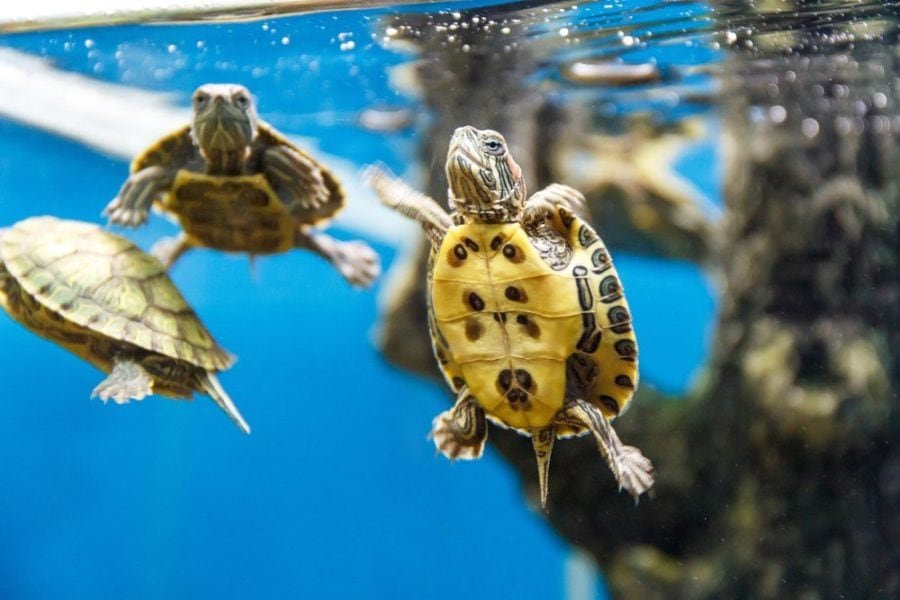
Aquatic turtles swimming in a filtered aquarium
A strong filter helps manage turtle waste, but it does not replace partial water changes, substrate cleaning or an appropriately sized habitat.

Quick comparison

Filter Manufacturer aquarium rating Best for Buying option
Fluval 407 50–100 gal Best all-round canister Check on Amazon
Fluval FX4 Up to 250 gal Large, heavily stocked turtle habitats Check on Amazon
Penn-Plax Cascade 1000 Elite Confirm current model rating Value canister option Check on Amazon
Zoo Med Turtle Clean 50 Turtle habitats up to 50 gal Purpose-built smaller turtle setup Check on Amazon
Tetra ReptoFilter 125 GPH Check habitat volume and water depth Shallow juvenile or small-species setups Check on Amazon

Rating caution: a fish-aquarium capacity printed on a box is not a promise that the filter can manage the waste of a turtle in a tank of that size. Compare actual circulation, media volume, intake-depth requirements and maintenance access, and choose generous capacity.

Best filters for turtle tanks

1. Fluval 407 — best overall

The Fluval 407 balances useful media capacity with manageable size. Fluval rates it for 50–100-gallon aquariums, with 383 GPH pump output, 245 GPH stated filter circulation and 4.2 liters of basket volume. Multiple baskets let you separate coarse mechanical media, finer pads and durable biological media.

It is a strong fit for a medium turtle habitat when the installed water depth and plumbing allow the canister to prime and operate correctly. As waste accumulates, real flow will fall, so clean the mechanical stages before they become packed without sterilizing all biological media.

Check the Fluval 407 on Amazon · See Fluval specifications

2. Fluval FX4 — best for a large, messy setup

The FX4 offers substantially more canister and mechanical-media area for a large turtle aquarium. Fluval lists a 700 GPH pump output, 450 GPH filter circulation, 3.7-gallon canister volume and 1-gallon biological-media volume. The utility valve can also help with controlled water removal during maintenance.

This filter is physically large and produces meaningful current. Check cabinet clearance, hose routing, outlet placement and the turtle’s ability to rest and swim without being pushed continuously. Manufacturer aquarium ratings should still be treated conservatively for turtles.

Check the Fluval FX4 on Amazon · See Fluval specifications

3. Penn-Plax Cascade 1000 Elite — value canister option

The Cascade 1000 Elite is a multi-basket external canister that provides space for staged mechanical, biological and optional chemical media. It can be a useful lower-cost alternative to premium canisters for a medium habitat.

Penn-Plax sells several Cascade sizes with similar names. Confirm the exact model, current flow and aquarium rating, included media, hose dimensions and replacement-part availability before ordering. Size for the turtle’s adult habitat, not only its current juvenile tank.

Check the Penn-Plax Cascade 1000 Elite on Amazon

4. Zoo Med Turtle Clean 50 — purpose-built compact canister

Zoo Med designed the Turtle Clean 50 for turtle tanks, tubs and similar habitats up to 50 gallons. The company lists 200 GPH, mechanical, biological and chemical media, easy priming and an included spray bar.

This model is useful when a standard aquarium canister’s intake arrangement does not suit a smaller turtle setup. Zoo Med says the motor head should be level with or below the waterline, so confirm that the planned water depth and stand position meet the installation requirements.

Check the Zoo Med Turtle Clean 50 on Amazon · See Zoo Med setup and maintenance guidance

5. Tetra ReptoFilter 125 GPH — for shallow smaller habitats

The internal Tetra ReptoFilter is intended for terrariums and turtle setups where a conventional canister intake may not work at the lower water level. Its 125 GPH rating and compact internal design suit a smaller habitat or juvenile setup rather than a large adult turtle aquarium.

Internal filters occupy swimming space and hold less waste than large canisters, so expect more frequent service. Guard the cord and installation so a turtle cannot dislodge the filter, become trapped or rest against an unsafe intake.

Check the Tetra ReptoFilter 125 GPH on Amazon

How to size a turtle filter

Start with the adult habitat

Identify the turtle species and expected adult shell size before choosing the tank or filter. Many commonly sold aquatic turtles grow far larger than buyers expect. A filter purchased for a small juvenile enclosure may become inadequate quickly.

Favor media capacity over headline flow

High flow helps carry waste to the intake, but a turtle filter also needs room to trap solids without clogging and to support a stable biofilter. Compare basket volume, sponge area and maintenance access. Advertised pump output is measured under favorable conditions; real circulation falls with hose height, media and accumulated debris.

Check minimum operating water depth

A turtle habitat may be only partly filled to provide a basking area or prevent escape. Canister filters depend on specific intake and canister placement for priming. Internal filters also have minimum and maximum waterline requirements. Follow the exact model’s instructions.

Control the current

Strong circulation should not pin a turtle against a surface or prevent it from resting. Aim outlets along a wall, use a spray bar where approved, and leave calm areas. Never improvise a restriction that overheats the motor or creates unsafe suction.

Recommended media arrangement

  1. Coarse mechanical foam first to collect food pieces, shed skin and large waste.
  2. Finer mechanical media to polish smaller suspended particles.
  3. Durable biological media in oxygenated flow after most solids are removed.
  4. Optional carbon or specialty media only for a defined purpose and according to its instructions.

Carbon can help with odor or removing certain medications after treatment, but it is not a substitute for an established biological filter or water changes. Zeolite and ammonia-binding products have finite capacity and should not be used to avoid cycling the habitat.

Maintenance without losing the biofilter

Turtle filters collect solids quickly. Inspect flow and service mechanical media before it becomes heavily clogged. Rinse reusable sponges in removed tank water and replace fine disposable pads when they break down. Biological media usually needs only gentle partial rinsing when debris restricts flow.

Do not replace every sponge, cartridge and biological medium on the same day. Beneficial microorganisms live on these surfaces, and removing them can cause ammonia or nitrite to rise. Test both after major maintenance, a long power interruption or any unexplained change in water quality.

Filtration does not replace water changes

A filter converts and traps waste; it does not remove everything from the system. Perform regular partial water changes, siphon settled debris and remove uneaten food. Use a conditioner appropriate for chlorine or chloramine in the source water and match the replacement-water temperature reasonably closely.

Frequency depends on habitat volume, turtle size, feeding and test results. Ammonia and nitrite should remain at zero in a cycled habitat. Rising nitrate, odor or cloudy water calls for testing and corrective maintenance rather than a fragrance or clarifying product.

Installation and electrical safety

  • Use a GFCI/RCD-protected outlet and form drip loops in all cords.
  • Keep power connections dry and unplug equipment before putting hands in the water.
  • Secure intakes, outlets and hoses so a strong turtle cannot detach them.
  • Use an intake guard and inspect it for blockage; protect small turtles from unsafe suction.
  • Keep the filter accessible—equipment that is difficult to service is more likely to be neglected.
  • Never run a canister or submerged motor dry.

Frequently asked questions

Does a turtle tank really need a filter?

Yes. A filter is essential for dependable mechanical and biological waste processing, but it must be combined with water changes and cleaning.

Can I use a fish-tank filter for a turtle?

Yes, if it works at the habitat’s water depth, offers generous real-world capacity and can be installed safely. Manufacturer fish-aquarium ratings should be treated conservatively because turtles create a heavy waste load.

How often should I clean a turtle filter?

Clean mechanical stages when flow declines or collected debris begins to accumulate substantially. The interval varies with the turtle, tank and filter. Preserve biological media and never wait until the filter is completely blocked.

Can I turn the filter off at night?

No. Biological filtration needs continuous oxygenated flow. Extended shutoff can damage the biofilter and allow stagnant water to develop inside a canister.

Our verdict

The Fluval 407 is the most balanced option for a medium turtle habitat. The Fluval FX4 provides substantially more media capacity for a large or heavily stocked setup, while the Zoo Med Turtle Clean 50 is the best purpose-built compact choice. Size every filter for the adult animal and actual installation rather than trusting the box rating alone.

Best 20-Gallon Fish Tank Kits: 5 Current Options

Best 20-Gallon Fish Tank Kits: 5 Current Options

A 20-gallon aquarium is one of the most practical starting sizes for freshwater fish. It provides more stable water conditions and more stocking flexibility than a small desktop tank, while remaining manageable in most homes. The best kit is not simply the one with the longest accessory list: the tank’s footprint, filtration, heater, lighting and availability of replacement parts all matter.

Established freshwater aquarium suitable for a 20-gallon fish tank setup
A well-planned 20-gallon aquarium gives fish useful swimming room and is easier to keep stable than a very small tank.
Our quick recommendation: The Tetra Complete LED 20-Gallon Kit is the most complete conventional starter package here. The Marina is a good alternative if you are happy to confirm or add a heater, while the SeaClear suits buyers who specifically want an acrylic aquarium.

Quick comparison

Model Best for Important point Buying option
Tetra Complete LED 20 Most complete starter package Includes heater and filtration Check on Amazon
Marina 20 Gallon LED Simple rectangular starter tank Confirm current contents and heater needs Check on Amazon
Marineland BIO-Wheel LED Established filtration design Day and night LED modes Check on Amazon
SeaClear Acrylic Combo Lightweight acrylic option Core equipment may need to be added Check on Amazon
Marineland Exhibit Series 20 Premium integrated setup Square footprint and manufacturer availability View manufacturer details

Product bundles can change. Check the seller’s current listing for the exact equipment, dimensions and warranty before ordering.

1. Tetra Complete LED 20-Gallon Aquarium Kit

Best for: beginners who want the core equipment in one package.

Tetra’s conventional 20-gallon glass kit combines a 24 x 12 x 16-inch aquarium with an LED hood, PF20 filtration, a 100-watt heater and thermometer. That makes it the easiest option in this list for setting up a heated tropical community, although you still need substrate, décor, a water conditioner, test supplies and a suitable cycling plan.

The included filter is appropriate for a sensibly stocked community, but no kit compensates for overstocking or missed maintenance. Preserve the biological media when cleaning and replace cartridges only when genuinely necessary, rather than discarding all established media at once.

Check the Tetra kit on Amazon   Manufacturer specifications

2. Marina 20 Gallon LED Aquarium Kit

Best for: shoppers wanting a straightforward rectangular glass tank.

The Marina kit is built around a familiar 20-gallon rectangular aquarium and includes filtration and LED lighting in the current Amazon listing. It is a clean foundation for a planted community tank, but bundle contents can vary. Confirm whether the current package includes a heater; if it does not, choose a thermostatically controlled heater sized for the aquarium and your room temperature.

Check the Marina kit on Amazon

3. Marineland BIO-Wheel LED Aquarium Kit

Best for: buyers who value an established hang-on-back filtration format.

This kit pairs a 20-gallon glass aquarium with Marineland’s BIO-Wheel-style filtration and an LED hood with daylight and night-light settings. The filter is easy to access for routine maintenance, and permanent biological surfaces can help support the nitrifying bacteria that process fish waste.

Check the live listing carefully because older aquarium-kit SKUs sometimes remain online after package contents change. Base your decision on the current seller description, not an old product photo or review.

Check the Marineland kit on Amazon   Manufacturer information

4. SeaClear 20-Gallon Acrylic Aquarium Combo

Best for: aquarists who specifically prefer acrylic.

The SeaClear combo is a 20-gallon acrylic aquarium measuring approximately 24 x 13 x 16 inches. Acrylic is lighter than glass and can offer excellent clarity, but it scratches more easily. Use cleaning tools specifically marked safe for acrylic and keep gravel away from the cleaning surface.

This is better viewed as an aquarium-and-lighting foundation than a truly complete starter kit. Budget separately for appropriate filtration, heating where required, a thermometer and testing supplies.

Check the SeaClear combo on Amazon

5. Marineland Exhibit Series Wi-Fi LED Kit

Best for: a premium display with integrated equipment.

The current Exhibit Series 20 takes a different approach from a standard rectangular starter kit. It uses an approximately 18 x 18-inch square footprint, integrated filtration, a heater, Wi-Fi-controlled lighting and a matching stand. The presentation is tidy, but its footprint produces different swimming space from a conventional 24-inch tank, so choose livestock around usable dimensions rather than gallon count alone.

No exact Amazon listing was verified for this current model, so the link below goes to the manufacturer rather than to a merely similar product.

View the Exhibit Series specifications

How to choose a 20-gallon aquarium kit

Long versus high tanks

Two tanks can hold roughly the same volume but provide very different living space. A longer footprint usually gives active fish more horizontal swimming room and offers more surface area for gas exchange. A taller or square tank may fit a particular room better, but it should not be treated as interchangeable for every species.

Filtration

Look for steady circulation, room for mechanical and biological media, accessible replacement parts and a flow rate suitable for the intended fish. Bettas and other slow-water fish may need gentler or baffled flow, while messy inhabitants require more waste-handling capacity. Filter turnover figures are only a starting point.

Heating and lighting

A heater is necessary for most tropical fish but may not be appropriate for every cool-water setup. Select one with thermostatic control and verify temperature with a separate thermometer. Kit lights are generally adequate for viewing and low-demand plants; demanding plants may need a better light with known output and a timer.

Stand and total weight

A filled 20-gallon setup commonly weighs more than 225 pounds once the tank, water, substrate and décor are included. Use a level stand designed to support the aquarium’s full footprint, and follow the tank manufacturer’s support requirements. Never rely on furniture simply because the aquarium fits on top.

Setting up the tank safely

  1. Rinse the empty aquarium with plain water and inspect it for damage. Do not use household soap.
  2. Position it on a suitable, level stand away from direct sun and temperature extremes.
  3. Add rinsed substrate and securely placed décor, then fill with conditioned water.
  4. Install the filter, heater and thermometer according to their instructions. Create drip loops on electrical cords and use a protected outlet where appropriate.
  5. Complete a fishless nitrogen cycle and confirm that the tank can process ammonia before adding fish.
  6. Add compatible livestock gradually and continue testing ammonia, nitrite, nitrate and temperature.

What can live in a 20-gallon tank?

Appropriate choices depend on adult size, temperament, social requirements, activity and the tank’s footprint. Possible plans include a carefully researched small community, a single betta with compatible tank mates, or a species-focused setup for suitable nano fish. Schooling fish still need an adequate group, and territorial species need sight breaks and usable floor space.

A 20-gallon tank is not automatically suitable for common goldfish, large cichlids, large plecos or other fish that quickly outgrow it. Avoid the old “one inch per gallon” rule; it ignores body mass, behaviour and waste production.

Frequently asked questions

Is a 20-gallon tank good for beginners?

Yes. Its additional water volume is more forgiving than a very small aquarium, provided it is fully cycled and maintained consistently.

How often should it be cleaned?

Many established tanks benefit from a partial water change and light substrate cleaning each week, but the exact schedule depends on stocking, feeding, plants and test results. Do not completely strip-clean a healthy aquarium or replace all biological media at once.

Does a complete kit include everything?

No. Even a well-equipped kit usually still needs water conditioner, a liquid test kit, substrate, décor, food, maintenance tools and species-appropriate additions. Livestock should only be added after cycling.

Final verdict

For a conventional heated freshwater setup, the Tetra Complete LED 20 is the strongest all-round starter package in this group. The Marina and Marineland BIO-Wheel kits are sensible alternatives when their current bundle contents match your needs. Choose the SeaClear for acrylic construction, or the Exhibit Series for a premium integrated display. Whichever tank you select, adult fish requirements and a properly completed nitrogen cycle matter more than the accessory count on the box.

Affiliate disclosure: Aquarium Hunter may earn a commission from qualifying Amazon purchases, at no additional cost to you. Recommendations are based on product suitability and verified listing matches.

15 Best LED Flame Bulbs in 2023 (Reviews & Guide)

15 Best LED Flame Bulbs in 2023 (Reviews & Guide)

Discover the best LED flame bulbs of 2023 for creating a warm, welcoming ambiance in any room, a safe and practical alternative to traditional candlelight.

Comparison Table

If you crave candlelight but want something more efficient and reliable, you’re in luck.

The best-LED bulbs give you the appearance of a candle without problems, and they do it at a fraction of the cost of a normal flame bulb.

You look at your room and think “Oh! Well, I need to add a piece of decoration here.” Fortunately, we have a suggestion for you; just look for a LED flame lamp.

Unlike conventional lighting systems, LED bulbs mimic the real flame with their dancing lights. Most also produce lights with colors close to the true color of fire.

In addition, these bulbs can be used to decorate both indoors and outdoors. In addition, they are perfect for events and special occasions.

We believe they are exactly what you need. This is why we took it one step further to present the following 10 best-LED lamps in 2022 reviews.

If you are looking for a way to add decorative light to your space while respecting the environment, LED flame lamps could be just what you are looking for.

The combination of aesthetic pleasure and energy-saving function is hard to beat. Read the 15 best reviews of LED flame lamps to find the right choice for your space.


Best LED Flame Bulb Reviews


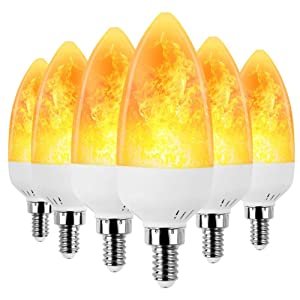
1. HUDSON LED Flame Effect Light Bulb

best LED flame bulbs

This LED bulb from Hudson Lighting produces realistic flames that automatically rotate with the bulb. So regardless of how you screw it in, the flame is always realistically oriented.

You can use it on any lamp, but it looks best with frosted glass or when used on a salt lamp.

If you are looking for a single bulb, this is a great option. In addition to looking good, it also uses LED technology to save energy. Each emits 200 lumens of light with a 360-degree beam angle and consumes just 3 watts of electricity.

In addition to the 100% satisfaction guarantee, this bulb is covered by a 2 year warranty. If something doesn’t work properly, it’s covered.

This light bulb creates a warm atmosphere that works both indoors and outdoors, at any time of the year.

Check Price On Amazon

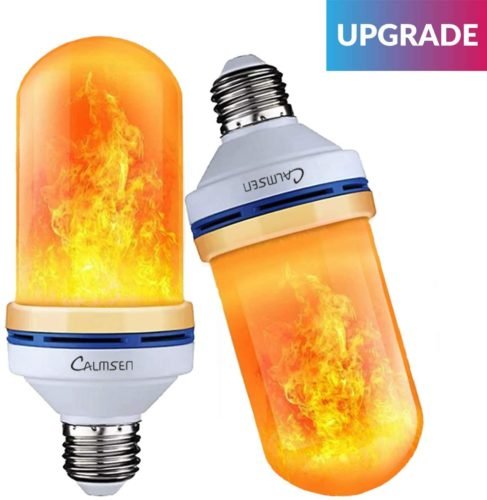
2. Calmsen LED Light Bulbs

best LED flame bulbs (Calmsen)

Providing a realistic flame effect, here is an LED flame bulb that produces the excellent flicker effect. It is available in frosted glass shade and allows you to choose from four different modes.

Furthermore, it has a built-in gravity sensor mode and allows you to use it conveniently. Additionally, the product comes with a powerful construction and can last 100,000 hours.

This is suitable for a wide range of applications, and you can easily use it in decorative places. The product is also eco-friendly and allows you to save energy.

Plus, it saves you 90% on electricity, making it an ideal replacement for your existing gas light. It can be perfect for improving your lifestyle and it comes with an automatic rotation function.

Check Price On Amazon

3. Y- STOP LED Flame Effect Fire Light Bulb


best LED flame bulbs (firelight bulb)

The Y-STOP LED bulb has 4 different modes: flame simulation mode, general light mode, gravity detection mode, and breathing mode.

It also has a gravity sensor that automatically adjusts the flame to keep it upright.

This bulb can be used in any lamp, but works best with a satin shade, flashlight, or salt lamp. The color is the same as a real flame but without the dangers of a traditional candle.

As it uses LED technology, this bulb saves up to 90% of the energy consumption of traditional bulbs. It uses 90 LEDs and produces 320 lumens of light.

The aluminum substrate provides good heat dissipation that helps the bulb last up to 5,000 hours.

Check Price On Amazon

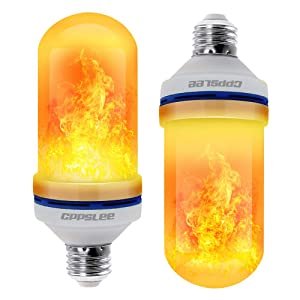
4.CPPSLEE LED Flame Effect Light Bulb (2 Pack)


In addition to 2 packages, the CPPSLEE LED Flame Effect bulb is available in 6 packages and one package so you can choose the most suitable number for you.

The bulb is also easy to install with its fixing screws for fire installation and fixing screws for fire installation. Plus, it saves up to 90 percent electricity; therefore, don’t expect a dramatic increase in your electric bills.

You will find it useful to decorate your room. And all it takes to get it is to install it in a frosted glass shade, salt lamp, or flashlight.

Check Price On Amazon

5. Omicoo LED Flame-Effect Light


best LED flame bulbs (Omicoo)

These Omicoo LED bulbs use 108 LEDs each and have advanced heat dissipation technology for an extended life of up to 100,000 hours.

This is a standard size 2-bulb package and comes with a 30-day money-back guarantee.

With 4 different modes, you have a lot of control over the lighting effects. Choose between flame emulation mode, breathing mode, general light, and inverted mode.

All you have to do is turn the light on and off to change the mode and it will reset to flame mode after going off for 45 seconds.

This bulb can be used in any lamp, but it will produce better flame effect behind satin lampshade or salt lamp.

Check Price On Amazon

6. LED Flame Effect Light Bulbs by HoogaLife


best LED flame bulbs (Hoogalife)


Available in a two-pack, this LED flame bulb offers visual warmth. In this, you will find a color of fire that creates an incredible atmosphere. Also, this is very easy to use and you can perfectly fix it on your standard light bulb. It also has wide applications and is available in an innovative design.

Additionally, the product uses little energy, which helps reduce electricity bills. It imitates the appearance of a real flame and is suitable for all kinds of occasions.

Also, this will give you the advantage of using it in your outdoor street light, indoor floor lamp, garage lights or ceiling light. It is perfectly sized and has proprietary LED technology with an enthusiastic gas lantern effect.

Check Price On Amazon

7. LEDERA LED 


The LEDERA bulb has a 360 degree beam angle, 1300K true fire color and consumes just 2 watts of power.

This represents 90% energy savings compared to traditional light bulbs that save electricity and save money on your electric bill. Also, this is a pack of 2, so get more for your money.

This light bulb can be used in almost all decorative lamps and creates a nice effect when used outdoors, in chandeliers or even as Halloween or Christmas decoration. It is a great option when you are looking to create an intimate and romantic atmosphere.

Check Price On Amazon

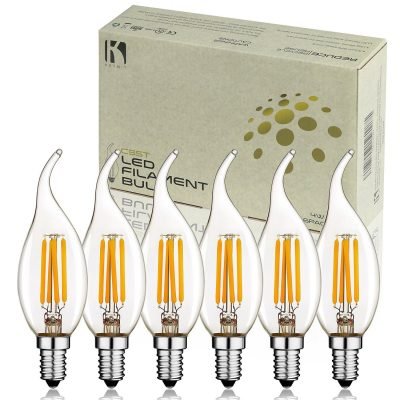
8. Keymit UL-492997 4W LED Bu


As for security, we believe the Keymit 4W LED Bulb Set is the best. Manufactured with the Epistar chip and certified by CE, ROHS and E492997 with UL certification, these bulbs are considered among the safest on the market today.

Plus they’re 100 percent dimmable and works with an old dimmer. They are also tested to illuminate up to 30,000 hours so that they can offer constant vision for several years.

Another thing we love about these LED bulbs is the fact that they are designed for indoor and outdoor use. We are sure you will like how they work.

Check Price On Amazon

9. CPPSLEE LED Flame Effect Light Bulb


This CPPSLEE bulb has 4 different modes: Breathing Mode, General Light Mode, Gravity Induced Mode, and of course, Flame Emulation. Automatically switch modes when the light turns off and on.

With 105 LEDs, this bulb saves 90% of the electricity used by traditional flame lamps. It uses just 1.8 watts to produce 150 lumens and has excellent heat dissipation for a lifespan of up to 50,000 hours.

The true color of fire and the flicker effect look better when used behind frosted glass or in a salt lamp.

You can use it indoors or outdoors and it’s a great way to create a warm and inviting atmosphere. This standard size 2-bulb package is covered by a lifetime warranty.

Check Price On Amazon

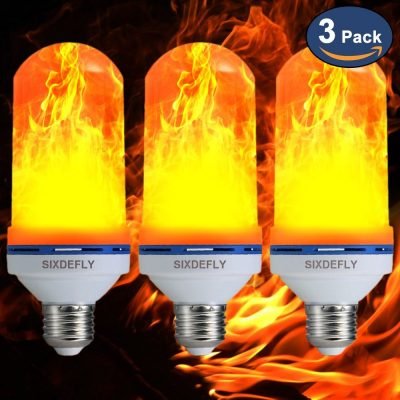
10. SIXDEFLY Flame Effect LED Light Bulbs (3-Pack)


We do not expect the flame light to turn it on continuously. This is why we created these bulbs which have three modes. They can switch from flame mode to normal light mode or breathing mode, depending on how you want it. These bulbs can also be used anywhere, anytime thanks to their accurate design. They look good in a room and we are sure you will love them for this. In addition, they are affordable and even covered by a full warranty for a risk-free purchase.

Check Price On Amazon

11. Flickering Flame Shaped Bulbs Menorah Replacement Bulbs


best LED flame bulbs (Menorah)

If you are looking for something that not only recreates the blink of an eye, but actually remembers the shape of an open flame, take a look at these light bulbs from the Dreidel company.

Please note that this bulb is of F7 size and only compatible with some lamps.

This 10 pack is perfect for lighting a menorah and fits all standard and deluxe options.

Each bulb has 1 watt of power, so even if it doesn’t emit a lot of light, each bulb is warm and beautiful, just like a real candle flame.

Check Price On Amazon

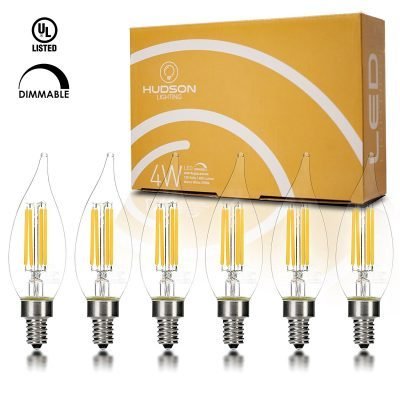
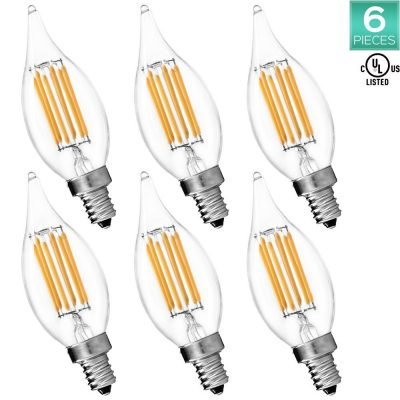
12. HUDSON LIGHTING Flame Tip Candelabra Bulbs (6 Pack)


best LED flame bulbs (Hudson Lighting)

You won’t believe you get these bulbs for a similar price. To make things even better, this package comes with a 2-year warranty and is UL Listed to give you peace of mind while in use.

The box has six bulbs, which are dimmable and use just 4 watts to help you save a lot in the long run. The bulbs are also stylish, and therefore perfect for chandeliers, ceiling fans, and porch lights, among other applications. Each of them has 400 lumens and lasts up to 20,000 hours.


13. KINDEEP E12 LED Flame Effect Light Bulb


best LED flame bulbs (Kindeep E12)

KINDEEP bulbs closely simulate natural flames without the risk of fire.

The 360 degree beam angle offers excellent lighting and the use of flickering light mode. The mode changes automatically when the light turns off and on.

These bulbs have a chandelier base that fits most decorative lights or chandeliers and the warm color closely resembles a real open flame. These lights are suitable for most chandeliers, candlesticks and decorative lamps.

Each bulb in this 6-pack packs 300 lumens of light with just 3 watts of power and has a long lifespan. If you have problems with these bulbs, don’t worry. They are covered by a one year warranty.

Check Price On Amazon

14. Luxrite Candelabra LED E12 Bulb (6 Pack)


best LED flame bulbs (Luxrite)

Unlike most LED bulbs, Luxrite E12 LED bulbs feature a vintage design that contributes to their distinctive quality. These bulbs are also eco-friendly and save up to 90 percent of energy.

Well, all these features are enough to start thinking about whether you can get these bulbs or not. But if you are not convinced enough, you can also see the bright color of these bulbs.

Well, the color is vibrant and quite similar to the natural light source, which means you can use it to decorate your living space.

Check Price On Amazon

15. YEAHBEER E12 Flame Bulb LED Candelabra Light Bulbs


best LED flame bulbs (cANDELABRA)

Finally, this YEAHBEER chandelier bulb. It is based on the classic original Edison filament bulb that adds warm and welcoming light to your home. This is the perfect size for most decorative lighting or chandeliers.

This bulb has been designed with excellent heat dissipation which protects the bulb components for longer life. It lasts up to 50,000 hours and consumes only 1.2 watts, 90% less energy than standard bulbs.

Check Price On Amazon

YOU MAY ALSO LIKE BELOW 


How to Choose the Best LED Flame Bulb?

There are a few things to consider when choosing the right LED bulb. Not all LED lights are created equal, so you should know what you are looking for.

Here are some key things to keep in mind:

Price. You should have an idea of what you can spend before making any purchases, but you should always make sure that you get the most out of your money. The same goes for these bulbs.

Duration. Some of these bulbs have a significantly longer lifespan than others. With that said, LED bulbs generally last much longer than regular bulbs, so remember that any LED bulb pays off.

Size. Not all of these bulbs are the same size. Some of our options are designed for standard lamps, while others are made for decorative lights, chandeliers or chandeliers. Check the lamps and plugs to make sure they are the correct size.

You will see different sizes in the products we have chosen for our list: E26, E12 and F7. E26 adapts to a standard light socket, E12 is generally designed for decorative lighting such as lanterns and chandeliers and F7 is a special size that adapts to electric menorahs etc.

Modes. Some of these bulbs are available in multiple modes and can be used without flicker or in light breathing mode.

You may have noticed that some of these bulbs have gravity sensors that “flip” the flame when installed upside down. This is to ensure that the light appears as realistic as possible by always orienting the “base” of the flame.

Number. We have found products that are supplied as single bulbs and some multiple packages. Whether you are looking for a light bulb for your salt lamp, some light bulbs for a chandelier or a complete set for an electric menorah, there is an option for you.


Benefits of Using a LED Flame Bulb

There are some real advantages to using an LED bulb itself:

1. They are energy efficient. LED bulbs use a fraction of the energy produced by ordinary bulbs. Although they may cost a little earlier, they consume up to 90% less energy. Over time, this can save you money on energy bills.

2. They are convenient. Some of these bulbs last up to 100,000 hours, which means you won’t have to replace them frequently. In fact, they can last for decades depending on how many hours you wear them every day.

3. They work well. While standard bulbs can get quite hot, LED bulbs are much cooler to the touch. This is a great feature if you have curious children in your home and you can leave them for long periods of time without worry.

Advantages of using an LED bulb

Standard LED bulbs emit 180 degree light, which makes sense if it is normal light. Aim the light from the top of the bulb and out, which is exactly where you want it when the normal light comes on.

Flame bulbs are slightly different in that their use is primarily decorative and are designed to mimic a candle. That is why you will see that some of these bulbs emit 360 degrees of light, like a real flame.


What about LED Flame Bulbs?

Now, LED bulbs have some great benefits in addition to their LEDs. If you are looking for the perfect lighting to create a cozy and inviting room or you want the space to be a little more romantic, you can’t go wrong with a flame bulb.

These bulbs are designed to mimic flames in every way. They’re the right color, emit the same amount of light, and even flicker for a truly lifelike appearance.

Get all the benefits of a beautiful candle flame without any of the dangers. Plus, you never have to worry about turning it on or cleaning dirty wax.

There are many uses for these bulbs as well. You can use them in decorative lamps and lanterns, as external lights for a warm night glow or even in Christmas decorations such as lanterns and Christmas lights.

You may have noticed that many of these bulbs are recommended for use with frosted glass, salt lamps, or flashlights for best results.

This does not mean that you cannot use them with any compatible lamp, but these particular lights help to produce a more natural effect.


Final Thoughts

LED bulbs are the perfect way to add atmosphere to a room. They give you the appearance of a real hot candle flame without safety concerns. In addition, using LED light, they are energy efficient and durable.

There are many options and we hope that our reviews and the best LED flame bulbs options will help you find the right one for you.

By choosing the best rated LED bulb, you will get a splendid lighting effect that will not only save energy, but will also last for many years.


Best Flameless Candles 2023 Reviews & Guide

Under Cabinet LED Lighting (2023 Reviews & Guide)

Best Ceiling Lights for Kitchen 2023 Reviews & Guide

Best Betta Filters: 5 Gentle, Effective Options

Best Betta Filters: 5 Gentle, Effective Options

Disclosure: As an Amazon Associate, Aquarium Hunter earns from qualifying purchases.

A betta filter should keep ammonia and nitrite at zero without forcing the fish to fight a strong current. For most single-betta aquariums, the best choice is a small adjustable filter or a properly sized sponge filter. Our top pick is the AquaClear 20 for tanks from 5 to 20 gallons because its flow can be reduced and its media basket is easy to customize.

Important: manufacturer tank ratings are only a starting point. Observe your fish after installation. If the betta is pushed sideways, hides constantly, cannot reach food, or has fins pulled toward the intake, reduce or diffuse the flow and fit an intake sponge.

Best Betta Filters: Quick Comparison

Filter Best for Flow control Amazon
AquaClear 20 Best overall, 5–20 gallons Adjustable; may still need a baffle View on Amazon
Penn-Plax Cascade 20 Compact tanks Adjustable View on Amazon
Aqueon QuietFlow Internal 10 Quiet internal installation Adjustable placement; baffle as needed View on Amazon
Marina S10 Slim hang-on-back option Adjustable View on Amazon
Tetra Whisper Internal 5–10 Simple internal filtration Fixed; intake sponge/baffle recommended View on Amazon

Do Betta Fish Need a Filter?

Yes, a filter is strongly recommended. Bettas can breathe air at the surface with their labyrinth organ, but that does not protect them from ammonia, nitrite, dissolved waste, or unstable water conditions. A filter gives beneficial bacteria a large, oxygen-rich surface where they convert toxic ammonia to nitrite and then nitrate.

A filter does not eliminate routine maintenance. Test the water and perform regular partial water changes based on the results and the tank’s stocking. Never replace all mature filter media at once, and rinse reusable sponge or biomedia gently in removed aquarium water rather than untreated tap water.

1. AquaClear 20 — Best Overall

AquaClear 20 filter for a betta tank

The AquaClear 20 is currently listed for 5- to 20-gallon aquariums. Its roomy media basket lets you use sponge and biological media without relying entirely on disposable cartridges. The output is adjustable, which makes it easier to tune than a fixed-flow filter.

Even at its lowest setting, a long-finned betta may need a sponge on the intake and a simple output baffle. Keep the aquarium water level high so the returning water does not create a steep waterfall.

Pros: adjustable flow, reusable media, flexible media basket. Cons: occupies space behind the tank and may require baffling.

Check the AquaClear 20 on Amazon


2. Penn-Plax Cascade 20 — Best Compact Hang-On Filter

Penn-Plax Cascade 20 nano aquarium filter

The Cascade 20 is a mini hang-on-back filter with adjustable flow and compact dimensions. It suits a small aquarium where space inside the tank is limited. Its leveling adjustment helps keep the unit positioned correctly, while the intake extension lets you choose where water is drawn from.

The small media area clogs faster than a larger filter, so inspect it frequently. Avoid treating a printed cartridge-replacement schedule as mandatory: preserve established biological media whenever it remains intact, and replace chemical carbon only when it has a specific job.

Pros: compact, adjustable flow, straightforward access. Cons: small media capacity and possible waterfall noise if the water level drops.

Check the Cascade 20 on Amazon


3. Aqueon QuietFlow Internal 10 — Best Quiet Internal Filter

Aqueon QuietFlow internal filter for betta fish

This internal model keeps the motor underwater, which can reduce mechanical and waterfall noise. It is designed for small aquariums and can be positioned to limit surface disturbance. Internal filters also allow the tank to sit closer to a wall.

The tradeoff is that the unit uses swimming space and must be unplugged before maintenance. Protect the intake, position the outlet away from the betta’s preferred resting area, and make a drip loop in the power cord.

Pros: quiet, space-saving outside the aquarium, flexible placement. Cons: uses interior space and may need an intake sponge.

Check the Aqueon QuietFlow 10 on Amazon


4. Marina S10 — Best Slim Hang-On-Back Filter

Marina S10 power filter for a betta aquarium

The Marina S10 is listed for aquariums up to 10 gallons. Its slim body and adjustable flow are useful where a bulky power filter would be awkward. The submerged motor is self-priming, so it should restart without the manual priming required by some hang-on filters.

As with every intake-driven filter, add a prefilter sponge if the slots can catch fins, shrimp, or fry. A prefilter also adds biological surface area, but it must be rinsed when debris restricts the flow.

Pros: slim design, adjustable output, simple restart. Cons: cartridge-based layout and limited media space.

Check the Marina S10 on Amazon


5. Tetra Whisper Internal 5–10 — Best Simple Internal Option

Tetra Whisper internal filter for 5 to 10 gallon tanks

The current Tetra listing covers 5- to 10-gallon aquariums and uses mechanical, chemical, and biological filtration. It clips inside the tank and is easy to access. It is inexpensive and widely supported with replacement media.

Its flow is fixed rather than truly adjustable, and recent buyer feedback includes reports of strong intake and output for small or weak fish. For a betta, we would only use it with a correctly fitted intake sponge and an output baffle if observation shows the fish struggling.

Pros: simple, quiet motor, easy-to-find media. Cons: fixed flow, significant interior footprint, and extra protection may be necessary.

Check the Tetra Whisper Internal on Amazon

What About Sponge Filters?

An air-driven sponge filter is often the gentlest choice for a betta, shrimp, fry, or a hospital tank. Water drawn through the sponge receives mechanical and biological filtration; beneficial bacteria on the sponge process ammonia and nitrite. It is incorrect to say a sponge filter provides only mechanical filtration.

You need a separate air pump, airline, check valve, and usually a control valve. Select a sponge rated for the tank, place the check valve in the correct direction, and keep the pump above the waterline or use a proper anti-siphon arrangement. Because models change frequently, compare current sponge filters on Amazon and verify the included accessories.

How to Choose a Betta Filter

Flow matters more than headline turnover

A filter rated for the tank is not automatically betta-safe. Long fins create drag, and individual fish vary. Adjustable flow, a broad outlet, a spray bar, or a baffle can make the current usable. Do not switch filtration off for long periods to solve a flow problem.

Protect the intake

A coarse prefilter sponge prevents fins, food, shrimp, and plant debris from entering the impeller. It also provides extra bacterial surface area. Choose one that fits securely without starving the pump of water.

Keep biological media mature

Most beneficial bacteria live on surfaces, especially sponge and biomedia. Clean media only when flow drops, using removed tank water. Replacing every cartridge at once can remove much of the biofilter and trigger an ammonia or nitrite spike.

Size the filter to the real aquarium

Use actual water volume after substrate and decor, stocking level, flow tolerance, and media capacity—not marketing alone. A five-gallon aquarium is a practical minimum starting point for one betta because it is easier to heat, filter, and stabilize than a bowl.

Setup and Safety Checklist

  • Cycle the aquarium before adding the fish and test ammonia, nitrite, nitrate, and pH.
  • Fit an intake sponge where fins could reach the intake.
  • Keep a clear route to the surface because bettas breathe atmospheric air.
  • Use a lid, heater, and gentle but continuous filtration.
  • Make drip loops and use a GFCI-protected outlet where available.
  • Unplug electrical equipment before putting hands into the tank.
  • After maintenance, confirm the filter restarts and water is flowing normally.

Frequently Asked Questions

How often should I clean a betta filter?

Clean it when debris noticeably reduces flow rather than on a rigid calendar. Many small filters need attention every few weeks, but the interval depends on feeding, plants, stocking, and media size. Rinse reusable media gently in water removed during a water change.

Should I replace the cartridge every month?

Not automatically. If the pad is structurally sound, rinse it and preserve the bacteria. Carbon becomes exhausted and can be replaced when you specifically need chemical filtration, but permanent sponge and biomedia are usually better biological foundations.

Can a filter hurt a betta?

Yes, if the intake traps fins or the current exhausts the fish. Add an intake guard, diffuse the output, and reassess the filter size. Torn fins, persistent hiding, or difficulty feeding are warning signs.

Can a betta live in a bowl without a filter?

A bowl is not a suitable long-term home. Small unfiltered containers accumulate waste quickly and are difficult to heat consistently. Use a cycled, covered aquarium with adequate swimming space, a heater, and gentle filtration.

Final Verdict

The AquaClear 20 is our best overall betta filter for 5- to 20-gallon tanks because it combines adjustable flow with reusable, customizable media. The Penn-Plax Cascade 20 is a compact alternative, while an air-driven sponge filter remains an excellent gentle option when paired with a suitable air pump.

Continue your setup with our guides to why bettas need filtration, betta heaters, safe betta plants, and complete betta tank setup.

Top 9 Freshwater Aquarium Eels [Varieties, Aquarium Eel Care]

Top 9 Freshwater Aquarium Eels [Varieties, Aquarium Eel Care]

Freshwater Aquarium Eels make excellent pets and are a quirky addition to home aquariums. In this article, we walk you through the 9 best varieties of freshwater eels for your aquarium.

It does surprise many, but years ago, people confused eels with snakes, because of their close resemblance. However, according to the anatomy of eels, they are just an elongated version of fish.

Eels do differ from fish in a number of ways, which include the absence of pelvic fins, and in some eel species an absence of pectoral fins. In addition, the dorsal and anal fins of eels are merged with the tail, thus forming a single fin running along the majority of the eel’s length.

Most aquarium enthusiasts will seek out common freshwater eels readily available in aquarium shops, such as the Kuhli Loach. However, there are also some lesser-known species that are fascinating and worth considering for your aquarium. 

Understanding the life cycle and needs of freshwater aquarium eels is necessary if you are to own them.

Freshwater eels do not generally live their whole life in freshwater. Most species return to the ocean at some point. 

Like with other fish, freshwater eels are available in all shapes, colors and sizes. Each species have different care requirements for them to be happy and healthy.

In this guide we will look at nine aquarium eels for freshwater tanks, summarizing their requirements and suitability. We also provide guidance on caring for eels in general.  


Types of Top 9 Freshwater Aquarium Eels 


1. Tire Track Eel (Mastacembelus favus)

Top 10 Freshwater Aquarium Eels - What Types of & Aquarium Eel Care

An nocturnal predator eel that is a very popular choice among aquarists is the Tire Track Eel. This eel is also known as the Spiny Eel or Zig Zag Eel. Although the Zig Zag Eel is in actual fact a different species Mastacembelus armatus. For our discussion, we will consider them as one as they have very similar traits and water requirements.

Many people confuse Tire Track eels for other eel species because of their similar traits.

Description

The Tire Track eel has zigzag marks along the back that extend to the center of the belly. These markings are found on many eels – thus causing confusion for fish-keepers new to eels with identifying what species they are.

In addition to its impressive markings, the Tire Track Eel is an excellent eel to keep in your aquarium. Like most eels, they live a quiet life and are not aggressive when housed with appropriate tank mates. These eels will eat smaller fish, so tankmates need to be large enough so not to be eaten.

Behavior

Tire Track Eels tend to be elusive when you first add it to your aquarium. No need to be concerned as this is normal behavior among eels and as the fish gets used to its new home they will become more and more confident to venture out. 

Similar to other eels, the Tire Track Eel lives a largely sedentary life. They like to hide in the sand and conceal them selves. For this reason, it is a good idea to include rocks, caves and places for your eel to hide.

This eel can grow up to two and a half feet in a tank, so an aquarium with a large capacity (a minimum of 125 gallons) is needed to house it comfortably. Expect them to live between 8 to 18 years.

If you keep more than one eel in the aquarium you can expect aggressive territorial behaviors. Once again, having a large aquarium will reduce this problem.

Water conditions

Tire Track Eels do like a brackish water. Although not necessary, you could add 2 tsps. of salt per 3 gallons of water creating an environment similar to the estuaries they originated from.

Water parameter:
  • Temperature: 72-82F
  • pH: 6.8-7.2
  • kH: 10-16
  • Prefer brackish water


2. Fire Eel (Mastacembelus erythrotaenia)
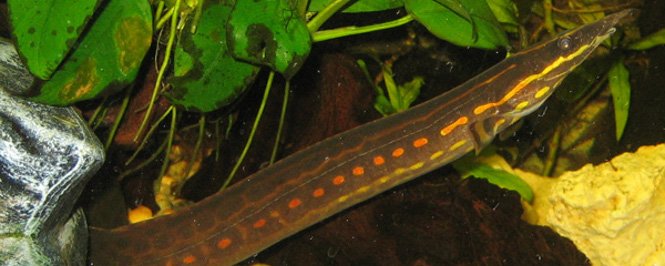
Top 10 Freshwater Aquarium Eels - What Types of & Aquarium Eel Care

Fire Eels grow the largest of all spiny eels, reaching 3 feet in their natural habitat. Aquarium specimens will not grow so large, reaching a maximum size of 20″. 

Fire Eels require lots of room. Your tank would need to be a minimum of 75-gallons. 120-gallons would be best suited to successfully keep this species.

Living to ten years if given appropriate care, the Fire Eel is generally peaceful towards tankmates, so long as they are not too small to be eaten. Recommended tank mates include larger barbs and Angelfish.

Behavior

The favorite activity of fire eels is to bury themselves in gravel. Like many eels they can be quite allusive in an aquarium.  When you have one, consider a 2.5 “(6.3 cm) or more gravel layer.

It is common for a fire eel to uproot plants. Having larger floating plants may be a better option with this species.

The bright red/orange ‘fire’ like markings on the eels body gives it its name. The eel is harmless to humans unless spiked by its spiny fins. These do excrete a toxic substance. Avoid handling these eels.

The Fire Eel is not recommended for the faint-hearted or first time fish keepers.

Water Parameters:

  • Temperature: 75-82F
  • pH: 6.0-7.5
  • dH: up to 18
  • Prefers low end brackish water (reduces skin infections)

3. Electric Eel (Electrophorus electricus)
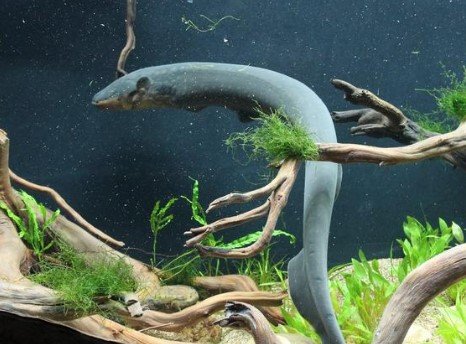
Top 10 Freshwater Aquarium Eels - What Types of & Aquarium Eel Care

Next up is the classic Electric Eel – not common in home aquariums due to the size aquarium required to house this species and difficulties with handling this species of eel. Having said that, they do make an interesting curiosity to a large aquarium.

Electric shock risk

Electric Eels produce a low amperage, high voltage up to around 600 volts) electrical pulse that they use to stun or kill their prey and to defend themselves from predators. Being almost blind, they also rely on low-level electrical impulses to navigate their environment. Although not pleasant, a shock from an Electric Eel, is relatively harmless to humans. The amperage is too low to cause serious injury. Having said that, they are better suited to experienced handlers.

Size

Electric Eels can grow quite large, even in an aquarium. You can expect them to grow to 4 feet long and live about 15 years, making them an excellent pet for life. Females tend to live longer (up to 22 years).

Therefore, it is necessary to have a tank, at the very minimum, of 200-gallons. A 540-gallon tank would be better, and if keeping more than one Electric Eel in the tank, then 2500-gallons.

Behavior

This species is best kept in a single species aquarium. More than one can be housed together if room. Larger eels are generally peaceful towards one another. Juveniles can be a little snappy.

Electric Eels spend most of their time laying on the bottom of their tank, raising to the surface periodically every 10 minutes for air (they have the ability to breath air as well as use gulls). Due to sometimes rapidly rising to the surface, they must have about six inches of empty space between the water and the tank lid.

Sand is an excellent choice for the substrate, as they can bury themselves.

Water Parameters:
  • Temperature: 73-82F
  • pH: 5.5-7.0
  • Hardness: 1-12
  • (not fussy about pH and hardness)

4. Freshwater Dragon Eel
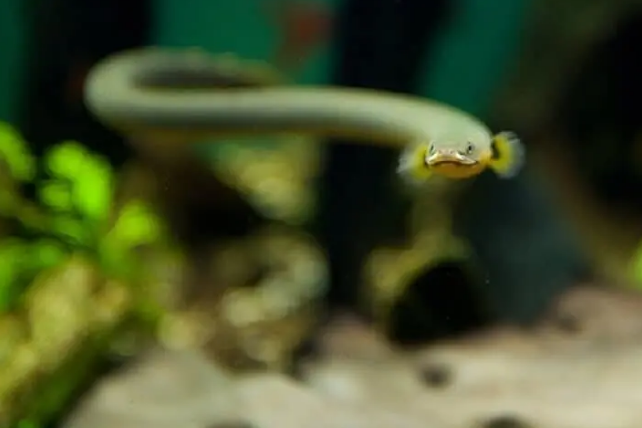
The name Freshwater Dragon Eel can refer to 2 different species, which are not ‘real’ eels, but rather an ancient species of fish more in line with gobies.

The two species are the Violetta Ghiozzo (Gobioides broussoneti) and the Cane Fish (Erpetoichthys calabaricus), both have the name Dragon Eel for their eel-like appearance.

Both species grow to a maximum size of 15 inches in captivity and need a tank of at least 30 gallons. They live around 10 years, so be sure to be committed before including this species to your collection. 

Behavior

Despite their looks and mystical name, Dragon Eels are a very peaceful species of fish. They are shy and may take a few days to settle into a new aquarium. Other, more aggressive fish, may bully them and outcompete them for food. Having poor eyesight, Dragon Eels are slow to find food presented to them.

Dragon Eels are hardy fish preferring a brackish water. Suitable tankmates would include other brackish water peaceful species such as sailfin mollies, angelfish, swordtails, corydoras and Archer fish.

Breeding

These fish can be bred in an aquarium. To do so have three females for every male. Once the eggs have been laid, the male will guard them, becoming aggressive. It is best then to remove the females.

Water parameters:
  • Temperature: 72-82F
  • pH:6.5-8.5
  • Hardness: 10-20dKH


5. Peacock Eel (Macrognathus siamensis)

Another nice option for freshwater aquarium eels is the Peacock Eel. This eel has unique fin pattering that look a bit like a peacock’s plumage. Typically, there are three to six of these types of commercials.

Peacock eel is one of the smallest eels available for aquariums. They grow to less than a foot in length, so you don’t need a huge tank. A tank that is 36 inches long and can hold 35 gallons is a good place to start.

Behavior

Peacock eels can be aggressive toward smaller aquarium fish. Also, they don’t do well among fish that are more aggressive than they are. They can be excellent tank mates to a mixed fish community provided they share their home with the right kinds of fish. Ideal tankmates would include discus, rainbow fish, swordtails, hatchet fish, angelfish and gouramis.

Peacock eels can get along well with their own species as long as they are of similar size, however, it is recommended that only one is kept in the aquarium.

Feeding

They can be picky eaters, preferring live food such as brine shrimp , river shrimp, blood worms, black worms and earth worms.  Peacocks can be trained to accept frozen foods. They won’t always accept food being presented to them and only require feeding every 2-3 days. Being nocturnal hunters in their natural habitat, they are more likely to accept food at nighttime. 

One thing to remember with Peacock Eels is that they are very good at escaping. It is important to ensure that you have a very secure hood to your tank. 

Water parameters:
  • Temperature: 73-82F
  • pH 6-8 (ideally 7.0)
  • dH 6-25 (ideally 10)


6. Pink Paddletail Eel (Moringua raitaborua)
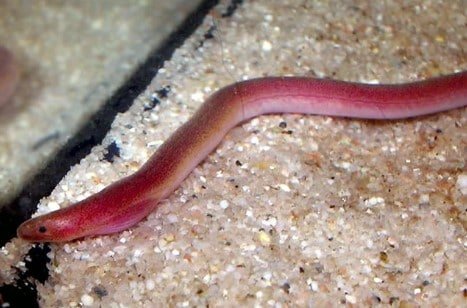
Freshwater Aquarium Eels - Pink Paddletail Eel (Moringua raitaborua)

The Pink Paddletail Eel is not commonly available to purchase in fish aquarium stores. However, if you do manage to find an exotic pink eel and you understand the challenges with keeping this species, then it will become a curiosity for visitors viewing you aquarium.

The Pink Paddletail eel is also known as the Purple Spaghetti Eel because of the beautiful pink and purple tint to its skin. It is a ‘true eel’ with very small eyes and a small head. 

Behavior

These eels need a good amount of fine sand as a substrate in their aquarium. They spend most of the day hiding in the sand and rarely go out. They are more active at night time. Provide plenty of places for the eels to hide and make their homes by including plants and rocks.

Care requirements

The Pink Paddletail eel is not considered easy-care and is recommended for experienced enthusiasts. It has very low tolerances to water variations and is susceptible to disease if the water is not pristine. 

Weekly water changes (of 30% of the water) is required and it is important to vacuum ammonia producing wastes from the bottom of the tank regularly. They require well oxygenated water. Ensure water parameters are correct with regular checks with a water test kit.

When conditions are not ideal these eels are prone to skin infections. A common illness is Ich (or White Spot). Care needs to be taken when treating your eels with medications as they are very sensitive fish. Use half recommended dosages and don’t use copper based medications.

They are a mid level brackish fish species, and skin infections can be reduced greatly by adding aquarium salt to the tank. Add 2-3 tsps. to every 2.5 gallons of water.

Feeding

Being carnivores, Pink Paddletail eels, like to eat live or frozen brine shrimp, river shrimp, blood worms and tubifex worms. It is not recommended to feed them flake or pellet foods. These may end up polluting the water if not eaten.

Due to their slim bodies, they can enter power heads and intake pipes. Use a fine netting or sponge to block the ends.

Size

This freshwater aquarium eel grows to just over 17″ and lives from 5-12 years if conditions are met. They require a minimum tank size of 30 gallons.

They peacefully coexist with other peaceful aquarium fish. However, they may eat smaller species such as neons or fry. Pink Paddletails can also be kept with their own species so long as they have room in the tank to establish their own territories.

They have not been know to breed in captivity.

Water Parameters:
  • Temperature: 72-78F
  • pH: 8.1-8.4
  • Hardiness: 8-12 dGH
  • Brackish water
  • High oxygen well filtered water necessary


7. Black Spotted Eel (Mastacembelus dayi)
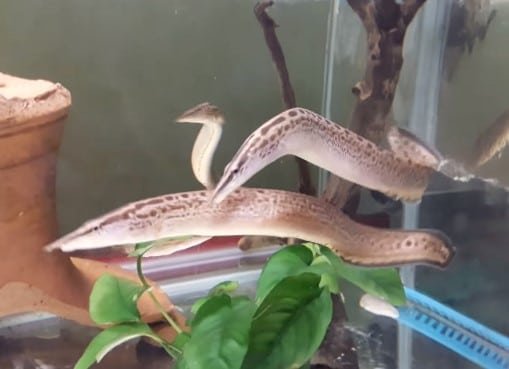
Freshwater Aquarium Eels - Black Spotted Eel (Mastacembelus dayi)

The Black Spotted Eel is an excellent freshwater eel for intermediate aquarists. They make an attractive feature to the home aquarium.  Being similar to other Spiny eel species such the Tire Track Eel, this eel is not strictly an ‘eel’.

Black Spotted eels grow up to 20 inches long and have a long shelf life between 8 and 18 years. This species require a minimum tank size of 75 gallons.

Care requirements

Black Spotted eels are prone to fungal disease and parasites if water conditions are not pristine. Weekly water changes (of 30% of water), efficient biological filter and a well oxygenated aquarium with good water flow is important. Regularly remove ammonia producing waste from the tank.

Behavior

The Black Spotted Eel is friendly, but shy. Provide plenty of places for it to retreat and hide in your aquarium, especially when you first introduce it. They get along well with other fish species. Over time they can be trained to take food from your fingers. 

This freshwater eel species is best kept singularly as it has a tendance to fight with its own kind.

They are fairly easy to care for, so long as aquarium cleanliness and water parameters are met. Being nocturnal omnivores, they are not picky eaters and will readily take live and frozen foods. Only feed occasional flake and pellet food. Make sure the food reaches them at the bottom of the tank. Other enthusiastic fish may gobble it up before it sinks. Eels only need feeding every 2-3 days.

They have not been bred in captivity.

Water Parameters:
  • Temperature: 74-82F
  • pH: 6.0-8.0
  • Hardiness: 6-25dGH


8. Half-Banded Spiny Eel (Macrognathus circumcinctus)
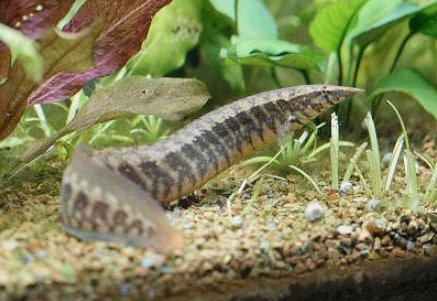
Freshwater Aquarium Eels - Half-Banded Spiny Eel (Macrognathus circumcinctus)

If you are looking for a small eel species the Half-Banded Spiny Eel is an excellent choice. This eel is perfect for aquarists with only a small aquarium.

Again, this species gets confused with other spiny finned eels such as Tire Track Eels. Often in aquarium shops they are sold as Zig Zag Eels.

Half-band spiny eel only grow to just under 8″. Juvenile eels, up to 3″, can be kept in a tank as small as 10 gallons. Adults require 35 gallons with tanks being about 36″ long. 

Behavior

This is a nocturnal animal, so you may not see it during the day. They like to bury themselves in sand, so it’s important to include a good layer of it in your aquarium.

Half-band spiny eel is a good neighbor and are very suitable in a community tank, so long as the fish in the tank aren’t so small to be eaten by the eels when they come hunting at night. Suitable tank mates include rasboras, larger gouramis and sucker-mouth catfish. Small species such as neons will fall prey. 

Being a sociable eel species, Half-banded Spiny Eels are great to keep in groups of five or more.

Diet

Their diet consists of live and fresh frozen foods. Seek out mosquito lava, brine shrimp, blood worms, earth worms and black worms.

You’ll encourage your eels to show themselves by dimming your aquarium lights and having plenty of hiding places for them to retreat to.

They are a relative hardy species of eel to keep.

Water parameters:
  • Temperature: 75-81F
  • pH6.0-7.0
  • dH: up to 15 degrees
  • Soft to slightly acidic water


9. African Spiny Eel (Mastacembelus vanderwaali)
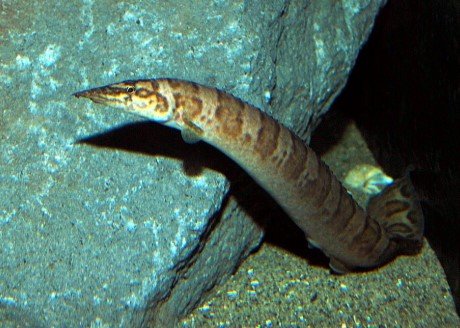
Freshwater Aquarium Eels - African Spiny Eel (Mastacembelus vanderwaali)

The African Spiny Eel is an excellent choice for aquarists who have darker tanks with dimmed lights, or aquariums with plenty of plants to offer shade to the tank bottom. These eels adapt well to the aquarium environment when they can easily hide in the foliage.

An African Spiny Eel is a dark colored eel. They are usually brown and black in color and have markings on their backs. This can include black dots or lines.

African Spiny Eels only grow to about six inches in length. They are perfect for smaller tanks with a mixed community of peaceful fish. Smaller tankmates may be mistaken for food. Slightly larger or, only slightly smaller, tankmates are fine.

Behavior

This species of freshwater aquarium eel is best kept singularly. It tends to fight with others of its kind.

You’ll need an aquarium at least 35 gallons with a sand/gravel substrate for the eel to bury in. Expect you eel to live from between 8-18 years.

Diet

Like other spiny eels (not strictly an ‘eel’), the African Spiny Eel enjoys a diet of live and frozen foods to include brine shrimp and worms. Don’t feed flaked food and only occasionally sinking pellet foods. If you have aggressive bottom feeders, they will outcompete the eel for food. It is only necessary to feed the eel about twice a week.

A unique quality for this eel is that, although they are shy when you add them to the tank for the first time, they do settle in quickly. Some are even known to eat food from their owners’ hands!

Water parameters:
  • Temperature: 74-82F
  • pH:7.4-8.4
  • Hardness: 5-15 dGH
  • Not a brackish water species


How to take care of freshwater aquarium eels?

Freshwater aquarium eels

The eels we have described above fall into different categories- spiny eels (not a true eel), true eels such as the Pink Paddletail Eel, and ancient goby fish that resemble eels. Within each category they do have specific requirements (refer to descriptions above for specifics). Here we will outline their general common requirements.

Freshwater aquarium eels are generally nocturnal fish with poor eyesight, preferring to hide away during the day. Providing them with a sandy substrate that they can bury into, that is deep enough for the eel to be concealed is important, together with providing plenty of places to hide with foliage cover shading the lower areas of the tank.

Eels require mild to medium water that is well oxygenated. Regular water checks, weekly water changes and a quality aquarium filter are needed to keep water pristine.

Most of the eel species outlined above are not true freshwater species, requiring the addition of aquarium salt to replicate their estuarine habitats. By doing so fungal infections and parasites will be reduced.

Your eel loves a dimmed light. You can get a dimmable LED light or simply place it in an area with little natural light. By doing so, your eel/s will be more active allowing you to appreciate them more. 

Lastly, ensure the tank you house your eel in is sufficient in size for the size your eel will grow to.

What to feed freshwater aquarium eels?

Live foods

Most eels are carnivorous eating small fish, insects, crustaceans and worms in their natural habitat. They require live food that replicates this diet. 

Eels love to eat meat based foods such as river shrimp, earthworms, blood worms and black worms. You can give them fresh freeze-dried food when live food is not available.

Your eel may even eat smaller fish in the aquarium, so be careful when selecting tank mates. Providing them with live feeder-fish such as surplus fish fry will meet their needs.

Granules

Sinking granules designed specifically for carnivorous eels can also be offered to them. Although don’t overfeed granules, as the uneaten food will quickly pollute the water, risking health problems with the more fragile species. 

Canned fish

Canned fish such as sardines are another good source of food, although they will need thorough cleaning if they have been packaged with potential contaminants such as vegetable oil. Fresh fish is the preferred option.

Try mixing your diet by feeding different foods during the week. Freshwater Aquarium Eels only need feeding every 2-3 days. If they are reluctant to come out for food, try feeding them at nighttime with the light out. 

Ensure the food reaches the eels living at the bottom of the tank. Aggressive fish feeders will outcompete eels for food.

Prices pulled from the Amazon Product Advertising API on:

Closing Thoughts – Freshwater Aquarium Eels

Although eels seem intimidating, it is very easy to take care of them once you know how to do it. They will provide an exotic touch to your aquarium.

.

Best Aquarium pH Meters: 4 Current Options

Best Aquarium pH Meters: 4 Current Options

The best aquarium pH meter is one you can calibrate, store correctly and check against a second method when a reading looks wrong. For a straightforward handheld option, the Apera PH20 offers useful routine accuracy. The Apera PH60 and Milwaukee PH56 add replaceable probes, while the Bluelab pH Pen places more emphasis on guided calibration and probe care.

Important: A digital meter is not maintenance-free. A neglected electrode can give a precise-looking but incorrect number. Never make a large aquarium chemistry adjustment from one surprising reading.

Disclosure: Aquarium Hunter may earn a commission from qualifying purchases made through clearly identified Amazon links, at no extra cost to you. Product inclusion is based on documented features and aquarium usefulness, not commission rate.

Aquarium water sample being checked with a pH test solution
Use a clean sample and confirm an unexpected digital reading before changing aquarium chemistry.

Quick comparison

Meter Stated pH accuracy Calibration Probe Best fit
Apera PH20 ±0.1 Automatic, 1–3 points Fixed Routine aquarium checks
Apera PH60 ±0.01 Automatic, 1–3 points Replaceable Owners who want a serviceable pen
Milwaukee PH56 PRO ±0.05 Automatic, 1–2 points Replaceable Higher-resolution handheld testing
Bluelab pH Pen See current manufacturer specification Two-point process Integrated pen sensor Users willing to follow a structured care routine

Accuracy is a manufacturer specification under stated conditions, not a promise that every reading will be correct. Buffer freshness, electrode condition, temperature, storage and sample contamination all affect real-world results. Displaying two decimal places does not by itself make a meter more accurate.

1. Apera PH20 — practical entry option

The PH20 is a sensible choice when you want a waterproof pen for routine freshwater or marine aquarium checks without paying for a replaceable probe. Apera specifies a 0.0–14.0 pH range, 0.1-pH resolution and ±0.1-pH accuracy. It supports automatic one-to-three-point calibration and automatic temperature compensation from 0–50°C.

The IP67 floatable housing and stable-reading indicator are helpful around an aquarium. The tradeoff is the fixed electrode: when the sensor reaches the end of its useful life, the complete tester is replaced. For many hobbyists, that is acceptable if the meter is used regularly and cared for correctly.

Best for: routine trend checking and aquarists who want a simple digital reading.

Not ideal for: buyers who specifically want a replaceable electrode or finer stated accuracy.

Check the Apera PH20 on Amazon

2. Apera PH60 — replaceable-probe upgrade

The PH60 family is the more serviceable Apera option. Its general-purpose replacement probe incorporates a temperature sensor and double-junction design. Being able to replace the probe matters because the glass electrode is a consumable component even when the meter body and display remain usable.

Check that a listing identifies the exact PH60 kit rather than another PH60-family probe designed for flat surfaces, spear measurements or smart-app operation. Specifications and included buffers vary by kit. Match the model number on the listing, packaging and manufacturer page before purchasing replacement parts.

Best for: regular users who prefer replacing a worn sensor instead of discarding the whole instrument.

Not ideal for: occasional testing where a liquid kit may be simpler to maintain.

Check the Apera PH60 kit on Amazon

3. Milwaukee PH56 PRO — higher-resolution waterproof tester

Milwaukee specifies the PH56 at -2.00 to 16.00 pH, 0.01-pH resolution and ±0.05-pH accuracy at 25°C. It provides automatic one- or two-point calibration, automatic temperature compensation and a replaceable MI56P probe. The product page describes an IP65 waterproof housing, stability indicator and hold function.

This is the strongest fit of the four when stated accuracy and a replaceable probe are priorities. It still requires fresh buffers and proper storage. The extra displayed decimal should not encourage constant adjustment of an aquarium that is otherwise stable.

Best for: frequent testing and owners who value a replaceable probe and finer manufacturer specification.

Buying note: no exact current Amazon affiliate listing was verified during this review, so this recommendation is intentionally not accompanied by a shopping button.

4. Bluelab pH Pen — maintenance-led option

The Bluelab pH Pen measures pH and temperature and includes automatic temperature compensation, a hold function, calibration indicator and waterproof body. Its most useful feature may be the supporting care procedure: Bluelab instructs owners to hydrate the probe in KCl storage solution before first use, complete a two-point calibration and keep the probe tip wet.

Bluelab recommends calibrating with fresh pH 7 and pH 4 solutions for the acidic range common to many aquariums, or pH 7 and pH 10 when readings are normally alkaline. The calibration indicator expires after 30 days as a reminder. That routine is more important than the brand name printed on the pen.

Best for: owners who want clear care guidance and will maintain the probe consistently.

Buying note: the old article linked a Bluelab combo meter intended for nutrient systems, not a verified current pH Pen listing. That mismatched affiliate link has been removed from this draft.

How to obtain a dependable aquarium reading

  1. Inspect and hydrate the electrode. Follow the meter manual if the probe is new or has dried out.
  2. Use fresh calibration buffers. Select points that bracket the expected aquarium range. Do not pour used buffer back into its bottle.
  3. Rinse between solutions. Shake off droplets gently; avoid rubbing the glass bulb.
  4. Test a clean sample. A cup of aquarium water reduces contamination and keeps the meter away from submerged electrical equipment.
  5. Wait for stability. Gently stir as the manual directs and wait for the reading to settle.
  6. Confirm surprises. Recheck calibration or compare with a fresh liquid test before changing water chemistry.
  7. Store the probe correctly. Use the specified storage solution. Do not assume distilled or RO water is suitable.

What automatic temperature compensation does

Automatic temperature compensation adjusts for the temperature-dependent response of the electrode. It does not calculate what the aquarium’s pH would be at a different temperature, and it does not correct a dry, dirty or poorly calibrated sensor.

Why RO and very soft water can be slow to test

Low-conductivity samples can produce a slow or unstable response with a general-purpose electrode. Apera notes that ordinary PH20 and PH60 testers may take one to five minutes to stabilize in pure water. Do not keep adding chemicals while waiting for a weakly buffered sample to settle.

pH is only part of aquarium chemistry

A pH result needs context. Carbonate hardness influences buffering, while general hardness describes dissolved calcium and magnesium. Carbon dioxide, biological activity, substrate and source water can also move pH. A stable aquarium outside a generic internet target may be safer than repeatedly forcing a number with acids or alkaline products. If a lower reading is genuinely needed, follow a measured approach such as the one in our guide to lowering aquarium pH safely.

Compare readings at similar times of day, particularly in planted tanks where photosynthesis changes dissolved carbon dioxide. Record pH alongside KH, temperature and maintenance events so a trend has meaning.

When a liquid test kit may be the better choice

A liquid color test does not require electrode storage or electronic calibration. It can be a better fit for occasional users, provided the reagent is in date and the color can be read reliably. A digital pen becomes worthwhile when you test often, need a numerical display, or find color matching difficult—and when you are willing to maintain it.

Sources

Top 10 Best Reverse Osmosis System – (Reviews & Guide)

Top 10 Best Reverse Osmosis System – (Reviews & Guide)

It is normal to always want to drink clean and safe water. If you were always unsure of where the water came from, you would definitely want to take the time to find a way to filter the water before using it.

There are many types of filters on the market today, but most people choose the best reverse osmosis systems. The technology has been around for a while and always delivers a high quality result for users.

Comparison Table

To reduce contaminants in drinking water or improve the taste and smell of tap water, water filters in coolers and jugs can do a good job. But to take water purification to the next level, consider a reverse osmosis water filtration system.

A reverse osmosis (RO) water system integrates with the plumbing under your sink to force water through a semi-permeable membrane and a series of filters, removing sediment and contaminants, leaving your family tens of gallons of purified water every day. This guide takes a look at RO systems, takes a look at the factors to consider when purchasing them, and lists the best RO systems on the market.

If you are looking for a water filtration system, you will quickly find that reverse osmosis systems are a popular choice. Many of these multi-stage water filtration systems remove up to 99 percent of the total dissolved solids (TDS) from your water supply, giving you water that tastes fresh and clean from contaminants.

The heart of these water filtration systems is a reverse osmosis membrane, which is so thin that almost only pure water molecules can pass through. Most reverse osmosis systems generally include 3-6 stages of filtration to remove everything from lead and arsenic to hormones and bacteria. One thing to consider on your reverse osmosis system must-haves list is a remineralization filter, which adds beneficial amounts of calcium and magnesium.

Many reverse osmosis systems are designed to be installed under the sink and include a water dispenser to mount on the sink or countertop. There are also counter-osmosis systems for countertops that are a good option for renters or anyone who is reluctant to pierce cabinets or counters. Powerful systems can meet the needs of a large family thirsty for better water, while tankless systems give you on-demand filtered water that’s always fresh.

So which one is right for you? We’ve researched and found the best options on the market so you can buy the right one for your home needs.

New to reverse osmosis water filters? You have come to the right place. Our comprehensive buying guide and reviews give you all the information you need to make an informed decision about the best reverse osmosis system for your home. We explain how an RO system works and what each specific term stands for so that you understand all the product descriptions you read.

Reverse osmosis filters are easy to install and low maintenance, and shouldn’t take you a few minutes more than once every few months to make sure everything is working properly. Read our quick installation guide to find out how to install the unit quickly and without leaks.


Top 10 Best Reverse Osmosis Systems on the Market


Now that you have an idea of where to start, you want to know where to get the best RO system for your money.

When selecting the best model available, consider the features that each has to offer. Not all models are created equal.

You want to find one that comes with superior filtering properties, compact construction, easy installation and maintenance, and affordability.

With this guide, you should be able to easily decide which model of water filtration product to buy for your home.


Best Reverse Osmosis System Reviews

1. iSpring 6-Stage Superb Taste High Capacity Under Sink RO System

This model comes with something new for anyone looking for a home reverse osmosis system. It is fortified with alkaline, which is important for restoring minerals lost in the reverse osmosis process.

Magnesium and calcium are added back to the water, even after they have been removed. This will help further improve the taste of the water compared to some of the bottled water people buy in stores.

The rejection rate for contaminants is up to 99 percent. This number is important in telling you how many impurities are removed in the reverse osmosis process. Because reverse osmosis is one of the most effective water filtration methods, this product can easily remove common contaminants to the highest degree.

You will also like the design. Even though it ends up under the sink, it still looks great. With its update to improve functionality, you should find that this model always offers the best possible performance.

The fact that this is a six-stage model just goes to show that the performance will always be what you need. It provides about 75 liters of filtered water per day. At this rate, you should never be without clean, fresh water for an hour.

Benefits

  • Relatively cheap
  • Affordable filters
  • Cheap filters
  • Six-stage filter
  • Low proportion of wastewater

Cons

  • Need more skills for installation
Check Price On Amazon

2. Home Master TMAFC Artesian Full Contact Undersink

This model gives you something different from anything you have used before. It is popular for an innovative design that ensures the system always delivers the best drinking water when you need it.

It’s amazing how you can filter water in seven different stages. These stages are designed to maximize water purity and quality at all times.

If you compare it with other models, you will see that this model contains a few more stages in the filtration process. This model uses the important catalytic carbon filtration medium to remove most of the chlorine from the water.

Compared to other models, it comes with a trap that helps to restore the water’s pH balance. This is important so that the water you drink has the correct pH level and a better taste.

If you can see other reviews, you will notice that this model gets a lot of positive reviews. This is good proof that this model is one of the best and will always meet your clean water needs.

Benefits

  • Seven-stage filter system
  • Eliminates most contaminants
  • Helps to balance the pH level
  • Catalytic carbon system

Cons

  • Processed water does not always have the correct pH balance
Check Price On Amazon

3. Express Water 50 GPD Reverse Osmosis Water Filtration System

This is definitely one of the best and highest rated water filtration systems you will see in the market. The first thing to consider is size – you’ll find it perfect for use in kitchen cabinets. The manufacturer has also simplified installation so you can do it at home without necessarily needing a plumber.

Using the 5-stage filter system is common, but with this model you get so much more. The performance will be of the highest level, with higher efficiency of the water filtration process.

The 5 micron filter in the first stage is important for removing large and fine particles from the water. The other stages ensure that the water is safe and clean to drink.

Many people who have used this model agree that it is one of the easiest ways to filter water at home. You can get one today to discover more benefits of owning this excellent model.

Benefits

  • Impressive water filtration
  • Removes 99 percent of contaminants
  • Free filters included
  • Comes with advanced technology

Cons

  • Instructions may not be clear to everyone
Check Price On Amazon

4. iSpring RCC7 High Capacity Under Sink Reverse Osmosis System

This model carries the WQA Gold Seal, which is a guarantee that it is a great product. That’s just one of the things you’ll enjoy. In addition, there are NSF certifications, which further guarantee that this model meets high standards of build quality.

Another important thing to note is that this is a five stage filtration system and how it will provide you with the best possible water quality. There are not many models on the market that use a five-speed system, so you can always know not to worry with this model.

According to some studies, this system removes more than 99 percent of chemicals and pollutants from water. You can be sure to change your drinking water at the end of the process.

The model is designed in such a way that even inexperienced technicians can easily install it in no time. This is partly due to the detailed manual that you receive with the product. You can also watch some DIY videos on YouTube and see how easy the installation is.

The affordable price is another reason you’ll love this model. A product so cost effective will save you some money and still have clean water.

Benefits

  • Easy to install
  • Impressive water pressure
  • Can deliver 75 liters per day
  • Water tastes better

Cons

  • Tends to leak
  • Water waste is high
Check Price On Amazon

5. Waterdrop RO Drinking Water Filtration System

With its tankless design and high performance, Waterdrop is a premium reverse osmosis filtration system. While most reverse osmosis systems are based on a large tank, which takes up most of the counter space and limits output, this system filters water on demand. The Waterdrop ensures an endless supply of treated water, because you don’t have to wait for the tank to refill. As a result, it can produce as much as 400 liters per day. This system is efficient, producing only 1 gallon of wastewater for every gallon of purified water.

Waterdrop also includes some great features for monitoring the system. A multi-color LED display shows the status of each of the three filters in their seven stages and the total dissolved solids content of the filtered water in real time. However, keep in mind that this new RO system technology is more expensive, up to double that of standard RO systems.

Check Price On Amazon

6. APEC Water Systems Essence Series Water Filter System

With easy installation and high capacity filters that last much longer than other systems, the APEC reverse osmosis system is an excellent choice for purifying your home water. While filters in other systems may only last for a few months, filters in this six-stage system will last a full year before needing to be replaced.

The six phases of the system remove contaminants and 99 percent of bacteria while adding essential and healthy minerals and calcium. This system produces up to 75 liters of treated water every day. A flow restrictor and automatic shutoff valve keeps wastewater production at 3 gallons for every 1 gallon of treated water. This system uses an 11-inch by 15-inch 4-gallon tank, so make sure you have plenty of space under the sink.

Check Price On Amazon

7. AQUA TRU Countertop Water Filtration System

The AQUA TRU water filter system for countertops allows water to be filtered without taking up space under the cabinet and eliminates the need for installation.

This self-contained system is ready to go out of the box. The four-stage system removes 82 contaminants including lead, chromium, copper, radium and chlorine. The quick-mount, sealed, rotating filters last up to two years. Fill the gallon tank and wait 12-15 minutes for the system to purify the water. And with a width of just 45 cm, this system doesn’t take up much space either.

Check Price On Amazon

8. RKIN AlcaPure Reverse Osmosis Countertop Water Filter


Just because you live in an apartment doesn’t mean you can’t use reverse osmosis water purification technology. This plug and play countertop water purifier does not need to be installed under the sink, making it a great option for property renters. With its compact design of just 9.5 inches wide, this water purifier is ideal for smaller homes. When it’s time to move, pack it up and bring it with you.

It has a four stage filtration system that removes up to 99 percent of contaminants. Additional filters add beneficial minerals such as calcium and magnesium, while a secondary filter removes small traces of impurities. The AlcaPure air purifier produces half a liter of purified water in about 15 minutes.

Check Price On Amazon

9. APEC Top Tier Supreme Certified High Output 90 GPD


This is a small RO system to consider. With its small size, it will easily fit in most of your kitchen cabinets.

Since it comes from a leading brand, you can be sure that it will deliver exceptional performance time after time. With the large number of contaminants removed, you can easily have almost perfect clean water.

This model has a 5 stage filtration process. This type of system should always provide the high performance you need. With the addition of extruded double carbon blocks, you can now get rid of all the unpleasant smells, colors and contaminants that can give your water an unpleasant taste.

This model is one of the best in terms of capacity, delivering up to 90 liters of filtered water per day. You will find yourself using it often and you will never be short of clean drinking water.

Benefits

  • No more leaks
  • Impressive quality
  • Large capacity filters
  • Dual carbon blocks

Cons

  • Has a low water pressure
Check Price On Amazon

10. Waterdrop WD-G3-W

The Waterdrop WD-G3-W is a 400 GPD fast flowing tankless filtration system that effectively removes the most common contaminants from drinking water, including fluoride, lime, heavy metals and other totally dissolved solids.

With a 1: 1 ratio of pure water to runoff, this efficient water system runs faster and wastes less water during the RO process than other reverse osmosis filters. The system does not use a storage tank, avoiding secondary water contamination, but directly produces pure filtered water at the touch of a button, ready to drink.

The furniture can easily be placed in a space under the sink, leaving more storage space in the cupboard. The system’s internal pump produces purified water at a rate of 400 liters per day, filtering a cup of water in about 12 seconds.

The Waterdrop RO WD-G3-W contains 3 filters that together provide 7 stages of filtration.

Benefits:

  • Tankless filtration, on request
  • Space-saving design
  • Built-in booster pump
  • Backed by good customer service
  • Large amount of filtered water per day

Cons:

  • The remineralization water filter adds small amounts of magnesium and calcium
  • Filling larger bottles or jugs can take a little longer
  • Highest price
Check Price On Amazon

What is the best reverse osmosis system for drinking water?

To qualify as a top level reverse osmosis system, a water filter must meet some important standards.

  • Size – Unlike in the past, today’s water filters are built on newly developed technology, which allows them to be smaller and more compact in size, while still delivering quality filtration. A good reverse osmosis water filter should not be too thick, so that customers can move and install the system easily.
  • Efficiency – A reverse osmosis water filter must be able to filter out as many contaminants as possible from the water, up to 99%.
  • Taste: It is important to be concerned about the taste of the processed water after the filtering process. Clean, pure water is good, but it also has to be tasty. If the last water comes out with a bad taste or a strange smell, the water filter is not good enough.

There are more standards for a good reverse osmosis filter. However, that depends on you and your standards and what you are looking for. Later we will discuss how to determine the best reverse osmosis water filtration system for you.


Best brand for reverse osmosis systems

More and more people are realizing the benefits and necessity of clean and pure drinking water. This ensures that the water filter market is growing by the day.

In particular, the reverse osmosis water filter market, which has proven to be one of the best water filtration methods, is expanding rapidly.

Of all the brands on the market, there are some that have built up an excellent reputation. These brands are constantly producing good quality filter models.

These are the top brands in the reverse osmosis market today.

  • ISpring
  • Home teacher
  • APEC
  • Water Express


The benefits of owning the best reverse osmosis system

Reverse osmosis water treatment systems offer a number of health benefits that make them a worthwhile investment for your home. The filtration process removes bacteria, microorganisms and impurities such as arsenic, chromium and other chemical contaminants.

They improve the taste of drinking water. Contaminants in water can cause bitter tastes and odors. When reverse osmosis systems remove these contaminants, the water smells and tastes cleaner.

They eliminate the need to buy bottled water. While it may not seem like it when you make the first investment in an RO system, it can save you money. Buying bottled water from a supermarket is considerably more expensive than filtering your own water.

They help the environment by reducing the waste from plastic bottles. And while there is some debate about the impact of reverse osmosis systems on the environment due to the amount of wastewater produced, they are doing the environment a favor by reducing the production of plastic waste that comes from bottled water.


How to install a reverse osmosis system yourself

Save yourself a plumbing bill and read on to learn how to install a reverse osmosis water filtration system yourself.

  • Close the cold water shut-off valve. Turn the valve clockwise to shut off the water.
  • Open the water tap. This will flush out any remaining water in the pipes, minimizing leaks when you disconnect the supply valve from the sink.
  • Disconnect the water line from the shut-off valve. Use pliers to unscrew and disconnect the supply line. Have a towel or cup handy to catch any residual water in the pipes.
  • Connect the cold water pipe to the RO system. Connect the cold water supply line to your system using the adapter provided by the RO system.
  • Open the cold water supply valve.
  • Install the filter and tank. Place the filter and tank under the sink.
  • Install the drain line. Locate the system drain line. Drill a hole in the existing sink drain line and install the drain line so that your system can drain your wastewater here.
  • Install the new faucet. If your sink has a pre-drilled hole, use this to install the new faucet. If not, you will need to drill a new hole in the sink or countertop to mount the new faucet.
  • Install the new faucet. Once the tap is installed, the supply line is connected to the outlet of the RO system.
  • Connect the reserve tank to the filter system. Follow the manufacturer’s instructions for proper connection.


Frequently asked questions about your new reverse osmosis installation

If you still have questions about your new RO system, you will find the answers to the most frequently asked questions below.

Q. How does a reverse osmosis system work?
Osmosis is the process of passing water molecules through a semi-permeable membrane from a less concentrated solution to a more concentrated solution. Reverse osmosis water filtration systems work by passing water under pressure through a semi-permeable membrane. The membrane allows the passage of water molecules, but does not allow the passage of larger molecules such as bacteria, viruses, sodium urea and chlorine.

Q. What do reverse osmosis systems remove?
Reverse osmosis systems remove harmful bacteria, viruses, sediment, dirt and a long list of toxic chemicals and compounds, including arsenic, copper, radium, cadmium and lead.

Q. Which is better for you, distilled water or reverse osmosis?
Because the distillation system cannot completely remove all traces of chlorine and some pesticides and herbicides from the water, RO filtration systems are more effective at purifying water.

Q. What is the difference between a single pass RO system and a double pass RO system?
The difference between a single pass and a double pass reverse osmosis installation is that the water produced in the first pass is recycled back through the system as feed water for the second pass. This means that the water passes through the system twice, creating a higher quality of purified water.

Q. Does the RO system have an impact on the environment?
Because reverse osmosis systems waste a significant amount of water, they are harmful to the environment. The average RO filtration system produces approximately 4 gallons of wastewater per gallon of purified water. That said, reverse osmosis systems reduce the consumption of bottled water, which is significantly more harmful to the environment due to the use of non-biodegradable plastic bottles.


conclusion

Nothing is perfect. So reverse osmosis is water. However, the benefits of reverse osmosis water outweigh the drawbacks. Having clean and healthy water is very important. And if today it’s easy to shop for yourself and set up a reverse osmosis plant in your home, nothing should stop you from drinking healthy reverse osmosis water. What are you waiting for? If you care about tap water at home, buy the best reverse osmosis system.

Best Pond Filters: 5 Current Systems Compared

Best Pond Filters: 5 Current Systems Compared

The best pond filter is the one that matches your pond volume, fish load, pump flow and maintenance routine. A small decorative pond may only need a compact prefilter, while a stocked koi pond usually needs a much larger mechanical and biological system. This guide compares five current filter styles rather than pretending one product suits every pond.

Affiliate disclosure: Aquarium Hunter may earn a commission from qualifying Amazon purchases, at no extra cost to you. We only link to an Amazon listing when we can match the exact product confidently.

Quick comparison

System Best suited to Important limitation Buying option
TetraPond Submersible Flat Box Small ponds and pump prefiltration Not a complete high-load biological filter Check on Amazon
Aquascape UltraKlean 2000 Compact pressurized filtration with UV Pump is selected separately Check on Amazon
OASE BioSmart 5000 Accessible flow-through filtration Rated capacity falls as fish load rises Read review
Laguna Pressure-Flo PF1000 Pressurized filtration and flexible return placement Requires correct pump matching and routine cleaning Read review
Aquascape Signature Series 2500 BioFalls Waterfall-based biological filtration Works best as part of a planned skimmer-and-waterfall system Check on Amazon

What a pond filter actually needs to do

A useful pond system combines several jobs. Mechanical filtration traps leaves, algae strands and suspended debris. Biological filtration gives beneficial bacteria a large oxygenated surface on which to convert toxic ammonia and nitrite into less harmful nitrate. A UV clarifier can help control free-floating green-water algae, but it does not remove settled waste or replace biological media. The pump supplies circulation; aeration may still be needed, especially in warm weather or heavily stocked ponds.

That distinction matters because a prefilter, UV unit and complete biological filter are not interchangeable. Start with the pond’s needs, then choose components that work together.

How to size a pond filter

  1. Calculate actual pond volume. For a rectangular pond, multiply average length by average width by average depth, then convert the result to gallons or litres. Irregular ponds require an estimate, so leave a safety margin.
  2. Allow for fish load. Koi and heavily stocked goldfish ponds create substantially more waste than lightly stocked wildlife ponds. Manufacturer maximums often fall when fish are present, so use the fish-load rating rather than the largest number on the box.
  3. Check real pump flow. A pump delivers less water after vertical lift, pipe friction and fittings are considered. Compare the filter’s recommended flow range with the pump’s flow at the system’s actual head height.
  4. Plan maintenance access. A technically capable filter can still be a poor choice if cleaning it is awkward. Make sure drains, backwash outlets and media are accessible.
  5. Think in systems. Bottom drains, skimmers, waterfalls and return jets affect what type of filter will work and where it can be installed.

TetraPond Submersible Flat Box Filter

Best for: protecting a pump and adding basic mechanical filtration in a small pond.

This low-profile box sits underwater and connects to a separate pump. Its foam pads intercept debris before it reaches the pump, and the manufacturer specifies compatibility with pumps from 200 to 2,000 GPH. That wide pump range makes it a flexible, inexpensive component for small water features and lightly stocked ponds.

Watch for: it is best understood as a pump prefilter, not a complete answer for a koi pond or a system with a high biological load. The foam must be rinsed regularly in pond water so accumulated debris does not restrict flow.

Check the exact TetraPond Flat Box listing on Amazon
Official TetraPond specifications

Aquascape UltraKlean 2000

Best for: pond owners wanting compact pressurized mechanical and biological filtration with an integrated UV clarifier.

The UltraKlean design can be positioned away from the pond and returns water under pressure, which is helpful where the outlet must feed a waterfall or stream. Its cleaning controls are more convenient than dismantling a basic submerged box. The integrated UV clarifier targets free-floating algae that cause green water.

Watch for: a UV clarifier is not a substitute for removing sludge and trapped solids. Select a compatible pump, respect the stated flow range, and maintain the filter and UV lamp according to the manual.

Check the exact Aquascape UltraKlean 2000 listing on Amazon
Official Aquascape UltraKlean information

OASE BioSmart 5000

Best for: pond owners who prefer an accessible flow-through filter with visible maintenance indicators.

The BioSmart separates mechanical debris while providing biological media, and its above-ground layout makes routine inspection straightforward. OASE lists different capacities for ponds with no fish, ponds with fish and koi ponds. For the BioSmart 5000, the official koi/heavy-fish figure is much lower than the headline 5,000-gallon light-load rating, illustrating why stocking level must be considered.

Watch for: this is a gravity-return filter, so its outlet position and return route must be planned correctly. Do not size it using the largest nominal pond figure when fish are present.

Official OASE BioSmart 5000 specifications

Laguna Pressure-Flo PF1000

Best for: compact pressurized filtration where a flexible return location is useful.

The Pressure-Flo PF1000 combines mechanical and biological filtration with UV clarification in a sealed canister. A pressurized outlet can return water to an elevated feature, while the cleaning mechanism reduces the need to open the canister for every maintenance cycle.

Watch for: pressure filters still collect waste and need regular cleaning. Performance depends on correct pump sizing, hose diameter and head height. Follow Laguna’s stated pond and flow guidance rather than assuming the model name is a universal capacity guarantee.

Official Laguna Pressure-Flo PF1000 specifications

Aquascape Signature Series 2500 BioFalls filter

Best for: a planned ecosystem pond where the biological filter also forms the head of a waterfall.

A BioFalls unit spreads incoming water through filter media before it flows over a waterfall lip. It can be visually integrated into landscaping and pairs naturally with a pond skimmer at the opposite end, creating circulation across the pond.

Watch for: this is a system component rather than a small stand-alone canister. Installation, liner connection, pump flow and the matching skimmer all need to be planned together. Choose the BioFalls size from Aquascape’s current guidance for the intended pond and waterfall.

Check the exact Aquascape Signature Series 2500 BioFalls on Amazon
Official Aquascape BioFalls information

Which filter type should you choose?

  • Submersible prefilter: simple and inexpensive for small ponds, but frequent hands-in-water cleaning may be required.
  • Flow-through box: accessible media and good gravity return, provided there is space at the correct height.
  • Pressurized filter: compact and flexible to position, with water able to return to a raised feature.
  • Waterfall filter: combines biological media with landscape design, usually as part of a skimmer-and-waterfall layout.
  • Koi-specific system: heavy fish loads often justify larger multi-stage filtration, easier waste purging and conservative sizing. See our koi pond filter comparison.

Maintenance that keeps filtration effective

Remove trapped solids before they break down, but avoid sterilising biological media. Rinse bio-media gently in dechlorinated or pond water, not untreated tap water that may damage beneficial bacteria. Check pump intakes, hoses and seals; purge settled waste; and replace a UV lamp according to the manufacturer’s schedule. Test ammonia and nitrite after starting a new system, adding fish, medicating the pond or performing major maintenance.

If green water is the main problem, read our guide to the best UV clarifiers for koi ponds. If you are planning for growing fish, our guide to how fast koi grow explains why future size matters.

Frequently asked questions

Can a pond be over-filtered?

Extra media capacity is usually helpful, but excessive flow can stress fish, bypass effective contact time or overwhelm a filter’s recommended range. Oversize biological capacity sensibly while keeping water flow within the equipment specifications.

Does a UV clarifier replace a pond filter?

No. UV can reduce free-floating algae and some suspended microorganisms, but it does not remove leaves, sludge, fish waste or dissolved ammonia. Mechanical and biological filtration remain essential in stocked ponds.

How often should a pond filter be cleaned?

There is no single schedule. Check flow and the manufacturer’s cleaning indicator, then adjust for season, feeding, fish load and falling leaves. Mechanical stages may need frequent attention during warm, heavily fed periods; biological media should be disturbed only as much as necessary.

Should the pump run all day?

For most stocked ponds, continuous circulation supports oxygenation and the beneficial bacteria living in the filter. If a filter is shut down long enough to become oxygen-depleted, stagnant water should not simply be flushed back into the pond.

How we selected these systems

We prioritised current manufacturer support, clearly described filtration roles, useful options for different pond layouts and maintainability. We did not rank products solely by a headline gallon figure, and we excluded old listings that could not be matched confidently. Amazon links above point only to exact verified product pages; manufacturer pages are provided for specifications and installation guidance.

References and further reading

Top 10 Best Pond Aerators in 2023– (Reviews & Buying Guide)

Top 10 Best Pond Aerators in 2023– (Reviews & Buying Guide)

Best Pond Aerators in 2022: Everyone knows the importance of using high quality filters for their aquariums. But not many people know how important a pond aerator is.

Pond vents help infuse oxygen into the water, ensuring that fish have enough to survive.

Comparison Table

Pond aerators come with a variety of different features. Finding the best pond aerators is difficult if you’ve never bought one before.

If you like to take care of fish on a large scale, it is essential that you include them in your environment.

In this article, we will discuss the 12 best pond aerators in existence in 2022.

However, before we get into the exact products we have listed, let’s first make sure that all our readers are on the same page and know exactly what a pond aerator can be used for and why it is needed. any pond, but especially if you have fish and other marine life.

Ponds must be properly maintained and cared for because they are closed, which means that water has no means of moving freely without external force or external help.


Benefits of a Best pond aerators

The main function of aeration is to add dissolved oxygen to the pond water. Air is pushed through the tube into a diffuser using an electric pump. This causes a column of bubbles to rise from the diffuser to the surface of the water.

This process allows much needed oxygen to enter the water and also emits carbon dioxide gas.

It also makes your pond move. When the bubbles rise to the surface, they create a lifting effect. This causes the water at the bottom of the pond to travel upwards with bubbles and then flow back to the bottom.

This circulation of water is very useful for several reasons:

  • Algae growth slows down.
  • It prevents the stratification of the tin
  • Prevents the formation of ice in winter

Increasing the flow of water can help reduce algae growth as the spores will be pushed away from the surface, giving them less time for the sunlight they need to grow.

Since pond water does not normally circulate, it stratifies. That is, it tends to be hot and oxygen-rich at the top and colder and completely oxygen-free at the bottom. For this reason, fish cannot swim in deeper areas as they have no oxygen to breathe.

The circulation of water from the aeration keeps all the water mixed and prevents stratification. This allows fish to use the entire pond rather than just the higher layers.

If you live in an area where freezing temperatures are common in winter, the entire pond can freeze, cutting oxygen to the water and killing your fish.

Operating an aerator during the cold months will prevent ice from forming directly on your head and provide your fish with a safe area to spend the winter.


Why use a pond aerator?

Unless you’ve never looked after fish in a pond before, you may not know why a pond aerator helps create a healthy aquarium.

In nature, ponds and lakes aerate themselves with the movement of water. Smaller artificial ponds without natural movement can greatly benefit from an aerator.

A pond aerator is useful for many things. Perhaps most importantly, it increases the oxygen levels in the water.

The aerator also helps to mix hydrogen peroxide from the top of the surface with the water on the bottom of the pond. This extends oxygen but also keeps the water at the perfect hot / cold temperature for fish.

The ventilation also helps to circulate the water and prevents the formation of dirt on the bottom. This manure not only smells bad and changes the color of the water, it also becomes a living space for leeches.

Aside from mud, non-aerated water is more susceptible to pieces of food and other debris. This makes the water cloudy and also increases the ammonia level in the water.


The 10 Best Aerators for Small & Large Ponds


Best Ponds Aerators Reviews

1. Aquascape Pond Air Aeration Kit

Best Pond Aerators

The first aerator in the list is the Aquascape aeration kit. Aquascape designs effective and inexpensive aquarium equipment, so you can trust this brand.

This aeration kit is supplied with a pump positioned outside the pond. It also has options for two or four outlets. You can adjust the amount you buy depending on how big or small your pond is.

The aeration discs are robust and made with a strong rubber cover, which protects them from any friction under water. The pump for this kit is also supplied with a replaceable filter cartridge. This facilitates replacement and repair when cleaning is needed.

The only problem with the Aquascape ventilation kit is that the discs supplied are not heavy. Therefore, they are not safe underwater.

They remain underwater for the most part, but tend to move easily. If these records had been held back by something, it would have been a more effective product.

Check Price On Amazon

2. Air Pro Deluxe Pond Aerator Kit By Living Water


Best Pond Aerators

Air Pro Deluxe is a powerful air pump classified for a pond up to 1 acre. It is certainly intended for very large ponds as it can emit 2.3 CFM of air.

The ¼ horsepower compressor comes with 100 feet of weighted overhead line and a large membrane diffuser mounted on a metal plate.

The compressor comes with a 2 year warranty and the pipes and diffuser are covered for 5 years. It is a high quality ventilation system which would be an excellent choice for larger ponds.

Check Price On Amazon

3. Airmax – Pond Air 2 Aeration Kit

Best Pond Aerators

For any aquatic equipment you need, Airmax has always been one of the best suppliers in the world.

The Pond Air 2 ventilation kit has all the basics you need to keep your pond clean and clean. It can help clean ponds that have a maximum capacity of 1000 gallons and can reach a 2 foot deep pond.

It is perfect for any small pond because it has a simple installation and is convenient to operate with only 4 watts. It also comes with an air flow control valve that can be used to easily adjust the output of your ventilation.

In addition, this type of aeration system can help mix the various layers of water through its bubbling air, ensuring that no water remains to remain stagnant.

Check Price On Amazon

4. Laguna Aeration Kit for Ponds

Next is the Laguna Pond ventilation kit. This ventilation kit is another great option because of the value you get for the cost of the items. The Laguna ventilation kit is particularly useful for use during the winter months.

Ponds generally tend to freeze and threaten the life of the fish that live in them. However, with this ventilation kit, the pond can remain active even in winter.

The ventilation system allows water to circulate with its 30-inch tube liner safe for the winter. Continuously infuses oxygen into the water.

The downside of the Laguna ventilation kit is that it is not absolutely silent. This is generally not a problem for external filters.

If you prefer to have peace and quiet near your pond, you may want to reconsider this option. This kit is fine elsewhere, but tranquility is not a quality it has.

Check Price On Amazon

5. Tetra Pond APK100 Air Pump Kit


Tetra Pond APK100 is designed for a small pond and is only rated for a depth of 60 cm.

The dual outlet and 30 feet of airline allows you to aerate two different areas.

Product information indicates that it is possible to manage a pond of up to 5,000 gallons (18,900 liters), but you would take it with a grain of salt and say up to 500 gallons (1,800 liters).

Check Price On Amazon

6. Hi-Blow Linear Air Pump Pond Aeration Septic Aerator


Towards the end of the list is the Hi-Blow septic aerator. This is another excellent product which is well designed and has excellent customer reviews.

You can easily infuse up to 80 liters of air into the water per minute. This gives it excellent reviews compared to other aeration pumps on the market.

It has a 71 watt power system, is sturdy and can last for years before needing to be replaced. An interesting feature it has is an alarm link accessory.

The problem with this ventilation kit is that it has very few additional features included. You only get the aeration filter and some pipes, but other than that nothing.

You can find many different products with multiple tubes, for example at a better price. If you want an aeration pump, this is a good option for you. If you are looking for a real kit, you should try something else.

Check Price On Amazon

7. EasyPro PA6SWN Single Diffuser Shallow Pond Aeration Kit

Another exceptional option for pond aeration kits is the one designed by EasyPro. This kit works perfectly for ponds that start from seven feet deep to 3/8 acres deep. This means that it can handle almost any size of the pond, deep or not.

It comes with a DM4 diffuser and 50 feet of tube. The beauty of the tube is that it is designed to sink quickly.

This means you don’t have to worry about it always floating around the pond. It is also designed for use in all types of weather conditions and has additional pump protection for this reason.

The problem with the EasyPro diffuser ventilation kit is that it is a bit expensive for what is included.

There are other kits on the market that do similar things and have similar characteristics. However, they are less expensive than that. With a little research, you can probably find a similar model at a lower cost.

Check Price On Amazon

8. Airmax Koi Air 1 Water Garden Aeration Kit


The Airmax KoiAir 1 is an excellent choice for medium sized ponds (2,000-8,000 gallons / 7,500-30.00 liters), which are up to 4 feet (120cm) deep.

The dual diffusers are designed to maximize unobstructed air flow. They are also flexible, helping to prevent cracks.

The weighted airline and diffuser plate should keep everything the way you want.

Check Price On Amazon

9. Danner – 0450 AP-20 Pond Air Pump with Diffuser (Multiple Sizes Available)


Danner is one of the reputable companies when it comes to pond conservation. Their product, Danner Pondmaster AP 20 Pond Air Pump is one of their pride and it really shows why.

The air pump for pond AP 20 can be used both indoors and outdoors. It can be used for a pond that has a maximum capacity of 2,500 gallons and a depth of up to 7 feet. It has an air flow rate that reaches a maximum capacity of 1.0 CFM and has a noise level of 40 dba.

For a unit with such a high power, it stores an electrical power of 20 watts.

It should be noted that this pond air pump should not be submerged in water and should be installed at least 12 inches above the pond water level to prevent water from returning to the pump.

It is also recommended to avoid any use of the pump in swimming pools and salt water.

Check Price On Amazon

10. Blue Diamond ET 80 Septic or Pond Linear Diaphragm Air Pump

One of the best things about this Blue Diamond aerator is the aluminum frame which makes it really durable. Since it has no wearing parts, it is weatherproof and can work intermittently or continuously.

Silent and oil-free operation is ideal for ponds because there is no excessive noise to distract or disturb the fish. If you ever need to make a repair, there are affordable replacement kits available and generally easy to find.

This air pump has a flow rate of 75 liters / minute which is suitable for up to 500 gallons and water up to six feet deep. It is covered by a two year warranty. Blue Diamond also tends to have good customer service, so if you have any questions or problems don’t hesitate to get in touch.

Check Price On Amazon

What is the best pond aerator?

Each aeration kit mentioned above had some good and bad qualities. However, one stood out. Read on to find out what it is!

The best aeration kit to get if you have just started in the world of pond aeration is the Aquascape Pond Air Aeration Kit. This kit is the best because it offers you the best investment for your money. It is truly amazing for beginners.

There are many useful features offered with this kit. This includes robust aeration discs. They are easy to install and have easily interchangeable filter cartridges.

The price of the item is also good. The use of the element is very simple and is very effective in his work. This makes Aquascape Pond Air Vent Kit the best on the list!

How to choose a pond aerator?

Now you have a good idea of ​​the different features and costs of pond aerators. Therefore, it is time to find the one that best suits your needs, especially the needs of your fish. It is easy to find out which option is correct.

Of all the big pond vents, choosing one seems like a daunting task. But if you remember a few key details about your pond, finding the perfect aerator becomes much easier.

Size of the pond

The size of your pond is the first thing to look at before deciding which aerator to get. Measure or professionally measure the amount of water in the pond area in gallons.

If it is a large body of water, it may be necessary to measure it in acres. In most cases it will not be an exact measurement, but an estimated size is also useful for finding the aerator pump.


Depth of the pond

The depth of your pond also plays an important role in obtaining an aerator for this. Some aerators have a point of maximum depth where they can work effectively. Make sure to keep that in mind.

If they go below this, there is no guarantee that your water will be properly aerated. Measuring the depth of the pond can also help you find a suitable aerator for the job.


Shape of the pond

This may be surprising, but the shape of your pond also influences the types of aerators you should buy. Circular or round ponds can be easily aerated using any type of diffusion system. This is because oxygen can be easily distributed around the pond.

Ponds with irregular shapes or depths can be difficult to cover since the area is not deep enough. Talking to an aeration service provider can help you with this problem if you are unsure.


Types of pond aerators

You should know the types of pond aerators before purchasing one for your pond. There are several types. The main ones are floating or submersible fountain aerators.

A submerged aeration system releases oxygen directly into the water. This system works well for irregularly shaped ponds.

Floating aerators often float in the middle of the pond. They provide ventilation through a falling water source. They work best for ponds with more regular shapes, such as circular or triangular.


compressors

The compressor in the aerator influences the progress of the aeration process. Two very common compressors are the linear compressor and the oscillating piston compressor.

The linear compressor uses an internal diaphragm to create and release air. This is perfect for smaller ponds.

On the other hand, oscillating piston compressors are perfect for any situation. Both shallow and deep ponds can benefit from this type of compressor.


Where to place the pool vents?

Once you find the right type of aerator, you should place it in an area of ​​your pond where it can be most effective. This is typically the deepest area of ​​your pond. Because?

Because it is where the greatest amount of dirt and the least amount of circulation is found. Alternatively, you can ask a ventilation service technician for advice on where to place it.


How to install a pond aerator?

Installing a pond aerator is a quick and easy process. You might be surprised at how easy it really is.

First, remove the aerator from the package and unroll the tube.

Then fill the diffuser and weigh it with gravel or something else to keep it underwater. It is also necessary to install the pump on dry ground. This ensures that you are well protected from the elements and have ample access to a power source.

Immerse the diffuser in the deepest part of the pond, then turn on the aerator. If all went well, your aerator should run smoothly! It couldn’t be simpler


conclusion

After all this information, you should feel a little better when buying an aerator for your pond. There seems to be a lot of research involved. For this reason, many people blow their ponds completely on air.

As a pet owner and pond lover, pay close attention to the environment you create for your fish. You want to make sure they have a healthy life and that vents are the perfect tool to make it a reality. If you need further help, don’t hesitate to contact a professional. They can offer even more advice on which kit is best for your needs.