

Most female koi spawn during a seasonal breeding period, commonly once in spring or early summer in temperate climates—but koi can spawn more than once when warm conditions last long enough. Frequency depends on water temperature, day length, climate, maturity, body condition, and whether suitable spawning material is available.
Koi do not give birth to live young. A female scatters adhesive eggs over plants, spawning brushes, or other surfaces while one or more males release milt to fertilize them externally. Adults provide no parental care and will eat eggs and fry.
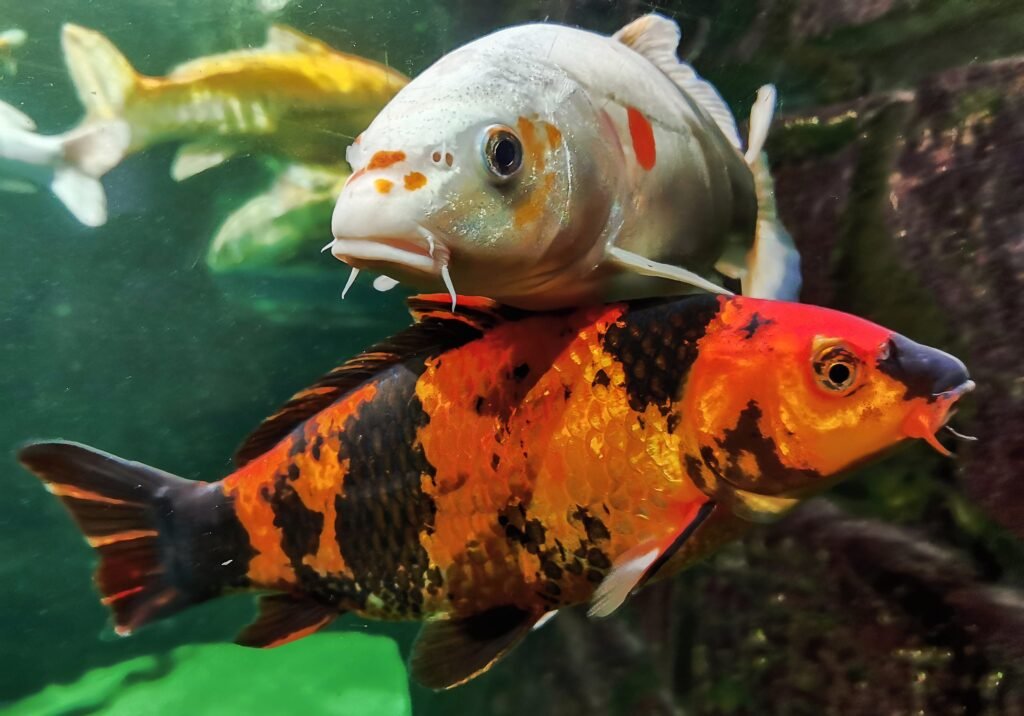
How often do koi fish lay eggs?
In many backyard ponds with a cold winter, mature females have one main spawning event each year as water warms. That makes “once annually” a useful expectation, but it is not a biological rule.
The U.S. Geological Survey describes carp as having a flexible life history, an extended breeding season in suitable climates, and the ability to spawn multiple times per year. Research on feral koi also shows that latitude and temperature alter the reproductive cycle: high-latitude populations may spawn once during a short warm period, while populations in warmer regions can have more than one cycle.
A female may not spawn at all in a particular year if she is immature, in poor condition, stressed, without males, or exposed to unsuitable temperature and habitat.
When is koi spawning season?
In the continental United States, spawning is most often observed from late spring into early summer. Local timing can shift by weeks or months. Temperature is more useful than a calendar date.
Common carp generally begin spawning as water reaches the mid-to-upper 60s°F, with activity often occurring around 65–75°F (18–24°C). The University of Maryland’s aquaculture guidance lists approximately 68°F (20°C) as an optimum spawning reference while noting a much broader possible range.
Typical cues include:
- Rising and stable water temperature
- Increasing spring day length
- Fresh water from rainfall or water changes
- Shallow vegetation, spawning brushes, or fibrous surfaces
- Mature, well-conditioned males and females
Do not force rapid temperature or water-chemistry changes to trigger breeding. Stability and fish health are more important than producing eggs.
How old must koi be to breed?
Maturity depends on sex, climate, growth, and body size. Males frequently mature earlier than females. In a New Zealand study of feral koi, males matured at about two years and females at about three years; colder-climate populations may mature later.
For a backyard pond, treat three to four years as a practical minimum expectation for females rather than trying to breed small juveniles. A sexually mature fish should also be healthy, well developed, and free from deformity or disease.
Signs that koi are preparing to spawn
- A female develops a broad, soft-looking abdomen.
- Males become more active and follow females closely.
- Males may develop small white breeding tubercles on the gill covers and leading pectoral-fin rays.
- Fish gather in shallow water, often around plants or spawning material.
- Chasing becomes vigorous, frequently around dawn.
Spawning can look violent. Males press and bump females against the pond edge or vegetation to encourage egg release. Remove sharp rocks, exposed hardware, and narrow traps before the season begins. Watch for exhausted, injured, or stranded fish.
What do koi eggs look like?
Fresh koi eggs are small, round, translucent to pale amber, and sticky. They adhere individually to plants, brushes, ropes, pond walls, and debris rather than forming a protected nest.
Egg appearance changes during development:
- Potentially viable eggs: remain translucent or amber and gradually show a darker embryo.
- Unfertilized or dead eggs: commonly turn opaque white.
- Fungused eggs: may develop white or gray fuzzy growth that can spread across neighboring eggs.
Color alone is not a perfect test immediately after spawning. Observe eggs over time and remove clearly opaque or fungused material carefully.
How many eggs can a koi lay?
Egg number varies enormously with female size, age, health, and condition. A mature female may produce tens or hundreds of thousands of eggs. Research on feral koi reported an average near 299,000 developing oocytes per female, with large individuals exceeding one million.
Those figures do not mean a backyard pond will produce the same number of fry. Many eggs are never fertilized, are eaten, develop fungus, or fail during incubation. Fry mortality is also high. Avoid fixed claims such as “60% will survive”; survival depends on conditions and management.
How long do koi eggs take to hatch?
Incubation is temperature-dependent. In typical warm spring pond conditions, hatching often takes about three to seven days. Maine’s fisheries guidance for common carp gives a broader four-to-ten-day range depending on water temperature.
Warmer water generally speeds development, but excessively warm water holds less oxygen and can increase microbial problems. Keep temperature stable, provide gentle aeration, and do not allow the egg mass to dry out.
Should you move koi eggs?
If the goal is to raise fry, separate the egg-covered spawning material from adult koi soon after spawning. Moving a spawning rope or brush is safer than scraping or handling individual eggs.
- Prepare a cycled nursery tank or protected pond area before spawning.
- Match temperature and water chemistry closely.
- Move the entire rope, brush, or plant section while keeping eggs wet.
- Provide gentle aeration nearby, not a forceful current directly on the eggs.
- Remove obviously dead or fungused eggs with clean tools.
- Test ammonia and nitrite daily once eggs begin hatching.
Do not move eggs into a natural lake or public waterway. Koi are ornamental common carp and can become invasive.
Protecting eggs in the original pond
Leaving eggs in a community koi pond results in heavy predation. If only a few naturally surviving fry are acceptable, provide dense protected spawning material and plant cover. If controlled breeding is the goal, use a separate breeding and nursery system.
A divider can help only if adults cannot reach through or around it and the protected side has adequate circulation. Check that small fry cannot be pulled into pump intakes.

Nursery water quality
Eggs and newly hatched fry need clean, oxygenated water without strong current. Use a mature sponge filter or an intake protected by fine foam. Important targets include:
- Ammonia: 0 ppm
- Nitrite: 0 ppm
- Stable temperature
- Adequate dissolved oxygen
- Gentle circulation
A large container is not automatically safe if it is uncycled. Decomposing eggs and excess food can produce ammonia quickly. Make small, temperature-matched water changes as testing requires.
What happens after hatching?
Newly hatched larvae initially remain attached to surfaces and use their yolk sacs. Do not begin heavy feeding immediately. Once fry become free-swimming, offer appropriately small foods such as commercial fry powder, infusoria-sized foods, or newly hatched brine shrimp as the fish become large enough.
Feed tiny portions several times per day while removing waste. Growth will be uneven, so larger fry may need to be separated from smaller siblings. Raising hundreds of koi requires substantial space, filtration, food, sorting, and humane plans for fish that are not retained.
Can a female koi become egg-bound?
A swollen abdomen is not proof of eggs. It can also indicate overfeeding, fluid retention, internal disease, tumors, or constipation. Do not squeeze a koi to release eggs.
If a female remains unusually swollen, becomes lethargic, isolates herself, develops raised scales, stops eating, or has trouble swimming, contact an aquatic veterinarian or an experienced koi-health professional. Handling and sedation carry risks and should not be improvised.
How to reduce accidental spawning injuries
- Remove sharp or unstable pond decorations.
- Keep pump intakes protected.
- Maintain excellent water quality before the breeding season.
- Provide soft spawning brushes or safe plant material.
- Observe intense chasing and separate an injured fish if necessary.
- Have a covered recovery tank ready before moving any fish.
Spawning can temporarily cloud the water and increase organic waste. Check oxygen, ammonia, and nitrite afterward, remove damaged plant material, and perform an appropriate partial water change.
Frequently asked questions
Do koi lay eggs every year?
Many mature females in temperate ponds spawn once during the annual warm season, but some skip a year and others can spawn more than once under prolonged favorable conditions.
Do koi guard their eggs?
No. Koi scatter adhesive eggs and provide no parental care. Adults commonly eat both eggs and fry.
Can koi lay eggs without a male?
A female may release unfertilized eggs without a successful male spawning event, but those eggs cannot develop into fry.
What time of day do koi spawn?
Spawning is often most active in the early morning, though local conditions vary.
Why did my koi eggs turn white?
Opaque white eggs are commonly unfertilized or dead. Fuzzy growth suggests fungus. Remove affected eggs carefully and improve sanitation, oxygenation, and water quality.
Bottom line
Expect one main koi spawning period each year in many U.S. backyard ponds, but understand that warm-climate koi can spawn more than once and some females may not spawn at all. Prepare safe spawning material, protect females from injury, separate eggs only into a cycled nursery, and plan responsibly for the potentially enormous number of fry.