
The best substrate for a betta fish is smooth, chemically suitable and easy to clean. Bettas do not require a special gravel for digestion or health. A fine inert sand or small rounded natural gravel works for most established tanks, while a stable planted substrate can be useful when the aquarium contains rooted plants. Avoid sharp stones, glass marbles used as a full bed, and particles that trap large amounts of waste.
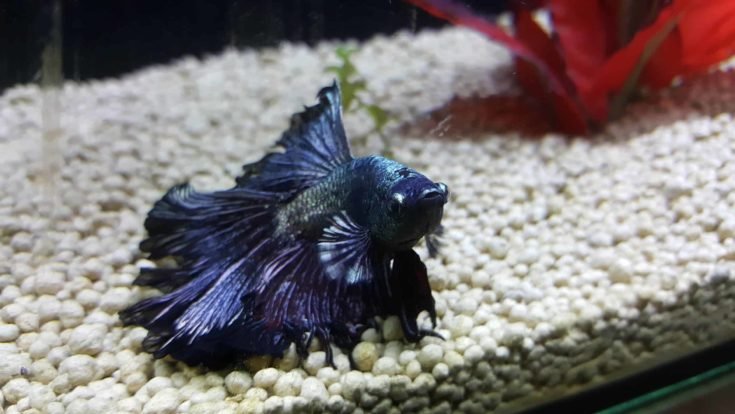
Affiliate disclosure: Aquarium Hunter may earn a commission from qualifying Amazon purchases, at no extra cost to you. Products are included for suitability and current availability rather than commission.
Quick comparison
| Substrate | Best use | Texture and chemistry | Buying option |
|---|---|---|---|
| CaribSea Peace River | Best general rounded gravel | Natural 1–2 mm grains; uncoated | Check on Amazon |
| CaribSea Moonlight Sand | Best light fine sand | Natural 0.25–0.75 mm freshwater sand | Check on Amazon |
| AquaNatural Galaxy Sand | Best dark decorative sand | Dark natural aquascaping sand | Check on Amazon |
| Seachem Flourite Black Sand | Best durable planted option | Stable porous clay; does not alter pH | Check on Amazon |
What matters in a betta substrate?
Smooth edges
Betta fins can tear on sharp décor, and the fish may rest on the bottom. Run a hand over dry gravel and remove pieces with cutting edges. Aquarium-safe smooth sand or rounded fine gravel is preferable to crushed, jagged or decorative craft material.
Stable water chemistry
Domestic bettas are normally kept in warm freshwater with stable, species-appropriate parameters. Avoid aragonite, crushed coral and limestone substrates unless testing shows that raising alkalinity is part of a deliberate water plan. Most betta tanks need an inert substrate rather than a strong buffer.
Manageable grain size
Fine sand keeps waste visible on the surface. Small gravel allows water movement between grains but traps food and debris, so it needs deeper vacuuming. Very large pebbles and marbles create inaccessible gaps where uneaten food decays.
Plant compatibility
Plants provide cover and resting places, but decorative sand or gravel is not complete plant nutrition. Root-feeding species may need root tabs; epiphytes such as Anubias and Java fern should be attached to wood or rock rather than burying the rhizome.
Four current substrate options
CaribSea Super Naturals Peace River
Best for: a natural fine-gravel betta tank.
CaribSea lists Peace River at approximately 1–2 mm and describes its Super Naturals range as uncoated. The rounded, relatively small grains are easier to arrange around plants than large decorative stones and create fewer deep waste pockets than marbles.
Tradeoffs: waste can still settle between the grains. Vacuum an open section during each water change and keep heavy décor supported independently of the loose substrate.
Check CaribSea Peace River on Amazon | Manufacturer specifications
CaribSea Super Naturals Moonlight Sand
Best for: a bright freshwater display with a fine surface.
Moonlight Sand has a published grain size of about 0.25–0.75 mm. Food and waste remain visible on top, making spot cleaning straightforward. Its light color works well with darker plants and décor.
Tradeoffs: white sand shows detritus and can shift under strong outlet flow. Use a shallow manageable bed, fill the tank slowly and keep the filter intake above the substrate.
Check CaribSea Moonlight Sand on Amazon | Manufacturer specifications
AquaNatural Galaxy Sand
Best for: a dark aquascape that visually emphasizes a colorful betta.
The verified ten-pound listing is intended as aquarium and aquascaping substrate rather than a small craft-sand packet. Dark substrate can reduce glare and makes pale waste less visually dominant.
Tradeoffs: confirm the current package instructions and rinse if directed. Dark color does not prove that a material is inert or safe, so use only the labeled aquarium product and monitor pH, KH and GH after installation.
Check AquaNatural Galaxy Sand on Amazon
Seachem Flourite Black Sand
Best for: a planted betta aquarium needing a long-lasting dark mineral substrate.
Seachem describes Flourite Black Sand as a stable porous clay material that is not chemically coated and does not alter pH. It can be used alone and does not require scheduled replacement.
Tradeoffs: it can be dusty after shipping. Rinse thoroughly, fill slowly over a plate, and use mechanical filter floss during clearing. It is not a substitute for a complete plant fertilization plan.
Check Seachem Flourite Black Sand on Amazon | Manufacturer specifications
Do bettas need substrate?
A betta can live safely in a bare-bottomed hospital, quarantine or breeding setup when water quality and enrichment are managed properly. In a permanent display, substrate improves appearance, anchors plants and provides microbial surface area. The filter remains the primary controlled biofilter; substrate alone does not cycle the aquarium.
How much substrate?
Calculate by tank footprint, not gallons alone. About one inch is often enough for a simple decorative bed; rooted areas may need roughly two inches or a deliberate slope. Avoid an unnecessarily deep uniform layer that is hard to clean. Manufacturer coverage calculators are more accurate because substrate density varies.
Installation and maintenance
- Confirm the material is labeled for aquarium use and suits the water chemistry.
- Rinse dry substrate as directed without soap, detergent or household cleaners.
- Place rocks and heavy décor securely before adding loose substrate around them.
- Fill slowly onto a plate to limit clouding.
- Protect the filter intake with correct placement or a prefilter sponge.
- Cycle the filter and verify zero ammonia and zero nitrite before adding the betta.
- Hover a siphon over sand or press it into gravel during regular partial water changes.
Substrates to avoid
- Sharp gravel or crushed stone: it can damage fins and resting fish.
- Glass marbles as a full bed: large gaps trap food and make cleaning difficult.
- Unknown craft or landscaping materials: coatings and chemistry may be unsuitable.
- Strongly buffering coral or aragonite without a tested need: it can push water parameters away from the target.
- Very deep fine sand: it is harder to maintain and unnecessary for most betta displays.
Frequently asked questions
Is sand or gravel better for a betta?
Both can work. Smooth sand is easy on fins and keeps waste on the surface; rounded fine gravel stays put and anchors plants but needs deeper vacuuming. Choose the option you can maintain consistently.
Can bettas eat gravel?
Bettas may investigate food that falls onto the bottom, but substrate is not food. Remove uneaten food and avoid particles or gaps that encourage waste accumulation.
Can live plants grow in sand?
Yes. Root feeders may need root tabs, while plants that feed from the water column need appropriate liquid nutrition. Do not bury the rhizomes of Anubias or Java fern.
How often should substrate be replaced?
Stable aquarium sand or gravel does not need scheduled replacement. Clean it in sections and replace it only for deterioration, contamination or a planned habitat change.
Bottom line
Peace River is the strongest rounded-gravel choice, Moonlight provides a fine light sand, Galaxy gives a dark decorative finish, and Flourite Black Sand suits planted layouts. Whichever you choose, prioritize smooth texture, stable water chemistry, a manageable depth and routine cleaning.